1990 Edition
CIA World Factbook 1990 (Project Gutenberg)
Geography
Climate
desert; continental (large daily and seasonal temperature ranges)
Coastline
none--landlocked
Comparative area
slightly larger than Alaska
Environment
harsh and rugged
Land boundaries
8,114 km total; China 4,673 km, USSR 3,441 km
Land use
1% arable land; 0% permanent crops; 79% meadows and pastures; 10% forest and woodland; 10% other; includes NEGL% irrigated
Maritime claims
none--landlocked
Natural resources
coal, copper, molybdenum, tungsten, phosphates, tin, nickel, zinc, wolfram, fluorspar, gold
Note
landlocked; strategic location between China and Soviet Union
Terrain
vast semidesert and desert plains; mountains in west and southwest; Gobi Desert in southeast
Total area
1,565,000 km2; land area: 1,565,000 km2
People and Society
Birth rate
35 births/1,000 population (1990)
Death rate
8 deaths/1,000 population (1990)
Ethnic divisions
90% Mongol, 4% Kazakh, 2% Chinese, 2% Russian, 2% other
Infant mortality rate
50 deaths/1,000 live births (1990)
Labor force
NA, but primarily agricultural; over half the adult population is in the labor force, including a large percentage of women; shortage of skilled labor
Language
Khalkha Mongol used by over 90% of population; minor languages include Turkic, Russian, and Chinese
Life expectancy at birth
62 years male, 67 years female (1990)
Literacy
80% (est.); 100% claimed (1985)
Nationality
noun--Mongolian(s); adjective--Mongolian
Net migration rate
0 migrants/1,000 population (1990)
Organized labor
425,000 members of the Central Council of Mongolian Trade Unions (CCMTU) controlled by the government (1984)
Population
2,187,275 (July 1990), growth rate 2.7% (1990)
Religion
predominantly Tibetan Buddhist, about 4% Muslim, limited religious activity because of Communist regime
Total fertility rate
4.7 children born/woman (1990)
Government
Administrative divisions
18 provinces (aymguud, singular--aymag) and 3 municipalities* (hotuud, singular--hot); Arhangay, Bayanhongor, Bayan-Olgiy, Bulgan, Darhan*, Dornod, Dornogovi, Dundgovi, Dzavhan, Erdenet*, Govi-Altay, Hentiy, Hovd, Hovsgol, Omnogovi, Ovorhangay, Selenge, Suhbaatar, Tov, Ulaanbaatar*, Uvs
Capital
Ulaanbaatar
Communists
MPRP membership 88,150 (1986 est.)
Constitution
6 July 1960
Diplomatic representation
Ambassador Gendengiin NYAMDOO; US--Ambassador Richard L. WILLIAMS
Elections
President--last held 21 March 1990 (next to be held July 1991); results--Punsalmaagiyn Ochirbat elected by the People's Great Hural; People's Great Hural--last held on 22 June 1986 (next to be held June 1990); results--MPRP was the only party; seats--(370 total) MPRP 370
Executive branch
chairman and deputy chairman of the Presidium of the People's Great Hural, Presidium of the People's Great Hural, chairman of the Council of Ministers, Council of Ministers (cabinet)
Flag
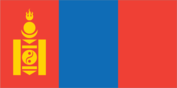
three equal, vertical bands of red (hoist side), blue, and red; centered on the hoist-side red band in yellow is a five-pointed star above the national emblem (soyombo--a columnar arrangement of abstract and geometric representations for fire, sun, moon, earth, water, and the yin-yang symbol)
Independence
13 March 1921 (from China; formerly Outer Mongolia)
Judicial branch
Supreme Court
Leaders
Chief of State--Chairman of the Presidium of the People's Great Hural Punsalmaagiyn OCHIRBAT (since 21 March 1990); Head of Government--Chairman of the Council of Ministers Sharabyn GUNGAADORJ (since 21 March 1990);
Legal system
blend of Russian, Chinese, and Turkish systems of law; no constitutional provision for judicial review of legislative acts; has not accepted compulsory ICJ jurisdiction
Legislative branch
unicameral People's Great Hural
Long-form name
Mongolian People's Republic; abbreviated MPR
Member of
CEMA, ESCAP, FAO, IAEA, IBEC, ILO, IPU, ITU, UN, UNESCO, UPU, WFTU, WHO, WIPO, WMO
National holiday
People's Revolution Day, 11 July (1921)
Political parties and leaders
only party--Mongolian People's Revolutionary Party (MPRP), Gombojabin Ochirbat, General Secretary
Suffrage
universal at age 18
Type
Communist state
Economy
Agriculture
accounts for 90% of exports and provides livelihood for about 50% of the population; livestock raising predominates (sheep, goats, horses); crops--wheat, barley, potatoes, forage
Aid
about $500-$700 million annually from USSR
Budget
revenues $2.2 billion; expenditures $2.19 billion, including capital expenditures of $0.9 billion (1987 est.)
Currency
tughrik (plural--tughriks); 1 tughrik (Tug) = 100 mongos
Electricity
657,000 kW capacity; 29,500 million kWh produced, 1,340 kWh per capita (1989)
Exchange rates
tughriks (Tug) per US$1--3.355 (1986-1988), 3.600 (1985)
Exports
$388 million (f.o.b., 1985); commodities--livestock, animal products, wool, hides, fluorspar, nonferrous metals, minerals; partners--nearly all trade with Communist countries (about 80% with USSR)
External debt
$NA
Fiscal year
calendar year
GDP
$1.7 billion, per capita $880 (1985 est.); average real growth rate 3.6% (1976-85 est.)
Imports
$1.0 billion (c.i.f., 1985); commodities--machinery and equipment, fuels, food products, industrial consumer goods, chemicals, building materials, sugar, tea; partners--nearly all trade with Communist countries (about 80% with USSR)
Industrial production
growth rate 10.9% (1985)
Industries
processing of animal products, building materials, food and beverage, mining (particularly coal)
Inflation rate (consumer prices)
NA%
Overview
Economic activity traditionally has been based on agriculture and the breeding of livestock--Mongolia has the highest number of livestock per person in the world. In recent years extensive mineral resources have been developed with Soviet support. The mining and processing of coal, copper, molybdenum, tin, tungsten, and gold account for a large part of industrial production.
Unemployment rate
NA%
Communications
Airports
80 total, 30 usable; 10 with permanent-surface runways; fewer than 5 with runways over 3,659 m; fewer than 20 with runways 2,440-3,659 m; 10 with runways 1,220-2,439 m
Civil air
22 major transport aircraft
Highways
46,700 km total; 1,000 km hard surface; 45,700 km other surfaces
Inland waterways
397 km of principal routes (1986)
Railroads
1,750 km 1.524-meter broad gauge (1986)
Telecommunications
stations--13 AM, 1 FM, 1 TV (with 18 provincial relays); relay of Soviet TV; 60,000 TV sets; 186,000 radio receivers; at least 1 satellite earth station
Military and Security
Branches
Mongolian People's Army, Air Force (negligible)
Defense expenditures
NA
Military manpower
males 15-49, 518,482; 338,652 fit for military service; 24,783 reach military age (18) annually