1985 Edition
CIA World Factbook 1985 (Internet Archive)
Geography
Agriculture
main crops — wheat, potatoes, corn, sugar beets, onions, beans, fruits; net agricultural importer
Airfields
- 73 total, 66 usable; 5 with permanent-surface runways; 1 with runways 2,4403,659 m, 30 with runways 1,220-2,439 m
- 359 total, 320 usable; 46 with permanent-surface runways; 13 with runways 2,440-3,659 m, 51 with runways 1,2202,439 m
Branches
- Army, Air Force, paramilitary Gendarmerie, Presidential Guard
- four-man Military-Police Junta, which exercises constituent and legislative powers and has delegated executive powers to President of Junta; the President has announced a plan for transition from military to civilian rule by 1989; National Congress (Senate, House of Representatives) dissolved; civilian judiciary remains
- Army of the Nation, National Navy, Air Force of the Nation, Carabineros of Chile
Budget
revenues, $4. 1 billion; expenditures, $4.4 billion (1982)
Capital
Santiago
Civil air
- 3 major transport aircraft
- 22 major transport aircraft
Coastline
6,435 km People
Communists
248,000 when PCCh was legal in 1973; active militants now estimated at about 20,000
Crude steel
765.0 billion metric tons capacity (1980); 715,600 metric tons produced (1980)
Elections
prohibited by decree; all electoral registers were destroyed in 1974 Chile (continued) Political parties and leaders: all political parties are officially recessed or outlawed, but they have been allowed to function on a very limited basis since 1982; National Party (PN), Patricio Philips; Independent Democratic Union (UDI), Sergio Fernandez; National Unity Movement (MUN), Andres Allamand; Movement of National Action (MAN), Federico Willoughby; Radical Party (PR), Enrique Silva Cimma; Social Democratic Party (PSD), Luis Bossay; Christian Democratic Party (PDC), Gabriel Valdes; Republican Right, Hugo Zepeda; Socialist Party, Ramon Silva Ulloa and Julio Stuardo (the PR, PSD, PDC, Republican Right, and some elements of the Socialist Party form the Democratic Alliance [AD]); Movement of Unitary Popular Action (MAPU); Movement of Unitary Popular Action — Workers/ Peasants (MAPU-OC), Bias Tomic and Oscar Garreton Purcell; Christian Left (1C), Luis Maira; Communist Party of Chile (PCCh), Luis Corvalan Lepe (in exile); Socialist Party — Almeyda faction (PSCh/Alm), Clodomiro Almeyda (in exile); Socialist Party— Altamirano faction (PSCh/Alt), Carlos Altamirano (in exile); Movement of the Revolutionary Left (MIR), Andres Pascal Allende (in exile); the MIR, PSCh/Alm, and PCCh form the leftist Popular Democratic Movement (MDP)
Electric power
3,250,000 kW capacity (1984); 12.5 billion kWh produced (1984), l,072kWh per capita
Ethnic divisions
95% European and European-Indian, 3% Indian, 2% other
Exports
$3.7 billion (f.o.b., 1983); copper, molybdenum, iron ore, paper products, fishmeal, fruits, wood products
Fiscal year
calendar year Communications
Fishing
catch 4 million metric tons (1982); exports $307.1 million (1983)
GDP
$23.6 billion (1982), $2,178.1 per capita; 77% private consumption, 14.8% government consumption; 9.9% gross investment, 1.7% net foreign balance; real growth rate 14.3% (1982)
Government leaders
Gen. Augusto PINOCHET Ugarte, President (since September 1973); Adm. Jose Toribio MERINO Castro (since September 1973), Air Force Maj. Gen. Fernando MATTHEI Aubel (since July 1978), Carabinero Gen. Cesar MENDOZA Duran (since September 1973), Army Lt. Gen. Cesar BENAVIDES Escobar (since March 1981), Junta members
Highways
- 27,505 km total; 242 km bituminous, 4,385 km gravel and laterite, and remainder unimproved
- 78,025 km total; 9,365 km paved, 37,700 km gravel, 32,000 km improved and unimproved earth
Imports
$2.7 billion (f.o.b., 1983); petroleum, sugar, wheat, capital goods, vehicles
Inland waterways
- approximately 2,000 km navigable
- 725 km
Labor force
3.0 million total employment (1982); 33% industry and commerce; 31 % services; 9% agriculture, forestry, and fishing; 9% mining; 5% construction
Land boundaries
6,325 km Water
Language
- French (official); Sangho, lingua franca and national language
- Spanish
Legal system
based on Code 1857 derived from Spanish law and subsequent codes influenced by French and Austrian law; current constitution came into effect in March 1981; the constitution provides for continued direct rule until 1989, with a phased return to full civilian rule by 1997; judicial review of legislative acts in the Supreme Court; legal education at University of Chile, Catholic University, and several others; has not accepted compulsory ICJ jurisdiction
Limits of territorial waters (claimed)
3 nm (fishing 200 nm)
Literacy
90% (1978)
Major industries
copper, other minerals, foodstuffs, fish processing, iron and steel, pulp, paper, and forestry products
Major trade partners
exports — 28% US, 13% FRG, 9% Japan, 5% UK, 4% Brazil (1983); imports— 24% US, 6% Brazil, 6% FRG, 5% Japan, 2% Venezuela (1983)
Member of
CIPEC, ECOSOC, FAO, G-77, GATT, IADB, IAEA, IBRD, ICAO, IDA, IDB — Inter-American Development Bank, IFAD, IFC, IHO, ILO, IMF, IMO, INTELSAT, INTERPOL, IPU, ITU, LAIA, OAS, PAHO, SELA, UN, UNESCO, UPU, WHO, WIPO, WMO, WSG, WTO Economy
Military budget
- for fiscal year ending 31 December 1984, $8.7 million; about 25% of total budget Antofagasta/ SANTIAGO South Pacific Ocean Punta Arenas* Boundary representation is not necessarily authonlativ Land 756,945 km2; larger than Texas; 47% barren mountain, desert, and urban; 29% forest; 15% permanent pasture, meadow; 7% other arable; 2% cultivated
- for fiscal year ending 31 December 1985, $776 million; 14.6% of central government budget
Military manpower
- males 15-49, 1,197,000; 618,000 fit for military service; about 49,000 reach military age (20) annually
- males 15-49, 3,149,000; 2,369,000 fit for military service; about 119,000 reach military age (19) annually
Monetary conversion rate
128 pesos=US$l (January 1985)
National holiday
Independence Day, 18 September
Nationality
noun— Chilean(s); adjective — Chilean
Official name
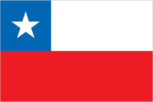
Republic of Chile
Organized labor
12% of labor force organized into labor unions (1982) Government
Other political or pressure groups
United Democratic Command (CUD), a social grouping of 300 labor organizations and other groups, dominated by the PCCh; laborNational Workers Command (CNT), includes trade unionists from the country's five largest labor confederations; Roman Catholic Church
Pipelines
crude oil, 755 km; refined products, 785 km; natural gas, 320 km
Political subdivisions
12 regions plus one metropolitan district, 41 provincial subdi-
Population
11, 882,000 (July 1985), average annual growth rate 1.5%
Ports
10 major, 13 minor
Railroads
- none
- 8,478 km total; 4,257 km 1.676meter gauge, 135km 1.435-meter standard gauge, 4,221 km 1.000-meter gauge; electrification, 1,503 km, 1.676-meter gauge, 79 km 1.000-meter gauge
Religion
89% Roman Catholic, 11% Protestant
Suffrage
none
Supply
primarily dependent on France
Telecommunications
- fair system of radiocommunication stations for intercity links; satellite ground station; 5,000 telephones (0.1 per 100 popl.); 1 FM, 3 AM stations; many facilities inoperative Defense Forces
- modern telephone system based on extensive radio-relay facilities; 595,100 telephones (5.0 per 100 popl.); 2 Atlantic Ocean satellite stations; 2 domestic satellite stations; 151 AM, 81 FM, 122 TV stations Defense Forces
Type
republic
Voting strength
(1970 presidential election) 36.6% Popular Unity coalition, 35.3% conservative independent, 28.1% Christian Democrat; (1973 congressional election) 44% Popular Unity coalition, 56% Democratic Confederation (PDC and PN)