1992 Edition
CIA World Factbook 1992 (Project Gutenberg)
Geography
Climate
dry, semiarid steppe; subject to drought
Coastline
none - landlocked
Comparative area
slightly larger than Maine
Disputes
violent and longstanding dispute with Armenia over status of Nagorno-Karabakh, lesser dispute concerns Nakhichevan'; some Azeris desire absorption of and/or unification with the ethnically Azeri portion of Iran; minor irredentist disputes along Georgia border
Environment
local scientists consider Apsheron Peninsula, including Baku and Sumgait, and the Caspian Sea to be "most ecologically devastated area in the world" because of severe air and water pollution
Exclusive fishing zone
NA nm; Azerbaijani claims in Caspian Sea unknown; 10 nm fishing zone provided for in 1940 treaty regarding trade and navigation between Soviet Union and Iran
Land area
86,100 km2; includes the Nakhichevan' Autonomous Republic and the Nagorno-Karabakh Autonomous Oblast; region's autonomy was abolished by Azerbaijan Supreme Soviet on 26 November 1991
Land boundaries
2,013 km total; Armenia (west) 566 km, Armenia (southwest) 221 km, Georgia 322 km, Iran (south) 432 km, Iran (southwest) 179 km, Russia 284 km, Turkey 9 km
Land use
NA% arable land; NA% permanent crops; NA% meadows and pastures; NA% forest and woodland; NA% other; includes 70% of cultivated land irrigated (1.2 million hectares)
Maritime claims
NA
Natural resources
petroleum, natural gas, iron ore, nonferrous metals, alumina
Note
landlocked; major polluters are oil, gas, and chemical industries
Terrain
large, flat Kura Lowland (much of it below sea level) with Great Caucasus Mountains to the north, Karabakh Upland in west; Baku lies on Aspheson Peninsula that juts into Caspian Sea
Total area
86,600 km2
People and Society
Birth rate
26 births/1,000 population (1992)
Death rate
7 deaths/1,000 population (1992)
Ethnic divisions
Azeri 82.7%, Russian 5.6%, Armenian 5.6%, Daghestanis 3.2%, other 2.9%; note - Armenian share may be less than 5.6% because many Armenians have fled the ethnic violence since 1989 census
Infant mortality rate
45 deaths/1,000 live births (1992)
Labor force
2,789,000; agriculture and forestry 32%, industry and construction 26%, other 42% (1990)
Languages
Azeri 82%, Russian 7%, Armenian 5%, other 6%
Life expectancy at birth
65 years male, 73 years female (1992)
Literacy
NA% (male NA%, female NA%) age 15 and over can read and write (1992 est.)
Nationality
noun - Azerbaijani(s); adjective - Azerbaijani
Net migration rate
--3 migrants/1,000 population (1992)
Organized labor
NA (1992)
Population
7,450,787 (July 1992), growth rate 1.6% (1992)
Religions
Moslem 87%, Russian Orthodox 5.6%, Armenian Orthodox 5.6%, other 1.8%
Total fertility rate
2.9 children born/woman (1992)
Government
Administrative divisions
1 autonomous republic (avtomnaya respublika), Nakhichevan' (administrative center at Nakhichevan'); note - all rayons except for the exclave of Nakhichevan' are under direct republic jurisdiction;1 autonomous oblast, Nagorno-Karabakh (officially abolished by Azerbaijani Supreme Soviet on 26 November 1991) has declared itself Nagorno-Karabakh Republic
Azerbaijani Republic; short-form name
Azerbaijan
Capital
Baku (Baky)
Chief of State
President-elect Ebulfez ELCIBEY (since 7 June 1992)
Constitution
adopted NA April 1978
Diplomatic representation
NA US: Ambassador (vacant); Robert MILES, Charge d'Affaires; Embassy at Hotel Intourist (telephone 8-011-7-8922-91-79-56) plus 8 hours; (mailing address is APO New York is 09862); telephone NA
Executive branch
president, Council of Ministers
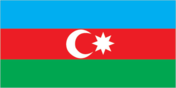
Flag
three equal horizontal bands of blue (top), red, and green; a crescent and eight-pointed star in white are centered in red band
Head of Government
Prime Minister Rahim GUSEYNOV (since 14 May 1992)
Independence
28 May 1918; on 28 April 1920, Azerbaijan became the Soviet Socialist Republic of Azerbaijan; on 30 April 1992 it became the Azerbaijani Republic; independence declared 30 August 1991
Judicial branch
Supreme Court
Legal system
based on civil law system
Legislative branch
National Parliament (Milli Majlis) was formed on the basis of the National Council (Milli Shura)
Member of
CIS, CSCE, IMF, OIC, UN, UNCTAD
National holiday
NA
National Parliament
last held NA September 1990 (next expected to be held late 1992); results - seats - (360 total) Communists 280, Democratic Bloc 45 (grouping of opposition parties), other 15, vacant 20; note - these figures are approximate
Other political or pressure groups
Self-proclaimed Armenian Nagorno-Karabakh Republic
Political parties and leaders
NA
President
held 8 September 1991 (next to be held 7 June 1992); results - Ebulfez ELCIBEY (6,390 unofficial)
Suffrage
universal at age 18
Type
republic
Economy
Agriculture
cotton, grain, rice, grapes, fruit, vegetables, tea, tobacco; cattle, pigs, sheep and goats
Budget
revenues $NA; expenditures $NA, including capital expenditures of $NA (1992)
Currency
as of May 1992, retaining ruble as currency
Economic aid
NA
Electricity
6,025,000 kW capacity; 23,300 million kWh produced, 3,280 kWh per capita (1991)
Exchange rates
NA
Exports
$780 million (f.o.b., 1991) commodities: oil and gas, chemicals, oilfield equipment, textiles, cotton (1991) partners: mostly CIS countries
External debt
$1.3 billion (1991 est.)
Fiscal year
calendar year
GDP
$NA, per capita $NA; real growth rate --0.7% (1991)
Illicit drugs
illicit producer of cannabis and opium; mostly for domestic consumption; status of government eradication programs unknown; used as transshipment points for illicit drugs to Western Europe
Imports
$2.2 billion (c.i.f., 1990) commodities: machinery and parts, consumer durables, foodstuffs, textiles (1991)
Industrial production
growth rate 3.8% (1991)
Industries
petroleum and natural gas, petroleum products, oilfield equipment; steel, iron ore, cement; chemicals and petrochemicals; textiles
Inflation rate (consumer prices)
87% (1991)
Overview
Azerbaijan is less developed industrially than either Armenia or Georgia, the other Transcaucasian states. It resembles the Central Asian states in its majority Muslim population, high structural unemployment, and low standard of living. The economy's most prominent products are cotton, oil, and gas. Production from the Caspian oil and gas field has been in decline for several years. With foreign assistance, the oil industry might generate the funds needed to spur industrial development. However, civil unrest, marked by armed conflict in the Nagorno-Karabakh region between Muslim Azeris and Christian Armenians, makes foreign investors wary. Azerbaijan accounts for 1.5% to 2% of the capital stock and output of the former Soviet Union. Although immediate economic prospects are not favorable because of civil strife, lack of economic reform, political disputes about new economic arrangements, and the skittishness of foreign investors, Azerbaijan's economic performance was the best of all former Soviet republics in 1991 largely because of its reliance on domestic resources for industrial output.
Unemployment rate
NA%
Communications
Airports
NA
Civil air
none
Highways
36,700 km total (1990); 31,800 km hard surfaced; 4,900 km earth
Inland waterways
NA km perennially navigable
Merchant marine
none - landlocked
Pipelines
NA
Ports
inland - Baku (Baky)
Railroads
2,090 km (includes NA km electrified); does not include industrial lines (1990)
Telecommunications
quality of local telephone service is poor; connections to other former USSR republics by landline or microwave and to countries beyond the former USSR via the Moscow international gateway switch; Azeri and Russian TV broadcasts are received; Turkish and Iranian TV broadcasts are received from INTELSAT through a TV receive-only earth station
Military and Security
Branches
Republic Security Forces (internal and border troops), National Guard; CIS Forces (Ground, Navy, Air, Air Defense)
Defense expenditures
$NA million, NA% of GDP
Manpower availability
males 15-49, NA; NA fit for military service; NA reach military age (18) annually