Introduction
<p>Azerbaijan -- a secular nation with a majority-Turkic and majority-Shia Muslim population -- was briefly independent (from 1918 to 1920) following the collapse of the Russian Empire; it was subsequently incorporated into the Soviet Union for seven decades. <br><br>Beginning in 1988, Azerbaijan and Armenia fought over the Nagorno-Karabakh region, which was populated largely by ethnic Armenians but incorporated into Soviet Azerbaijan as an autonomous oblast in the early 1920s. In the late Soviet period, an ethnic-Armenian separatist movement sought to end Azerbaijani control over the region. Fighting over Nagorno-Karabakh escalated after Armenia and Azerbaijan gained independence from the Soviet Union in 1991. By the time a ceasefire took effect in 1994, separatists with Armenian support controlled Nagorno‑Karabakh and seven surrounding Azerbaijani territories. After decades of cease-fire violations and sporadic flare-ups, a second sustained conflict began in 2020 when Azerbaijan tried to win back the territories it had lost in the 1990s. After significant Azerbaijani gains, Armenia returned the southern part of Nagorno-Karabakh and the surrounding territories to Azerbaijan. In September 2023, Azerbaijan took military action to regain the rest of Nagorno-Karabakh; after a conflict that lasted only one day, nearly the entire ethnic Armenian population of Nagorno-Karabakh fled to Armenia.<br><br>Since gaining its independence in 1991, Azerbaijan has significantly reduced the poverty rate and has directed some revenue from its oil and gas production to develop the country’s infrastructure. However, corruption remains a burden on the economy, and Western observers and members of the country’s political opposition have accused the government of authoritarianism. The country’s leadership has remained in the ALIYEV family since Heydar ALIYEV, the most highly ranked Azerbaijani member of the Communist Party during the Soviet period, became president during the first Nagorno-Karabakh War in 1993. </p>
Geography
- Land
- 82,629 sq km
- Note
- <strong>note:</strong> includes the exclave of Naxcivan Autonomous Republic and the Nagorno-Karabakh region; the final status of the region has yet to be determined
- Total
- 86,600 sq km
- Water
- 3,971 sq km
about three-quarters the size of Pennsylvania; slightly smaller than Maine
dry, semiarid steppe
- 0 km (landlocked)
- note
- <strong>note:</strong> Azerbaijan borders the Caspian Sea (713 km)
Europe, Asia
- Highest point
- Bazarduzu Dagi 4,466 m
- Lowest point
- Caspian Sea -28 m
- Mean elevation
- 384 m
40 30 N, 47 30 E
both the main area of the country and the Naxcivan exclave are landlocked
14,693 sq km (2022)
- Border countries
- Armenia 996 km; Georgia 428 km; Iran 689 km; Russia 338 km; Turkey 17 km
- number of neighbors
- 5
- Total
- 2,468 km
- Agricultural land
- 57.8% (2023 est.)
- Agricultural land: arable land
- arable land: 25.3% (2023 est.)
- Agricultural land: permanent crops
- permanent crops: 3.3% (2023 est.)
- Agricultural land: permanent pasture
- permanent pasture: 29.2% (2023 est.)
- arable land
- 25.31%
- Forest
- 14.4% (2023 est.)
- Other
- 27.7% (2023 est.)
- permanent crops
- 3.31%
Yes
Southwestern Asia, bordering the Caspian Sea, between Iran and Russia, with a small European portion north of the Caucasus range
- Salt water lake(s)
- Caspian Sea (shared with Iran, Russia, Turkmenistan, and Kazakhstan) - 374,000 sq km
- Google Maps
- https://goo.gl/maps/az3Zz7ar2aoB9AUc6
- OpenStreetMap
- https://www.openstreetmap.org/relation/364110
Asia
none (landlocked)
droughts
petroleum, natural gas, iron ore, nonferrous metals, bauxite
highest population density is found in the far eastern area of the country, in and around Baku; apart from smaller urbanized areas, the rest of the country has a fairly light and evenly distributed population
Western Asia
large, flat Kur-Araz Ovaligi (Kura-Araks Lowland, much of it below sea level) with Great Caucasus Mountains to the north, Qarabag Yaylasi (Karabakh Upland) to the west; Baku lies on Abseron Yasaqligi (Apsheron Peninsula) that juts into Caspian Sea
- UTC+04:00
- number of time zones
- 1
People and Society
- 0-14 years
- 22.3% (male 1,269,241/female 1,104,529)
- 15-64 years
- 68.7% (male 3,659,441/female 3,656,493)
- 65 years and over
- 9% (2024 est.) (male 401,551/female 558,984)
- Beer
- 0.36 liters of pure alcohol (2019 est.)
- Other alcohols
- 0.01 liters of pure alcohol (2019 est.)
- Spirits
- 0.94 liters of pure alcohol (2019 est.)
- Total
- 1.38 liters of pure alcohol (2019 est.)
- Wine
- 0.06 liters of pure alcohol (2019 est.)
11.13 births/1,000 population (2025 est.)
6.6%
3% (2023 est.)
59.7% (2019 est.)
- 6.44 deaths/1,000 population (2025 est.)
- adult female
- 69 per 1,000
- adult male
- 145 per 1,000
- Elderly dependency ratio
- 14 (2025 est.)
- Potential support ratio
- 7.1 (2025 est.)
- Total dependency ratio
- 45.6 (2025 est.)
- Youth dependency ratio
- 31.6 (2025 est.)
- improved total
- 57.81%
- Improved: rural
- rural: 94.5% of population (2022 est.)
- Improved: total
- total: 97.6% of population (2022 est.)
- Improved: urban
- urban: 100% of population (2022 est.)
- Unimproved: rural
- rural: 5.5% of population (2022 est.)
- Unimproved: total
- total: 2.4% of population (2022 est.)
- Unimproved: urban
- urban: 0% of population (2022 est.)
- Education expenditure (% GDP)
- 3.7% of GDP (2023 est.)
- Education expenditure (% national budget)
- 11.9% national budget (2025 est.)
4 % of GDP
- Azerbaijani 94.8%, other 1.8%; less than 1%: Talish, Russian, Avar, Sakhur, Tartar, Georgian, Jewish, Kurd<br><!--EndFragment --> (2019 est.)
- note
- <strong>note:</strong> Nagorno-Karabakh, which is part of Azerbaijan on the basis of the borders recognized when the Soviet Union dissolved in 1991, was populated almost entirely by ethnic Armenians; Azerbaijan has over 80 ethnic groups
0.79 (2025 est.)
- 4 % of GDP
- Health expenditure (as % of GDP)
- 4.7% of GDP (2021)
- Health expenditure (as % of national budget)
- 4.6% of national budget (2022 est.)
0.1%
3.9 beds/1,000 population (2019 est.)
- Female
- 9 deaths/1,000 live births
- Male
- 12.6 deaths/1,000 live births
- neonatal
- 13 deaths/1,000 live births
- Total
- 10.7 deaths/1,000 live births (2025 est.)
- Languages
- Azerbaijani 96.1%, other 1.4%; less than 1%: Russian, Avar, Talyshi, Turkish, Tatar, Sakhur, Tat, Ukrainian, Georgian, Hebrew (2019 est.)
- Major-language sample(s)
- <br>Dünya fakt kitabı, əsas məlumatlar üçün əvəz olunmaz mənbədir (Azerbaijani)<br><br>The World Factbook, the indispensable source for basic information.
- Note
- <strong>note:</strong> Russian is widely spoken
- number of languages
- 1
- Female
- 78.6 years
- Male
- 73.5 years
- Total population
- 75.9 years (2024 est.)
- Female
- 99.7% (2023 est.)
- Male
- 99.8% (2023 est.)
- Total population
- 99.8% (2023 est.)
2.432 million BAKU (capital) (2023)
18 deaths/100,000 live births (2023 est.)
- Female
- 36 years
- Male
- 32.8 years
- Total
- 34.8 years (2025 est.)
24 years (2019 est.)
- Adjective
- Azerbaijani
- Noun
- Azerbaijani(s)
-0.71 migrant(s)/1,000 population (2025 est.)
19.9% (2016)
3.19 physicians/1,000 population (2022)
- Female
- 5,339,994
- Male
- 5,354,376
- Total
- 10,694,370 (2025 est.)
0.4% (2025 est.)
- Muslim 97.3% (predominantly Shia), Christian 2.6%, other <0.1, unaffiliated <0.1 (2020 est.)
- note
- <strong>note:</strong> religious affiliation for the majority of Azerbaijanis is largely nominal, percentages for actual practicing adherents are probably much lower
- improved total
- 68%
- Improved: urban
- urban: 100% of population (2022 est.)
- Unimproved: urban
- urban: 0% of population (2022 est.)
- Female
- 13 years (2023 est.)
- Male
- 13 years (2023 est.)
- Total
- 13 years (2023 est.)
- 0-14 years
- 1.15 male(s)/female
- 15-64 years
- 1 male(s)/female
- 65 years and over
- 0.72 male(s)/female
- At birth
- 1.15 male(s)/female
- Total population
- 1 male(s)/female (2024 est.)
- Female
- 0.1% (2025 est.)
- Male
- 37.9% (2025 est.)
- Total
- 18.4% (2025 est.)
1.69 children born/woman (2025 est.)
- Note
- <strong>note:</strong> data include Nagorno-Karabakh
- Rate of urbanization
- 1.38% annual rate of change (2020-25 est.)
- Urban population
- 57.6% of total population (2023)
- measles
- 71%
Government
66 districts (<em>rayonlar</em>; singular - <em>rayon</em>), 11 cities (saharlar; sahar - singular)<br><br><strong>districts:</strong> Abseron, Agcabadi, Agdam, Agdas, Agstafa, Agsu, Astara, Babak, Balakan, Barda, Beylaqan, Bilasuvar, Cabrayil, Calilabad, Culfa, Daskasan, Fuzuli, Gadabay, Goranboy, Goycay, Goygol, Haciqabul, Imisli, Ismayilli, Kalbacar, Kangarli, Kurdamir, Lacin, Lankaran, Lerik, Masalli, Neftcala, Oguz, Ordubad, Qabala, Qax, Qazax, Qobustan, Quba, Qubadli, Qusar, Saatli, Sabirabad, Sabran, Sadarak, Sahbuz, Saki, Salyan, Samaxi, Samkir, Samux, Sarur, Siyazan, Susa, Tartar, Tovuz, Ucar, Xacmaz, Xizi, Xocali, Xocavand, Yardimli, Yevlax, Zangilan, Zaqatala, Zardab <br><br><strong>cities:</strong> Baku, Ganca, Lankaran, Mingacevir, Naftalan, Naxcivan (Nakhichevan), Saki, Sirvan, Sumqayit, Xankandi, Yevlax
- Daylight saving time
- does not observe daylight savings time
- Etymology
- the name may derive from the Old Persian word <em>badkuba</em>, meaning "windward" and referring to its windy location on the shore of the Caspian Sea
- Geographic coordinates
- 40 23 N, 49 52 E
- Name
- Baku (Baki, Baky)
- Note
- <strong>note: </strong>at approximately 28 m below sea level, Baku's elevation makes it the lowest capital city in the world
- Time difference
- UTC+4 (9 hours ahead of Washington, DC, during Standard Time)
- Citizenship by birth
- yes
- Citizenship by descent only
- yes
- Dual citizenship recognized
- no
- Residency requirement for naturalization
- 5 years
- svg
- https://mainfacts.com/media/images/coats_of_arms/az.svg
- Amendment process
- proposed by the president of the republic or by at least 63 members of the National Assembly; passage requires at least 95 votes of Assembly members in two separate readings of the draft amendment six months apart and requires presidential approval after each of the two Assembly votes, followed by presidential signature; constitutional articles on the authority, sovereignty, and unity of the people cannot be amended
- History
- several previous; latest adopted 12 November 1995
- alternative spellings
- AZ, Republic of Azerbaijan, Azərbaycan Respublikası
- Conventional long form
- Republic of Azerbaijan
- Conventional short form
- Azerbaijan
- Etymology
- the name can be translated as "Fire Keeper" or "The Land of Fire," from the local word <em>azer</em>, or "fire," and <em>baydjan</em>, a word derived from the Iranian word <em>baykan</em>, or "guardian;" may refer to fire worshippers who lived in the region
- FIFA code
- AZE
- Former
- Azerbaijan Soviet Socialist Republic
- Local long form
- Azarbaycan Respublikasi
- local long form (aze)
- Azərbaycan Respublikası
- Local short form
- Azarbaycan
- Chief of mission
- Ambassador (vacant); Chargé d'Affaires Amy CARLON (since 23 June 2025)
- Email address and website
- <br>BakuACS@state.gov<br><br>https://az.usembassy.gov/
- Embassy
- 111 Azadlig Avenue, AZ1007 Baku
- FAX
- [994] (12) 488-3330
- Mailing address
- 7050 Baku Place, Washington, DC 20521-7050
- Telephone
- [994] (12) 488-3300
- Chancery
- 2741 34th Street NW, Washington, DC 20008
- Chief of mission
- Ambassador Khazar IBRAHIM (since 15 September 2021)
- Consulate(s) general
- Los Angeles
- Email address and website
- <br>azerbaijan@azembassy.us<br><br>https://washington.mfa.gov.az/en
- FAX
- [1] (202) 337-5911
- Telephone
- [1] (202) 337-3500
- Cabinet
- Council of Ministers appointed by the president and confirmed by the National Assembly
- Chief of state
- President Ilham ALIYEV (since 31 October 2003)
- Election results
- <em><br>2024: </em>Ilham ALIYEV reelected president; percent of vote - Ilham ALIYEV (YAP) 92.1%, Zahid ORUJ (independent) 2.2%<em>; </em>on 16 February 2024, Ali ASADOV reappointed prime minister by parliamentary vote, 105-1<em><br><br>2018:</em> Ilham ALIYEV reelected president in first round; percent of vote - Ilham ALIYEV (YAP) 86%, Zahid ORUJ (independent) 3.1%, other 10.9%
- Election/appointment process
- president directly elected by absolute-majority popular vote in 2 rounds (if needed) for a 7-year term; a single individual is eligible for unlimited terms; prime minister and first deputy prime minister appointed by the president and confirmed by the National Assembly
- Expected date of next election
- 2031
- Head of government
- Prime Minister Ali ASADOV (since 8 October 2019)
- Most recent election date
- 7 February 2024
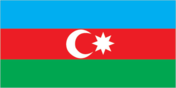
<strong>description:</strong> three equal horizontal bands of sky blue (top), red, and green; a vertical crescent moon and an eight-pointed star in white are centered in the red band<br><br><strong>meaning:</strong> the blue band stands for Azerbaijan's Turkic heritage, red for modernization and progress, and green for Islam; the crescent moon and star are a Turkic insignia; the eight star points represent the eight Turkic peoples of the world
The flag of Azerbaijan features three equal horizontal bands of blue, red and green, with a white fly-side facing crescent and eight-pointed star centered in the red band.
- svg
- https://flagcdn.com/az.svg
presidential republic
30 August 1991 (declared from the Soviet Union); 18 October 1991 (adopted by the Supreme Council of Azerbaijan)
has not submitted an ICJ jurisdiction declaration; non-party state to the ICCt
ADB, BSEC, CD, CE, CICA, CIS, EAPC, EBRD, ECO, FAO, GCTU, GUAM, IAEA, IBRD, ICAO, ICC (NGOs), ICRM, IDA, IDB, IFAD, IFC, IFRCS, ILO, IMF, IMO, Interpol, IOC, IOM, IPU, ISO, ITSO, ITU, ITUC (NGOs), MIGA, NAM, OAS (observer), OIC, OPCW, OSCE, PFP, UN, UNCTAD, UNESCO, UNHCR, UNIDO, UNOOSA, UNWTO, UPU, WCO, WFTU (NGOs), WHO, WIPO, WMO, WTO (observer)
- Highest court(s)
- Supreme Court (consists of the chairman, vice chairman, and 23 judges in plenum sessions and organized into civil, economic affairs, criminal, and rights violations chambers); Constitutional Court (consists of 9 judges)
- Judge selection and term of office
- Supreme Court judges nominated by the president and appointed by the Milli Majlis; judges appointed for 10 years; Constitutional Court chairman and deputy chairman appointed by the president; other court judges nominated by the president and appointed by the Milli Majlis to serve single 15-year terms
- Subordinate courts
- Courts of Appeal (replaced the Economic Court in 2002); district and municipal courts
civil law system
- Electoral system
- plurality/majority
- Expected date of next election
- November 2029
- Legislative structure
- unicameral
- Legislature name
- National Assembly (Milli Majlis)
- Most recent election date
- 9/1/2024
- Number of seats
- 125 (all directly elected)
- Parties elected and seats per party
- New Azerbaidjan Party (YAP) (68); Independents (44); Other (13)
- Percentage of women in chamber
- 20.8%
- Scope of elections
- full renewal
- Term in office
- 5 years
blue, red, green
- Selected World Heritage Site locales
- Walled City of Baku; Gobustan Rock Art Cultural Landscape; Historic Center of Sheki; Cultural Landscape of Khinalig People and "Koc Yolu" Transhumance Route
- Total World Heritage Sites
- 5 (4 cultural, 1 natural)
Republic Day (founding of the Democratic Republic of Azerbaijan), 28 May (1918)
flames of fire
Azerbaijan Hope Party or ÜMİD<br>Azerbaijan Democratic Enlightenment Party or ADMP<br>Azerbaijan National Independence Party or AMİP<br>Civic Solidarity Party or VHP<br>Democratic Reforms Party or DiP<br>Great Order Party or BAP<br>Justice, Law, Democracy Party or ƏHD<br>Great Order Party or BQP<br>Motherland Party or AVP<br>National Front Party or MCP<br>National Revival Movement Party or MDHP<br>New Azerbaijan Party or YAP<br>Republican Alternative Party or REAL<br>Unity Party or VƏHDƏT
Monday
18 years of age; universal
Yes
Economy
- milk, wheat, barley, potatoes, tomatoes, watermelons, onions, apples, maize, cotton (2023)
- note
- <b>note:</b> top ten agricultural products based on tonnage
- On alcohol and tobacco
- 2% of household expenditures (2023 est.)
- On food
- 42.7% of household expenditures (2023 est.)
- Expenditures
- $22.95 billion (2022 est.)
- Note
- <b>note:</b> central government revenues (excluding grants) and expenditures converted to US dollars at average official exchange rate for year indicated
- Revenues
- $30.966 billion (2022 est.)
- code
- AZN
- name
- Azerbaijani manat (AZN) [₼]
- $4.67 billion
- Current account balance 2022
- $23.478 billion (2022 est.)
- Current account balance 2023
- $8.329 billion (2023 est.)
- Current account balance 2024
- $4.671 billion (2024 est.)
- Note
- <b>note:</b> balance of payments - net trade and primary/secondary income in current dollars
- $12.2 billion
- Debt - external 2023
- $12.378 billion (2023 est.)
- Note
- <b>note:</b> present value of external debt in current US dollars
<p>upper-middle income, oil-dependent Caucasus economy; minimal economic diversification and dominance of state-owned enterprises; growth and fiscal consolidation supported by oil revenues, but risks remain from demand shocks; potential economic gains from Nagorno-Karabakh ceasefire; education investments to diversify and retain human capital</p>
- Currency
- Azerbaijani manats (AZN) per US dollar -
- Exchange rates 2020
- 1.7 (2020 est.)
- Exchange rates 2021
- 1.7 (2021 est.)
- Exchange rates 2022
- 1.7 (2022 est.)
- Exchange rates 2023
- 1.7 (2023 est.)
- Exchange rates 2024
- 1.7 (2024 est.)
- $34.11 billion
- Exports 2022
- $47.274 billion (2022 est.)
- Exports 2023
- $35.487 billion (2023 est.)
- Exports 2024
- $34.113 billion (2024 est.)
- Note
- <b>note:</b> balance of payments - exports of goods and services in current dollars
- crude petroleum, natural gas, refined petroleum, plastics, electricity (2023)
- note
- <b>note:</b> top five export commodities based on value in dollars
- Italy 37%, Turkey 19%, Israel 5%, Greece 4%, Russia 4% (2023)
- note
- <b>note:</b> top five export partners based on percentage share of exports
- net inflows
- $231.28 million
- Exports of goods and services
- 45.9% (2024 est.)
- Government consumption
- 14.4% (2024 est.)
- Household consumption
- 55.4% (2024 est.)
- Imports of goods and services
- -36.8% (2024 est.)
- Investment in fixed capital
- 16.8% (2024 est.)
- Investment in inventories
- 4.3% (2024 est.)
- Note
- <b>note:</b> figures may not total 100% due to rounding or gaps in data collection
- Agriculture
- 5.7% (2024 est.)
- Industry
- 42.6% (2024 est.)
- Note
- <b>note:</b> figures may not total 100% due to non-allocated consumption not captured in sector-reported data
- Services
- 42.3% (2024 est.)
- $74.316 billion (2024 est.)
- note
- <b>note:</b> data in current dollars at official exchange rate
$7,284
26.6 (2005)
$71.75 billion
$7,330
21 % of GDP
- $27.34 billion
- Imports 2022
- $21.274 billion (2022 est.)
- Imports 2023
- $25.016 billion (2023 est.)
- Imports 2024
- $27.339 billion (2024 est.)
- Note
- <b>note:</b> balance of payments - imports of goods and services in current dollars
- cars, crude petroleum, refined petroleum, broadcasting equipment, garments (2023)
- note
- <b>note:</b> top five import commodities based on value in dollars
- Russia 17%, China 16%, Turkey 14%, Georgia 4%, Germany 4% (2023)
- note
- <b>note:</b> top five import partners based on percentage share of imports
- 2.1% (2024 est.)
- note
- <b>note:</b> annual % change in industrial value added based on constant local currency
petroleum and petroleum products, natural gas, oilfield equipment; steel, iron ore; cement; chemicals and petrochemicals; textiles
- 2.21%
- Inflation rate (consumer prices) 2022
- 13.9% (2022 est.)
- Inflation rate (consumer prices) 2023
- 8.8% (2023 est.)
- Inflation rate (consumer prices) 2024
- 2.2% (2024 est.)
- Note
- <b>note:</b> annual % change based on consumer prices
- 5.02 million (2024 est.)
- note
- <b>note:</b> number of people ages 15 or older who are employed or seeking work
- total
- 5.12 million persons
- agriculture
- 34.23%
- industry
- 15.54%
- services
- 50.24%
- Note
- <b>note:</b> central government debt as a % of GDP
- Public debt 2021
- 16.8% of GDP (2021 est.)
- $255.98 billion
- Note
- <b>note:</b> data in 2021 dollars
- Real GDP (purchasing power parity) 2022
- $213.497 billion (2022 est.)
- Real GDP (purchasing power parity) 2023
- $216.388 billion (2023 est.)
- Real GDP (purchasing power parity) 2024
- $225.198 billion (2024 est.)
- 4.07%
- Note
- <b>note:</b> annual GDP % growth based on constant local currency
- Real GDP growth rate 2022
- 4.7% (2022 est.)
- Real GDP growth rate 2023
- 1.4% (2023 est.)
- Real GDP growth rate 2024
- 4.1% (2024 est.)
- $25,089
- Note
- <b>note:</b> data in 2021 dollars
- Real GDP per capita 2022
- $21,100 (2022 est.)
- Real GDP per capita 2023
- $21,300 (2023 est.)
- Real GDP per capita 2024
- $22,100 (2024 est.)
- $1.35 billion
- Note
- <b>note:</b> personal transfers and compensation between resident and non-resident individuals/households/entities
- Remittances 2022
- 5% of GDP (2022 est.)
- Remittances 2023
- 2.6% of GDP (2023 est.)
- Remittances 2024
- 1.8% of GDP (2024 est.)
- $12.7 billion
- Note
- <b>note:</b> holdings of gold (year-end prices)/foreign exchange/special drawing rights in current dollars
- Reserves of foreign exchange and gold 2022
- $11.338 billion (2022 est.)
- Reserves of foreign exchange and gold 2023
- $13.749 billion (2023 est.)
- Reserves of foreign exchange and gold 2024
- $12.699 billion (2024 est.)
40 % of GDP
18 % of GDP
- 15.4% (of GDP) (2022 est.)
- note
- <b>note:</b> central government tax revenue as a % of GDP
- 5.46%
- Note
- <b>note:</b> % of labor force seeking employment
- Unemployment rate 2022
- 5.7% (2022 est.)
- Unemployment rate 2023
- 5.7% (2023 est.)
- Unemployment rate 2024
- 5.6% (2024 est.)
- Female
- 15.3% (2024 est.)
- Male
- 12.3% (2024 est.)
- Note
- <b>note:</b> % of labor force ages 15-24 seeking employment
- Total
- 13.7% (2024 est.)
Energy
- Consumption
- 6,000 metric tons (2023 est.)
- Imports
- 10,000 metric tons (2023 est.)
- Consumption
- 23.857 billion kWh (2023 est.)
- consumption per capita
- 2,367 kWh
- Exports
- 3.246 billion kWh (2023 est.)
- Imports
- 212 million kWh (2023 est.)
- Installed generating capacity
- 8.383 million kW (2023 est.)
- Transmission/distribution losses
- 2.197 billion kWh (2023 est.)
- Electrification - total population
- 100% (2022 est.)
- Biomass and waste
- 0.4% of total installed capacity (2023 est.)
- Fossil fuels
- 93.5% of total installed capacity (2023 est.)
- hydroelectric
- 6.02%
- Hydroelectricity
- 5.6% of total installed capacity (2023 est.)
- nuclear
- 0%
- renewable
- 5.8%
- Solar
- 0.2% of total installed capacity (2023 est.)
- Wind
- 0.3% of total installed capacity (2023 est.)
- 1,732 kg of oil equivalent
- Total energy consumption per capita 2023
- 66.467 million Btu/person (2023 est.)
- Consumption
- 12.703 billion cubic meters (2023 est.)
- Exports
- 23.65 billion cubic meters (2023 est.)
- Imports
- 2.173 billion cubic meters (2023 est.)
- Production
- 35.775 billion cubic meters (2023 est.)
- Proven reserves
- 1.699 trillion cubic meters (2021 est.)
- Crude oil estimated reserves
- 7 billion barrels (2021 est.)
- Refined petroleum consumption
- 109,000 bbl/day (2023 est.)
- Total petroleum production
- 618,000 bbl/day (2023 est.)
1.3%
Communications
- per 100 inhabitants
- 21 per 100
- Subscriptions per 100 inhabitants
- 21 (2023 est.)
- Total
- 2.15 million (2023 est.)
TV is the most popular medium; many homes are hooked up to satellite; all Azerbaijan-based channels promote government positions; state-owned AzTV runs three national channels, and state-funded iTV is a national public service broadcaster; 4 national privately-owned stations; Turkish, Russian, and western TV is available on cable; analog terrestrial TV was phased out in 2016-17; radio outlets focus on entertainment, with around a dozen stations on FM in Baku; newspaper distribution is largely limited to Baku (2023)
.az
- Percent of population
- 89% (2023 est.)
AZ ####
+994
- Subscriptions per 100 inhabitants
- 13 (2024 est.)
- Total subscriptions
- 1.33 million (2024 est.)
- subscriptions per 100
- 108 per 100
- Subscriptions per 100 inhabitants
- 110 (2024 est.)
- Total subscriptions
- 11.3 million (2024 est.)
Transportation
- passengers carried
- 2.58 million passengers
- registered carrier departures
- 28,424 departures
32 (2025)
4K
Right
5 (2025)
- By type
- general cargo 40, oil tanker 44, other 228
- Total
- 312 (2023)
- Broad gauge
- 2,944.3 km (2017) 1.520-m gauge (approx. 1,767 km electrified)
- Total
- 2,944.3 km (2017)
AZ
Military and Security
- armored vehicles
- tanks
the Azerbaijani military was established in 1991, although its origins go back to 1918; much of the military’s original equipment was acquired from former Soviet military forces that departed Azerbaijan by 1992; territorial defense is the military’s primary focus, particularly with regards to neighboring Armenia; a secondary focus is guarding against Iran; Armenia and Azerbaijan engaged in open conflicts over the Nagorno-Karabakh enclave in 1991-94 and 2020; tensions continued following the 2020 conflict, and Azerbaijan seized the entire enclave in 2023 <br><br>key bilateral security relationships include Israel, Russia, and Turkiye; Azerbaijan's ties with Turkiye have included weapons transfers, technical advice, bilateral training exercises, and military support during its conflicts with Armenia; Azerbaijan is not part of NATO but has had a cooperative relationship with it dating back to when it joined NATO’s Partnership for Peace program in 1994 and has provided troops to NATO-led missions in Kosovo (1999-2008) and Afghanistan (2002-2014) (2025)
- Azerbaijan Armed Forces: Land Forces, Air Forces, Navy Forces, Special Forces, State Border Service, Coast Guard<br><br>Ministry of Internal Affairs: Internal Troops, local police forces; Special State Protection Service (SSPS): National Guard (2025)
- active duty personnel
- 82,000
- note
- <strong>note:</strong> the Ministry of Internal Affairs and the State Security Service (intelligence, counterterrorism) are responsible for internal security; the SSPS is under the president and provides protective services to senior officials, foreign missions, significant state assets, government buildings, etc; the National Guard also serves as a reserve for the Army
- percent of total labor force
- 1.58 %
information varies widely; estimated 100,000 active Armed Forces personnel (2025)
Baku has been actively upgrading the military's inventory for over a decade with equipment acquisitions from several sources, including Belarus, China, Israel, Russia, and Türkiye; while most of the military's equipment was once Soviet-era material, it now fields quantities of modern armaments, including armored vehicles, artillery systems, air defense systems, fighter aircraft, tanks, and UAVs (2025)
- 5 % of GDP
- current USD
- $3,777,088,235
- Military Expenditures 2020
- 5% of GDP (2020 est.)
- Military Expenditures 2021
- 5% of GDP (2021 est.)
- Military Expenditures 2022
- 4.5% of GDP (2022 est.)
- Military Expenditures 2023
- 4.5% of GDP (2023 est.)
- Military Expenditures 2024
- 5.1% of GDP (2024 est.)
- percent of central government expenditure
- 15.23 %
- percent of GDP
- 4.99 % of GDP
18-30 years of age for compulsory military service for men; 18-35 years of age voluntary/contractual service for men (18-40 for women volunteers); 18 months service for conscripts, 36 months for voluntary/contractual service (2025)
- PowerIndex score
- 1.1991
Transnational Issues
- IDPs
- 657,996 (2024 est.)
- Refugees
- 6,698 (2024 est.)
- Stateless persons
- 271 (2024 est.)
Space
2013 - first communications satellite (Azerspace-1) built by US company and launched on European rocket<br><br>2014 - took operational control over remote sensing (RS) satellite (SPOT-7, now Azersky) from a French company (satellite ceased operations in 2023)<br><br>2017 - second communications satellite (Azerspace-2) built by US company and launched on European rocket<br><br>2023 - agreed to participate in China's International Lunar Research Station Cooperation project, which aims to establish a base on the Moon in the 2030s; signed agreement with Israel to jointly develop two multi-spectral RS satellites (Azersky-2 program) for scheduled launches in 2026 and 2028 (2025)
Space Agency of the Republic of Azerbaijan (Azercosmos; established 2010 as a state-owned satellite operating company); Azerbaijan National Aerospace Agency (NASA; Azərbaycan Milli Aerokosmik Agentliyi, MAKA; established 1992; since 2006, has operated under the Ministry of Defense Industry) (2025)
largely focused on the acquisition and operation of satellites; operates foreign-built communications and remote sensing (RS) satellites; cooperates with a variety of foreign space agencies and commercial entities, including those of China, the ESA (bilaterally with individual member states such as France), Israel, Russia, Turkey, and the US; Azercosmos is the largest satellite operator in the Caucasus region (2025)
Terrorism
- Islamic State of Iraq and ash-Sham (ISIS); Islamic Revolutionary Guard Corps (IRGC)/Qods Force
- note
- <strong>note:</strong> details about the history, aims, leadership, organization, areas of operation, tactics, targets, weapons, size, and sources of support of the group(s) appear(s) in the Terrorism reference guide
Environment
- From coal and metallurgical coke
- 17,000 metric tonnes of CO2 (2023 est.)
- From consumed natural gas
- 24.921 million metric tonnes of CO2 (2023 est.)
- From petroleum and other liquids
- 13.954 million metric tonnes of CO2 (2023 est.)
- Total emissions
- 38.892 million metric tonnes of CO2 (2023 est.)
severe air, soil, and water pollution; soil pollution from oil spills, pesticides, and toxic defoliants used in producing cotton; surface and underground water pollution from untreated municipal and industrial wastewater and agricultural run-off
- Party to
- Air Pollution, Biodiversity, Climate Change, Climate Change-Kyoto Protocol, Climate Change-Paris Agreement, Comprehensive Nuclear Test Ban, Desertification, Endangered Species, Hazardous Wastes, Law of the Sea, Marine Dumping-London Convention, Ozone Layer Protection, Ship Pollution, Wetlands
- Signed, but not ratified
- none of the selected agreements
- Agriculture
- 188.9 kt (2019-2021 est.)
- Energy
- 268.8 kt (2022-2024 est.)
- Other
- 1 kt (2019-2021 est.)
- Waste
- 93.8 kt (2019-2021 est.)
27.2 micrograms per cubic meter (2019 est.)
12 % of total land area
1 % of total
34.675 billion cubic meters (2022 est.)
- 161 % of internal resources
- Agricultural
- 11.962 billion cubic meters (2022 est.)
- Industrial
- 598 million cubic meters (2022 est.)
- Municipal
- 408 million cubic meters (2022 est.)
- Municipal solid waste generated annually
- 2.93 million tons (2024 est.)
- Percent of municipal solid waste recycled
- 14.4% (2022 est.)