1994 Edition
CIA World Factbook 1994 (Project Gutenberg)
Introduction
Administrative divisions
9 provinces; Central, Copperbelt, Eastern, Luapula, Lusaka, Northern, North-Western, Southern, Western
Agriculture
accounts for 12% of GDP and 85% of labor force; crops - corn (food staple), sorghum, rice, peanuts, sunflower, tobacco, cotton, sugarcane, cassava; cattle, goats, beef, eggs
Airports
total: 113 usable: 103 with permanent-surface runways: 13 with runways over 3,659 m: 1 with runways 2,440-3,659 m: 4 with runways 1,220-2,439 m: 22
Area
total area: 752,610 sq km land area: 740,720 sq km comparative area: slightly larger than Texas
Birth rate
45.99 births/1,000 population (1994 est.)
Branches
Army, Air Force, Police
Budget
revenues: $665 million expenditures: $767 million, including capital expenditures of $300 million (1991 est.)
Capital
Lusaka
Climate
tropical; modified by altitude; rainy season (October to April)
Coastline
0 km (landlocked)
Constitution
2 August 1991
Currency
1 Zambian kwacha (ZK) = 100 ngwee
Death rate
17.65 deaths/1,000 population (1994 est.)
Defense expenditures
exchange rate conversion - $45 million, 1% of GDP (1992 est.)
Digraph
ZA
Diplomatic representation in US
chief of mission: Ambassador Dunstan Weston KAMANA chancery: 2419 Massachusetts Avenue NW, Washington, DC 20008 telephone: (202) 265-9717 through 9721
Economic aid
recipient: US commitments, including Ex-Im (1970-89), $4.8 billion; Western (non-US) countries, ODA and OOF bilateral commitments (1970-89), $4.8 billion; OPEC bilateral aid (1979-89), $60 million; Communist countries (1970-89), $533 million
Electricity
capacity: 2,775,000 kW production: 12 billion kWh consumption per capita: 1,400 kWh (1991)
Environment
current issues: poaching seriously threatens rhinoceros and elephant populations; deforestation; soil erosion; desertification natural hazards: NA international agreements: party to - Biodiversity, Climate Change, Endangered Species, Law of the Sea, Nuclear Test Ban, Ozone Layer Protection, Wetlands
Ethnic divisions
African 98.7%, European 1.1%, other 0.2%
Exchange rates
Zambian kwacha (ZK) per US$1 - 344.8276 (October 1993), 156.25 (1992), 61.7284 (1991), 28.9855 (1990), 12.9032 (1989)
Executive branch
chief of state and head of government: President Frederick CHILUBA (since 31 October 1991); Vice President Levy MWANAWASA (since 31 October 1991); election last held 31 October 1991 (next to be held in 1996); results - Frederick CHILUBA 84%, Kenneth KAUNDA 16% cabinet: Cabinet; appointed by the president from members of the National Assembly
Exports
$1 billion (f.o.b., 1992 est.) commodities: copper, zinc, cobalt, lead, tobacco partners: EC countries, Japan, South Africa, US, India
External debt
$7.6 billion (1991)
FAX
[260-1] 261-538
Fiscal year
calendar year
Flag
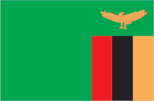
green with a panel of three vertical bands of red (hoist side), black, and orange below a soaring orange eagle, on the outer edge of the flag
Highways
total: 36,370 km paved: 6,500 km unpaved: crushed stone, gravel, stabilized earth 7,000 km; improved, unimproved earth 22,870 km
Illicit drugs
role as regional transshipment center for mandrax and heroin
Imports
$1.2 billion (c.i.f., 1992 est.) commodities: machinery, transportation equipment, foodstuffs, fuels, manufactures partners: EC countries, Japan, Saudi Arabia, South Africa, US
Independence
24 October 1964 (from UK)
Industrial production
growth rate -2% (1991); accounts for 40% of GDP
Industries
copper mining and processing, construction, foodstuffs, beverages, chemicals, textiles, and fertilizer
Infant mortality rate
85 deaths/1,000 live births (1994 est.)
Inflation rate (consumer prices)
191% (1992)
Inland waterways
2,250 km, including Zambezi and Luapula Rivers, Lake Tanganyika
International disputes
quadripoint with Botswana, Namibia, and Zimbabwe is in disagreement; Tanzania-Zaire-Zambia tripoint in Lake Tanganyika may no longer be indefinite since it is reported that the indefinite section of the Zaire-Zambia boundary has been settled
Irrigated land
320 sq km (1989 est.)
Judicial branch
Supreme Court
Labor force
2.455 million by occupation: agriculture 85%, mining, manufacturing, and construction 6%, transport and services 9%
Land boundaries
total 5,664 km, Angola 1,110 km, Malawi 837 km, Mozambique 419 km, Namibia 233 km, Tanzania 338 km, Zaire 1,930 km, Zimbabwe 797 km
Land use
arable land: 7% permanent crops: 0% meadows and pastures: 47% forest and woodland: 27% other: 19%
Languages
English (official) note: about 70 indigenous languages
Legal system
based on English common law and customary law; judicial review of legislative acts in an ad hoc constitutional council; has not accepted compulsory ICJ jurisdiction
Legislative branch
unicameral
Life expectancy at birth
total population: 44.18 years male: 43.82 years female: 44.54 years (1994 est.)
Literacy
age 15 and over can read and write (1990 est.) total population: 73% male: 81% female: 65%
Location
Southern Africa, between Zaire and Zimbabwe
Manpower availability
males age 15-49 1,882,053; fit for military service 988,913
Map references
Africa, Standard Time Zones of the World
Maritime claims
none; landlocked
Member of
ACP, AfDB, C, CCC, ECA, FAO, FLS, G-19, G-77, GATT, IAEA, IBRD, ICAO, IDA, IFAD, IFC, IFTU, ILO, IMF, INTELSAT, INTERPOL, IOC, IOM, ITU, LORCS, NAM, OAU, SADC, UN, UNCTAD, UNESCO, UNIDO, UNOMOZ, UNOSOM, UPU, WCL, WHO, WIPO, WMO, WTO
Names
conventional long form: Republic of Zambia conventional short form: Zambia former: Northern Rhodesia
National Assembly
elections last held 31 October 1991 (next to be held in 1996); results - percent of vote by party NA; seats - (150 total) MMD 125, UNIP 25; note - the MMD's majority was weakened by the defection of 13 of its parliamentary members during 1993 and the defeat of its candidates in 4 of the resulting by-elections
National holiday
Independence Day, 24 October (1964)
National product
GDP - purchasing power equivalent - $7.3 billion (1993 est.)
National product per capita
$800 (1993 est.)
National product real growth rate
-2.8% (1992)
Nationality
noun: Zambian(s) adjective: Zambian
Natural resources
copper, cobalt, zinc, lead, coal, emeralds, gold, silver, uranium, hydropower potential
Net migration rate
-0.05 migrant(s)/1,000 population (1994 est.)
Note
landlocked
Overview
The economy has been in decline for more than a decade with falling imports and growing foreign debt. Economic difficulties stem from a chronically depressed level of copper production and ineffective economic policies. In 1991 real GDP fell by 2% and in 1992 by 3% more. An annual population growth of 3% has brought a decline in per capita GDP of 50% over the past decade. A high inflation rate has also added to Zambia's economic woes in recent years.
Pipelines
crude oil 1,724 km
Political parties and leaders
Movement for Multiparty Democracy (MMD), Frederick CHILUBA; United National Independence Party (UNIP), Kebby MUSOKATWANE; National Party (NP), Inonge MBIKUSITA-LEWANIKA;
Population
9,188,190 (July 1994 est.)
Population growth rate
2.83% (1994 est.)
Ports
Mpulungu (lake port)
Railroads
1,266 km, all 1.067-meter gauge; 13 km double track
Religions
Christian 50-75%, Muslim and Hindu 24-49%, indigenous beliefs 1%
Suffrage
18 years of age; universal
Telecommunications
facilities are among the best in Sub-Saharan Africa; high-capacity microwave connects most larger towns and cities; broadcast stations - 11 AM, 5 FM, 9 TV; satellite earth stations - 1 Indian Ocean INTELSAT and 1 Atlantic Ocean INTELSAT
Terrain
mostly high plateau with some hills and mountains
Total fertility rate
6.68 children born/woman (1994 est.)
Type
republic
Unemployment rate
NA%
US diplomatic representation
chief of mission: Ambassador Roland KUCHEL embassy: corner of Independence Avenue and United Nations Avenue, Lusaka mailing address: P. O. Box 31617, Lusaka telephone: [260-1] 228-595, 228-601, 228-602, 228-603