2019 Edition
CIA World Factbook 2019 Archive (Wayback Machine)
Introduction
Background
Uzbekistan is the geographic and population center of Central Asia. The country has a diverse economy and a relatively young population. Russia conquered and united the disparate territories of present-day Uzbekistan in the late 19th century. Stiff resistance to the Red Army after the Bolshevik Revolution was eventually suppressed and a socialist republic established in 1924. During the Soviet era, intensive production of "white gold" (cotton) and grain led to the overuse of agrochemicals and the depletion of water supplies, leaving the land degraded and the Aral Sea and certain rivers half-dry. Independent since the dissolution of the USSR in 1991, the country has diversified agricultural production while developing its mineral and petroleum export capacity and increasing its manufacturing base, although cotton remains a major part of its economy. Uzbekistan’s first president, Islam KARIMOV, led Uzbekistan for 25 years until his death in September 2016. His successor, former Prime Minister Shavkat MIRZIYOYEV, has improved relations with Uzbekistan’s neighbors and introduced wide-ranging economic, judicial, and social reforms.
Geography
Area
- Land
- 425,400 sq km
- Total
- 447,400 sq km
- Water
- 22,000 sq km
Area Comparative
about four times the size of Virginia; slightly larger than California
Climate
mostly mid-latitude desert, long, hot summers, mild winters; semiarid grassland in east
Coastline
0 km (doubly landlocked); note - Uzbekistan includes the southern portion of the Aral Sea with a 420 km shoreline
Elevation
- Highest Point
- Adelunga Toghi 4,301 m
- Lowest Point
- Sariqamish Kuli -12 m
Environment Current Issues
shrinkage of the Aral Sea has resulted in growing concentrations of chemical pesticides and natural salts; these substances are then blown from the increasingly exposed lake bed and contribute to desertification and respiratory health problems; water pollution from industrial wastes and the heavy use of fertilizers and pesticides is the cause of many human health disorders; increasing soil salination; soil contamination from buried nuclear processing and agricultural chemicals, including DDT
Environment International Agreements
- Party To
- Biodiversity, Climate Change, Climate Change-Kyoto Protocol, Desertification, Endangered Species, Environmental Modification, Hazardous Wastes, Ozone Layer Protection, Wetlands
- Signed But Not Ratified
- none of the selected agreements
Geographic Coordinates
41 00 N, 64 00 E
Geography Note
along with Liechtenstein, one of the only two doubly landlocked countries in the world
Irrigated Land
42,150 sq km (2012)
Land Boundaries
- Border Countries
- Afghanistan 144 km, Kazakhstan 2330 km, Kyrgyzstan 1314 km, Tajikistan 1312 km, Turkmenistan 1793 km
- Total
- 6,893 km
Land Use
- Agricultural Land
- 62.6% (2011 est.)
- Agricultural Land Arable Land
- 10.1% (2011 est.)
- Agricultural Land Permanent Crops
- 0.8% (2011 est.)
- Agricultural Land Permanent Pasture
- 51.7% (2011 est.)
- Forest
- 7.7% (2011 est.)
- Other
- 29.7% (2011 est.)
Location
Central Asia, north of Turkmenistan, south of Kazakhstan
Map References
Asia
Maritime Claims
none (doubly landlocked)
Natural Hazards
earthquakes; floods; landslides or mudslides; avalanches; droughts
Natural Resources
natural gas, petroleum, coal, gold, uranium, silver, copper, lead and zinc, tungsten, molybdenum
Population Distribution
most of the population is concentrated in the fertile Fergana Valley in the easternmost arm of the country; the south has significant clusters of people, while the central and western deserts are sparsely populated
Terrain
mostly flat-to-rolling sandy desert with dunes; broad, flat intensely irrigated river valleys along course of Amu Darya, Syr Darya (Sirdaryo), and Zarafshon; Fergana Valley in east surrounded by mountainous Tajikistan and Kyrgyzstan; shrinking Aral Sea in west
People and Society
Age Structure
- 0 14 Years
- 23.61% (male 3,631,957 /female 3,457,274)
- 15 24 Years
- 17.85% (male 2,735,083 /female 2,623,511)
- 25 54 Years
- 44.95% (male 6,714,567 /female 6,781,485)
- 55 64 Years
- 8.15% (male 1,156,462 /female 1,289,703)
- 65 Years And Over
- 5.44% (male 698,610 /female 935,057) (2018 est.)
Birth Rate
16.6 births/1,000 population (2018 est.)
Current Health Expenditure
6.3% (2016)
Death Rate
5.4 deaths/1,000 population (2018 est.)
Dependency Ratios
- Elderly Dependency Ratio
- 6.2 (2015 est.)
- Potential Support Ratio
- 16 (2015 est.)
- Total Dependency Ratio
- 47.7 (2015 est.)
- Youth Dependency Ratio
- 41.4 (2015 est.)
Drinking Water Source
- Improved Rural
- 80.9% of population
- Improved Total
- 87.3% of population
- Improved Urban
- 98.5% of population
- Unimproved Rural
- 19.1% of population
- Unimproved Total
- 12.7% of population (2012 est.)
- Unimproved Urban
- 1.5% of population
Education Expenditures
6.3% of GDP (2017)
Ethnic Groups
Uzbek 83.8%, Tajik 4.8%, Kazakh 2.5%, Russian 2.3%, Karakalpak 2.2%, Tatar 1.5%, other 4.4% (2017 est.)
HIV/AIDS Adult Prevalence Rate
0.2% (2018 est.)
HIV/AIDS Deaths
1,300 (2018 est.)
HIV/AIDS People Living With HIV/AIDS
52,000 (2018 est.)
Hospital Bed Density
4 beds/1,000 population (2013)
Infant Mortality Rate
- Female
- 14 deaths/1,000 live births
- Male
- 20.7 deaths/1,000 live births
- Total
- 17.4 deaths/1,000 live births (2018 est.)
Languages
Uzbek (official) 74.3%, Russian 14.2%, Tajik 4.4%, other 7.1%
Life Expectancy at Birth
- Female
- 77.5 years
- Male
- 71.2 years
- Total Population
- 74.3 years (2018 est.)
Literacy
- Definition
- age 15 and over can read and write
- Female
- 100% (2016)
- Male
- 100%
- Total Population
- 100%
Major Urban Areas Population
2.49 million TASHKENT (capital) (2019)
Maternal Mortality Rate
29 deaths/100,000 live births (2017 est.)
Median Age
- Female
- 29.7 years
- Male
- 28.5 years
- Total
- 29.1 years (2018 est.)
Mother's Mean Age at First Birth
23.4 years (2014 est.)
Nationality
- Adjective
- Uzbekistani
- Noun
- Uzbekistani
Net Migration Rate
-2.1 migrant(s)/1,000 population (2018 est.)
Obesity Adult Prevalence Rate
16.6% (2016)
Physicians Density
2.37 physicians/1,000 population (2014)
Population
30,023,709 (July 2018 est.)
Population Growth Rate
0.91% (2018 est.)
Religions
Muslim 88% (mostly Sunni), Eastern Orthodox 9%, other 3%
Sanitation Facility Access
- Improved Rural
- 100% of population (2015 est.)
- Improved Total
- 100% of population (2015 est.)
- Improved Urban
- 100% of population (2015 est.)
- Unimproved Rural
- 0% of population (2015 est.)
- Unimproved Total
- 0% of population (2015 est.)
- Unimproved Urban
- 0% of population (2015 est.)
School Life Expectancy Primary To Tertiary Education
- Female
- 12 years (2017)
- Male
- 12 years
- Total
- 12 years
Sex Ratio
- 0 14 Years
- 1.05 male(s)/female
- 15 24 Years
- 1.04 male(s)/female
- 25 54 Years
- 0.99 male(s)/female
- 55 64 Years
- 0.9 male(s)/female
- 65 Years And Over
- 0.75 male(s)/female
- At Birth
- 1.06 male(s)/female
- Total Population
- 0.99 male(s)/female (2018 est.)
Total Fertility Rate
1.75 children born/woman (2018 est.)
Urbanization
- Rate Of Urbanization
- 1.28% annual rate of change (2015-20 est.)
- Urban Population
- 50.4% of total population (2019)
Government
Administrative Divisions
12 provinces (viloyatlar, singular - viloyat), 1 autonomous republic* (avtonom respublikasi), and 1 city** (shahar); Andijon Viloyati, Buxoro Viloyati [Bukhara Province], Farg'ona Viloyati [Fergana Province], Jizzax Viloyati, Namangan Viloyati, Navoiy Viloyati, Qashqadaryo Viloyati (Qarshi), Qoraqalpog'iston Respublikasi [Karakalpakstan Republic]* (Nukus), Samarqand Viloyati [Samarkand Province], Sirdaryo Viloyati (Guliston), Surxondaryo Viloyati (Termiz), Toshkent Shahri [Tashkent City]**, Toshkent Viloyati [Tashkent Province], Xorazm Viloyati (Urganch)
Capital
- Geographic Coordinates
- 41 19 N, 69 15 E
- Name
- Tashkent (Toshkent)
- Time Difference
- UTC+5 (10 hours ahead of Washington, DC, during Standard Time)
Citizenship
- Citizenship By Birth
- no
- Citizenship By Descent Only
- at least one parent must be a citizen of Uzbekistan
- Dual Citizenship Recognized
- no
- Residency Requirement For Naturalization
- 5 years
Constitution
- Amendments
- proposed by the Supreme Assembly or by referendum; passage requires two-thirds majority vote of both houses of the Assembly or passage in a referendum; amended several times, last in 2017 (2018)
- History
- several previous; latest adopted 8 December 1992
Country Name
- Conventional Long Form
- Republic of Uzbekistan
- Conventional Short Form
- Uzbekistan
- Etymology
- a combination of the Turkic words "uz" (self) and "bek" (master) with the Persian suffix "-stan" (country) to give the meaning "Land of the Free"
- Former
- Uzbek Soviet Socialist Republic
- Local Long Form
- O'zbekiston Respublikasi
- Local Short Form
- O'zbekiston
Diplomatic Representation From The Us
- Chief Of Mission
- Ambassador Daniel ROSENBLUM (since 24 May 2019)
- Embassy
- 3 Moyqo'rq'on, 5th Block, Yunusobod District, Tashkent 100093
- Fax
- [998] (71) 120-6335
- Mailing Address
- use embassy street address
- Telephone
- [998] (71) 120-5450
Diplomatic Representation In The Us
- Chancery
- 1746 Massachusetts Avenue NW, Washington, DC 20036
- Chief Of Mission
- Ambassador Javlon VAHOBOV (since 29 November 2017)
- Consulate's General
- New York
- Fax
- [1] (202) 293-6804
- Telephone
- [1] (202) 887-5300
Executive Branch
- Cabinet
- Cabinet of Ministers appointed by the president with most requiring approval of the Senate chamber of the Supreme Assembly (Oliy Majlis)
- Chief Of State
- President Shavkat MIRZIYOYEV (interim president from 8 September 2016; formally elected president on 4 December 2016 to succeed longtime President Islom KARIMOV, who died on 2 September 2016)
- Election Results
- Shavkat MIRZIYOYEV elected president in first round; percent of vote - Shavkat MIRZIYOYEV (LDPU) 88.6%, Hotamjon KETMONOV (NDP) 3.7%, Narimon UMAROV (Adolat) 3.5%, Sarvar OTAMURODOV (Milliy Tiklanish/National Revival) 2.4%, other 1.8%
- Elections Appointments
- president directly elected by absolute majority popular vote in 2 rounds if needed for a 5-year term (eligible for a second term; previously a 5-year term, extended by a 2002 constitutional amendment to 7 years, and reverted to 5 years in 2011); election last held on 4 December 2016 (next to be held in 2021); prime minister nominated by majority party in legislature since 2011, but appointed along with the ministers and deputy ministers by the president
- Head Of Government
- Prime Minister Abdulla ARIPOV (since 14 December 2016); First Deputy Prime Minister/Minister of Transport Achilbay RAMATOV (since 15 December 2016)
Flag Description
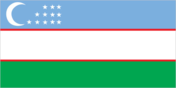
three equal horizontal bands of blue (top), white, and green separated by red fimbriations with a vertical, white crescent moon (closed side to the hoist) and 12 white, five-pointed stars shifted to the hoist on the top band; blue is the color of the Turkic peoples and of the sky, white signifies peace and the striving for purity in thoughts and deeds, while green represents nature and is the color of Islam; the red stripes are the vital force of all living organisms that links good and pure ideas with the eternal sky and with deeds on earth; the crescent represents Islam and the 12 stars the months and constellations of the Uzbek calendar
Government Type
presidential republic; highly authoritarian
Independence
1 September 1991 (from the Soviet Union)
International Law Organization Participation
has not submitted an ICJ jurisdiction declaration; non-party state to the ICCt
International Organization Participation
ADB, CICA, CIS, EAPC, EBRD, ECO, FAO, IAEA, IBRD, ICAO, ICC (national committees), ICCt, ICRM, IDA, IDB, IFAD, IFC, IFRCS, ILO, IMF, Interpol, IOC, ISO, ITSO, ITU, MIGA, NAM, OIC, OPCW, OSCE, PFP, SCO, UN, UNCTAD, UNESCO, UNIDO, UNWTO, UPU, WCO, WFTU (NGOs), WHO, WIPO, WMO, WTO (observer)
Judicial Branch
- Highest Courts
- Supreme Court (consists of 67 judges organized into administrative, civil, criminal, and economic sections); Constitutional Court (consists of 7 judges)
- Judge Selection And Term Of Office
- judges of the highest courts nominated by the president and confirmed by the Senate of the Oliy Majlis; judges appointed for initial 5-year term and can be reappointed for subsequent 10-year and lifetime terms
- Subordinate Courts
- regional, district, city, and town courts
Legal System
civil law system
Legislative Branch
- Description
- bicameral Supreme Assembly or Oliy Majlis consists of: Senate (100 seats; 84 members indirectly elected by regional governing councils and 16 appointed by the president; members serve 5-year terms) Legislative Chamber or Qonunchilik Palatasi (150 seats; members directly elected in single-seat constituencies by absolute majority vote with a second round, if needed; members serve 5-year terms)
- Election Results
- Senate - percent of vote by party - NA; seats by party - NA; composition - men 83, women 17, percent of women 17% Legislative Chamber - percent of vote by party - NA; seats by party - LDPU 52, National Revival Democratic Party 36, NDP 27, Adolat 20, Ecological Movement 15; composition - men 126, women 24, percent of women 16%; note - total Supreme Assembly percent of women 16.4%
- Elections
- Senate - last held 13-14 January 2015 (next to be held in 2020) Legislative Chamber - last held on 21 December 2014 and 4 January 2015 (next to be held in December 2019)
National Anthem
- Lyrics Music
- Abdulla ARIPOV/Mutal BURHANOV
- Name
- "O'zbekiston Respublikasining Davlat Madhiyasi" (National Anthem of the Republic of Uzbekistan)
National Holiday
Independence Day, 1 September (1991)
National Symbol S
khumo (mythical bird); national colors: blue, white, red, green
Political Parties And Leaders
Ecological Party of Uzbekistan (O'zbekiston Ekologik Partivasi) [Boriy ALIKHANOV] Justice (Adolat) Social Democratic Party of Uzbekistan [Narimon UMAROV] Liberal Democratic Party of Uzbekistan (O'zbekiston Liberal-Demokratik Partiyasi) or LDPU [Aktam HAITOV] National Revival Democratic Party of Uzbekistan (O'zbekiston Milliy Tiklanish Demokratik Partiyasi) [Sarvar OTAMURATOV] People's Democratic Party of Uzbekistan (Xalq Demokratik Partiyas) or NDP [Hotamjon KETMONOV] (formerly Communist Party)
Suffrage
18 years of age; universal
Economy
Agriculture Products
cotton, vegetables, fruits, grain; livestock
Budget
- Expenditures
- 15.08 billion (2017 est.)
- Revenues
- 15.22 billion (2017 est.)
Budget Surplus Or Deficit
0.3% (of GDP) (2017 est.)
Central Bank Discount Rate
- 2015
- 9%
- 2016
- 9%
Commercial Bank Prime Lending Rate
- 31 December 2012
- 11.2%
- 31 December 2016
- 16%
Current Account Balance
- 2016
- $384 million
- 2017
- $1.713 billion
Debt External
- 31 December 2016
- $16.76 billion
- 31 December 2017
- $16.9 billion
Distribution Of Family Income Gini Index
- 1998
- 44.7
- 2003
- 36.8
Economy Overview
Uzbekistan is a doubly landlocked country in which 51% of the population lives in urban settlements; the agriculture-rich Fergana Valley, in which Uzbekistan’s eastern borders are situated, has been counted among the most densely populated parts of Central Asia. Since its independence in September 1991, the government has largely maintained its Soviet-style command economy with subsidies and tight controls on production, prices, and access to foreign currency. Despite ongoing efforts to diversify crops, Uzbek agriculture remains largely centered on cotton; Uzbekistan is the world's fifth-largest cotton exporter and seventh-largest producer. Uzbekistan's growth has been driven primarily by state-led investments, and export of natural gas, gold, and cotton provides a significant share of foreign exchange earnings.Recently, lower global commodity prices and economic slowdowns in neighboring Russia and China have hurt Uzbekistan's trade and investment and worsened its foreign currency shortage. Aware of the need to improve the investment climate, the government is taking incremental steps to reform the business sector and address impediments to foreign investment in the country. Since the death of first President Islam KARIMOV and election of President Shavkat MIRZIYOYEV, emphasis on such initiatives and government efforts to improve the private sector have increased. In the past, Uzbek authorities accused US and other foreign companies operating in Uzbekistan of violating Uzbek laws and have frozen and seized their assets.As a part of its economic reform efforts, the Uzbek Government is looking to expand opportunities for small and medium enterprises and prioritizes increasing foreign direct investment. In September 2017, the government devalued the official currency rate by almost 50% and announced the loosening of currency restrictions to eliminate the currency black market, increase access to hard currency, and boost investment.
Exchange Rates
- 2013
- 2,311.4
- 2014
- 2,569.6
- 2015
- 2,966.6
- 2016
- 2,966.6
- 2017
- 3,906.1
- Currency
- Uzbekistani soum (UZS) per US dollar -
Exports
- 2016
- $11.2 billion
- 2017
- $11.48 billion
Exports Commodities
energy products, cotton, gold, mineral fertilizers, ferrous and nonferrous metals, textiles, foodstuffs, machinery, automobiles
Exports Partners
Switzerland 38.7%, China 15.5%, Russia 10.7%, Turkey 8.6%, Kazakhstan 7.7%, Afghanistan 4.7% (2017)
Fiscal Year
calendar year
GDP Composition By End Use
- Exports Of Goods And Services
- 19% (2017 est.)
- Government Consumption
- 16.3% (2017 est.)
- Household Consumption
- 59.5% (2017 est.)
- Imports Of Goods And Services
- -20% (2017 est.)
- Investment In Fixed Capital
- 25.3% (2017 est.)
- Investment In Inventories
- 3% (2017 est.)
GDP Composition By Sector Of Origin
- Agriculture
- 17.9% (2017 est.)
- Industry
- 33.7% (2017 est.)
- Services
- 48.5% (2017 est.)
GDP Official Exchange Rate
$48.83 billion (2017 est.)
GDP Per Capita Ppp
- 2015
- $6,300
- 2016
- $6,700
- 2017
- $6,900
GDP Purchasing Power Parity
- 2015
- $196.5 billion
- 2016
- $211.8 billion
- 2017
- $223 billion
GDP Real Growth Rate
- 2015
- 7.9%
- 2016
- 7.8%
- 2017
- 5.3%
Gross National Saving
- 2015
- 27.6% of GDP
- 2016
- 25.4% of GDP
- 2017
- 32.7% of GDP
Household Income Or Consumption By Percentage Share
- Highest 10
- 29.6% (2003)
- Lowest 10
- 2.8%
Imports
- 2016
- $10.92 billion
- 2017
- $11.42 billion
Imports Commodities
machinery and equipment, foodstuffs, chemicals, ferrous and nonferrous metals
Imports Partners
China 23.7%, Russia 22.5%, Kazakhstan 10.7%, South Korea 9.8%, Turkey 5.8%, Germany 5.6% (2017)
Industrial Production Growth Rate
4.5% (2017 est.)
Industries
textiles, food processing, machine building, metallurgy, mining, hydrocarbon extraction, chemicals
Inflation Rate Consumer Prices
- 2016
- 8%
- 2017
- 12.5%
Labor Force
18.12 million (2017 est.)
Labor Force By Occupation
- Agriculture
- 25.9%
- Industry
- 13.2%
- Services
- 60.9% (2012 est.)
Market Value Of Publicly Traded Shares
- 31 December 2006
- $715.3 million
- 31 December 2012
- $NA
Population Below Poverty Line
14% (2016 est.)
Public Debt
- 2016
- 10.5% of GDP
- 2017
- 24.3% of GDP
Reserves Of Foreign Exchange And Gold
- 31 December 2016
- $14 billion
- 31 December 2017
- $16 billion
Stock Of Broad Money
- 31 December 2016
- $7.729 billion
- 31 December 2017
- $4.173 billion
Stock Of Direct Foreign Investment Abroad
NA
Stock Of Direct Foreign Investment at Home
NA
Stock Of Domestic Credit
- 31 December 2016
- $11.63 billion
- 31 December 2017
- $5.558 billion
Stock Of Narrow Money
- 31 December 2016
- $7.729 billion
- 31 December 2017
- $4.173 billion
Taxes And Other Revenues
31.2% (of GDP) (2017 est.)
Unemployment Rate
- 2016
- 5.1%
- 2017
- 5%
Energy
Carbon Dioxide Emissions From Consumption Of Energy
95.58 million Mt (2017 est.)
Crude Oil Exports
27,000 bbl/day (2015 est.)
Crude Oil Imports
420 bbl/day (2015 est.)
Crude Oil Production
41,000 bbl/day (2018 est.)
Crude Oil Proved Reserves
594 million bbl (1 January 2018 est.)
Electricity Access
100% (2016)
Electricity Consumption
49.07 billion kWh (2016 est.)
Electricity Exports
13 billion kWh (2014 est.)
Electricity From Fossil Fuels
86% of total installed capacity (2016 est.)
Electricity From Hydroelectric Plants
14% of total installed capacity (2017 est.)
Electricity From Nuclear Fuels
0% of total installed capacity (2017 est.)
Electricity From Other Renewable Sources
0% of total installed capacity (2017 est.)
Electricity Imports
10.84 billion kWh (2016 est.)
Electricity Installed Generating Capacity
12.96 million kW (2016 est.)
Electricity Production
55.55 billion kWh (2016 est.)
Natural Gas Consumption
43.07 billion cu m (2017 est.)
Natural Gas Exports
9.401 billion cu m (2017 est.)
Natural Gas Imports
0 cu m (2017 est.)
Natural Gas Production
52.1 billion cu m (2017 est.)
Natural Gas Proved Reserves
1.841 trillion cu m (1 January 2018 est.)
Refined Petroleum Products Consumption
60,000 bbl/day (2016 est.)
Refined Petroleum Products Exports
3,977 bbl/day (2015 est.)
Refined Petroleum Products Imports
0 bbl/day (2015 est.)
Refined Petroleum Products Production
61,740 bbl/day (2015 est.)
Communications
Broadband Fixed Subscriptions
- Subscriptions Per 100 Inhabitants
- 11 (2017 est.)
- Total
- 3,320,210
Broadcast Media
the government controls media; 17 state-owned broadcasters - 13 TV and 4 radio - provide service to virtually the entire country; about 20 privately owned TV stations, overseen by local officials, broadcast to local markets; privately owned TV stations are required to lease transmitters from the government-owned Republic TV and Radio Industry Corporation; in 2019, the Uzbek Agency for Press and Information was reorganized into the Agency of Information and Mass Communications and became part of the Uzbek Presidential Administration with recent appointment of the Uzbek President's elder daughter as it deputy director (2019)
Internet Country Code
.uz
Internet Users
- Percent Of Population
- 46.8% (July 2018 est.)
- Total
- 15,157,210
Telephone System
- Domestic
- fixed-line 12 per 100 person and mobile-cellular 82 per 100; the state-owned telecommunications company, Uzbek Telecom, owner of the fixed-line telecommunications system, has used loans from the Japanese government and the China Development Bank to upgrade fixed-line services including conversion to digital exchanges; mobile-cellular services are provided by 2 private and 3 state-owned operators with a total subscriber base of 22.8 million as of January 2018 (2018)
- General Assessment
- digital exchanges in large cities and in rural areas; increased investment in infrastructure and growing subscriber base; fixed-line is underdeveloped due to preeminence of mobile market; growth in broadband penetration in the future; Wi-Fi hotspot in the city of Tashkent in the future (2018)
- International
- country code - 998; linked by fiber-optic cable or microwave radio relay with CIS member states and to other countries by leased connection via the Moscow international gateway switch; the country also has a link to the Trans-Asia-Europe (TAE) fiber-optic cable; Uzbekistan has supported the national fiber- optic backbone project of Afghanistan since 2008
Telephones Fixed Lines
- Subscriptions Per 100 Inhabitants
- 12 (2017 est.)
- Total Subscriptions
- 3,444,330
Telephones Mobile Cellular
- Subscriptions Per 100 Inhabitants
- 82 (2017 est.)
- Total Subscriptions
- 24,265,460
Transportation
Airports
53 (2013)
Airports With Paved Runways
- 1 524 To 2 437 M
- 6 (2013)
- 2 438 To 3 047 M
- 13 (2013)
- 914 To 1 523 M
- 4 (2013)
- Over 3 047 M
- 6 (2013)
- Total
- 33 (2013)
- Under 914 M
- 4 (2013)
Airports With Unpaved Runways
- 2 438 To 3 047 M
- 2 (2013)
- Total
- 20 (2013)
- Under 914 M
- 18 (2013)
Civil Aircraft Registration Country Code Prefix
UK (2016)
National Air Transport System
- Annual Freight Traffic On Registered Air Carriers
- 114,334,520 mt-km (2015)
- Annual Passenger Traffic On Registered Air Carriers
- 2,486,673 (2015)
- Inventory Of Registered Aircraft Operated By Air Carriers
- 29 (2015)
- Number Of Registered Air Carriers
- 2 (2015)
Pipelines
13,700 km gas, 944 km oil (2016)
Ports And Terminals
Termiz (Amu Darya)
Railways
- Broad Gauge
- 4,642 km 1.520-m gauge (1,684 km electrified) (2018)
- Total
- 4,642 km (2018)
Roadways
- Paved
- 75,511 km (2000)
- Total
- 86,496 km (2000)
- Unpaved
- 10,985 km (2000)
Waterways
1,100 km (2012)
Military and Security
Military And Security Forces
Armed Forces of Uzbekistan: Army, Air and Air Defense Forces; National Guard; Ministry of Internal Affairs: Internal Security Troops (2019)
Military Expenditures
- 2010
- 3.5% of GDP
- 2018
- 4% of GDP
Military Service Age And Obligation
18-27 years of age for compulsory military service; 1-year conscript service obligation for males (conscripts have the option of paying for a shorter service of one month while remaining in the reserves until the age of 27); Uzbek citizens who have completed their service terms in the armed forces have privileges in employment and admission to higher educational institutions (2016)
Transnational Issues
Disputes International
prolonged drought and cotton monoculture in Uzbekistan and Turkmenistan created water-sharing difficulties for Amu Darya river states; field demarcation of the boundaries with Kazakhstan commenced in 2004; border delimitation of 130 km of border with Kyrgyzstan is hampered by serious disputes around enclaves and other areas
Illicit Drugs
transit country for Afghan narcotics bound for Russian and, to a lesser extent, Western European markets; limited illicit cultivation of cannabis and small amounts of opium poppy for domestic consumption; poppy cultivation almost wiped out by government crop eradication program; transit point for heroin precursor chemicals bound for Afghanistan
Refugees And Internally Displaced Persons
79,942 (2018)
Trafficking In Persons
- Current Situation
- Uzbekistan is a source country for men, women, and children subjected to forced labor and women and children subjected to sex trafficking; government-compelled forced labor of adults remained endemic during the 2014 cotton harvest; despite a decree banning the use of persons under 18, children were mobilized to harvest cotton by local officials in some districts; in some regions, local officials forced teachers, students, private business employees, and others to work in construction, agriculture, and cleaning parks; Uzbekistani women and children are victims of sex trafficking domestically and in the Middle East, Eurasia, and Asia; Uzbekistani men and, to a lesser extent, women are subjected to forced labor in Kazakhstan, Russia, and Ukraine in the construction, oil, agriculture, retail, and food sectors
- Tier Rating
- Tier 2 Watch List – Uzbekistan does not fully comply with the minimum standards for the elimination of trafficking; however, it is making significant efforts to do so; law enforcement efforts in 2014 were mixed; the government made efforts to combat sex and transnational labor trafficking, but government-compelled forced labor of adults in the cotton harvest went unaddressed, and the decree prohibiting forced child labor was not applied universally; official complicity in human trafficking in the cotton harvest remained prevalent; authorities made efforts to identify and protect sex and transnational labor victims, although a systematic process is still lacking; minimal efforts were made to assist victims of forced labor in the cotton harvest, as the government does not openly acknowledge the existence of this forced labor; the ILO did not have permission or funding to monitor the 2014 harvest, but the government authorized the UN's International Labour Organization to conduct a survey on recruitment practices and working conditions in agriculture, particularly the cotton sector, and to monitor the 2015-17 cotton harvests for child and forced labor in project areas (2015)