2019 Edition
CIA World Factbook 2019 Archive (Wayback Machine)
Introduction
Background
The Trucial States of the Persian Gulf coast granted the UK control of their defense and foreign affairs in 19th century treaties. In 1971, six of these states - Abu Dhabi, 'Ajman, Al Fujayrah, Ash Shariqah, Dubayy, and Umm al Qaywayn - merged to form the United Arab Emirates (UAE). They were joined in 1972 by Ra's al Khaymah. The UAE's per capita GDP is on par with those of leading West European nations. For more than three decades, oil and global finance drove the UAE's economy. In 2008-09, the confluence of falling oil prices, collapsing real estate prices, and the international banking crisis hit the UAE especially hard. The UAE did not experience the "Arab Spring" unrest seen elsewhere in the Middle East in 2010-11, partly because of the government's multi-year, $1.6-billion infrastructure investment plan for the poorer northern emirates, and its aggressive pursuit of advocates of political reform. The UAE in recent years has played a growing role in regional affairs. In addition to donating billions of dollars in economic aid to help stabilize Egypt, the UAE was one of the first countries to join the Defeat-ISIS coalition, and to participate as a key partner in a Saudi-led military campaign in Yemen.
Geography
Area
- Land
- 83,600 sq km
- Total
- 83,600 sq km
- Water
- 0 sq km
Area Comparative
slightly larger than South Carolina; slightly smaller than Maine
Climate
desert; cooler in eastern mountains
Coastline
1,318 km
Elevation
- Highest Point
- Jabal Yibir 1,527 m
- Lowest Point
- Persian Gulf 0 m
- Mean Elevation
- 149 m
Environment Current Issues
air pollution; rapid population growth and high energy demand contribute to water scarcity; lack of natural freshwater resources compensated by desalination plants; land degradation and desertification; waste generation, beach pollution from oil spills
Environment International Agreements
- Party To
- Biodiversity, Climate Change, Climate Change-Kyoto Protocol, Desertification, Endangered Species, Hazardous Wastes, Marine Dumping, Ozone Layer Protection
- Signed But Not Ratified
- Law of the Sea
Geographic Coordinates
24 00 N, 54 00 E
Geography Note
strategic location along southern approaches to Strait of Hormuz, a vital transit point for world crude oil
Irrigated Land
923 sq km (2012)
Land Boundaries
- Border Countries
- Oman 609 km, Saudi Arabia 457 km
- Total
- 1,066 km
Land Use
- Agricultural Land
- 4.6% (2011 est.)
- Agricultural Land Arable Land
- 0.5% (2011 est.)
- Agricultural Land Permanent Crops
- 0.5% (2011 est.)
- Agricultural Land Permanent Pasture
- 3.6% (2011 est.)
- Forest
- 3.8% (2011 est.)
- Other
- 91.6% (2011 est.)
Location
Middle East, bordering the Gulf of Oman and the Persian Gulf, between Oman and Saudi Arabia
Map References
Middle East
Maritime Claims
- Contiguous Zone
- 24 nm
- Continental Shelf
- 200 nm or to the edge of the continental margin
- Exclusive Economic Zone
- 200 nm
- Territorial Sea
- 12 nm
Natural Hazards
frequent sand and dust storms
Natural Resources
petroleum, natural gas
Population Distribution
population is heavily concentrated to the northeast on the Musandam Peninsula; the three largest emirates - Abu Dhabi, Dubai, and Sharjah - are home to nearly 85% of the population
Terrain
flat, barren coastal plain merging into rolling sand dunes of vast desert; mountains in east
People and Society
Age Structure
- 0 14 Years
- 14.39% (male 724,904 /female 671,524)
- 15 24 Years
- 7.64% (male 408,376 /female 332,986)
- 25 54 Years
- 70.45% (male 5,297,201 /female 1,537,300)
- 55 64 Years
- 6.05% (male 499,579 /female 87,037)
- 65 Years And Over
- 1.47% (male 106,739 /female 35,669) (2018 est.)
Birth Rate
9.8 births/1,000 population (2018 est.)
Current Health Expenditure
3.5% (2016)
Death Rate
1.7 deaths/1,000 population (2018 est.)
Dependency Ratios
- Elderly Dependency Ratio
- 1.2 (2015 est.)
- Potential Support Ratio
- 83.4 (2015 est.)
- Total Dependency Ratio
- 17.4 (2015 est.)
- Youth Dependency Ratio
- 16.2 (2015 est.)
Drinking Water Source
- Improved Rural
- 100% of population
- Improved Total
- 99.6% of population
- Improved Urban
- 99.6% of population
- Unimproved Rural
- 0% of population
- Unimproved Total
- 0.4% of population (2015 est.)
- Unimproved Urban
- 0.4% of population
Ethnic Groups
Emirati 11.6%, South Asian 59.4% (includes Indian 38.2%, Bangladeshi 9.5%, Pakistani 9.4%, other 2.3%), Egyptian 10.2%, Filipino 6.1%, other 12.8% (2015 est.)
Hospital Bed Density
1.2 beds/1,000 population (2013)
Infant Mortality Rate
- Female
- 4.9 deaths/1,000 live births
- Male
- 6 deaths/1,000 live births
- Total
- 5.5 deaths/1,000 live births (2018 est.)
Languages
Arabic (official), English, Hindi, Malayam, Urdu, Pashto, Tagalog, Persian
Life Expectancy at Birth
- Female
- 80.1 years
- Male
- 77.3 years
- Total Population
- 78.7 years (2018 est.)
Literacy
- Definition
- age 15 and over can read and write
- Female
- 95.8% (2015)
- Male
- 93.1%
- Total Population
- 93.8%
Major Urban Areas Population
2.833 million Dubai, 1.629 million Sharjah, 1.452 million ABU DHABI (capital) (2019)
Maternal Mortality Rate
3 deaths/100,000 live births (2017 est.)
Median Age
- Female
- 31.1 years
- Male
- 39 years
- Total
- 37.2 years (2018 est.)
Nationality
- Adjective
- Emirati
- Noun
- Emirati(s)
Net Migration Rate
6.3 migrant(s)/1,000 population (2018 est.)
Obesity Adult Prevalence Rate
31.7% (2016)
Physicians Density
2.39 physicians/1,000 population (2016)
Population
9,701,315 (July 2018 est.)
Population Growth Rate
1.44% (2018 est.)
Religions
Muslim (official) 76%, Christian 9%, other (primarily Hindu and Buddhist, less than 5% of the population consists of Parsi, Baha'i, Druze, Sikh, Ahmadi, Ismaili, Dawoodi Bohra Muslim, and Jewish) 15% (2005 est.)
Sanitation Facility Access
- Improved Rural
- 95.2% of population (2015 est.)
- Improved Total
- 97.6% of population (2015 est.)
- Improved Urban
- 98% of population (2015 est.)
- Unimproved Rural
- 4.8% of population (2015 est.)
- Unimproved Total
- 2.4% of population (2015 est.)
- Unimproved Urban
- 2% of population (2015 est.)
School Life Expectancy Primary To Tertiary Education
- Female
- 14 years (2016)
- Male
- 13 years
- Total
- 14 years
Sex Ratio
- 0 14 Years
- 1.08 male(s)/female
- 15 24 Years
- 1.23 male(s)/female
- 25 54 Years
- 3.45 male(s)/female
- 55 64 Years
- 5.74 male(s)/female
- 65 Years And Over
- 2.99 male(s)/female
- At Birth
- 1.06 male(s)/female
- Total Population
- 2.64 male(s)/female (2018 est.)
Total Fertility Rate
1.73 children born/woman (2018 est.)
Unemployment Youth Ages 15 24
- Female
- 13.5% (2017 est.)
- Male
- 6%
- Total
- 7.7%
Urbanization
- Rate Of Urbanization
- 1.71% annual rate of change (2015-20 est.)
- Urban Population
- 86.8% of total population (2019)
Government
Administrative Divisions
7 emirates (imarat, singular - imarah); Abu Zaby (Abu Dhabi), 'Ajman, Al Fujayrah, Ash Shariqah (Sharjah), Dubayy (Dubai), Ra's al Khaymah, Umm al Qaywayn
Capital
- Geographic Coordinates
- 24 28 N, 54 22 E
- Name
- Abu Dhabi
- Time Difference
- UTC+4 (9 hours ahead of Washington, DC, during Standard Time)
Citizenship
- Citizenship By Birth
- no
- Citizenship By Descent Only
- the father must be a citizen of the United Arab Emirates; if the father is unknown, the mother must be a citizen
- Dual Citizenship Recognized
- no
- Residency Requirement For Naturalization
- 30 years
Constitution
- Amendments
- proposed by the Supreme Council and submitted to the Federal National Council; passage requires at least a two-thirds majority vote of Federal National Council members present and approval of the Supreme Council president; amended 2009 (2016)
- History
- previous 1971 (provisional); latest drafted in 1979, became permanent May 1996
Country Name
- Abbreviation
- UAE
- Conventional Long Form
- United Arab Emirates
- Conventional Short Form
- none
- Etymology
- self-descriptive country name; the name "Arabia" can be traced back many centuries B.C., the ancient Egyptians referred to the region as "Ar Rabi"; "emirates" derives from "amir" the Arabic word for "commander," "lord," or "prince"
- Former
- Trucial Oman, Trucial States
- Local Long Form
- Al Imarat al Arabiyah al Muttahidah
- Local Short Form
- none
Diplomatic Representation From The Us
- Chief Of Mission
- Ambassador (vacant); Charge d'Affaires Steven C. BONDY (since 22 March 2018)
- Consulate's General
- Dubai
- Embassy
- Embassies District, Plot 38 Sector W59-02, Street No. 4, P. O. Box 4009, Abu Dhabi
- Fax
- [971] (2) 414-2603
- Mailing Address
- P. O. Box 4009, Abu Dhabi
- Telephone
- [971] (2) 414-2200
Diplomatic Representation In The Us
- Chancery
- 3522 International Court NW, Suite 400, Washington, DC 20008
- Chief Of Mission
- Ambassador Yusif bin Mani bin Said al-UTAYBA (since 28 July 2008)
- Consulate's General
- Boston, Los Angeles, New York
- Fax
- [1] (202) 243-2432
- Telephone
- [1] (202) 243-2400
Executive Branch
- Cabinet
- Council of Ministers announced by the prime minister and approved by the president
- Chief Of State
- President KHALIFA bin Zayid Al-Nuhayyan (since 2 November 2004), ruler of Abu Zaby (Abu Dhabi) (since 4 November 2004); Vice President and Prime Minister MUHAMMAD BIN RASHID Al-Maktum (since 5 January 2006)
- Election Results
- KHALIFA bin Zayid Al-Nuhayyan reelected president; FSC vote NA
- Elections Appointments
- president and vice president indirectly elected by the Federal Supreme Council - composed of the rulers of the 7 emirates - for a 5-year term (no term limits); election last held 3 November 2009 (next election NA); prime minister and deputy prime minister appointed by the president
- Head Of Government
- Prime Minister Vice President MUHAMMAD BIN RASHID Al-Maktum (since 5 January 2006); Deputy Prime Ministers SAIF bin Zayid Al-Nuhayyan, MANSUR bin Zayid Al-Nuhayyan (both since 11 May 2009)
Flag Description
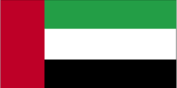
three equal horizontal bands of green (top), white, and black with a wider vertical red band on the hoist side; the flag incorporates all four Pan-Arab colors, which in this case represent fertility (green), neutrality (white), petroleum resources (black), and unity (red); red was the traditional color incorporated into all flags of the emirates before their unification
Government Type
federation of monarchies
Independence
2 December 1971 (from the UK)
International Law Organization Participation
has not submitted an ICJ jurisdiction declaration; non-party state to the ICCt
International Organization Participation
ABEDA, AfDB (nonregional member), AFESD, AMF, BIS, CAEU, CICA, FAO, G-77, GCC, IAEA, IBRD, ICAO, ICC (national committees), ICRM, IDA, IDB, IFAD, IFC, IFRCS, IHO, ILO, IMF, IMO, IMSO, Interpol, IOC, IPU, ISO, ITSO, ITU, LAS, MIGA, NAM, OAPEC, OIC, OIF (observer), OPCW, OPEC, PCA, UN, UNCTAD, UNESCO, UNIDO, UNRWA, UNWTO, UPU, WCO, WHO, WIPO, WMO, WTO
Judicial Branch
- Highest Courts
- Federal Supreme Court (consists of the court president and 4 judges; jurisdiction limited to federal cases)
- Judge Selection And Term Of Office
- judges appointed by the federal president following approval by the Federal Supreme Council, the highest executive and legislative authority consisting of the 7 emirate rulers; judges serve until retirement age or the expiry of their appointment terms
- Subordinate Courts
- Federal Court of Cassation (determines the constitutionality of laws promulgated at the federal and emirate level; federal level courts of first instance and appeals courts); the emirates of Abu Dhabi, Dubai, and Ra's al Khaymah have parallel court systems; the other 4 emirates have incorporated their courts into the federal system; note - the Abu Dhabi Global Market Courts and the Dubai International Financial Center Courts, the country’s two largest financial free zones, both adjudicate civil and commercial disputes.
Legal System
mixed legal system of Islamic (sharia) law and civil law
Legislative Branch
- Description
- unicameral Federal National Council (FNC) or Majlis al-Ittihad al-Watani (40 seats; 20 members indirectly elected using single non-transferable vote by an electoral college whose members are selected by each emirate ruler proportional to its FNC membership, and 20 members appointed by the rulers of the 7 constituent states; members serve 4-year terms)
- Election Results
- all candidates ran as independents; seats by emirate - Abu Dhabi 4, Dubai 4, Sharjah 3, Ras al-Khaimah 3, Ajman 2, Fujairah 2, Umm al-Quwain 2; composition (preliminary) - 13 men, 7 women, percent of elected women 35%; note - to attain overall FNC gender parity, 13 women and 7 men will be appointed; overall FNC percent of women 50%
- Elections
- last held for indirectly elected members on 5 October 2019 (next to be held in October 2023)
National Anthem
- Lyrics Music
- AREF Al Sheikh Abdullah Al Hassan/Mohamad Abdel WAHAB
- Name
- "Nashid al-watani al-imarati" (National Anthem of the UAE)
National Holiday
Independence Day (National Day), 2 December (1971)
National Symbol S
golden falcon; national colors: green, white, black, red
Political Parties And Leaders
none; political parties are banned
Suffrage
limited; note - rulers of the seven emirates each select a proportion of voters for the Federal National Council (FNC) that together account for about 12 percent of Emirati citizens
Economy
Agriculture Products
dates, vegetables, watermelons; poultry, eggs, dairy products; fish
Budget
- Expenditures
- 111.1 billion (2017 est.)
- Revenues
- 110.2 billion (2017 est.)
Budget Surplus Or Deficit
-0.2% (of GDP) (2017 est.)
Central Bank Discount Rate
NA
Commercial Bank Prime Lending Rate
- 31 December 2016
- 5.7%
- 31 December 2017
- 6%
Current Account Balance
- 2016
- $13.23 billion
- 2017
- $26.47 billion
Debt External
- 31 December 2016
- $218.7 billion
- 31 December 2017
- $237.6 billion
Economy Overview
The UAE has an open economy with a high per capita income and a sizable annual trade surplus. Successful efforts at economic diversification have reduced the portion of GDP from the oil and gas sector to 30%.Since the discovery of oil in the UAE nearly 60 years ago, the country has undergone a profound transformation from an impoverished region of small desert principalities to a modern state with a high standard of living. The government has increased spending on job creation and infrastructure expansion and is opening up utilities to greater private sector involvement. The country's free trade zones - offering 100% foreign ownership and zero taxes - are helping to attract foreign investors.The global financial crisis of 2008-09, tight international credit, and deflated asset prices constricted the economy in 2009. UAE authorities tried to blunt the crisis by increasing spending and boosting liquidity in the banking sector. The crisis hit Dubai hardest, as it was heavily exposed to depressed real estate prices. Dubai lacked sufficient cash to meet its debt obligations, prompting global concern about its solvency and ultimately a $20 billion bailout from the UAE Central Bank and Abu Dhabi Government that was refinanced in March 2014.The UAE’s dependence on oil is a significant long-term challenge, although the UAE is one of the most diversified countries in the Gulf Cooperation Council. Low oil prices have prompted the UAE to cut expenditures, including on some social programs, but the UAE has sufficient assets in its sovereign investment funds to cover its deficits. The government reduced fuel subsidies in August 2015, and introduced excise taxes (50% on sweetened carbonated beverages and 100% on energy drinks and tobacco) in October 2017. A five-percent value-added tax was introduced in January 2018. The UAE's strategic plan for the next few years focuses on economic diversification, promoting the UAE as a global trade and tourism hub, developing industry, and creating more job opportunities for nationals through improved education and increased private sector employment.
Exchange Rates
- 2013
- 3.673
- 2014
- 3.673
- 2015
- 3.673
- 2016
- 3.673
- 2017
- 3.673
- Currency
- Emirati dirhams (AED) per US dollar -
Exports
- 2016
- $298.6 billion
- 2017
- $308.5 billion
Exports Commodities
crude oil 45%, natural gas, reexports, dried fish, dates (2012 est.)
Exports Partners
India 10.1%, Iran 9.9%, Japan 9.3%, China 5.4%, Oman 5%, Switzerland 4.4%, South Korea 4.1% (2017)
Fiscal Year
calendar year
GDP Composition By End Use
- Exports Of Goods And Services
- 100.4% (2017 est.)
- Government Consumption
- 12.3% (2017 est.)
- Household Consumption
- 34.9% (2017 est.)
- Imports Of Goods And Services
- -72.4% (2017 est.)
- Investment In Fixed Capital
- 23% (2017 est.)
- Investment In Inventories
- 1.8% (2017 est.)
GDP Composition By Sector Of Origin
- Agriculture
- 0.9% (2017 est.)
- Industry
- 49.8% (2017 est.)
- Services
- 49.2% (2017 est.)
GDP Official Exchange Rate
$382.6 billion (2017 est.)
GDP Per Capita Ppp
- 2015
- $70,000
- 2016
- $70,100
- 2017
- $68,600
GDP Purchasing Power Parity
- 2015
- $670.5 billion
- 2016
- $690.5 billion
- 2017
- $696 billion
GDP Real Growth Rate
- 2015
- 5.1%
- 2016
- 3%
- 2017
- 0.8%
Gross National Saving
- 2015
- 30.7% of GDP
- 2016
- 30.9% of GDP
- 2017
- 28.5% of GDP
Imports
- 2016
- $226.5 billion
- 2017
- $229.2 billion
Imports Commodities
machinery and transport equipment, chemicals, food
Imports Partners
China 8.5%, US 6.8%, India 6.6% (2017)
Industrial Production Growth Rate
1.8% (2017 est.)
Industries
petroleum and petrochemicals; fishing, aluminum, cement, fertilizer, commercial ship repair, construction materials, handicrafts, textiles
Inflation Rate Consumer Prices
- 2016
- 1.6%
- 2017
- 2%
Labor Force
5.344 million (2017 est.)
Labor Force By Occupation
- Agriculture
- 7%
- Industry
- 15%
- Services
- 78% (2000 est.)
Market Value Of Publicly Traded Shares
- 31 December 2013
- $180.3 billion
- 31 December 2014
- $201.6 billion
- 31 December 2015
- $195.9 billion
Population Below Poverty Line
19.5% (2003 est.)
Public Debt
- 2016
- 20.2% of GDP
- 2017
- 19.7% of GDP
Reserves Of Foreign Exchange And Gold
- 31 December 2016
- $85.39 billion
- 31 December 2017
- $95.37 billion
Stock Of Broad Money
- 31 December 2016
- $129.1 billion
- 31 December 2017
- $134 billion
Stock Of Direct Foreign Investment Abroad
- 31 December 2016
- $114.6 billion
- 31 December 2017
- $124.4 billion
Stock Of Direct Foreign Investment at Home
- 31 December 2016
- $134.8 billion
- 31 December 2017
- $129.9 billion
Stock Of Domestic Credit
- 31 December 2016
- $396 billion
- 31 December 2017
- $395.5 billion
Stock Of Narrow Money
- 31 December 2016
- $129.1 billion
- 31 December 2017
- $134 billion
Taxes And Other Revenues
28.8% (of GDP) (2017 est.)
Unemployment Rate
- 2014
- 3.6%
- 2016
- 1.6%
Energy
Carbon Dioxide Emissions From Consumption Of Energy
289.4 million Mt (2017 est.)
Crude Oil Exports
2.552 million bbl/day (2015 est.)
Crude Oil Imports
0 bbl/day (2015 est.)
Crude Oil Production
3.216 million bbl/day (2018 est.)
Crude Oil Proved Reserves
97.8 billion bbl (1 January 2018 est.)
Electricity Access
100% (2017)
Electricity Consumption
113.2 billion kWh (2016 est.)
Electricity Exports
0 kWh (2016 est.)
Electricity From Fossil Fuels
99% of total installed capacity (2016 est.)
Electricity From Hydroelectric Plants
0% of total installed capacity (2017 est.)
Electricity From Nuclear Fuels
0% of total installed capacity (2017 est.)
Electricity From Other Renewable Sources
1% of total installed capacity (2017 est.)
Electricity Imports
1.141 billion kWh (2016 est.)
Electricity Installed Generating Capacity
28.91 million kW (2016 est.)
Electricity Production
121.8 billion kWh (2016 est.)
Natural Gas Consumption
74.48 billion cu m (2017 est.)
Natural Gas Exports
7.504 billion cu m (2017 est.)
Natural Gas Imports
20.22 billion cu m (2017 est.)
Natural Gas Production
62.01 billion cu m (2017 est.)
Natural Gas Proved Reserves
6.091 trillion cu m (1 January 2018 est.)
Refined Petroleum Products Consumption
896,000 bbl/day (2016 est.)
Refined Petroleum Products Exports
817,700 bbl/day (2015 est.)
Refined Petroleum Products Imports
392,000 bbl/day (2015 est.)
Refined Petroleum Products Production
943,500 bbl/day (2017 est.)
Communications
Broadband Fixed Subscriptions
- Subscriptions Per 100 Inhabitants
- 21 (2017 est.)
- Total
- 1,297,585
Broadcast Media
except for the many organizations now operating in media free zones in Abu Dhabi and Dubai, most TV and radio stations remain government-owned; widespread use of satellite dishes provides access to pan-Arab and other international broadcasts; restrictions since June 2017 on some satellite channels and websites originating from or otherwise linked to Qatar (2018)
Internet Country Code
.ae
Internet Users
- Percent Of Population
- 90.6% (July 2016 est.)
- Total
- 5,370,299
Telephone System
- Domestic
- microwave radio relay, fiber-optic and coaxial cable; fixed-line 38 per 100 and mobile-cellular 326 per 100 (2018)
- General Assessment
- modern fiber-optic integrated services; digital network with rapidly growing use of mobile-cellular telephones; key centers are Abu Dhabi and Dubai; 5G technology developing; two operators are competitive, but majority owned by the government; HSPA (high speed packet access) + LTE networks cover most of the population; low cost smart phones readily available; well-established fibre-broadband network provides future growth (2018)
- International
- country code - 971; linked to the international submarine cable FLAG (Fiber-Optic Link Around the Globe); landing point for both the SEA-ME-WE-3 and SEA-ME-WE-4 submarine cable networks; satellite earth stations - 3 Intelsat (1 Atlantic Ocean and 2 Indian)
Telephones Fixed Lines
- Subscriptions Per 100 Inhabitants
- 38 (2017 est.)
- Total Subscriptions
- 2,320,837
Telephones Mobile Cellular
- Subscriptions Per 100 Inhabitants
- 326 (2017 est.)
- Total Subscriptions
- 19,826,224
Transportation
Airports
43 (2013)
Airports With Paved Runways
- 1 524 To 2 437 M
- 5 (2013)
- 2 438 To 3 047 M
- 3 (2013)
- 914 To 1 523 M
- 3 (2013)
- Over 3 047 M
- 12 (2013)
- Total
- 25 (2013)
- Under 914 M
- 2 (2013)
Airports With Unpaved Runways
- 1 524 To 2 437 M
- 4 (2013)
- 2 438 To 3 047 M
- 1 (2013)
- 914 To 1 523 M
- 6 (2013)
- Over 3 047 M
- 1 (2013)
- Total
- 18 (2013)
- Under 914 M
- 6 (2013)
Civil Aircraft Registration Country Code Prefix
A6 (2016)
Heliports
5 (2013)
Merchant Marine
- By Type
- container ship 2, general cargo 103, oil tanker 22, other 489 (2018)
- Total
- 616
National Air Transport System
- Annual Freight Traffic On Registered Air Carriers
- 16.647 billion mt-km (2015)
- Annual Passenger Traffic On Registered Air Carriers
- 84,738,479 (2015)
- Inventory Of Registered Aircraft Operated By Air Carriers
- 498 (2015)
- Number Of Registered Air Carriers
- 12 (2015)
Pipelines
533 km condensate, 3277 km gas, 300 km liquid petroleum gas, 3287 km oil, 24 km oil/gas/water, 218 km refined products, 99 km water (2013)
Ports And Terminals
- Container Port's Teus
- Dubai Port (15,368,000), Khor Fakkan (Khawr Fakkan) (Sharjah) (2,321,000) (2017)
- Lng Terminal's Export
- Das Island
- Major Seaport S
- Al Fujayrah, Mina' Jabal 'Ali (Dubai), Khor Fakkan (Khawr Fakkan) (Sharjah), Mubarraz Island (Abu Dhabi), Mina' Rashid (Dubai), Mina' Saqr (Ra's al Khaymah)
Roadways
- Paved
- 4,080 km (includes 253 km of expressways) (2008)
- Total
- 4,080 km (2008)
Military and Security
Military And Security Forces
United Arab Emirates Armed Forces: Land Forces, Navy, Air Force, Presidential Guard, Joint Aviation Command; Ministry of Interior: Critical Infrastructure Coastal Patrol Agency (CICPA) (2019)
Military Expenditures
- 2011
- 5.45% of GDP
- 2012
- 5.08% of GDP
- 2013
- 6.02% of GDP
- 2014
- 5.64% of GDP
- 2016
- 5.7% of GDP
Military Service Age And Obligation
18-30 years of age for compulsory military service for men; 17 years of age for male volunteers with parental approval; 24-month general service obligation, 16 months for secondary school graduates; women can volunteer to serve for 9 months regardless of education (2018)
Transnational Issues
Disputes International
boundary agreement was signed and ratified with Oman in 2003 for entire border, including Oman's Musandam Peninsula and Al Madhah enclaves, but contents of the agreement and detailed maps showing the alignment have not been published; Iran and UAE dispute Tunb Islands and Abu Musa Island, which Iran occupies
Illicit Drugs
the UAE is a drug transshipment point for traffickers given its proximity to Southwest Asian drug-producing countries; the UAE's position as a major financial center makes it vulnerable to money laundering; anti-money-laundering controls improving, but informal banking remains unregulated