2020 Edition
factbook.json (GitHub)
Introduction
Background
The Spaniards first explored Suriname in the 16th century, and the English then settled it in the mid-17th century. Suriname became a Dutch colony in 1667. With the abolition of African slavery in 1863, workers were brought in from India and Java. The Netherlands granted the colony independence in 1975. Five years later, the civilian government was replaced by a military regime that soon declared Suriname a socialist republic. It continued to exert control through a succession of nominally civilian administrations until 1987, when international pressure finally forced a democratic election. In 1990, the military overthrew the civilian leadership, but a democratically elected government -- a four-party coalition -- returned to power in 1991. The coalition expanded to eight parties in 2005 and ruled until 2010, when voters returned former military leader Desire BOUTERSE and his opposition coalition to power. President BOUTERSE ran unopposed in 2015 and was reelected. Opposition parties campaigned hard against BOUTERSE in the run-up to the 2020 elections, and a multi-party coalition led by Chandrikapersad SANTOKHI’s VHP and Ronnie Brunswijk’s ABOP was installed.
Geography
Area
- land
- 156,000 sq km
- total
- 163,820 sq km
- water
- 7,820 sq km
Area - comparative
slightly larger than Georgia
Climate
tropical; moderated by trade winds
Coastline
386 km
Elevation
- highest point
- Juliana Top 1,230 m
- lowest point
- unnamed location in the coastal plain -2 m
- mean elevation
- 246 m
Geographic coordinates
4 00 N, 56 00 W
Geography - note
smallest independent country on the South American continent; mostly tropical rainforest; great diversity of flora and fauna; relatively small population, mostly along the coast
Irrigated land
600 sq km (2020)
Land boundaries
- border countries
- Brazil 515 km; French Guiana 556 km; Guyana 836 km
- total
- 1,907 km
Land use
- agricultural land
- 0.4% (2023 est.)
- agricultural land: arable land
- arable land: 0.3% (2023 est.)
- agricultural land: permanent crops
- permanent crops: 0% (2023 est.)
- agricultural land: permanent pasture
- permanent pasture: 0.1% (2023 est.)
- forest
- 91.7% (2023 est.)
- other
- 7.9% (2023 est.)
Location
Northern South America, bordering the North Atlantic Ocean, between French Guiana and Guyana
Major watersheds (area sq km)
- Atlantic Ocean drainage
- Amazon (6,145,186 sq km)
Map references
South America
Maritime claims
- exclusive economic zone
- 200 nm
- territorial sea
- 12 nm
Natural hazards
flooding
Natural resources
timber, hydropower, fish, kaolin, shrimp, bauxite, gold, and small amounts of nickel, copper, platinum, iron ore
Population distribution
population is concentrated along the northern coastal strip; the remainder of the country is sparsely populated
Terrain
mostly rolling hills; narrow coastal plain with swamps
People and Society
Age structure
- 0-14 years
- 22.5% (male 73,864/female 71,573)
- 15-64 years
- 70% (male 226,417/female 226,235)
- 65 years and over
- 7.5% (2024 est.) (male 20,071/female 28,598)
Alcohol consumption per capita
- beer
- 3.4 liters of pure alcohol (2019 est.)
- other alcohols
- 0.18 liters of pure alcohol (2019 est.)
- spirits
- 2.87 liters of pure alcohol (2019 est.)
- total
- 6.6 liters of pure alcohol (2019 est.)
- wine
- 0.14 liters of pure alcohol (2019 est.)
Birth rate
14.63 births/1,000 population (2025 est.)
Child marriage
- men married by age 18
- 19.6% (2018)
- women married by age 15
- 8.8% (2018)
- women married by age 18
- 36% (2018)
Children under the age of 5 years underweight
6.7% (2018 est.)
Currently married women (ages 15-49)
52.2% (2018 est.)
Death rate
6.74 deaths/1,000 population (2025 est.)
Dependency ratios
- elderly dependency ratio
- 11.2 (2025 est.)
- potential support ratio
- 8.9 (2025 est.)
- total dependency ratio
- 43 (2025 est.)
- youth dependency ratio
- 31.8 (2025 est.)
Drinking water source
- improved: rural
- rural: 96.6% of population (2022 est.)
- improved: total
- total: 98% of population (2022 est.)
- improved: urban
- urban: 98.7% of population (2022 est.)
- unimproved: rural
- rural: 3.4% of population (2022 est.)
- unimproved: total
- total: 2% of population (2022 est.)
- unimproved: urban
- urban: 1.3% of population (2022 est.)
Education expenditure
- Education expenditure (% GDP)
- 2.9% of GDP (2023 est.)
- Education expenditure (% national budget)
- 8.6% national budget (2024 est.)
Ethnic groups
Hindustani (also known locally as "East Indians"; their ancestors emigrated from northern India in the latter part of the 19th century) 27.4%, Maroon (their African ancestors were brought to the country in the 17th and 18th centuries as slaves and escaped to the interior) 21.7%, Creole (mixed White and Black) 15.7%, Javanese 13.7%, mixed 13.4%, other 7.6%, unspecified 0.6% (2012 est.)
Gross reproduction rate
0.9 (2025 est.)
Health expenditure
- Health expenditure (as % of GDP)
- 5.7% of GDP (2021)
- Health expenditure (as % of national budget)
- 13.1% of national budget (2022 est.)
Hospital bed density
2.9 beds/1,000 population (2020 est.)
Infant mortality rate
- female
- 21 deaths/1,000 live births
- male
- 37.6 deaths/1,000 live births
- total
- 29.3 deaths/1,000 live births (2025 est.)
Languages
- Languages
- Dutch (official), English (widely spoken), Sranang Tongo (Surinamese, sometimes called Taki-Taki, is the native language of Creoles and much of the younger population), Caribbean Hindustani (a dialect of Hindi), Javanese
- major-language sample(s)
- Het Wereld Feitenboek, een omnisbare bron van informatie. (Dutch) The World Factbook, the indispensable source for basic information. (English)
Life expectancy at birth
- female
- 76.7 years
- male
- 69 years
- total population
- 72.7 years (2024 est.)
Major urban areas - population
239,000 PARAMARIBO (capital) (2018)
Maternal mortality ratio
84 deaths/100,000 live births (2023 est.)
Median age
- female
- 32.9 years
- male
- 31 years
- total
- 32.3 years (2025 est.)
Nationality
- adjective
- Surinamese
- noun
- Surinamer(s)
Net migration rate
2.46 migrant(s)/1,000 population (2025 est.)
Obesity - adult prevalence rate
26.4% (2016)
Physician density
1.36 physicians/1,000 population (2023)
Population
- female
- 329,858
- male
- 323,747
- total
- 653,605 (2025 est.)
Population growth rate
1.04% (2025 est.)
Religions
Protestant 23.6% (includes Evangelical 11.2%, Moravian 11.2%, Reformed 0.7%, Lutheran 0.5%), Hindu 22.3%, Roman Catholic 21.6%, Muslim 13.8%, other Christian 3.2%, Winti 1.8%, Jehovah's Witness 1.2%, other 1.7%, none 7.5%, unspecified 3.2% (2012 est.)
Sanitation facility access
- improved: rural
- rural: 91.2% of population (2022 est.)
- improved: total
- total: 96.1% of population (2022 est.)
- improved: urban
- urban: 98.5% of population (2022 est.)
- unimproved: rural
- rural: 8.8% of population (2022 est.)
- unimproved: total
- total: 3.9% of population (2022 est.)
- unimproved: urban
- urban: 1.5% of population (2022 est.)
School life expectancy (primary to tertiary education)
- female
- 11 years (2021 est.)
- male
- 10 years (2021 est.)
- total
- 11 years (2021 est.)
Sex ratio
- 0-14 years
- 1.03 male(s)/female
- 15-64 years
- 1 male(s)/female
- 65 years and over
- 0.7 male(s)/female
- at birth
- 1.07 male(s)/female
- total population
- 0.98 male(s)/female (2024 est.)
Total fertility rate
1.87 children born/woman (2025 est.)
Urbanization
- rate of urbanization
- 0.88% annual rate of change (2020-25 est.)
- urban population
- 66.4% of total population (2023)
Government
Administrative divisions
10 districts (distrikten, singular - distrikt); Brokopondo, Commewijne, Coronie, Marowijne, Nickerie, Para, Paramaribo, Saramacca, Sipaliwini, Wanica
Capital
- etymology
- the name comes from the Guaraní words para (water or river) and maribo (inhabitants)
- geographic coordinates
- 5 50 N, 55 10 W
- name
- Paramaribo
- time difference
- UTC-3 (2 hours ahead of Washington, DC, during Standard Time)
Citizenship
- citizenship by birth
- no
- citizenship by descent only
- at least one parent must be a citizen of Suriname
- dual citizenship recognized
- no
- residency requirement for naturalization
- 5 years
Constitution
- amendment process
- proposed by the National Assembly; passage requires at least two-thirds majority vote of the total membership
- history
- previous 1975; latest ratified 30 September 1987, effective 30 October 1987
Country name
- conventional long form
- Republic of Suriname
- conventional short form
- Suriname
- etymology
- name may derive from the Surinen people who inhabited the area at the time of European contact
- former
- Netherlands Guiana, Dutch Guiana
- local long form
- Republiek Suriname
- local short form
- Suriname
Diplomatic representation from the US
- chief of mission
- Ambassador Robert J. FAUCHER (since 31 January 2023)
- email address and website
- caparamar@state.gov https://sr.usembassy.gov/
- embassy
- 165 Kristalstraat, Paramaribo
- FAX
- [597] 551-524
- mailing address
- 3390 Paramaribo Place, Washington DC 20521-3390
- telephone
- [597] 556-700
Diplomatic representation in the US
- chancery
- 4301 Connecticut Avenue NW, Suite 400, Washington, DC 20008
- chief of mission
- Ambassador Jan Marten Willem SCHALKWIJK (since 19 April 2022)
- consulate(s) general
- Miami
- email address and website
- amb.vs@gov.sr https://surinameembassy.org/index.html
- FAX
- [1] (202) 629-4769
- telephone
- [1] (202) 629-4302
Executive branch
- cabinet
- Cabinet of Ministers appointed by the president
- chief of state
- President Jennifer GEERLINGS-SIMONS (since 16 July 2025)
- election results
- 2025: Jennifer GEERLINGS-SIMONS elected president unopposed; National Assembly vote - NA 2020: Chandrikapersad "Chan" SANTOKHI elected president unopposed; National Assembly vote - NA 2015: Desire Delano BOUTERSE reelected president unopposed; National Assembly vote - NA
- election/appointment process
- president and vice president indirectly elected by the National Assembly; president and vice president serve a 5-year term (no term limits)
- expected date of next election
- 2030
- head of government
- President Jennifer GEERLINGS-SIMONS (since 16 July 2025)
- most recent election date
- 6 July 2025
Flag
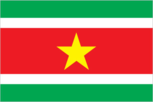
description: five horizontal bands of green (top, double-width), white, red (quadruple-width), white, and green (double-width); a five-pointed yellow star is centered on the red band meaning: red stands for progress and love, green for hope and fertility, and white for peace, justice, and freedom; the star represents the unity of ethnic groups
Government type
presidential republic
Independence
25 November 1975 (from the Netherlands)
International law organization participation
accepts compulsory ICJ jurisdiction with reservations; accepts ICCt jurisdiction
International organization participation
ACP, ACS, AOSIS, Caricom, CD, CDB, CELAC, FAO, G-77, IADB, IBRD, ICAO, ICCt, ICRM, IDA, IDB, IFAD, IFC, IFRCS, IHO, ILO, IMF, IMO, Interpol, IOC, IOM, IPU, ISO (correspondent), ITU, ITUC (NGOs), LAES, MIGA, NAM, OAS, OIC, OPANAL, OPCW, PCA, Petrocaribe, UN, UNASUR, UNCTAD, UNESCO, UNIDO, UPU, WHO, WIPO, WMO, WTO
Judicial branch
- highest court(s)
- High Court of Justice of Suriname (consists of the court president, vice president, and 4 judges)
- judge selection and term of office
- court judges appointed by the national president in consultation with the National Assembly, the State Advisory Council, and the Order of Private Attorneys; judges serve for life
- subordinate courts
- cantonal courts
Legal system
civil law system influenced by Dutch civil law
Legislative branch
- electoral system
- proportional representation
- expected date of next election
- May 2030
- legislative structure
- unicameral
- legislature name
- National Assembly (Nationale Assemblee)
- most recent election date
- 5/25/2025
- number of seats
- 51 (all directly elected)
- parties elected and seats per party
- National Democratic Party (NDP) (18); Progressive Reform Party (VHP) (17); National Party of Suriname (NPS) (6); General Liberation and Development Party (ABOP) (6); Other (4)
- percentage of women in chamber
- 31.4%
- scope of elections
- full renewal
- term in office
- 5 years
National anthem(s)
- history
- adopted 1959; originally adapted from a Sunday-school song written in 1893; contains lyrics in both Dutch and Sranang Tongo
- lyrics/music
- Cornelis Atses HOEKSTRA and Henry DE ZIEL/Johannes Corstianus DE PUY
- title
- "God zij met ons Suriname!" (God Be With Our Suriname)
National color(s)
green, white, red, yellow
National heritage
- selected World Heritage Site locales
- Central Suriname Nature Reserve (n); Historic Inner City of Paramaribo (c); Jodensavanne Archaeological Site: Jodensavanne Settlement and Cassipora Creek Cemetery (c)
- total World Heritage Sites
- 3 (2 cultural, 1 natural)
National holiday
Independence Day, 25 November (1975)
National symbol(s)
royal palm, faya lobi (flower)
Political parties
Brotherhood and Unity in Politics or BEP Democratic Alternative '91 or DA91 General Liberation and Development Party or ABOP National Democratic Party or NDP National Party of Suriname or NPS Party for Democracy and Development in Unity or DOE Party for National Unity and Solidarity or KTPI People's Alliance (Pertjajah Luhur) or PL Progressive Workers' and Farmers' Union or PALU Progressive Reform Party or VHP Reform and Renewal Movement or HVB Surinamese Labor Party or SPA
Suffrage
18 years of age; universal
Economy
Agricultural products
rice, sugarcane, oranges, vegetables, chicken, cassava, plantains, pineapples, eggs, citrus fruits (2023)
Budget
- expenditures
- $1.648 billion (2019 est.)
- revenues
- $863 million (2019 est.)
Current account balance
- Current account balance 2022
- $76.321 million (2022 est.)
- Current account balance 2023
- $148.118 million (2023 est.)
- Current account balance 2024
- $9.306 million (2024 est.)
Debt - external
- Debt - external 2023
- $2.645 billion (2023 est.)
Economic overview
upper middle-income South American economy; new floating currency regime; key aluminum goods, gold, and hydrocarbon exporter; new IMF plan for economic recovery and fiscal sustainability; controversial hardwood industry
Exchange rates
- Currency
- Surinamese dollars (SRD) per US dollar -
- Exchange rates 2020
- 9.31 (2020 est.)
- Exchange rates 2021
- 18.239 (2021 est.)
- Exchange rates 2022
- 24.709 (2022 est.)
- Exchange rates 2023
- 36.776 (2023 est.)
- Exchange rates 2024
- 33.181 (2024 est.)
Exports
- Exports 2022
- $2.6 billion (2022 est.)
- Exports 2023
- $2.533 billion (2023 est.)
- Exports 2024
- $2.793 billion (2024 est.)
Exports - commodities
gold, fish, refined petroleum, wood, tobacco (2023)
Exports - partners
Switzerland 49%, UAE 28%, Guyana 5%, USA 4%, France 3% (2023)
GDP - composition, by sector of origin
- agriculture
- 7.5% (2023 est.)
- industry
- 39.9% (2023 est.)
- services
- 48.3% (2023 est.)
GDP (official exchange rate)
$4.714 billion (2024 est.)
Gini Index coefficient - distribution of family income
- Gini Index coefficient - distribution of family income 2022
- 39.2 (2022 est.)
Household income or consumption by percentage share
- highest 10%
- 30.1% (2022 est.)
- lowest 10%
- 2.2% (2022 est.)
Imports
- Imports 2022
- $2.342 billion (2022 est.)
- Imports 2023
- $2.203 billion (2023 est.)
- Imports 2024
- $2.571 billion (2024 est.)
Imports - commodities
refined petroleum, ships, excavation machinery, trucks, tobacco (2023)
Imports - partners
USA 22%, China 12%, Netherlands 11%, Trinidad & Tobago 9%, Guyana 8% (2023)
Industrial production growth rate
2.1% (2023 est.)
Industries
gold mining, oil, lumber, food processing, fishing
Inflation rate (consumer prices)
- Inflation rate (consumer prices) 2022
- 52.4% (2022 est.)
- Inflation rate (consumer prices) 2023
- 51.6% (2023 est.)
- Inflation rate (consumer prices) 2024
- 16.2% (2024 est.)
Labor force
255,500 (2024 est.)
Public debt
- Public debt 2016
- 75.8% of GDP (2016 est.)
Real GDP (purchasing power parity)
- Real GDP (purchasing power parity) 2022
- $11.68 billion (2022 est.)
- Real GDP (purchasing power parity) 2023
- $11.976 billion (2023 est.)
- Real GDP (purchasing power parity) 2024
- $12.316 billion (2024 est.)
Real GDP growth rate
- Real GDP growth rate 2022
- 2.4% (2022 est.)
- Real GDP growth rate 2023
- 2.5% (2023 est.)
- Real GDP growth rate 2024
- 2.8% (2024 est.)
Real GDP per capita
- Real GDP per capita 2022
- $18,700 (2022 est.)
- Real GDP per capita 2023
- $19,000 (2023 est.)
- Real GDP per capita 2024
- $19,400 (2024 est.)
Remittances
- Remittances 2022
- 3.9% of GDP (2022 est.)
- Remittances 2023
- 4.3% of GDP (2023 est.)
- Remittances 2024
- 3.4% of GDP (2024 est.)
Reserves of foreign exchange and gold
- Reserves of foreign exchange and gold 2022
- $1.195 billion (2022 est.)
- Reserves of foreign exchange and gold 2023
- $1.346 billion (2023 est.)
- Reserves of foreign exchange and gold 2024
- $1.632 billion (2024 est.)
Unemployment rate
- Unemployment rate 2022
- 8.2% (2022 est.)
- Unemployment rate 2023
- 7.7% (2023 est.)
- Unemployment rate 2024
- 7.4% (2024 est.)
Youth unemployment rate (ages 15-24)
- female
- 35.9% (2024 est.)
- male
- 16.9% (2024 est.)
- total
- 24.2% (2024 est.)
Energy
Coal
- imports
- 2 metric tons (2023 est.)
Electricity
- consumption
- 1.896 billion kWh (2023 est.)
- installed generating capacity
- 537,000 kW (2023 est.)
- transmission/distribution losses
- 245.206 million kWh (2023 est.)
Electricity access
- electrification - rural areas
- 98%
- electrification - total population
- 99% (2022 est.)
- electrification - urban areas
- 100%
Electricity generation sources
- biomass and waste
- 0.3% of total installed capacity (2023 est.)
- fossil fuels
- 57.1% of total installed capacity (2023 est.)
- hydroelectricity
- 42% of total installed capacity (2023 est.)
- solar
- 0.6% of total installed capacity (2023 est.)
Energy consumption per capita
- Total energy consumption per capita 2023
- 60.896 million Btu/person (2023 est.)
Natural gas
- consumption
- 6.967 million cubic meters (2023 est.)
- production
- 7.173 million cubic meters (2023 est.)
Petroleum
- crude oil estimated reserves
- 89 million barrels (2021 est.)
- refined petroleum consumption
- 17,000 bbl/day (2023 est.)
- total petroleum production
- 14,000 bbl/day (2023 est.)
Communications
Broadband - fixed subscriptions
- subscriptions per 100 inhabitants
- 20 (2022 est.)
- total
- 125,000 (2022 est.)
Broadcast media
2 state-owned TV stations; 1 state-owned radio station; multiple private radio and TV stations (2019)
Internet country code
.sr
Internet users
- percent of population
- 78% (2023 est.)
Telephones - fixed lines
- subscriptions per 100 inhabitants
- 20 (2023 est.)
- total subscriptions
- 129,000 (2023 est.)
Telephones - mobile cellular
- subscriptions per 100 inhabitants
- 142 (2024 est.)
- total subscriptions
- 902,000 (2024 est.)
Transportation
Airports
55 (2025)
Civil aircraft registration country code prefix
PZ
Heliports
1 (2025)
Merchant marine
- by type
- general cargo 5, oil tanker 3, other 5
- total
- 13 (2023)
Ports
- key ports
- Moengo, Nieuw Nickerie, Paramaribo, Paranam
- large
- 0
- medium
- 0
- ports with oil terminals
- 3
- small
- 1
- total ports
- 4 (2024)
- very small
- 3
Military and Security
Military - note
the National Leger is responsible for defending the sovereignty and territorial integrity of Suriname against foreign aggression; other special tasks include border control and supporting domestic security as required; the military police, for example, have direct responsibility for immigration control at the country’s ports of entry, and the military assists the police in combating crime, particularly narco-trafficking, including joint military and police patrols, as well as joint special security teams; in addition, the military provides aid and assistance during times of natural emergencies and participates in socio-economic development projects (2025)
Military and security forces
Suriname National Army (Nationaal Leger or NL); Army (Landmacht), Navy (Marine); Air Force (Luchtmacht), Military Police (Korps Militaire Politie) Ministry of Justice and Police: Suriname Police Force (Korps Politie Suriname or KPS) (2026)
Military and security service personnel strengths
approximately 2,000 National Army (2025)
Military equipment inventories and acquisitions
the Suriname Army has a limited inventory of older or secondhand armaments originating from such suppliers as Brazil, France, the Netherlands, and India (2025)
Military expenditures
- Military Expenditures 2015
- 1.4% of GDP (2015 est.)
- Military Expenditures 2016
- 1.2% of GDP (2016 est.)
- Military Expenditures 2017
- 1.1% of GDP (2017 est.)
- Military Expenditures 2018
- 1.1% of GDP (2018 est.)
- Military Expenditures 2019
- 1.2% of GDP (2019 est.)
Military service age and obligation
18-28 years of age for voluntary military service for men and women; no conscription (2025)
Transnational Issues
Refugees and internally displaced persons
- refugees
- 3,241 (2024 est.)
Environment
Carbon dioxide emissions
- from consumed natural gas
- 14,000 metric tonnes of CO2 (2023 est.)
- from petroleum and other liquids
- 2.507 million metric tonnes of CO2 (2023 est.)
- total emissions
- 2.521 million metric tonnes of CO2 (2023 est.)
Environmental issues
deforestation; pollution of inland waterways from small-scale mining activities
International environmental agreements
- party to
- Biodiversity, Climate Change, Climate Change-Kyoto Protocol, Climate Change-Paris Agreement, Comprehensive Nuclear Test Ban, Desertification, Endangered Species, Hazardous Wastes, Law of the Sea, Marine Dumping-London Convention, Marine Dumping-London Protocol, Nuclear Test Ban, Ozone Layer Protection, Ship Pollution, Tropical Timber 2006, Wetlands, Whaling
- signed, but not ratified
- none of the selected agreements
Particulate matter emissions
12.2 micrograms per cubic meter (2019 est.)
Total renewable water resources
99 billion cubic meters (2022 est.)
Total water withdrawal
- agricultural
- 431.1 million cubic meters (2022 est.)
- industrial
- 135.5 million cubic meters (2022 est.)
- municipal
- 49.3 million cubic meters (2022 est.)
Waste and recycling
- municipal solid waste generated annually
- 78,600 tons (2024 est.)
- percent of municipal solid waste recycled
- 16.9% (2022 est.)