1989 Edition
CIA World Factbook 1989 (Internet Archive)
Geography
Climate
- tropical
- tropical; monsoonal; northeast monsoon (December to March); southwest monsoon (June to October)
Coastline
- 926 km
- 1,340 km
Comparative area
- undetermined
- slightly larger than West Virginia
Contiguous zone
24 nm
Continental shelf
edge of continental margin or 200 nm
Disputes
China, Malaysia, the Philippines, Taiwan, and Vietnam claim all or part of the Spratly Islands
Environment
- subject to typhoons; includes numerous small islands, atolls, shoals, and coral reefs
- occasional cyclones, tornados; deforestation; soil erosion
Extended economic zone
200 nm
Land boundaries
- none
- none
Land use
- 0% arable land; 0% permanent crops; 0% meadows and pastures; 0% forest and woodland; 100% other
- 1 6% arable land; 1 7% permanent crops; 7% meadows and pastures; 37% forest and woodland; 23% other; includes 8% irrigated
Maritime claims
undetermined
Natural resources
- fish, guano; oil and natural gas potential
- limestone, graphite, mineral sands, gems, phosphates, clay
Note
- strategically located near several primary shipping lanes in the central South China Sea; serious navigational hazard
- only 29 km from India across the Palk Strait; near major Indian Ocean sea lanes
Terrain
- flat
- mostly low, flat to rolling plain; mountains in south-central interior
Territorial sea
1 2 nm
Total area
- less than 5 km2; land area: less than 5 km2; includes 100 or so islets, coral reefs, and sea mounts scattered over the South China Sea
- 65,610 km2; land area: 64,740 km2
Total area
100km South China Sea ^Northeast Cay ' ^ Southwest Cay, est or Thitu Island . , i Island * -Lankiam Cay Ffal ' Loaita'lsland Island-, ItuAoa Island.'??"" Cay Nh », • Namyit Island ' ' IXSin Cowe Island J . ' 'fiery Cross Keel - Spratly Island * Allison fleet •Amboyna Cay
People and Society
Birth rate
21 births/ 1,000 population (1990)
Death rate
6 deaths/ 1 ,000 population (1990)
Ethnic divisions
74% Sinhalese; 18% Tamil; 7% Moor; 1% Burgher, Malay, and Veddha
Infant mortality rate
3 1 deaths/ 1 ,000 live births (1990)
Labor force
6,600,000; 45.9% agriculture, 13.3% mining and manufacturing, 12.4% trade and transport, 28.4% services and other (1985 est.)
Language
Sinhala (official); Sinhala and Tamil listed as national languages; Sinhala spoken by about 74% of population, Tamil spoken by about 1 8%; English commonly used in government and spoken by about 10% of the population
Life expectancy at birth
68 years male, 72 years female (1990)
Literacy
87%
Nationality
noun — Sri Lankan(s); adjective— Sri Lankan
Net migration rate
NEGL migrants/ 1,000 population (1990)
Organized labor
about 33% of labor force, over 50% of which are employed on tea, rubber, and coconut estates
Population
- no permanent inhabitants; garrisons
- 17,196,436 (July 1990), growth rate 1.5% (1990)
Religion
69% Buddhist, 1 5% Hindu, 8% Christian, 8% Muslim
Total fertility rate
2.3 children born/ woman (1990) Sri Lanka (continued)
Government
Administrative divisions
24 districts; Amparai, Anuradhapura, Badulla, Batticaloa, Colombo, Galle, Gampaha, Hambantota, Jaffna, Kalutara, Kandy, Kegalla, Kurunegala, Mannar, Matale, Matara, Moneragala, Mullativu, Nuwara Eliya, Polonnaruwa, Puttalam, Ratnapura, Trincomalee, Vavuniya; note — the administrative structure may now include 8 provinces (Central, North Central, North Eastern, North Western, Sabaragamuwa, Southern, Uva, and Western) and 25 districts (with Kilinochchi added to the existing districts)
Capital
Colombo
Constitution
31 August 1978
Diplomatic representation
Ambassador W. Susanta De ALWIS; Chancery at 2148 Wyoming Avenue NW, Washington DC 20008; telephone (202) 483-4025 through 4028; there is a Sri Lankan Consulate in New York; US — Ambassador Marion V. CREEKMORE; Embassy at 210 Galle Road, Colombo 3 (mailing address is P. O. Box 106, Colombo); telephone [94] (1) 548007
Elections
President — last held 19 December 1988 (next to be held December 1994); results — Ranasinghe Premadasa (UNP) 50%, Sirimavo Bandaranaike (SLFP) 45%, others 5%; Parliament— last held 15 February 1989 (next to be held by February 1995); results— percent of vote by party NA; seats— (225 total) UNP 125, SLFP 67, others 33
Executive branch
president, prime minister. Cabinet
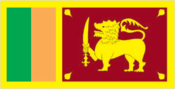
Flag
yellow with two panels; the smaller hoist-side panel has two equal vertical bands of green (hoist side) and orange; the other panel is a large dark red rectangle with a yellow lion holding a sword and there is a yellow bo leaf in each corner; the yellow field appears as a border that goes around the entire flag and extends between the two panels
Independence
4 February 1948 (from UK; formerly Ceylon)
Judicial branch
Supreme Court
Leaders
Chief of State — President Ranasinghe PREMADASA (since 2 January 1989); Head of Government — Prime Minister Dingiri Banda WIJETUNGE (since 6 March 1989) Political parties and leaders: United National Party (UNP), Ranasinghe Premadasa; Sri Lanka Freedom Party (SLFP), Sirimavo Bandaranaike; Sri Lanka Muslim Congress (SLMC), Mhm. Ashraff; All Ceylon Tamil Congress (ACTC), Kumar Ponnambalam; Mahajana Eksath Peramuna (MEP, or People's United Front), Dinesh Gundawardene; Sri Lanka Mahajana Party (SLMP, or Sri Lanka People's Party), Chandrika Baudaranaike Kumaranatunga; Lanka Sama Samaja Party (LSSP, Lanka Socialist Party/Trotskyite), Colin R. de Silva; Nava Sama Samaja Party (NSSP, or New Socialist Party), Vasudeva Nanayakkara; Tamil United Liberation Front (TULF), leader NA; Communist Party/Moscow (CP/M), K. P. Silva; Communist Party/Beijing (CP/B), N. Shanmugathasan
Legal system
a highly complex mixture of English common law, Roman-Dutch, Muslim, and customary law; has not accepted compulsory ICJ jurisdiction
Legislative branch
unicameral Parliament
Long-form name
- none
- Democratic Socialist Republic of Sri Lanka
Member of
ADB, ANRPC, CCC, Colombo Plan, Commonwealth, ESCAP, FAO, G-77, GATT, IAEA, IBRD, ICAO, IDA, IFAD, IFC, ILO, IMF, IMO, INTELSAT, INTERPOL, IPU, IRC, ITU, NAM, SAARC, UN, UNESCO, UPU, WFTU, WHO, WIPO, WMO, WTO
National holiday
Independence and National Day, 4 February (1948)
Other political or pressure groups
Liberation Tigers of Tamil Eelam (LTTE) and other smaller Tamil separatist groups; Janatha Vimukthi Peramuna (JVP or People's Liberation Front); Buddhist clergy; Sinhalese Buddhist lay groups; labor unions
Suffrage
universal at age 18
Type
republic
Economy
Agriculture
accounts for 25% of GDP and nearly half of labor force; most important staple crop is paddy rice; other field crops — sugarcane, grains, pulses, oilseeds, roots, spices; cash crops — tea, rubber, coconuts; animal products — milk, eggs, hides, meat; not self-sufficient in rice production
Aid
US commitments, including Ex-Im (FY70-88), $932 million; Western (nonUS) countries, ODA and OOF bilateral commitments (1980-87), $4.3 billion; OPEC bilateral aid (1979-89), $169 million; Communist countries (1970-88), $369 million
Budget
revenues $1.5 billion; expenditures $2.3 billion, including capital expenditures of $0.7 billion (1989)
Currency
Sri Lankan rupee (plural — rupees); 1 Sri Lankan rupee (SLRe) = 100 cents
Electricity
1 ,300,000 kW capacity; 4,200 million kWh produced, 250 kWh per capita (1 989)
Exchange rates
Sri Lankan rupees (SLRs) per US$1— 40.000 (January 1990), 36.047 (1989), 31.807 (1988), 29.445 (1987), 28.017(1986), 27.163(1985) Fiscal yean calendar year
Exports
$1.5 billion (f.o.b., 1988); commodities— tea, textiles and garments, petroleum products, coconut, rubber, agricultural products, gems and jewelry, marine products; partners — US 26%, Egypt, Iraq, UK, FRG, Singapore, Japan
External debt
$5.6 billion (1989)
GDP
$6.1 billion, per capita $370; real growth rate 2.7% (1988)
Imports
$2.3 billion (c.i.f., 1988); commodities— petroleum, machinery and equipment, textiles and textile materials, wheat, transportation equipment, electrical machinery, sugar, rice; partners — Japan, Saudi Arabia, US 5.6%, India, Singapore, FRG, UK, Iran
Industrial production
growth rate 5% (1988)
Industries
- some guano mining
- processing of rubber, tea, coconuts, and other agricultural commodities; cement, petroleum refining, textiles, tobacco, clothing
Inflation rate (consumer prices)
1 5% (1988)
Overview
- Economic activity is limited to commercial fishing and phosphate mining. Geological surveys carried out several years ago suggest that substantial reserves of oil and natural gas may lie beneath the islands; commercial exploitation has yet to be developed.
- Agriculture, forestry, and fishing dominate the economy, employing about half of the labor force and accounting for about 25% of GDP. The plantation crops of tea, rubber, and coconuts provide about 50% of export earnings and almost 20% of budgetary revenues. The economy has been plagued by high rates of unemployment since the late 1970s.
Unemployment rate
20% (1988 est.)
Communications
Airports
3 total, 2 usable; none with runways over 2,439 m; 1 with runways 1,2202,439 m
Note
approximately 50 small islands or reefs are occupied by China, Malaysia, the Philippines, Taiwan, and Vietnam Jaffna Ste region.! map V
Ports
none; offshore anchorage only Defense Forces