2005 Edition
CIA World Factbook 2005 (Project Gutenberg)
Introduction
Administrative divisions
9 provinces (do, singular and plural) and 7 metropolitan cities (gwangyoksi, singular and plural) : provinces: Cheju-do, Cholla-bukto (North Cholla), Cholla-namdo (South Cholla), Ch'ungch'ong-bukto (North Ch'ungch'ong), Ch'ungch'ong-namdo (South Ch'ungch'ong), Kangwon-do, Kyonggi-do, Kyongsang-bukto (North Kyongsang), Kyongsang-namdo (South Kyongsang) : metropolitan cities: Inch'on-gwangyoksi (Inch'on), Kwangju-gwangyoksi (Kwangju), Pusan-gwangyoksi (Pusan), Soul-t'ukpyolsi (Seoul), Taegu-gwangyoksi (Taegu), Taejon-gwangyoksi (Taejon), Ulsan-gwangyoksi (Ulsan)
Age structure
0-14 years: 19.4% (male 4,952,177/female 4,450,821) 15-64 years: 72% (male 17,715,267/female 17,147,808) 65 years and over: 8.6% (male 1,670,971/female 2,485,600) (2005 est.)
Agriculture - products
rice, root crops, barley, vegetables, fruit; cattle, pigs, chickens, milk, eggs; fish
Airports
179 (2004 est.)
Airports - with paved runways
- total
- 88 over 3,047 m: 3 2,438 to 3,047 m: 21 1,524 to 2,437 m: 14 914 to 1,523 m: 12 under 914 m: 38 (2004 est.)
Airports - with unpaved runways
- total
- 91 914 to 1,523 m: 3 under 914 m: 88 (2004 est.)
Area
- land
- 98,190 sq km
- total
- 98,480 sq km
- water
- 290 sq km
Area - comparative
slightly larger than Indiana
Background
Korea was an independent kingdom under Chinese suzerainty for most of the past millennium. Following its victory in the Russo-Japanese War in 1905, Japan occupied Korea; five years later it formally annexed the entire peninsula. After World War II, a republic was set up in the southern half of the Korean Peninsula while a Communist-style government was installed in the north. During the Korean War (1950-53), US and other UN forces intervened to defend South Korea from North Korean attacks supported by the Chinese. An armistice was signed in 1953, splitting the peninsula along a demilitarized zone at about the 38th parallel. Thereafter, South Korea achieved rapid economic growth with per capita income rising to roughly 14 times the level of North Korea. In 1987, South Korean voters elected ROH Tae-woo to the presidency, ending 26 years of military dictatorships. South Korea today is a fully functioning modern democracy. In June 2000, a historic first North-South summit took place between the South's President KIM Tae-chung and the North's leader KIM Jong Il. Geography Korea, South
Birth rate
10.08 births/1,000 population (2005 est.)
Budget
- expenditures
- $155.8 billion, including capital expenditures of NA (2004 est.)
- revenues
- $150.5 billion
Capital
Seoul
Climate
temperate, with rainfall heavier in summer than winter
Coastline
2,413 km
Constitution
17 July 1948
Country name
- abbreviation
- ROK
- conventional long form
- Republic of Korea
- conventional short form
- South Korea
- local long form
- Taehan-min'guk
- local short form
- none note: the South Koreans generally use the term "Han'guk" to refer to their country
Currency (code)
South Korean won (KRW)
Currency code
KRW
Current account balance
$26.78 billion (2004 est.)
Death rate
6.26 deaths/1,000 population (2005 est.)
Debt - external
$160 billion (2004 est.)
Diplomatic representation from the US
- chief of mission
- Ambassador Christopher R. HILL
- embassy
- 82 Sejong-no, Jongno-gu, Seoul 110-710
- FAX
- [82] (2) 738-8845
- mailing address
- American Embassy, Unit 15550, APO AP 96205-5550
- telephone
- [82] (2) 397-4114
Diplomatic representation in the US
- chancery
- 2450 Massachusetts Avenue NW, Washington, DC 20008
- chief of mission
- Ambassador Lee Tae-sik (designated)
- consulate(s)
- Agana (Guam) and New York
- consulate(s) general
- Atlanta, Boston, Chicago, Honolulu, Houston, Los Angeles, New York, San Francisco, and Seattle
- FAX
- [1] (202) 387-0205
- telephone
- [1] (202) 939-5600
Disputes - international
Military Demarcation Line within the 4-km wide Demilitarized Zone has separated North from South Korea since 1953; periodic maritime disputes with North Korea over the Northern Limit Line; South Korea and Japan claim Liancourt Rocks (Tok-do/Take-shima), occupied by South Korea since 1954 This page was last updated on 20 October, 2005 ======================================================================
Distribution of family income - Gini index
35.8 (2000)
Economic aid - donor
ODA $334 million (2003)
Economy - overview
Since the early 1960s, South Korea has achieved an incredible record of growth and integration into the high-tech modern world economy. Four decades ago GDP per capita was comparable with levels in the poorer countries of Africa and Asia. In 2004, it joined the trillion dollar club of world economies. Today its GDP per capita is 14 times North Korea's and equal to the lesser economies of the European Union. This success through the late 1980s was achieved by a system of close government/business ties, including directed credit, import restrictions, sponsorship of specific industries, and a strong labor effort. The government promoted the import of raw materials and technology at the expense of consumer goods and encouraged savings and investment over consumption. The Asian financial crisis of 1997-99 exposed longstanding weaknesses in South Korea's development model, including high debt/equity ratios, massive foreign borrowing, and an undisciplined financial sector. Growth plunged to a negative 6.9% in 1998, then strongly recovered to 9.5% in 1999 and 8.5% in 2000. Growth fell back to 3.3% in 2001 because of the slowing global economy, falling exports, and the perception that much-needed corporate and financial reforms had stalled. Led by consumer spending and exports, growth in 2002 was an impressive 7.0%, despite anemic global growth. Economic growth fell to 3.1% in 2003 because of a downturn in consumer spending and recovered to an estimated 4.6% in 2004 on the strength of rapid export growth. The government plans to boost infrastructure spending in 2005. Moderate inflation, low unemployment, an export surplus, and fairly equal distribution of income characterize this solid economy.
Electricity - consumption
293.6 billion kWh (2003)
Electricity - exports
0 kWh (2003)
Electricity - imports
0 kWh (2003)
Electricity - production
322.5 billion kWh (2003)
Electricity - production by source
- fossil fuel
- 62.4%
- hydro
- 0.8%
- nuclear
- 36.6%
- other
- 0.2% (2001)
Elevation extremes
- highest point
- Halla-san 1,950 m
- lowest point
- Sea of Japan 0 m
Environment - current issues
air pollution in large cities; acid rain; water pollution from the discharge of sewage and industrial effluents; drift net fishing
Environment - international agreements
- party to
- Antarctic-Environmental Protocol, Antarctic-Marine Living Resources, Antarctic Treaty, Biodiversity, Climate Change, Climate Change-Kyoto Protocol, Desertification, Endangered Species, Environmental Modification, Hazardous Wastes, Law of the Sea, Marine Dumping, Ozone Layer Protection, Ship Pollution, Tropical Timber 83, Tropical Timber 94, Wetlands, Whaling signed, but not ratified: none of the selected agreements
Ethnic groups
homogeneous (except for about 20,000 Chinese)
Exchange rates
South Korean won per US dollar - 1,145.3 (2004), 1,191.6 (2003), 1,251.1 (2002), 1,291 (2001), 1,131 (2000)
Executive branch
- cabinet
- State Council appointed by the president on the prime minister's recommendation
- chief of state
- President ROH Moo-hyun (since 25 February 2003)
- election results
- results of the 19 December 2002 election - ROH Moo-hyun elected president; percent of vote - ROH Moo-hyun (MDP) 48.9%; LEE Hoi-chang (GNP) 46.6%; other 4.5%
- elections
- president elected by popular vote for single five-year term; election last held 19 December 2002 (next to be held in February 2008); prime minister appointed by president with consent of National Assembly; deputy prime ministers appointed by president on prime minister's recommendation
- head of government
- Prime Minister LEE Hae-chan (since 25 May 2004); Deputy Prime Ministers HAN Duck-soo (14 March 2005), KIM Jin-pyo (since 28 January 2005), and OH Myung (since 18 October 2004)
Exports
$250.6 billion f.o.b. (2004 est.)
Exports - commodities
semiconductors, wireless telecommunications equipment, motor vehicles, computers, steel, ships, petrochemicals
Exports - partners
China 19.7%, US 17%, Japan 8.6%, Hong Kong 7.2% (2004)
Fiscal year
calendar year Communications Korea, South
Flag description
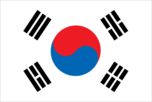
white with a red (top) and blue yin-yang symbol in the center; there is a different black trigram from the ancient I Ching (Book of Changes) in each corner of the white field Economy Korea, South
GDP - composition by sector
- agriculture
- 3.2%
- industry
- 40.4%
- services
- 56.3% (2004 est.)
GDP - per capita
purchasing power parity - $19,200 (2004 est.)
GDP - real growth rate
4.6% (2004 est.)
GDP (purchasing power parity)
$925.1 billion (2004 est.)
Geographic coordinates
37 00 N, 127 30 E
Geography - note
strategic location on Korea Strait People Korea, South
Government type
republic
Heliports
206 (2004 est.) Military Korea, South
Highways
- paved
- 66,721 km (including 1,996 km of expressways)
- total
- 86,990 km
- unpaved
- 20,269 km (2001)
HIV/AIDS - adult prevalence rate
less than 0.1% (2003 est.)
HIV/AIDS - deaths
less than 200 (2003 est.)
HIV/AIDS - people living with HIV/AIDS
8,300 (2003 est.)
Household income or consumption by percentage share
lowest 10%: 2.9% highest 10%: 22.5% (1999 est.)
Imports
$214.2 billion f.o.b. (2004 est.)
Imports - commodities
machinery, electronics and electronic equipment, oil, steel, transport equipment, organic chemicals, plastics
Imports - partners
Japan 20.6%, China 13.2%, US 12.9%, Saudi Arabia 5.3% (2004)
Independence
15 August 1945 (from Japan)
Industrial production growth rate
10.1% (2004 est.)
Industries
electronics, telecommunications, automobile production, chemicals, shipbuilding, steel
Infant mortality rate
- female
- 6.57 deaths/1,000 live births (2005 est.)
- male
- 7.5 deaths/1,000 live births
- total
- 7.05 deaths/1,000 live births
Inflation rate (consumer prices)
3.6% (2004 est.)
International organization participation
AfDB, APEC, APT, ARF, AsDB, ASEAN (dialogue partner), Australia Group, BIS, CP, EBRD, FAO, IAEA, IBRD, ICAO, ICC, ICCt, ICFTU, ICRM, IDA, IEA, IFAD, IFC, IFRCS, IHO, ILO, IMF, IMO, Interpol, IOC, IOM, ISO, ITU, LAIA, MIGA, MINURSO, NAM (guest), NEA, NSG, OAS (observer), OECD, ONUB, OPCW, OSCE (partner), PCA, UN, UNCTAD, UNESCO, UNIDO, UNMIL, UNMOGIP, UNOMIG, UPU, WCL, WCO, WHO, WIPO, WMO, WToO, WTO, ZC
Internet country code
.kr
Internet hosts
694,206 (2001)
Internet Service Providers (ISPs)
11 (2000)
Internet users
29.22 million (2003) Transportation Korea, South
Investment (gross fixed)
28.7% of GDP (2004 est.)
Irrigated land
11,590 sq km (1998 est.)
Judicial branch
Supreme Court (justices appointed by president with consent of National Assembly); Constitutional Court (justices appointed by president based partly on nominations by National Assembly and Chief Justice of the court)
Labor force
22.9 million (2004 est.)
Labor force - by occupation
agriculture 8%, industry 19%, services 73% (2004 est.)
Land boundaries
- border countries
- North Korea 238 km
- total
- 238 km
Land use
- arable land
- 17.18%
- other
- 80.87% (2001)
- permanent crops
- 1.95%
Languages
Korean, English widely taught in junior high and high school
Legal system
combines elements of continental European civil law systems, Anglo-American law, and Chinese classical thought
Legislative branch
- unicameral National Assembly or Kukhoe (299 seats - members elected for four-year terms; 243 in single-seat constituencies, 56 by proportional representation
- election results
- percent of vote by party - Uri 51%, GNP 41%, DLP 3%, DP 3%, others 2%; seats by party - Uri 146, GNP 125, DLP 10, DP 9, ULD 3, independents 6 note: percent of vote is for 2004 general election; seats by party reflect results of 2005 byelections involving six seats; MDP became DP in May 2005 (2005)
- elections
- last held 15 April 2004 (next to be held in April 2008; byelections held on 30 April 2005)
Life expectancy at birth
- female
- 80.57 years (2005 est.)
- male
- 73.42 years
- total population
- 76.85 years
Literacy
- definition: age 15 and over can read and write
- female
- 96.6% (2002) Government Korea, South
- male
- 99.2%
- total population
- 97.9%
Location
Eastern Asia, southern half of the Korean Peninsula bordering the Sea of Japan and the Yellow Sea
Manpower available for military service
males age 20-49: 12,458,257 (2005 est.)
Manpower fit for military service
males age 20-49: 9,932,026 (2005 est.)
Manpower reaching military service age annually
- males
- 344,723 (2005 est.)
Map references
Asia
Maritime claims
- contiguous zone
- 24 nm
- continental shelf
- not specified
- exclusive economic zone
- 200 nm
- territorial sea
- 12 nm; between 3 nm and 12 nm in the Korea Strait
Median age
- female
- 35.53 years (2005 est.)
- male
- 33.53 years
- total
- 34.51 years
Merchant marine
- by type
- bulk carrier 125, cargo 196, chemical tanker 88, container 71, liquefied gas 20, passenger 5, passenger/cargo 22, petroleum tanker 51, refrigerated cargo 15, roll on/roll off 5, vehicle carrier 3
- foreign-owned
- 2 (Germany 1, United Kingdom 1)
- registered in other countries
- 366 (2005)
- total
- 601 ships (1,000 GRT or over) 6,992,656 GRT/11,081,142 DWT
Military branches
Army, Navy, Air Force, Marine Corps, National Maritime Police (Coast Guard)
Military expenditures - dollar figure
$16.18 billion (2004)
Military expenditures - percent of GDP
2.8% (2004) Transnational Issues Korea, South
Military service age and obligation
20-30 years of age for compulsory military service; conscript service obligation - 24-28 months, depending on the military branch involved; 18 years of age for voluntary military service; some 4,000 women serve as commissioned and noncommissioned officers, approx. 2.3% of all officers; women, in service since 1950, are admitted to seven service branches, including infantry; excluded from artillery, armor, anti-air, and chaplaincy corps (2005)
National holiday
Liberation Day, 15 August (1945)
Nationality
- adjective
- Korean
- noun
- Korean(s)
Natural gas - consumption
20.92 billion cu m (2003 est.)
Natural gas - exports
0 cu m (2003 est.)
Natural gas - imports
21.11 billion cu m (2003 est.)
Natural gas - production
0 cu m (2003 est.)
Natural hazards
occasional typhoons bring high winds and floods; low-level seismic activity common in southwest
Natural resources
coal, tungsten, graphite, molybdenum, lead, hydropower potential
Net migration rate
0 migrant(s)/1,000 population (2005 est.)
Oil - consumption
2.07 million bbl/day (2004 est.)
Oil - exports
630,100 bbl/day (2003)
Oil - imports
2.263 million bbl/day (2003)
Oil - production
0 bbl/day (2004 est.)
Pipelines
gas 1,433 km; refined products 827 km (2004)
Political parties and leaders
Democratic Labor Party or DLP [KIM Hye-kyung, chairwoman]; Democratic Party or DP [HAHN Hwa-kap, chairman]; Grand National Party or GNP [PARK Geun-hye, chairwoman]; United Liberal Democrats or ULD [KIM Hak-won, chairman]; Uri Party [MOON Hee-sang, chairman]
Political pressure groups and leaders
Federation of Korean Industries; Federation of Korean Trade Unions; Korean Confederation of Trade Unions; Korean National Council of Churches; Korean Traders Association; Korean Veterans' Association; National Council of Labor Unions; National Democratic Alliance of Korea; National Federation of Farmers' Associations; National Federation of Student Associations
Population
48,422,644 (July 2005 est.)
Population below poverty line
4% (2001 est.)
Population growth rate
0.38% (2005 est.)
Ports and harbors
Inch'on, Masan, P'ohang, Pusan, Ulsan
Public debt
21.3% of GDP (2004 est.)
Radio broadcast stations
AM 58, FM 150, shortwave 2 (2004)
Radios
47.5 million (2000)
Railways
- standard gauge
- 3,472 km 1.435-m gauge (1,342 km electrified) (2004)
- total
- 3,472 km
Religions
no affiliation 46%, Christian 26%, Buddhist 26%, Confucianist 1%, other 1%
Reserves of foreign exchange and gold
$199.1 billion (2004 est.)
Sex ratio
- at birth
- 1.08 male(s)/female under 15 years: 1.11 male(s)/female 15-64 years: 1.03 male(s)/female 65 years and over: 0.67 male(s)/female
- total population
- 1.01 male(s)/female (2005 est.)
Suffrage
20 years of age; universal
Telephone system
- domestic
- NA
- general assessment
- excellent domestic and international services
- international
- country code - 82; fiber-optic submarine cable to China; the Russia-Korea-Japan submarine cable; satellite earth stations - 3 Intelsat (2 Pacific Ocean and 1 Indian Ocean) and 1 Inmarsat (Pacific Ocean region)
Telephones - main lines in use
22.877 million (2003)
Telephones - mobile cellular
33,591,800 (2003)
Television broadcast stations
64 (additionally 119 Cable Operators; 239 Relay Cable Operators) (2004)
Televisions
15.9 million (1997)
Terrain
mostly hills and mountains; wide coastal plains in west and south
Total fertility rate
1.26 children born/woman (2005 est.)
Unemployment rate
3.6% (2004 est.)
Waterways
1,608 km note: most navigable only by small craft (2004)