2025 Edition Primary
Edition Builder
Introduction
Background
A Malay trading port known as Temasek existed on the island of Singapore by the 14th century. The settlement changed hands several times in the ensuing centuries and was eventually burned in the 17th century, falling into obscurity. In 1819, the British founded modern Singapore as a trading colony on the same site and granted it full internal self-government for all matters except defense and foreign affairs in 1959. Singapore joined the Malaysian Federation in 1963 but was ousted two years later and became independent. Singapore subsequently became one of the world's most prosperous countries, with strong international trading links and per capita GDP among the highest globally. The People’s Action Party has won every general election in Singapore since the end of the British colonial era, aided by its success in delivering consistent economic growth, as well as the city-state's fragmented opposition and electoral procedures that strongly favor the ruling party.
Geography
Area
- Land
- 709.2 sq km
- Total
- 719 sq km
- Water
- 10 sq km
Area - comparative
slightly more than 3.5 times the size of Washington, D.C.
Climate
tropical; hot, humid, rainy; two distinct monsoon seasons - northeastern monsoon (December to March) and southwestern monsoon (June to September); inter-monsoon - frequent afternoon and early evening thunderstorms
Coastline
193 km
Continent
Asia
Elevation
- Highest point
- Bukit Timah 166 m
- Lowest point
- Singapore Strait 0 m
Geographic coordinates
1 22 N, 103 48 E
Geography - note
focal point for Southeast Asian sea routes; consists of about 60 islands, the largest of which by far is Pulau Ujong; land reclamation has removed many former islands and created a number of new ones
Irrigated land
0 sq km (2022)
Land boundaries
- Total
- 0 km
Land use
- Agricultural land
- 0.9% (2023 est.)
- Agricultural land: arable land
- arable land: 0.8% (2023 est.)
- Agricultural land: permanent crops
- permanent crops: 0.1% (2023 est.)
- Agricultural land: permanent pasture
- permanent pasture: 0% (2022 est.)
- arable land
- 0.78%
- Forest
- 22% (2023 est.)
- Other
- 77.1% (2023 est.)
- permanent crops
- 0.14%
Landlocked
No
Location
Southeastern Asia, islands between Malaysia and Indonesia
Map links
- Google Maps
- https://goo.gl/maps/QbQt9Y9b5KFzsahV6
- OpenStreetMap
- https://www.openstreetmap.org/relation/536780
Map references
Southeast Asia
Maritime claims
- Exclusive fishing zone
- within and beyond territorial sea, as defined in treaties and practice
- Territorial sea
- 3 nm
Natural hazards
flash floods
Natural resources
fish, deepwater ports
Population distribution
most of the urbanization is along the southern coast, with relatively dense population clusters found in the central areas
Subregion
South-Eastern Asia
Terrain
lowlying, gently undulating central plateau
Time zone
- UTC+08:00
- number of time zones
- 1
People and Society
Age structure
- 0-14 years
- 14.6% (male 455,536/female 424,969)
- 15-64 years
- 71.1% (male 2,157,441/female 2,126,799)
- 65 years and over
- 14.3% (2024 est.) (male 400,653/female 463,061)
Alcohol consumption per capita
- Beer
- 1.26 liters of pure alcohol (2019 est.)
- Other alcohols
- 0.04 liters of pure alcohol (2019 est.)
- Spirits
- 0.24 liters of pure alcohol (2019 est.)
- Total
- 1.81 liters of pure alcohol (2019 est.)
- Wine
- 0.27 liters of pure alcohol (2019 est.)
Birth rate
8.77 births/1,000 population (2025 est.)
Child marriage
- Women married by age 15
- 0% (2023)
- Women married by age 18
- 0.1% (2023)
Currently married women (ages 15-49)
43.8% (2020 est.)
Death rate
- 4.38 deaths/1,000 population (2025 est.)
- adult female
- 38 per 1,000
- adult male
- 72 per 1,000
Dependency ratios
- Elderly dependency ratio
- 21.2 (2025 est.)
- Potential support ratio
- 4.7 (2025 est.)
- Total dependency ratio
- 41.6 (2025 est.)
- Youth dependency ratio
- 20.5 (2025 est.)
Drinking water source
- improved total
- 100%
- Improved: total
- total: 100% of population (2022 est.)
- Improved: urban
- urban: 100% of population (2022 est.)
- Unimproved: total
- total: 0% of population (2022 est.)
- Unimproved: urban
- urban: 0% of population (2022 est.)
Education expenditure
- Education expenditure (% GDP)
- 2.2% of GDP (2024 est.)
- Education expenditure (% national budget)
- 12% national budget (2025 est.)
Education expenditures
2 % of GDP
Ethnic groups
- Chinese 74.2%, Malay 13.7%, Indian 8.9%, other 3.2% (2021 est.)
- note
- <strong>note:</strong> data represent population by self-identification; the population is divided into four categories: Chinese, Malay (includes indigenous Malays and Indonesians), Indian (includes Indian, Pakistani, Bangladeshi, or Sri Lankan), and other ethnic groups (includes Eurasians, Caucasians, Japanese, Filipino, Vietnamese)
Gross reproduction rate
0.58 (2025 est.)
Health expenditure
- 4 % of GDP
- Health expenditure (as % of GDP)
- 5.6% of GDP (2021)
- Health expenditure (as % of national budget)
- 18.1% of national budget (2022 est.)
HIV/AIDS - adult prevalence rate
0.1%
Hospital bed density
2.6 beds/1,000 population (2021 est.)
Infant mortality rate
- Female
- 1.4 deaths/1,000 live births
- Male
- 1.7 deaths/1,000 live births
- neonatal
- 1 deaths/1,000 live births
- Total
- 1.5 deaths/1,000 live births (2025 est.)
Languages
- Languages
- English (official) 48.3%, Mandarin (official) 29.9%, other Chinese dialects (includes Hokkien, Cantonese, Teochew, Hakka) 8.7%, Malay (official) 9.2%, Tamil (official) 2.5%, other 1.4% (2020 est.)
- Major-language sample(s)
- <br>The World Factbook, the indispensable source for basic information. (English)<br><br>世界概況 – 不可缺少的基本消息來源 (Mandarin)
- Note
- <strong>note:</strong> data represent language most frequently spoken at home
- number of languages
- 4
Life expectancy at birth
- Female
- 89.5 years
- Male
- 84 years
- Total population
- 86.7 years (2024 est.)
Literacy
- Female
- 96.4% (2021 est.)
- Male
- 98.9% (2021 est.)
- Total population
- 97.7% (2021 est.)
Major urban areas - population
6.081 million SINGAPORE (capital) (2023)
Maternal mortality ratio
6 deaths/100,000 live births (2023 est.)
Median age
- Female
- 40.6 years
- Male
- 38 years
- Total
- 39.8 years (2025 est.)
Mother's mean age at first birth
- 30.5 years (2015 est.)
- note
- <strong>note:</strong> data represents median age
Nationality
- Adjective
- Singapore
- Noun
- Singaporean(s)
Net migration rate
4.11 migrant(s)/1,000 population (2025 est.)
Obesity - adult prevalence rate
6.1% (2016)
Physician density
2.83 physicians/1,000 population (2022)
Population
- Female
- 3,039,683
- Male
- 3,040,862
- Total
- 6,080,545 (2025 est.)
Population growth rate
0.85% (2025 est.)
Religions
Buddhist 31.1%, Christian 18.9%, Muslim 15.6%, Taoist 8.8%, Hindu 5%, other 0.6%, none 20% (2020 est.)
Sanitation facility access
- improved total
- 100%
- Improved: total
- total: 100% of population (2022 est.)
- Improved: urban
- urban: 100% of population (2022 est.)
- Unimproved: total
- total: 0% of population (2022 est.)
- Unimproved: urban
- urban: 0% of population (2022 est.)
School life expectancy (primary to tertiary education)
- Female
- 17 years (2022 est.)
- Male
- 17 years (2022 est.)
- Total
- 17 years (2022 est.)
Sex ratio
- 0-14 years
- 1.07 male(s)/female
- 15-64 years
- 1.01 male(s)/female
- 65 years and over
- 0.87 male(s)/female
- At birth
- 1.05 male(s)/female
- Total population
- 1 male(s)/female (2024 est.)
Tobacco use
- Female
- 3.8% (2025 est.)
- Male
- 27.6% (2025 est.)
- Total
- 16.2% (2025 est.)
Total fertility rate
1.18 children born/woman (2025 est.)
Urbanization
- Rate of urbanization
- 0.74% annual rate of change (2020-25 est.)
- Urban population
- 100% of total population (2023)
Vaccination rate
- measles
- 97%
Government
Administrative divisions
no first-order administrative divisions; five community development councils: Central Singapore Development Council, North East Development Council, North West Development Council, South East Development Council, South West Development Council (2019)
Capital
- Etymology
- name derives from the Sanskrit words <em>simha</em> (lion) and <em>pur </em>(city); according to Malayan folklore, an Indian prince visited Singapore in the 7th century and mistook the first animal he saw for a lion, which is not native to the country
- Geographic coordinates
- 1 17 N, 103 51 E
- Name
- Singapore
- Time difference
- UTC+8 (13 hours ahead of Washington, DC, during Standard Time)
Citizenship
- Citizenship by birth
- no
- Citizenship by descent only
- at least one parent must be a citizen of Singapore
- Dual citizenship recognized
- no
- Residency requirement for naturalization
- 10 years
Coat of arms
- svg
- https://mainfacts.com/media/images/coats_of_arms/sg.svg
Constitution
- Amendment process
- proposed by Parliament; passage requires two-thirds majority vote in the second and third readings by the elected Parliament membership and assent of the president of the republic; passage of amendments affecting sovereignty or control of the Police Force or the Armed Forces requires at least two-thirds majority vote in a referendum
- History
- several previous; latest adopted 22 December 1965
Country name
- alternative spellings
- SG, Singapura, Republik Singapura, 新加坡共和国
- Conventional long form
- Republic of Singapore
- Conventional short form
- Singapore
- Etymology
- name derives from the Sanskrit words <em>simha </em>(lion) and <em>pur </em>(city); according to Malayan folklore, an Indian prince visited Singapore in the 7th century and mistook the first animal he saw for a lion, which is not native to the country
- FIFA code
- SIN
- Local long form
- Republic of Singapore
- local long form (eng)
- Republic of Singapore
- Local short form
- Singapore
Diplomatic representation from the US
- Chief of mission
- Ambassador Anjani K. SINHA (since 17 November 2025)
- Email address and website
- <br>singaporeusembassy@state.gov<br><br>https://sg.usembassy.gov/
- Embassy
- 27 Napier Road, Singapore 258508
- FAX
- [65] 6476-9340
- Mailing address
- 4280 Singapore Place, Washington DC 20521-4280
- Telephone
- [65] 6476-9100
Diplomatic representation in the US
- Chancery
- 3501 International Place NW, Washington, DC 20008
- Chief of mission
- Ambassador LUI Tuck Yew (since 30 June 2023)
- Consulate(s)
- New York
- Consulate(s) general
- San Francisco
- Email address and website
- <br>singemb_was@mfa.sg<br><br>https://www.mfa.gov.sg/washington/
- FAX
- [1] (202) 537-0876
- Telephone
- [1] (202) 537-3100
Executive branch
- Cabinet
- Cabinet appointed by the president on the advice of the prime minister; responsible to Parliament
- Chief of state
- President THARMAN Shanmugaratnam (since 14 September 2023)
- Election results
- <em><br>2023: </em>THARMAN Shanmugaratnam elected president; percent of vote - THARMAN Shanmugaratnam (independent) 70.4%, NG Kok Song (independent) 15.7%, TAN Kin Lian (independent) 13.9%<br><em><br>2017</em>: HALIMAH Yacob declared president on 13 September 2017, being the only eligible candidate
- Election/appointment process
- president directly elected by simple-majority popular vote for a 6-year term (no term limits); following legislative elections, the president appoints the leader of the majority party or majority coalition as prime minister; deputy prime ministers also appointed by the president
- Expected date of next election
- 2029
- Head of government
- Prime Minister Lawrence WONG (since 15 May 2024)
- Most recent election date
- 1 September 2023
Flag
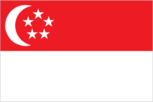
<strong>description: </strong>two equal horizontal bands of red (top) and white; a vertical white crescent is on the left side of the red band, with a circle of five five-pointed white stars to the right of the crescent<br><br><strong>meaning:</strong> red stands for brotherhood and equality, and white for purity and virtue; the waxing crescent moon symbolizes a young nation on the ascendancy; the stars represent the national ideals of democracy, peace, progress, justice, and equality
Flag description
The flag of Singapore is composed of two equal horizontal bands of red and white. On the hoist side of the red band is a fly-side facing white crescent which partially encloses five small five-pointed white stars arranged in the shape of a pentagon.
Flag image
- svg
- https://flagcdn.com/sg.svg
Government type
parliamentary republic
Independence
9 August 1965 (from Malaysian Federation)
International law organization participation
has not submitted an ICJ jurisdiction declaration; non-party state to the ICCt
International organization participation
ADB, AOSIS, APEC, Arctic Council (observer), ARF, ASEAN, BIS, C, CP, EAS, FAO, FATF, G-77, IAEA, IBRD, ICAO, ICC (national committees), ICCt, ICRM, IDA, IFC, IFRCS, IHO, ILO, IMF, IMO, IMSO, Interpol, IOC, IPU, ISO, ITSO, ITU, ITUC (NGOs), MIGA, NAM, OPCW, Pacific Alliance (observer), PCA, UN, UNCTAD, UNESCO, UNHCR, UNOOSA, UPU, WCO, WHO, WIPO, WMO, WTO
Judicial branch
- Highest court(s)
- Supreme Court (number of judges varies but includes judicial commissioners, judges of appeal, and international judges); the court is organized into an upper-tier Appeal Court and a lower-tier High Court
- Judge selection and term of office
- judges appointed by the president from candidates recommended by the prime minister after consultation with the chief justice; judges usually serve until retirement at age 65, but terms can be extended
- Subordinate courts
- district, magistrates', juvenile, family, community, and coroners' courts; small claims tribunals; employment claims tribunals
Legal system
English common law
Legislative branch
- Electoral system
- plurality/majority
- Expected date of next election
- May 2030
- Legislative structure
- unicameral
- Legislature name
- Parliament
- Most recent election date
- 5/3/2025
- Number of seats
- 108 (97 directly elected; 9 appointed)
- Parties elected and seats per party
- People's Action Party (PAP) (87); Workers' Party (WPS) (12)
- Percentage of women in chamber
- 32.3%
- Scope of elections
- full renewal
- Term in office
- 5 years
National color(s)
red, white
National heritage
- Selected World Heritage Site locales
- Singapore Botanic Gardens
- Total World Heritage Sites
- 1 (cultural)
National holiday
National Day, 9 August (1965)
National symbol(s)
lion, merlion (mythical half-lion, half-fish creature), orchid
Political parties
- People's Action Party or PAP<br>Workers' Party or WPS<br>there are 13 additional active political parties in Singapore
- note
- <strong>note: </strong>the PAP has won every general election since the end of the British colonial era in 1959
Start of week
Monday
Suffrage
21 years of age; universal and compulsory
UN Member
Yes
Economy
Agricultural products
- chicken, eggs, vegetables, pork, duck, spinach, lettuce, pork offal, cabbages, pork fat (2023)
- note
- <b>note:</b> top ten agricultural products based on tonnage
Average household expenditures
- On alcohol and tobacco
- 1.7% of household expenditures (2023 est.)
- On food
- 7% of household expenditures (2023 est.)
Budget
- Expenditures
- $73.144 billion (2022 est.)
- Note
- <b>note:</b> central government revenues (excluding grants) and expenditures converted to US dollars at average official exchange rate for year indicated
- Revenues
- $80.836 billion (2022 est.)
Currency
- code
- SGD
- name
- Singapore dollar (SGD) [$]
Current account balance
- $96.02 billion
- Current account balance 2022
- $93.771 billion (2022 est.)
- Current account balance 2023
- $89.403 billion (2023 est.)
- Current account balance 2024
- $96.015 billion (2024 est.)
- Note
- <b>note:</b> balance of payments - net trade and primary/secondary income in current dollars
Economic overview
<p>high-income, service-based economy; global financial hub; business-friendly policies and open to investment and trade; inflation easing but persistent in services; public investments in education, healthcare, and infrastructure; strong human capital development challenged by aging population</p>
Exchange rates
- Currency
- Singapore dollars (SGD) per US dollar -
- Exchange rates 2020
- 1.38 (2020 est.)
- Exchange rates 2021
- 1.343 (2021 est.)
- Exchange rates 2022
- 1.379 (2022 est.)
- Exchange rates 2023
- 1.343 (2023 est.)
- Exchange rates 2024
- 1.336 (2024 est.)
Exports
- $978.6 billion
- Exports 2022
- $947.355 billion (2022 est.)
- Exports 2023
- $917.683 billion (2023 est.)
- Exports 2024
- $978.597 billion (2024 est.)
- Note
- <b>note:</b> balance of payments - exports of goods and services in current dollars
Exports - commodities
- integrated circuits, refined petroleum, machinery, vaccines, gold (2023)
- note
- <b>note:</b> top five export commodities based on value in dollars
Exports - partners
- Hong Kong 13%, China 11%, USA 10%, Malaysia 9%, S. Korea 6% (2023)
- note
- <b>note:</b> top five export partners based on percentage share of exports
Foreign direct investment
- net inflows
- $151.94 billion
GDP - composition, by end use
- Exports of goods and services
- 178.8% (2024 est.)
- Government consumption
- 10.6% (2024 est.)
- Household consumption
- 31.5% (2024 est.)
- Imports of goods and services
- -143.6% (2024 est.)
- Investment in fixed capital
- 21.9% (2024 est.)
- Investment in inventories
- 0.3% (2024 est.)
- Note
- <b>note:</b> figures may not total 100% due to rounding or gaps in data collection
GDP - composition, by sector of origin
- Agriculture
- 0% (2024 est.)
- Industry
- 21.4% (2024 est.)
- Note
- <b>note:</b> figures may not total 100% due to non-allocated consumption not captured in sector-reported data
- Services
- 73% (2024 est.)
GDP (official exchange rate)
- $547.387 billion (2024 est.)
- note
- <b>note:</b> data in current dollars at official exchange rate
GDP per capita (nominal)
$90,674
Gini Index coefficient - distribution of family income
- Gini Index coefficient - distribution of family income 2016
- 45.8 (2016)
GNI (gross national income)
$458.4 billion
GNI per capita
$74,750
Gross domestic investment
22 % of GDP
Imports
- $786.02 billion
- Imports 2022
- $744.364 billion (2022 est.)
- Imports 2023
- $728.5 billion (2023 est.)
- Imports 2024
- $786.02 billion (2024 est.)
- Note
- <b>note:</b> balance of payments - imports of goods and services in current dollars
Imports - commodities
- integrated circuits, refined petroleum, crude petroleum, gold, gas turbines (2023)
- note
- <b>note:</b> top five import commodities based on value in dollars
Imports - partners
- China 15%, Malaysia 11%, Taiwan 11%, USA 10%, S. Korea 6% (2023)
- note
- <b>note:</b> top five import partners based on percentage share of imports
Industrial production growth rate
- 4.2% (2024 est.)
- note
- <b>note:</b> annual % change in industrial value added based on constant local currency
Industries
electronics, chemicals, financial services, oil drilling equipment, petroleum refining, biomedical products, scientific instruments, telecommunication equipment, processed food and beverages, ship repair, offshore platform construction, entrepot trade
Inflation rate (consumer prices)
- 2.39%
- Inflation rate (consumer prices) 2022
- 6.1% (2022 est.)
- Inflation rate (consumer prices) 2023
- 4.8% (2023 est.)
- Inflation rate (consumer prices) 2024
- 2.4% (2024 est.)
- Note
- <b>note:</b> annual % change based on consumer prices
Labor force
- 3.722 million (2024 est.)
- note
- <b>note:</b> number of people ages 15 or older who are employed or seeking work
- total
- 3.74 million persons
Labor force - by occupation
- agriculture
- 0.1%
- industry
- 14%
- services
- 85.91%
Public debt
- 176 % of GDP
- Note
- <b>note:</b> central government debt as a % of GDP
- Public debt 2023
- 175.6% of GDP (2023 est.)
Real GDP (purchasing power parity)
- $909.69 billion
- Note
- <b>note:</b> data in 2021 dollars
- Real GDP (purchasing power parity) 2022
- $752.948 billion (2022 est.)
- Real GDP (purchasing power parity) 2023
- $766.662 billion (2023 est.)
- Real GDP (purchasing power parity) 2024
- $800.304 billion (2024 est.)
Real GDP growth rate
- 4.39%
- Note
- <b>note:</b> annual GDP % growth based on constant local currency
- Real GDP growth rate 2022
- 4.1% (2022 est.)
- Real GDP growth rate 2023
- 1.8% (2023 est.)
- Real GDP growth rate 2024
- 4.4% (2024 est.)
Real GDP per capita
- $150,689
- Note
- <b>note:</b> data in 2021 dollars
- Real GDP per capita 2022
- $133,600 (2022 est.)
- Real GDP per capita 2023
- $129,600 (2023 est.)
- Real GDP per capita 2024
- $132,600 (2024 est.)
Remittances
- Note
- <b>note:</b> personal transfers and compensation between resident and non-resident individuals/households/entities
- Remittances 2021
- 0% of GDP (2021 est.)
- Remittances 2022
- 0% of GDP (2022 est.)
- Remittances 2023
- 0% of GDP (2023 est.)
Reserves of foreign exchange and gold
- $383.95 billion
- Note
- <b>note:</b> holdings of gold (year-end prices)/foreign exchange/special drawing rights in current dollars
- Reserves of foreign exchange and gold 2022
- $296.629 billion (2022 est.)
- Reserves of foreign exchange and gold 2023
- $359.835 billion (2023 est.)
- Reserves of foreign exchange and gold 2024
- $383.946 billion (2024 est.)
Revenue (excl grants)
19 % of GDP
Tax revenue
14 % of GDP
Taxes and other revenues
- 13.9% (of GDP) (2023 est.)
- note
- <b>note:</b> central government tax revenue as a % of GDP
Unemployment rate
- 2.82%
- Note
- <b>note:</b> % of labor force seeking employment
- Unemployment rate 2022
- 3.6% (2022 est.)
- Unemployment rate 2023
- 3.5% (2023 est.)
- Unemployment rate 2024
- 3.2% (2024 est.)
Youth unemployment rate (ages 15-24)
- Female
- 10.8% (2024 est.)
- Male
- 5.6% (2024 est.)
- Note
- <b>note:</b> % of labor force ages 15-24 seeking employment
- Total
- 7.8% (2024 est.)
Energy
Coal
- Consumption
- 1.153 million metric tons (2023 est.)
- Exports
- 97 metric tons (2023 est.)
- Imports
- 1.326 million metric tons (2023 est.)
Electricity
- Consumption
- 56.672 billion kWh (2023 est.)
- consumption per capita
- 9,750 kWh
- Installed generating capacity
- 13.134 million kW (2023 est.)
- Transmission/distribution losses
- 169.447 million kWh (2023 est.)
Electricity access
- Electrification - total population
- 100% (2022 est.)
Electricity generation sources
- Biomass and waste
- 3.1% of total installed capacity (2023 est.)
- Fossil fuels
- 94.8% of total installed capacity (2023 est.)
- hydroelectric
- 0%
- nuclear
- 0%
- renewable
- 4.02%
- Solar
- 2% of total installed capacity (2023 est.)
Energy consumption per capita
- 5,283 kg of oil equivalent
- Total energy consumption per capita 2023
- 643.259 million Btu/person (2023 est.)
Natural gas
- Consumption
- 13.134 billion cubic meters (2023 est.)
- Exports
- 399.452 million cubic meters (2023 est.)
- Imports
- 13.973 billion cubic meters (2023 est.)
Petroleum
- Refined petroleum consumption
- 1.514 million bbl/day (2023 est.)
Renewable energy consumption
1.1%
Communications
Broadband - fixed subscriptions
- per 100 inhabitants
- 27 per 100
- Subscriptions per 100 inhabitants
- 27 (2023 est.)
- Total
- 1.57 million (2023 est.)
Broadcast media
state-controlled broadcast media; 6 domestic TV stations operated by state-owned MediaCorp; broadcasts from Malaysian and Indonesian stations available; satellite dishes banned; multi-channel cable TV services available; 19 domestic radio stations, including 11 for MediaCorp, 5 for state-linked Singapore Press Holdings, 2 for Singapore Armed Forces Reservists Association, and 1 for BBC Radio; Malaysian and Indonesian radio stations available (2019)
Internet country code
.sg
Internet users
- Percent of population
- 94% (2023 est.)
Postal code format
######
Telephone calling code
+65
Telephones - fixed lines
- Subscriptions per 100 inhabitants
- 33 (2023 est.)
- Total subscriptions
- 1.912 million (2023 est.)
Telephones - mobile cellular
- subscriptions per 100
- 173 per 100
- Subscriptions per 100 inhabitants
- 171 (2024 est.)
- Total subscriptions
- 9.96 million (2024 est.)
Transportation
Air transport
- passengers carried
- 47.5 million passengers
- registered carrier departures
- 218,963 departures
Airports
9 (2025)
Civil aircraft registration country code prefix
9V
Driving side
Left
Heliports
1 (2025)
Merchant marine
- By type
- bulk carrier 591, container ship 604, general cargo 107, oil tanker 600, other 1,300
- Total
- 3,202 (2023)
Ports
- Key ports
- Jurong Island, Keppel - (East Singapore), Pulau Bukom, Pulau Sebarok
- Large
- 2
- Medium
- 1
- Ports with oil terminals
- 3
- Small
- 1
- Total ports
- 5 (2024)
- Very small
- 1
Vehicle registration code
SGP
Military and Security
Land forces
- armored vehicles
- tanks
Military - note
the SAF’s primary responsibility is external defense, particularly maritime security, but it also trains for certain domestic security operations, including joint deterrence patrols with police in instances of heightened terrorism alerts; the Army includes a “people’s defense force,” which is a divisional headquarters responsible for homeland security and counterterrorism; the SAF regularly participates in bilateral and multilateral training exercises<br><br>Singapore is a member of the Five Powers Defense Arrangements (FPDA), a series of mutual assistance agreements reached in 1971 embracing Australia, Malaysia, New Zealand, Singapore, and the UK; the FPDA commits the members to consult with one another in the event or threat of an armed attack on any of the members and to mutually decide what measures should be taken, jointly or separately; Singapore also has close security ties with the US, including granting the US military access, basing, and overflight privileges<br><br>the SAF's roots go back to 1854 when the Singapore Volunteer Rifle Corps was formed under colonial rule; the first battalion of regular soldiers, the First Singapore Infantry Regiment, was organized in 1957; the modern SAF was established in 1965 (2025)
Military and security forces
- Singapore Armed Forces (SAF; aka Singapore Defense Force): Singapore Army, Republic of Singapore Navy, Republic of Singapore Air Force (includes air defense), Digital and Intelligence Service<br><br>Ministry of Home Affairs: Singapore Police Force (SPF; includes Police Coast Guard and the Gurkha Contingent) (2025)
- active duty personnel
- 59,000
- note
- <strong>note 1:</strong> the Gurkha Contingent of the Singapore Police Force (GCSPF) is a paramilitary unit for riot control and acts as a rapid reaction force <strong><br></strong><br><strong>note 2:</strong> the Navy includes the multi-agency standing Maritime Security Task Force (MSTF), which assists the Police Coast Guard in conducting maritime security operations
- percent of total labor force
- 1.72 %
Military and security service personnel strengths
- information varies; approximately 55,000 active-duty Armed Forces (40,000 Army; 7,000 Navy; 8,000 Air Force) (2025)
- note
- <strong>note:</strong> the Army is comprised mostly of conscripts and reservists with a small core of professional soldiers, while the Air Force and Navy are staffed mainly by professional personnel
Military deployments
maintains permanent training detachments of military personnel in Australia, France, and the US (2025)
Military equipment inventories and acquisitions
the SAF has a diverse and modern mix of domestically produced and imported Western weapons systems from such suppliers as France, Germany, and the US; Singapore has a small but sophisticated defense industry, which produces armaments such as armored vehicles and naval warships (2025)
Military expenditures
- 3 % of GDP
- current USD
- $15,061,025,802
- Military Expenditures 2020
- 3% of GDP (2020 est.)
- Military Expenditures 2021
- 3% of GDP (2021 est.)
- Military Expenditures 2022
- 3% of GDP (2022 est.)
- Military Expenditures 2023
- 3% of GDP (2023 est.)
- Military Expenditures 2024
- 3% of GDP (2024 est.)
- percent of central government expenditure
- 20.13 %
- percent of GDP
- 2.84 % of GDP
Military service age and obligation
- 18 years of age for voluntary enlistment for men and women (16.5 for early enlistment program with parental consent); 18-21 years of age for compulsory military service for men; 24-month conscript service obligation (2026)
- note
- <strong>note 1: </strong>all male Singaporean citizens and permanent residents, unless exempted, are required to enter National Service (NS) upon attaining the age of 18; most NS conscripts serve in the Armed Forces, but some go into the Police Force or Civil Defense Force; conscripts comprise over half of the defense establishment<br><br><strong>note 2:</strong> the Singapore Armed Forces (SAF) also has a uniformed volunteer auxiliary branch known as the Volunteer Corps (SAFVC); the SAFVC allows citizens and residents not subject to the National Service obligation, including Singaporean women, first generation permanent residents, and naturalized citizens, to contribute towards Singapore's defense; the volunteers must be 18-45 and physically fit<br><br><strong>note 3:</strong> members of the Gurkha Contingent (GC) of the Singapore Police Force are mostly recruited from a small number of hill tribes in Nepal; the GC was formed in 1949 originally from selected ex-British Army Gurkhas
Military strength ranking
- PowerIndex score
- 0.5272
Transnational Issues
Refugees and internally displaced persons
- Stateless persons
- 1,109 (2024 est.)
Environment
Carbon dioxide emissions
- From coal and metallurgical coke
- 2.338 million metric tonnes of CO2 (2023 est.)
- From consumed natural gas
- 25.765 million metric tonnes of CO2 (2023 est.)
- From petroleum and other liquids
- 210.859 million metric tonnes of CO2 (2023 est.)
- Total emissions
- 238.962 million metric tonnes of CO2 (2023 est.)
Environmental issues
water pollution; industrial pollution; limited freshwater resources; waste disposal problems from limited land availability; air pollution; deforestation; seasonal smoke/haze from forest fires in Indonesia
International environmental agreements
- Party to
- Biodiversity, Climate Change, Climate Change-Kyoto Protocol, Climate Change-Paris Agreement, Comprehensive Nuclear Test Ban, Desertification, Endangered Species, Hazardous Wastes, Law of the Sea, Nuclear Test Ban, Ozone Layer Protection, Ship Pollution
- Signed, but not ratified
- none of the selected agreements
Particulate matter emissions
10 micrograms per cubic meter (2019 est.)
Protected areas
2 % of total land area
Renewable electricity output
4 % of total
Total renewable water resources
600 million cubic meters (2022)
Total water withdrawal
- 33 % of internal resources
- Agricultural
- 0 cubic meters (2022)
- Industrial
- 162.624 million cubic meters (2022)
- Municipal
- 198.207 million cubic meters (2022)
Waste and recycling
- Municipal solid waste generated annually
- 1.87 million tons (2024 est.)
- Percent of municipal solid waste recycled
- 51.7% (2022 est.)