2018 Edition
CIA World Factbook 2018 Archive (Wayback Machine)
Introduction
Background
A Malay trading port known as Temasek existed on the island of Singapore by the 14th century. The settlement changed hands several times in the ensuing centuries and was eventually burned in the 17th century and fell into obscurity. The British founded Singapore as a trading colony on the site in 1819. It joined the Malaysian Federation in 1963 but was ousted two years later and became independent. Singapore subsequently became one of the world's most prosperous countries with strong international trading links (its port is one of the world's busiest in terms of tonnage handled) and with per capita GDP equal to that of the leading nations of Western Europe.
Geography
Area
- land
- 709.2 sq km
- total
- 719.2 sq km
- water
- 10 sq km
Area Comparative
slightly more than 3.5 times the size of Washington, DC
Climate
tropical; hot, humid, rainy; two distinct monsoon seasons - northeastern monsoon (December to March) and southwestern monsoon (June to September); inter-monsoon - frequent afternoon and early evening thunderstorms
Coastline
193 km
Elevation
- 0 m lowest point: Singapore Strait
- note
- 166 highest point: Bukit Timah
Environment Current Issues
water pollution; industrial pollution; limited natural freshwater resources; limited land availability presents waste disposal problems; air pollution; deforestation; seasonal smoke/haze resulting from forest fires in Indonesia
Environment International Agreements
- party to
- Biodiversity, Climate Change, Climate Change-Kyoto Protocol, Desertification, Endangered Species, Hazardous Wastes, Law of the Sea, Ozone Layer Protection, Ship Pollution
- signed, but not ratified
- none of the selected agreements
Geographic Coordinates
1 22 N, 103 48 E
Geography Note
focal point for Southeast Asian sea routes; consists of about 60 islands, by far the largest of which is Pulau Ujong; land reclamation has removed many former islands and created a number of new ones
Irrigated Land
0 sq km (2012)
Land Boundaries
0 km
Land Use
- arable land: 0.9% (2011 est.) / permanent crops: 0.1% (2011 est.) / permanent pasture: 0% (2011 est.)
- agricultural land
- 1% (2011 est.)
- forest
- 3.3% (2011 est.)
- other
- 95.7% (2011 est.)
Location
Southeastern Asia, islands between Malaysia and Indonesia
Map References
Southeast Asia
Maritime Claims
- exclusive fishing zone
- within and beyond territorial sea, as defined in treaties and practice
- territorial sea
- 3 nm
Natural Hazards
flash floods
Natural Resources
fish, deepwater ports
Population Distribution
most of the urbanization is along the southern coast, with relatively dense population clusters found in the central areas
Terrain
lowlying, gently undulating central plateau
People and Society
Age Structure
- 0-14 years
- 12.77% (male 391,714 /female 373,766)
- 15-24 years
- 16.05% (male 473,012 /female 489,553)
- 25-54 years
- 50.61% (male 1,476,528 /female 1,558,179)
- 55-64 years
- 10.53% (male 316,001 /female 315,648)
- 65 years and over
- 10.03% (male 274,863 /female 326,727) (2018 est.)
Birth Rate
8.7 births/1,000 population (2018 est.)
Death Rate
3.5 deaths/1,000 population (2018 est.)
Dependency Ratios
- elderly dependency ratio
- 16 (2015 est.)
- potential support ratio
- 6.2 (2015 est.)
- total dependency ratio
- 37.3 (2015 est.)
- youth dependency ratio
- 21.3 (2015 est.)
Drinking Water Source
- improved: urban: 100% of population
- total: 100% of population
- unimproved: urban: 0% of population
- total: 0% of population (2015 est.)
Education Expenditures
2.9% of GDP (2013)
Ethnic Groups
- Chinese 74.3%, Malay 13.4%, Indian 9%, other 3.2% (2017 est.)
- note
- individuals self-identify; the population is divided into four categories: Chinese, Malay (includes Malays and Indonesians), Indian (includes Indian, Pakistani, Bangladeshi, or Sri Lankan), and other ethnic groups (includes Eurasians, Caucasians, Japanese, Filipino, Vietnamese
Health Expenditures
4.9% of GDP (2014)
Hiv Aids Adult Prevalence Rate
0.2% (2017 est.)
Hiv Aids Deaths
<100 (2017 est.)
Hiv Aids People Living With Hiv Aids
7,600 (2017 est.)
Hospital Bed Density
2.4 beds/1,000 population (2015)
Infant Mortality Rate
- female
- 2.1 deaths/1,000 live births (2018 est.)
- male
- 2.5 deaths/1,000 live births (2018 est.)
- total
- 2.3 deaths/1,000 live births (2018 est.)
Languages
- English (official) 36.9%, Mandarin (official) 34.9%, other Chinese dialects (includes Hokkien, Cantonese, Teochew) 12.2%, Malay (official) 10.7%, Tamil (official) 3.3%, other 2% (2015 est.)
- note
- data represent language most frequently spoken at home
Life Expectancy At Birth
- female
- 88.3 years (2018 est.)
- male
- 82.8 years (2018 est.)
- total population
- 85.5 years (2018 est.)
Literacy
- definition
- age 15 and over can read and write (2016 est.)
- female
- 95.4% (2016 est.)
- male
- 98.7% (2016 est.)
- total population
- 97% (2016 est.)
Major Infectious Diseases
- note
- active local transmission of Zika virus by Aedes species mosquitoes has been identified in this country (as of August 2016); it poses an important risk (a large number of cases possible) among US citizens if bitten by an infective mosquito; other less common ways to get Zika are through sex, via blood transfusion, or during pregnancy, in which the pregnant woman passes Zika virus to her fetus
Major Urban Areas Population
5.792 million SINGAPORE (capital) (2018)
Maternal Mortality Rate
10 deaths/100,000 live births (2015 est.)
Median Age
- female
- 35.1 years (2018 est.)
- male
- 34.8 years
- total
- 34.9 years
Mother S Mean Age At First Birth
- 30.5 years (2015 est.)
- note
- median age
Nationality
- adjective
- Singapore
- noun
- Singaporean(s)
Net Migration Rate
13.1 migrant(s)/1,000 population (2017 est.)
Obesity Adult Prevalence Rate
6.1% (2016)
Physicians Density
2.28 physicians/1,000 population (2016)
Population
5,995,991 (July 2018 est.)
Population Growth Rate
1.79% (2018 est.)
Religions
Buddhist 33.2%, Christian 18.8%, Muslim 14%, Taoist 10%, Hindu 5%, other 0.6%, none 18.5% (2015 est.)
Sanitation Facility Access
- improved: urban: 100% of population (2015 est.)
- total: 100% of population (2015 est.)
- unimproved: urban: 0% of population (2015 est.)
- total: 0% of population (2015 est.)
School Life Expectancy Primary To Tertiary Education
- female
- 13 years (2009)
- male
- 13 years (2009)
- total
- 13 years (2009)
Sex Ratio
- 0-14 years
- 1.05 male(s)/female (2017 est.)
- 15-24 years
- 0.97 male(s)/female (2017 est.)
- 25-54 years
- 0.95 male(s)/female (2017 est.)
- 55-64 years
- 1 male(s)/female (2017 est.)
- 65 years and over
- 0.83 male(s)/female (2017 est.)
- at birth
- 1.07 male(s)/female (2017 est.)
- total population
- 0.96 male(s)/female (2017 est.)
Total Fertility Rate
0.84 children born/woman (2018 est.)
Unemployment Youth Ages 15 24
- female
- 12.5% (2016 est.)
- male
- 6.2% (2016 est.)
- total
- 9.1% (2016 est.)
Urbanization
- rate of urbanization
- 1.39% annual rate of change (2015-20 est.)
- urban population
- 100% of total population (2018)
Government
Administrative Divisions
none
Capital
- geographic coordinates
- 1 17 N, 103 51 E
- name
- Singapore
- time difference
- UTC+8 (13 hours ahead of Washington, DC, during Standard Time)
Citizenship
- citizenship by birth
- no
- citizenship by descent only
- at least one parent must be a citizen of Singapore
- dual citizenship recognized
- no
- residency requirement for naturalization
- 10 years
Constitution
- amendments
- proposed by Parliament; passage requires two-thirds majority vote in the second and third readings by the elected Parliament membership and assent by the president of the republic; passage of amendments affecting constitutional articles on fundamental liberties, the president, or constitutional amendment procedures also requires at least two-thirds majority vote in a referendum; amended many times, last in 2016 (2018)
- history
- several previous; latest adopted 22 December 1965 (2018)
Country Name
- conventional long form
- Republic of Singapore
- conventional short form
- Singapore
- etymology
- name derives from the Sanskrit words "singa" (lion) and "pura" (city) to describe the city-state's leonine symbol
- local long form
- Republic of Singapore
- local short form
- Singapore
Diplomatic Representation From The Us
- chief of mission
- Ambassador (vacant); Charge d'Affaires Stephanie SYPTAK-RAMNATH (since 20 January 2017)
- embassy
- 27 Napier Road, Singapore 258508
- FAX
- [65] 6476-9340
- mailing address
- FPO AP 96507-0001
- telephone
- [65] 6476-9100
Diplomatic Representation In The Us
- chancery
- 3501 International Place NW, Washington, DC 20008
- chief of mission
- Ambassador Ashok Kumar MIRPURI (since 30 July 2012)
- consulate(s)
- New York
- consulate(s) general
- San Francisco
- FAX
- [1] (202) 537-0876
- telephone
- [1] (202) 537-3100
Executive Branch
- cabinet
- Cabinet appointed by the president on the advice of the prime minister; Cabinet responsible to Parliament
- chief of state
- President HALIMAH Yacob (since 14 September 2017); note - President TAN's term ended on 31 August 2017; HALIMAH is Singapore's first female president; the head of the Council of Presidential Advisors, J.Y. PILLAY, served as acting president until HALIMAH was sworn in as president on 14 September 2017
- election results
- HALIMAH Yacob was declared president on 13 September 2017, being the only eligible candidate; Tony TAN Keng Yam elected president in the previous contested election on 27 August 2011; percent of vote - Tony TAN Keng Yam (independent) 35.2% , TAN Cheng Bock (independent) 34.9%, TAN Jee Say (independent) 25%, TAN Kin Lian (independent) 4.9%
- elections/appointments
- president directly elected by simple majority popular vote for a single 6-year term; election last held on 13 September 2017 (next to be held in 2023); following legislative elections, leader of majority party or majority coalition appointed prime minister by president; deputy prime ministers appointed by the president
- head of government
- Prime Minister LEE Hsien Loong (since 12 August 2004); Deputy Prime Ministers TEO Chee Hean (since 1 April 2009) and Tharman SHANMUGARATNAM (since 21 May 2011)
Flag Description
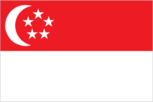
two equal horizontal bands of red (top) and white; near the hoist side of the red band, there is a vertical, white crescent (closed portion is toward the hoist side) partially enclosing five white five-pointed stars arranged in a circle; red denotes brotherhood and equality; white signifies purity and virtue; the waxing crescent moon symbolizes a young nation on the ascendancy; the five stars represent the nation's ideals of democracy, peace, progress, justice, and equality
Government Type
parliamentary republic
Independence
9 August 1965 (from Malaysian Federation)
International Law Organization Participation
has not submitted an ICJ jurisdiction declaration; non-party state to the ICCt
International Organization Participation
ADB, AOSIS, APEC, Arctic Council (observer), ARF, ASEAN, BIS, C, CP, EAS, FAO, FATF, G-77, IAEA, IBRD, ICAO, ICC (national committees), ICCt, ICRM, IDA, IFC, IFRCS, IHO, ILO, IMF, IMO, IMSO, Interpol, IOC, IPU, ISO, ITSO, ITU, ITUC (NGOs), MIGA, NAM, OPCW, Pacific Alliance (observer), PCA, UN, UNCTAD, UNESCO, UNHCR, UPU, WCO, WHO, WIPO, WMO, WTO
Judicial Branch
- highest courts
- Supreme Court (although the number of judges varies - as of Feb 2018, it had a total of 21 judges, 7 judicial commissioners, 4 senior judges, and 15 international judges); the court is organized into an upper tier Appeal Court and a lower tier High Court)
- judge selection and term of office
- judges appointed by the president from candidates recommended by the prime minister after consultation with the chief justice; judges usually serve until retirement at age 65, but terms can be extended
- subordinate courts
- district, magistrates', juvenile, family, community, and coroners' courts; small claims tribunals; employment claims tribunals
Legal System
English common law
Legislative Branch
- description
- unicameral Parliament (101 seats; 89 members directly elected by popular vote, up to 9 nominated by a parliamentary selection committee and appointed by the president, and up to 9 but currently 3 non-constituency members from opposition parties to ensure political diversity; members serve 5-year terms)
- election results
- percent of vote by party - PAP 69.9%, WP 12.5%, other 17.6%; seats by party - PAP 83, WP 6; composition - men 77, women 24, percent of women 23.8%
- elections
- last held on 11 September 2015 (next to be held in 2020)
National Anthem
- lyrics/music
- ZUBIR Said
- name
- "Majulah Singapura" (Onward Singapore)
- note
- adopted 1965; first performed in 1958 at the Victoria Theatre, the anthem is sung only in Malay
National Holiday
National Day, 9 August (1965)
National Symbol S
lion, merlion (mythical half lion-half fish creature), orchid; national colors: red, white
Political Parties And Leaders
National Solidarity Party or NSPPeople's Action Party or PAP [LEE Hsien Loong]Singapore Democratic Party or SDP [Dr. CHEE Soon Juan]Workers' Party or WP [Pritam SINGH]
Suffrage
21 years of age; universal and compulsory
Economy
Agriculture Products
vegetables; poultry, eggs; fish, ornamental fish, orchids
Budget
- expenditures
- 51.87 billion (2017 est.)
- note
- expenditures include both operational and development expenditures
- revenues
- 50.85 billion (2017 est.)
Budget Surplus Or Deficit
-0.3% (of GDP) (2017 est.)
Central Bank Discount Rate
- 2.15% (2017 est.)
- 1.17% (2016 est.)
Commercial Bank Prime Lending Rate
- 5.28% (31 December 2017 est.)
- 5.35% (31 December 2016 est.)
Current Account Balance
- $60.99 billion (2017 est.)
- $58.85 billion (2016 est.)
Debt External
- $566.1 billion (31 December 2017 est.)
- $464.1 billion (30 September 2017 est.)
Distribution Of Family Income Gini Index
- 45.9 (2017)
- 45.8 (2016)
Economy Overview
Singapore has a highly developed and successful free-market economy. It enjoys an open and corruption-free environment, stable prices, and a per capita GDP higher than that of most developed countries. Unemployment is very low. The economy depends heavily on exports, particularly of electronics, petroleum products, chemicals, medical and optical devices, pharmaceuticals, and on Singapore’s vibrant transportation, business, and financial services sectors.The economy contracted 0.6% in 2009 as a result of the global financial crisis, but has continued to grow since 2010. Growth from 2012-2017 was slower than during the previous decade, a result of slowing structural growth - as Singapore reached high-income levels - and soft global demand for exports. Growth recovered to 3.6% in 2017 with a strengthening global economy.The government is attempting to restructure Singapore’s economy to reduce its dependence on foreign labor, raise productivity growth, and increase wages amid slowing labor force growth and an aging population. Singapore has attracted major investments in advanced manufacturing, pharmaceuticals, and medical technology production and will continue efforts to strengthen its position as Southeast Asia's leading financial and technology hub. Singapore is a signatory of the Comprehensive and Progressive Agreement for Trans-Pacific Partnership (CPTPP), and a party to the Regional Comprehensive Economic Partnership (RCEP) negotiations with nine other ASEAN members plus Australia, China, India, Japan, South Korea, and New Zealand. In 2015, Singapore formed, with the other ASEAN members, the ASEAN Economic Community.
Exchange Rates
- Singapore dollars (SGD) per US dollar -
- 1.3 (2017 est.)
- 1.35 (2016 est.)
- 1.3815 (2015 est.)
- 1.3748 (2014 est.)
- 1.2671 (2013 est.)
Exports
- $396.8 billion (2017 est.)
- $338 billion (2016 est.)
Exports Commodities
machinery and equipment (including electronics and telecommunications), pharmaceuticals and other chemicals, refined petroleum products, foodstuffs and beverages
Exports Partners
China 14.7%, Hong Kong 12.6%, Malaysia 10.8%, US 6.6%, Indonesia 5.8%, Japan 4.7%, South Korea 4.6%, Thailand 4% (2017)
Fiscal Year
1 April - 31 March
Gdp Composition By End Use
- exports of goods and services
- 173.3% (2017 est.)
- government consumption
- 10.9% (2017 est.)
- household consumption
- 35.6% (2017 est.)
- imports of goods and services
- -149.1% (2017 est.)
- investment in fixed capital
- 24.8% (2017 est.)
- investment in inventories
- 2.8% (2017 est.)
Gdp Composition By Sector Of Origin
- agriculture
- 0% (2017 est.)
- industry
- 24.8% (2017 est.)
- services
- 75.2% (2017 est.)
Gdp Official Exchange Rate
$323.9 billion (2017 est.) (2017 est.)
Gdp Per Capita Ppp
- $94,100 (2017 est.)
- $90,900 (2016 est.)
- $89,900 (2015 est.)
- note
- data are in 2017 dollars
Gdp Purchasing Power Parity
- $528.1 billion (2017 est.)
- $509.7 billion (2016 est.)
- $497.8 billion (2015 est.)
- note
- data are in 2017 dollars
Gdp Real Growth Rate
- 3.6% (2017 est.)
- 2.4% (2016 est.)
- 2.2% (2015 est.)
Gross National Saving
- 46.5% of GDP (2017 est.)
- 46% of GDP (2016 est.)
- 45.7% of GDP (2015 est.)
Household Income Or Consumption By Percentage Share
- highest 10%
- 27.5% (2017)
- lowest 10%
- 27.5% (2017)
Imports
- $312.1 billion (2017 est.)
- $277.6 billion (2016 est.)
Imports Commodities
machinery and equipment, mineral fuels, chemicals, foodstuffs, consumer goods
Imports Partners
China 13.9%, Malaysia 12%, US 10.7%, Japan 6.3%, South Korea 5% (2017)
Industrial Production Growth Rate
5.7% (2017 est.)
Industries
electronics, chemicals, financial services, oil drilling equipment, petroleum refining, biomedical products, scientific instruments, telecommunication equipment, processed food and beverages, ship repair, offshore platform construction, entrepot trade
Inflation Rate Consumer Prices
- 0.6% (2017 est.)
- -0.5% (2016 est.)
Labor Force
- 3.657 million (2017 est.)
- note
- excludes non-residents
Labor Force By Occupation
- agriculture
- 0.7%
- industry
- 25.6%
- note
- excludes non-residents
- services
- 73.7% (2017)
Market Value Of Publicly Traded Shares
- $809.4 billion (31 December 2017 est.)
- $712.3 billion (31 December 2016 est.)
- $696 billion (31 December 2015 est.)
Population Below Poverty Line
NA
Public Debt
- 111.1% of GDP (2017 est.)
- 106.8% of GDP (2016 est.)
- note
- Singapore's public debt consists largely of Singapore Government Securities (SGS) issued to assist the Central Provident Fund (CPF), which administers Singapore's defined contribution pension fund; special issues of SGS are held by the CPF, and are non-tradable; the government has not borrowed to finance deficit expenditures since the 1980s; Singapore has no external public debt
Reserves Of Foreign Exchange And Gold
- $279.9 billion (31 December 2017 est.)
- $271.8 billion (31 December 2016 est.)
Stock Of Broad Money
- $137.4 billion (31 December 2017 est.)
- $119.4 billion (31 December 2016 est.)
Stock Of Direct Foreign Investment Abroad
- $841.4 billion (31 December 2017 est.)
- $759.2 billion (31 December 2016 est.)
Stock Of Direct Foreign Investment At Home
- $1.285 trillion (31 December 2017 est.)
- $1.22 trillion (31 December 2016 est.)
Stock Of Domestic Credit
- $471.2 billion (31 December 2017 est.)
- $383.3 billion (31 December 2016 est.)
Stock Of Narrow Money
- $137.4 billion (31 December 2017 est.)
- $119.4 billion (31 December 2016 est.)
Taxes And Other Revenues
15.7% (of GDP) (2017 est.)
Unemployment Rate
- 2.2% (2017 est.)
- 2.1% (2016 est.)
Energy
Carbon Dioxide Emissions From Consumption Of Energy
249.5 million Mt (2017 est.)
Crude Oil Exports
14,780 bbl/day (2015 est.)
Crude Oil Imports
783,300 bbl/day (2015 est.)
Crude Oil Production
0 bbl/day (2017 est.)
Crude Oil Proved Reserves
0 bbl (1 January 2018 est.)
Electricity Access
- electrification - total population
- 100% (2016)
Electricity Consumption
47.69 billion kWh (2016 est.)
Electricity Exports
0 kWh (2016 est.)
Electricity From Fossil Fuels
98% of total installed capacity (2016 est.)
Electricity From Hydroelectric Plants
0% of total installed capacity (2017 est.)
Electricity From Nuclear Fuels
0% of total installed capacity (2017 est.)
Electricity From Other Renewable Sources
2% of total installed capacity (2017 est.)
Electricity Imports
0 kWh (2016 est.)
Electricity Installed Generating Capacity
13.35 million kW (2016 est.)
Electricity Production
48.66 billion kWh (2016 est.)
Natural Gas Consumption
12.97 billion cu m (2017 est.)
Natural Gas Exports
622.9 million cu m (2017 est.)
Natural Gas Imports
13.48 billion cu m (2017 est.)
Natural Gas Production
0 cu m (2017 est.)
Natural Gas Proved Reserves
0 cu m (1 January 2017 est.)
Refined Petroleum Products Consumption
1.322 million bbl/day (2016 est.)
Refined Petroleum Products Exports
1.82 million bbl/day (2015 est.)
Refined Petroleum Products Imports
2.335 million bbl/day (2015 est.)
Refined Petroleum Products Production
755,000 bbl/day (2015 est.)
Communications
Broadband Fixed Subscriptions
- subscriptions per 100 inhabitants
- 25 (2017 est.)
- total
- 1,470,400 (2017 est.)
Broadcast Media
state controls broadcast media; 7 domestic TV stations operated by MediaCorp which is wholly owned by a state investment company; broadcasts from Malaysian and Indonesian stations available; satellite dishes banned; multi-channel cable TV services available; a total of 18 domestic radio stations broadcasting, with MediaCorp operating 11, Singapore Press Holdings, also government-linked, another 5, and another 2 controlled by the Singapore Armed Forces Reservists Association; Malaysian and Indonesian radio stations are available as is BBC; a number of Internet service radio stations are also available
Internet Country Code
.sg
Internet Users
- percent of population
- 81% (July 2016 est.)
- total
- 4,683,200 (July 2016 est.)
Telephone System
- domestic
- excellent domestic facilities; combined fixed-line and mobile-cellular teledensity more than 180 telephones per 100 persons; multiple providers of high-speed Internet connectivity (2016)
- general assessment
- excellent service (2016)
- international
- country code - 65; numerous submarine cables provide links throughout Asia, Australia, the Middle East, Europe, and US; satellite earth stations - 4; supplemented by VSAT coverage (2016)
Telephones Fixed Lines
- subscriptions per 100 inhabitants
- 34 (2017 est.)
- total subscriptions
- 1,983,100 (2017 est.)
Telephones Mobile Cellular
- subscriptions per 100 inhabitants
- 144 (2017 est.)
- total subscriptions
- 8,462,800 (2017 est.)
Transportation
Airports
9 (2013)
Airports With Paved Runways
- 1,524 to 2,437 m
- 3 (2017)
- 2,438 to 3,047 m
- 2 (2017)
- 914 to 1,523 m
- 1 (2017)
- over 3,047 m
- 2 (2017)
- total
- 9 (2017)
- under 914 m
- 1 (2017)
Civil Aircraft Registration Country Code Prefix
9V (2016)
Merchant Marine
- by type
- bulk carrier 592, container ship 504, general cargo 134, oil tanker 722, other 1606 (2017)
- total
- 3,558 (2017)
National Air Transport System
- annual freight traffic on registered air carriers
- 6,154,365,275 mt-km (2015)
- annual passenger traffic on registered air carriers
- 33,290,544 (2015)
- inventory of registered aircraft operated by air carriers
- 197 (2015)
- number of registered air carriers
- 5 (2015)
Pipelines
3220 km domestic gas (2014), 1122 km cross-border pipelines (2017), 8 km refined products (2013)
Ports And Terminals
- container port(s) (TEUs)
- Singapore (30,903,600) (2016)
- LNG terminal(s) (import)
- Singapore
- major seaport(s)
- Singapore
Roadways
- paved
- 3,496 km (includes 164 km of expressways) (2014)
- total
- 3,496 km (2014)
Military and Security
Maritime Threats
the International Maritime Bureau reports the territorial and offshore waters in the South China Sea as high risk for piracy and armed robbery against ships; numerous commercial vessels have been attacked and hijacked both at anchor and while underway; hijacked vessels are often disguised and cargo diverted to ports in East Asia; crews have been murdered or cast adrift; the Singapore Straits saw four attacks against commercial vessels in 2017, a slight increase over the two attacks in 2016
Military Branches
Singapore Armed Forces: Army, Navy, Air Force (includes Air Defense) (2013)
Military Expenditures
- 3.12% of GDP (2017)
- 3.35% of GDP (2016)
- 3.16% of GDP (2015)
- 3.11% of GDP (2014)
- 3.09% of GDP (2013)
Military Service Age And Obligation
18-21 years of age for male compulsory military service; 16 1/2 years of age for volunteers; 2-year conscript service obligation, with a reserve obligation to age 40 (enlisted) or age 50 (officers) (2012)
Transnational Issues
Disputes International
disputes persist with Malaysia over each country’s extensive land reclamation works, bridge construction, and maritime boundaries in the Johor and Singapore Straitsin 2008, ICJ awarded sovereignty of Pedra Branca (Pulau Batu Puteh/Horsburgh Island) to Singapore, and Middle Rocks to Malaysia, but did not rule on maritime regimes, boundaries, or disposition of South Ledgein 2017, Malaysia filed a challenge to the 2008 ruling and applied for ownership of South Ledge; piracy remains a problem in the Malacca Strait
Illicit Drugs
drug abuse limited because of aggressive law enforcement efforts, including carrying out death sentences; as a transportation and financial services hub, Singapore is vulnerable, despite strict laws and enforcement, as a venue for money laundering
Terrorism
Terrorist Groups Foreign Based
- Islamic State of Iraq and ash-Sham (ISIS) network in Singapore
- aim(s): enhance its networks in Singapore; implement ISIS's strict interpretation of shariaarea(s) of operation: attacks in Bangladesh are staged in Singapore; operates under the name the Islamic State in Bangladesh (April 2018)
- Jemaah Islamiyah (JI)
- aim(s): enhance its networks in Singapore and, ultimately, overthrow the Singapore Government and establish a pan-Islamic state across Southeast Asiaarea(s) of operation: maintains a presence (April 2018)