1994 Edition
CIA World Factbook 1994 (Project Gutenberg)
Introduction
Administrative divisions
10 prefectures (prefectures, singular - prefecture in French; plural - NA, singular - prefegitura in Kinyarwanda); Butare, Byumba, Cyangugu, Gikongoro, Gisenyi, Gitarama, Kibungo, Kibuye, Kigali, Ruhengeri
Agriculture
accounts for almost 50% of GDP and about 90% of the labor force; cash crops - coffee, tea, pyrethrum (insecticide made from chrysanthemums); main food crops - bananas, beans, sorghum, potatoes; stock raising; self-sufficiency declining; country imports foodstuffs as farm production fails to keep up with a 2.8% annual growth in population
Airports
total: 8 usable: 7 with permanent-surface runways: 3 with runways over 3,659 m: with runways 2,440-3,659 m: 1 with runways 1,220-2,439 m: 2
Area
total area: 26,340 sq km land area: 24,950 sq km comparative area: slightly smaller than Maryland
Birth rate
49.17 births/1,000 population (1994 est.)
Branches
Army (including Air Wing), Gendarmerie note: Rwanda plans to demobilize and reorganize with RPF elements during 1994
Budget
revenues: $350 million expenditures: $NA, including capital expenditures of $NA (1992 est.)
Capital
Kigali
Climate
temperate; two rainy seasons (February to April, November to January); mild in mountains with frost and snow possible
Coastline
0 km (landlocked)
Constitution
18 June 1991
Currency
1 Rwandan franc (RF) = 100 centimes
Death rate
21.35 deaths/1,000 population (1994 est.)
Defense expenditures
exchange rate conversion - $37 million, 1.6% of GDP (1988 est.)
Digraph
RW
Diplomatic representation in US
chief of mission: Ambassador Aloys UWIMANA chancery: 1714 New Hampshire Avenue NW, Washington, DC 20009 telephone: (202) 232-2882
Economic aid
recipient: US commitments, including Ex-Im (FY70-89), $128 million; Western (non-US) countries, ODA and OOF bilateral commitments (1970-89), $2 billion; OPEC bilateral aid (1979-89), $45 million; Communist countries (1970-89), $58 million note: in October 1990 Rwanda launched a Structural Adjustment Program with the IMF; since September 1991, the EC has given $46 million and the US $25 million in support of this program (1993)
Electricity
capacity: 30,000 kW production: 130 million kWh consumption per capita: 15 kWh (1991)
Environment
current issues: deforestation; overgrazing; soil exhaustion; soil erosion natural hazards: periodic droughts international agreements: party to - Endangered Species, Nuclear Test Ban; signed, but not ratified - Biodiversity, Climate Change, Law of the Sea
Ethnic divisions
Hutu 90%, Tutsi 9%, Twa (Pygmoid) 1%
Exchange rates
Rwandan francs (RF) per US$1 - 145.45 (December 1993), 133.35 (1992), 125.14 (1991), 82.60 (1990), 79.98 (1989)
Executive branch
chief of state: Interim President Dr. Theodore SINDIKUBWABO (since 8 April 1994, following the death of President Juvenal HABYARIMANA on 6 April 1994) the last election was held 19 December 1988 (next planned for 1995); results - the late President Juvenal HABYARIMANA was reelected head of government: Prime Minister Jean KAMBANDA, appointed by President SINDIKUBWABWO 8 April 1994 following the assassination of Agatha UWILINGIYIMANA on 7 April 1994 cabinet: Council of Ministers; appointed by the president
Exports
$66.6 million (f.o.b., 1992 est.) commodities: coffee 63%, tea, cassiterite, wolframite, pyrethrum partners: Germany, Belgium, Italy, Uganda, UK, France, US
External debt
$845 million (1991 est.)
FAX
- (202) 232-4544
- [250] 72128 note: embassy closed on 10 April 1994 and personnel withdrawn because of severe civil strife and consequent danger for foreign nationals
Fiscal year
calendar year
Flag
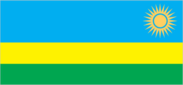
three equal vertical bands of red (hoist side), yellow, and green with a large black letter R centered in the yellow band; uses the popular pan-African colors of Ethiopia; similar to the flag of Guinea, which has a plain yellow band
Highways
total: 4,885 km paved: 460 km unpaved: gravel, improved earth 1,725 km; unimproved earth 2,700 km
Imports
$259.5 million (f.o.b., 1992 est.) commodities: textiles, foodstuffs, machines and equipment, capital goods, steel, petroleum products, cement and construction material partners: US, Belgium, Germany, Kenya, Japan
Independence
1 July 1962 (from UN trusteeship under Belgian administration)
Industrial production
growth rate -2.2% (1991); accounts for 17% of GDP
Industries
mining of cassiterite (tin ore) and wolframite (tungsten ore), tin, cement, agricultural processing, small-scale beverage production, soap, furniture, shoes, plastic goods, textiles, cigarettes
Infant mortality rate
118.7 deaths/1,000 live births (1994 est.)
Inflation rate (consumer prices)
9.5% (1992 est.)
Inland waterways
Lac Kivu navigable by shallow-draft barges and native craft
International disputes
none
Irrigated land
40 sq km (1989 est.)
Judicial branch
Constitutional Court (consists of the Court of Cassation and the Council of State in joint session)
Labor force
3.6 million by occupation: agriculture 93%, government and services 5%, industry and commerce 2% note: 49% of population of working age (1985)
Land boundaries
total 893 km, Burundi 290 km, Tanzania 217 km, Uganda 169 km, Zaire 217 km
Land use
arable land: 29% permanent crops: 11% meadows and pastures: 18% forest and woodland: 10% other: 32%
Languages
Kinyarwanda (official), French (official), Kiswahili used in commercial centers
Legal system
based on German and Belgian civil law systems and customary law; judicial review of legislative acts in the Supreme Court; has not accepted compulsory ICJ jurisdiction
Legislative branch
unicameral
Life expectancy at birth
total population: 40.25 years male: 39.33 years female: 41.21 years (1994 est.)
Literacy
age 15 and over can read and write (1990 est.) total population: 50% male: 64% female: 37%
Location
Central Africa, between Tanzania and Zaire
Manpower availability
males age 15-49 1,733,246; fit for military service 883,291
Map references
Africa, Standard Time Zones of the World
Maritime claims
none; landlocked
Member of
ACCT, ACP, AfDB, ECA, CCC, CEEAC, CEPGL, FAO, G-77, GATT, IBRD, ICAO, ICFTU, IDA, IFAD, IFC, ILO, IMF, INTELSAT, INTERPOL, IOC, ITU, LORCS, NAM, OAU, UN, UNCTAD, UNESCO, UNIDO, UPU, WCL, WHO, WIPO, WMO, WTO
Names
conventional long form: Republic of Rwanda conventional short form: Rwanda local long form: Republika y'u Rwanda local short form: Rwanda
National Development Council
(Conseil National de Developpement) elections last held 19 December 1988 (new elections to be held in 1995); results - MRND was the only party; seats - (70 total) MRND 70
National holiday
Independence Day, 1 July (1962)
National product
GDP - purchasing power equivalent - $6.8 billion (1993 est.)
National product per capita
$800 (1993 est.)
National product real growth rate
1.3% (1992 est.)
Nationality
noun: Rwandan(s) adjective: Rwandan
Natural resources
gold, cassiterite (tin ore), wolframite (tungsten ore), natural gas, hydropower
Net migration rate
0 migrant(s)/1,000 population (1994 est.)
Note
landlocked; predominantly rural population
Other political or pressure groups
Rwanda Patriotic Front (RPF), Alexis KANYARENGWE, Chairman (since 1990); Rwanda Patriotic Army (RPA), the RPF military wing, Maj. Gen. Paul KAGAME, commander
Overview
Almost 50% of GDP comes from the agricultural sector; coffee and tea make up 80-90% of total exports. The amount of fertile land is limited, however, and deforestation and soil erosion have created problems. The industrial sector in Rwanda is small, contributing only 17% to GDP. Manufacturing focuses mainly on the processing of agricultural products. The Rwandan economy remains dependent on coffee/tea exports and foreign aid. Weak international prices since 1986 have caused the economy to contract and per capita GDP to decline. A structural adjustment program with the World Bank began in October 1990. Ethnic-based insurgency in 1990-93 devastated wide areas of the north and displaced hundreds of thousands of people. A peace accord in mid-1993 temporarily ended most of the fighting, but massive resumption of civil warfare in April 1994 in the capital city Kigali has been taking thousands of lives and severely damaging short-term economic prospects
Political parties and leaders
- Republican National Movement for Democracy and Development (MRND);
- significant independent parties include
- Democratic Republican Movement (MDR); Liberal Party (PL); Democratic and Socialist Party (PSD); Coalition for the Defense of the Republic (CDR); Party for Democracy in Rwanda (PADER); Christian Democratic Party (PDL) note: formerly a one-party state, Rwanda legalized independent parties in mid-1991; since then, at least 10 new political parties have registered
Population
8,373,963 (July 1994 est.) note: the demographic estimates were prepared before civil strife, starting in April 1994, set in motion substantial and continuing population changes
Population growth rate
2.78% (1994 est.)
Religions
Roman Catholic 65%, Protestant 9%, Muslim 1%, indigenous beliefs and other 25%
Suffrage
universal adult at age NA
Telecommunications
telephone system does not provide service to the general public but is intended for business and government use; the capital, Kigali, is connected to the centers of the prefectures by microwave radio relay; the remainder of the network depends on wire and high frequency radio; international connections employ microwave radio relay to neighboring countries and satellite communications to more distant countries; satellite earth stations - 1 Indian Ocean INTELSAT and 1 SYMPHONIE station in Kigali (includes telex and telefax service); broadcast stations - 1 AM, 1 FM, 1 TV
Terrain
mostly grassy uplands and hills; mountains in west
Total fertility rate
8.19 children born/woman (1994 est.)
Type
republic; presidential system note: a new, interim government formed in August 1992 to last until peace accord; political parties are working to form a multiethical broad-based transitonal government to lead them to elections in 1995
Unemployment rate
NA%
US diplomatic representation
chief of mission: (vacant) embassy: Boulevard de la Revolution, Kigali mailing address: B. P. 28, Kigali telephone: [250] 75601 through 75603