1990 Edition
CIA World Factbook 1990 (Project Gutenberg)
Geography
Climate
wet season May to November; hot and humid
Coastline
1,519 km
Comparative area
slightly more than 2.5 times the size of Washington, DC
Contiguous zone
12 nm;
Continental shelf
200 m;
Environment
subject to typhoons from June to December; archipelago of six island groups totaling over 200 islands in the Caroline chain
Extended economic zone
200 nm;
Land boundaries
none
Land use
NA% arable land; NA% permanent crops; NA% meadows and pastures; NA% forest and woodland; NA% other
Natural resources
forests, minerals (especially gold), marine products; deep-seabed minerals
Note
important location 850 km southeast of the Philippines; includes World War II battleground of Peleliu and world-famous rock islands
Terrain
islands vary geologically from the high mountainous main island of Babelthuap to low, coral islands usually fringed by large barrier reefs
Territorial sea
3 nm
Total area
458 km2; land area: 458 km2
People and Society
Birth rate
25 births/1,000 population (1990)
Death rate
6 deaths/1,000 population (1990)
Ethnic divisions
Palauans are a composite of Polynesian, Malayan, and Melanesian races
Infant mortality rate
26 deaths/1,000 live births (1990)
Labor force
NA
Language
Palauan is the official language, though English is commonplace; inhabitants of the isolated southwestern islands speak a dialect of Trukese
Life expectancy at birth
68 years male, 74 years female (1990)
Literacy
NA%, but education compulsory through eight grades
Nationality
noun--Palauan(s); adjective--Palauan
Net migration rate
- 12 migrants/1,000 population (1990)
Organized labor
NA
Population
14,310 (July 1990), growth rate 0.7% (1990)
Religion
predominantly Christian, mainly Roman Catholic
Total fertility rate
3.3 children born/woman (1990)
Government
Administrative divisions
none
Capital
Koror; a new capital is being built about 20 km northeast in eastern Babelthuap
Constitution
11 January 1981
Diplomatic representation
none; US--US Liaison Officer Steven R. PRUETT; US Liaison Office at Top Side,
Elections
President--last held on 2 November 1988 (next to be held November 1992); Ngiratkel Etpison 26.3%, Roman Tmetuchl 25.9%, Thomas Remengesau 19.5%, others 28.3%; Senate--last held 2 November 1988 (next to be held November 1992); results--percent of vote NA; seats--(18 total); House of Delegates--last held 2 November 1988 (next to be held November 1992); results--percent of vote NA; seats--(16 total)
Executive branch
US president, US vice president, national president, national vice president
Flag
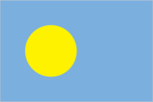
light blue with a large yellow disk (representing the moon) shifted slightly to the hoist side
Independence
still part of the US-administered UN trusteeship (the last polity remaining under the trusteeship; the Republic of the Marshall Islands, Federated States of Micronesia, and Commonwealth of the Northern Marianas have left); administered by the Office of Territorial and International Affairs, US Department of Interior
Judicial branch
Supreme Court
Leaders
Chief of State--President George Walker BUSH (since 20 January 1989), represented by High Commissioner Janet MCCOY (since NA); Head of Government--President Ngiratkel ETPISON (since 2 November 1988)
Legal system
based on Trust Territory laws, acts of the legislature, municipal, common, and customary laws
Legislative branch
bicameral Parliament (Olbiil Era Kelulau or OEK) consists of an upper house or Senate and a lower house or House of Delegates
Long-form name
Trust Territory of the Pacific Islands (no short-form name); may change to Republic of Palau after independence; note--Belau, the native form of Palau, is sometimes used
National holiday
Constitution Day, 9 July (1979)
Neeriyas, Koror (mailing address
P. O. Box 6028, Koror, Republic of Palau 96940); telephone 160-680-920 or 990
Political parties
no formal parties
Suffrage
universal at age 18
Type
UN trusteeship administered by the US; constitutional government signed a Compact of Free Association with the US on 10 January 1986, after approval in a series of UN-observed plebiscites; until the UN trusteeship is terminated with entry into force of the Compact, Palau remains under US administration as the Palau District of the Trust Territory of the Pacific Islands
Economy
Agriculture
subsistence-level production of coconut, copra, cassava, sweet potatoes
Aid
US commitments, including Ex-Im (FY70-87), $2 billion; Western (non-US) countries, ODA and OOF bilateral commitments (1970-87), $62.6 million
Budget
revenues $6.0 million; expenditures NA, including capital expenditures of NA (1986)
Currency
US currency is used
Electricity
16,000 kW capacity; 22 million kWh produced, 1,550 kWh per capita (1989)
Exchange rates
US currency is used
Exports
$0.5 million (f.o.b., 1986); commodities--NA; partners--US, Japan
External debt
$NA
Fiscal year
1 October-30 September
GDP
$31.6 million, per capita $2,260; real growth rate NA% (1986)
Imports
$27.2 million (c.i.f., 1986); commodities--NA; partners--US
Industrial production
growth rate NA%
Industries
tourism, craft items (shell, wood, pearl), some commercial fishing and agriculture
Inflation rate (consumer prices)
NA%
Overview
The economy consists primarily of subsistence agriculture and fishing. Tourism provides some foreign exchange, although the remote location of Palau and a shortage of suitable facilities has hindered development. The government is the major employer of the work force, relying heavily on financial assistance from the US.
Unemployment rate
20% (1986)
Communications
Airports
2 with permanent-surface runways 1,220-2,439 m
Highways
25.7 km paved macadam and concrete roads, otherwise stone-, coral-, or laterite-surfaced roads (1986)
Ports
Koror
Telecommunications
stations--1 AM, 1 FM, 1 TV; 1 Pacific Ocean INTELSAT earth station
Military and Security
Note
defense is the responsibility of the US and that will not change when the UN trusteeship terminates