1994 Edition
CIA World Factbook 1994 (Project Gutenberg)
Introduction
Administrative divisions
none (territory of Australia)
Affiliation
(territory of Australia)
Agriculture
Norfolk Island pine seed, Kentia palm seed, cereals, vegetables, fruit, cattle, poultry
Airports
total: 1 usable: 1 with permanent-surface runways: 1 with runways over 3,659 m: with runways 2,440-3,659 m: with runways 1,220-2,439 m: 1
Area
total area: 34.6 sq km land area: 34.6 sq km comparative area: about 0.2 times the size of Washington, DC
Budget
revenues: $NA expenditures: $4.2 million, including capital expenditures of $400,000 (1989 est.)
Capital
Kingston (administrative center); Burnt Pine (commercial center)
Climate
subtropical, mild, little seasonal temperature variation
Coastline
32 km
Constitution
Norfolk Island Act of 1979
Currency
1 Australian dollar ($A) = 100 cents
Digraph
NF
Diplomatic representation in US
none (territory of Australia)
Economic aid
none
Electricity
capacity: 7,000 kW production: 8 million kWh consumption per capita: 3,160 kWh (1990)
Environment
current issues: NA natural hazards: subject to typhoons (especially May to July) international agreements: NA
Ethnic divisions
descendants of the Bounty mutineers, Australian, New Zealander
Exchange rates
Australian dollars ($A) per US$1 - 1.4364 (January 1994), 1.4704 (1993), 1.3600 (1992), 1.2835 (1991), 1.2799 (1990), 1.2618 (1989)
Executive branch
chief of state: Queen ELIZABETH II (since 6 February 1952), represented by Administrator A. G. KERR (since NA April 1992), who is appointed by the Governor General of Australia head of government: Assembly President David Ernest BUFFETT (since NA May 1992) cabinet: Executive Council
Exports
$1.7 million (f.o.b., FY86) commodities: postage stamps, seeds of the Norfolk Island pine and Kentia palm, small quantities of avocados partners: Australia, Pacific Islands, NZ, Asia, Europe
External debt
$NA
Fiscal year
1 July - 30 June
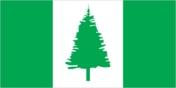
Flag
three vertical bands of green (hoist side), white, and green with a large green Norfolk Island pine tree centered in the slightly wider white band
Highways
total: 80 km paved: 53 km unpaved: earth, coral 27 km
Imports
$15.6 million (c.i.f., FY86) commodities: NA partners: Australia, Pacific Islands, NZ, Asia, Europe
Independence
none (territory of Australia)
Industrial production
growth rate NA%
Industries
tourism
Inflation rate (consumer prices)
NA%
International disputes
none
Irrigated land
NA sq km
Judicial branch
Supreme Court
Labor force
NA
Land boundaries
0 km
Land use
arable land: 0% permanent crops: 0% meadows and pastures: 25% forest and woodland: 0% other: 75%
Languages
English (official), Norfolk a mixture of 18th century English and ancient Tahitian
Legal system
wide legislative and executive responsibility under the Norfolk Island Act of 1979; Supreme Court
Legislative Assembly
elections last held 1989 (held every three years); results - percent of vote by party NA; seats - (9 total) percent of seats by party NA
Legislative branch
unicameral
Literacy
total population: NA% male: NA% female: NA%
Location
Southwestern Oceania, 1,575 km east of Australia in the South Pacific Ocean
Map references
Oceania
Maritime claims
exclusive fishing zone: 200 nm territorial sea: 3 nm
Member of
none
Names
conventional long form: Territory of Norfolk Island conventional short form: Norfolk Island
National holiday
Pitcairners Arrival Day Anniversary, 8 June (1856)
National product
GDP $NA
National product per capita
$NA
National product real growth rate
NA%
Nationality
noun: Norfolk Islander(s) adjective: Norfolk Islander(s)
Natural resources
fish
Note
defense is the responsibility of Australia
Overview
The primary economic activity is tourism, which has brought a level of prosperity unusual among inhabitants of the Pacific Islands. The number of visitors has increased steadily over the years and reached 29,000 in FY89. Revenues from tourism have given the island a favorable balance of trade and helped the agricultural sector to become self-sufficient in the production of beef, poultry, and eggs.
Political parties and leaders
NA
Population
2,710 (July 1994 est.)
Population growth rate
1.7% (1994 est.)
Ports
none; loading jetties at Kingston and Cascade
Religions
Anglican 39%, Roman Catholic 11.7%, Uniting Church in Australia 16.4%, Seventh-Day Adventist 4.4%, none 9.2%, unknown 16.9%, other 2.4% (1986)
Suffrage
18 years of age; universal
Telecommunications
1,500 radio receivers (1982); radio link service with Sydney; 987 telephones (1983); broadcast stations - 1 AM, no FM, no TV
Terrain
volcanic formation with mostly rolling plains
Type
territory of Australia
Unemployment rate
NA%
US diplomatic representation
none (territory of Australia)