2007 Edition
CIA World Factbook 2007 (Project Gutenberg)
Introduction
Administrative divisions
12 provinces (provincies, singular - provincie); Drenthe, Flevoland, Friesland (Fryslan), Gelderland, Groningen, Limburg, Noord-Brabant (North Brabant), Noord-Holland (North Holland), Overijssel, Utrecht, Zeeland, Zuid-Holland (South Holland)
Age structure
0-14 years: 18% (male 1,515,123/female 1,445,390) 15-64 years: 67.8% (male 5,656,448/female 5,525,481) 65 years and over: 14.2% (male 994,723/female 1,354,296) (2006 est.)
Agriculture - products
grains, potatoes, sugar beets, fruits, vegetables; livestock
Airports
27 (2006)
Airports - with paved runways
- over 3,047 m
- 2 2,438 to 3,047 m: 9 1,524 to 2,437 m: 3 914 to 1,523 m: 4
- total
- 20
- under 914 m
- 2 (2006)
Airports - with unpaved runways
- total
- 7 914 to 1,523 m: 3
- under 914 m
- 4 (2006)
Area
- land
- 33,883 sq km
- total
- 41,526 sq km
- water
- 7,643 sq km
Area - comparative
slightly less than twice the size of New Jersey
Background
The Dutch United Provinces declared their independence from Spain in 1579; during the 17th century, they became a leading seafaring and commercial power, with settlements and colonies around the world. After a 20-year French occupation, a Kingdom of the Netherlands was formed in 1815. In 1830 Belgium seceded and formed a separate kingdom. The Netherlands remained neutral in World War I, but suffered invasion and occupation by Germany in World War II. A modern, industrialized nation, the Netherlands is also a large exporter of agricultural products. The country was a founding member of NATO and the EEC (now the EU), and participated in the introduction of the euro in 1999. Geography Netherlands
Birth rate
10.9 births/1,000 population (2006 est.)
Budget
- expenditures
- $306.5 billion; including capital expenditures of $NA (2006 est.)
- revenues
- $304.3 billion
Capital
- daylight saving time
- +1hr, begins last Sunday in March; ends last Sunday in October
- geographic coordinates
- 52 23 N, 4 54 E
- name
- Amsterdam
- note
- The Hague (seat of government)
- time difference
- UTC+1 (6 hours ahead of Washington, DC during Standard Time)
Climate
temperate; marine; cool summers and mild winters
Coastline
451 km
Constitution
adopted 1815; amended many times, most recently in 2002
Country name
- conventional long form
- Kingdom of the Netherlands
- conventional short form
- Netherlands
- local long form
- Koninkrijk der Nederlanden
- local short form
- Nederland
Currency (code)
- euro (EUR)
- note
- on 1 January 1999, the European Monetary Union introduced the euro as a common currency to be used by financial institutions of member countries; on 1 January 2002, the euro became the sole currency for everyday transactions within the member countries
Currency code
EUR
Current account balance
$50.17 billion (2006 est.)
Death rate
8.68 deaths/1,000 population (2006 est.)
Debt - external
$1.899 trillion (30 June 2006)
Dependent areas
Aruba, Netherlands Antilles
Diplomatic representation from the US
- chief of mission
- Ambassador Roland E. ARNALL
- embassy
- Lange Voorhout 102, 2514 EJ, The Hague
- mailing address
- PSC 71, Box 1000, APO AE 09715
- telephone
- [31] (70) 310-2209
Diplomatic representation in the US
- chancery
- 4200 Linnean Avenue NW, Washington, DC 20008
- chief of mission
- Ambassador Christiaan Mark Johan KRONER
- telephone
- [1] (202) 244-5300
Disputes - international
none
Distribution of family income - Gini index
30.9 (2005)
Economic aid - donor
ODA, $4 billion (2003 est.)
Economy - overview
The Netherlands has a prosperous and open economy, which depends heavily on foreign trade. The economy is noted for stable industrial relations, moderate unemployment and inflation, a sizable current account surplus, and an important role as a European transportation hub. Industrial activity is predominantly in food processing, chemicals, petroleum refining, and electrical machinery. A highly mechanized agricultural sector employs no more than 2% of the labor force but provides large surpluses for the food-processing industry and for exports. The Netherlands, along with 11 of its EU partners, began circulating the euro currency on 1 January 2002. The country continues to be one of the leading European nations for attracting foreign direct investment. Economic growth slowed considerably in 2001-06, as part of the global economic slowdown, but for the four years before that, annual growth averaged nearly 4%, well above the EU average.
Electricity - consumption
102.4 billion kWh (2004)
Electricity - exports
5.2 billion kWh (2004)
Electricity - imports
21.4 billion kWh (2004)
Electricity - production
92.7 billion kWh (2004)
Electricity - production by source
- fossil fuel
- 89.9%
- hydro
- 0.1%
- nuclear
- 4.3%
- other
- 5.7% (2001)
Elevation extremes
- highest point
- Vaalserberg 322 m
- lowest point
- Zuidplaspolder -7 m
Environment - current issues
water pollution in the form of heavy metals, organic compounds, and nutrients such as nitrates and phosphates; air pollution from vehicles and refining activities; acid rain
Environment - international agreements
- party to
- Air Pollution, Air Pollution-Nitrogen Oxides, Air Pollution-Persistent Organic Pollutants, Air Pollution-Sulfur 85, Air Pollution-Sulfur 94, Air Pollution-Volatile Organic Compounds, Antarctic-Environmental Protocol, Antarctic-Marine Living Resources, Antarctic Treaty, Biodiversity, Climate Change, Climate Change-Kyoto Protocol, Desertification, Endangered Species, Environmental Modification, Hazardous Wastes, Kyoto Protocol, Law of the Sea, Marine Dumping, Marine Life Conservation, Ozone Layer Protection, Ship Pollution, Tropical Timber 83, Tropical Timber 94, Wetlands, Whaling
Ethnic groups
Dutch 83%, other 17% (of which 9% are non-Western origin mainly Turks, Moroccans, Antilleans, Surinamese, and Indonesians) (1999 est.)
Exchange rates
euros per US dollar - 0.79669 (2006), 0.8041 (2005), 0.8054 (2004), 0.886 (2003), 1.0626 (2002)
Executive branch
- cabinet
- Council of Ministers appointed by the monarch
- chief of state
- Queen BEATRIX (since 30 April 1980); Heir Apparent WILLEM-ALEXANDER (born 27 April 1967), son of the monarch
- elections
- none; the monarchy is hereditary; following Second Chamber elections, the leader of the majority party or leader of a majority coalition is usually appointed prime minister by the monarch; vice prime ministers appointed by the monarch
- head of government
- Prime Minister Jan Peter BALKENENDE (since 22 July 2002) and Deputy Prime Ministers Gerrit ZALM (since 27 May 2003) and Laurens Jan BRINKHORST (since 31 March 2005)
- note
- there is also a Council of State composed of the monarch, heir apparent, and councilors that provides consultations to the cabinet on legislative and administrative policy
Exports
$413.8 billion f.o.b. (2006 est.)
Exports - commodities
machinery and equipment, chemicals, fuels; foodstuffs
Exports - partners
Germany 24.9%, Belgium 13%, France 9.4%, UK 9.2%, Italy 5.7%, US 4.3%, Spain 4.1% (2005)
FAX
- [1] (202) 362-3430
- [31] (70) 361-4688
- consulate(s)
- Boston
- consulate(s) general
- Chicago, Los Angeles, Miami, New York
- consulate(s) general
- Amsterdam
Fiscal year
calendar year Communications Netherlands
Flag description
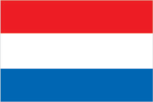
three equal horizontal bands of red (top), white, and blue; similar to the flag of Luxembourg, which uses a lighter blue and is longer; one of the oldest flags in constant use, originating with WILLIAM I, Prince of Orange, in the latter half of the 16th century Economy Netherlands
GDP - composition by sector
- agriculture
- 2.1%
- industry
- 23.9%
- services
- 73.9% (2006 est.)
GDP - per capita (PPP)
$31,700 (2006 est.)
GDP - real growth rate
2.9% (2006 est.)
GDP (official exchange rate)
$612.7 billion (2006 est.)
GDP (purchasing power parity)
$512 billion (2006 est.)
Geographic coordinates
52 30 N, 5 45 E
Geography - note
located at mouths of three major European rivers (Rhine, Maas or Meuse, and Schelde) People Netherlands
Government type
constitutional monarchy
Heliports
1 (2006)
HIV/AIDS - adult prevalence rate
0.2% (2001 est.)
HIV/AIDS - deaths
less than 100 (2003 est.)
HIV/AIDS - people living with HIV/AIDS
19,000 (2001 est.)
Household income or consumption by percentage share
- highest 10%
- 22.9% (1999)
- lowest 10%
- 2.5%
Illicit drugs
major European producer of ecstasy, illicit amphetamines, and other synthetic drugs; important gateway for cocaine, heroin, and hashish entering Europe; major source of US-bound ecstasy; large financial sector vulnerable to money laundering This page was last updated on 8 February, 2007
Imports
$373.8 billion f.o.b. (2006 est.)
Imports - commodities
machinery and transport equipment, chemicals, fuels, foodstuffs, clothing
Imports - partners
Germany 16.6%, Belgium 9.3%, China 8.8%, US 7.6%, UK 5.8%, France 4.7%, Russia 4.4% (2005)
Independence
23 January 1579 (the northern provinces of the Low Countries conclude the Union of Utrecht breaking with Spain; on 26 July 1581 they formally declared their independence with an Act of Abjuration; however, it was not until 30 January 1648 and the Peace of Westphalia that Spain recognized this independence)
Industrial production growth rate
2.3% (2006 est.)
Industries
agroindustries, metal and engineering products, electrical machinery and equipment, chemicals, petroleum, construction, microelectronics, fishing
Infant mortality rate
- female
- 4.38 deaths/1,000 live births (2006 est.)
- male
- 5.52 deaths/1,000 live births
- total
- 4.96 deaths/1,000 live births
Inflation rate (consumer prices)
1.4% (2006 est.)
International organization participation
AfDB, Arctic Council (observer), AsDB, Australia Group, Benelux, BIS, CBSS (observer), CE, CERN, EAPC, EBRD, EIB, EMU, ESA, EU, FAO, G-10, IADB, IAEA, IBRD, ICAO, ICC, ICCt, ICRM, IDA, IEA, IFAD, IFC, IFRCS, IHO, ILO, IMF, IMO, Interpol, IOC, IOM, IPU, ISO, ITU, ITUC, MIGA, MONUC, NAM (guest), NATO, NEA, NSG, OAS (observer), OECD, OPCW, OSCE, Paris Club, PCA, SECI (observer), UN, UNCTAD, UNESCO, UNHCR, UNIDO, UNMIS, UNRWA, UNTSO, UNWTO, UPU, WCL, WCO, WEU, WHO, WIPO, WMO, WTO, ZC
Internet country code
.nl
Internet hosts
8,363,158 (2006)
Internet Service Providers (ISPs)
52 (2000)
Internet users
10,806,328 (2004) Transportation Netherlands
Investment (gross fixed)
19.3% of GDP (2006 est.)
Irrigated land
5,650 sq km (2003)
Judicial branch
Supreme Court or Hoge Raad (justices are nominated for life by the monarch)
Labor force
7.6 million (2006 est.)
Labor force - by occupation
- agriculture
- 2%
- industry
- 19%
- services
- 79% (2004 est.)
Land boundaries
- border countries
- Belgium 450 km, Germany 577 km
- total
- 1,027 km
Land use
- arable land
- 21.96%
- other
- 77.27% (2005)
- permanent crops
- 0.77%
Languages
Dutch (official), Frisian (official)
Legal system
civil law system incorporating French penal theory; constitution does not permit judicial review of acts of the States General; accepts compulsory ICJ jurisdiction, with reservations
Legislative branch
- bicameral States General or Staten Generaal consists of the First Chamber or Eerste Kamer (75 seats; members indirectly elected by the country's 12 provincial councils for four-year terms) and the Second Chamber or Tweede Kamer (150 seats; members directly elected by popular vote to serve four-year terms)
- election results
- First Chamber - percent of vote by party - NA%; seats by party - CDA 23, PvdA 19, VVD 15, Green Party 5, Socialist Party 4, D66 3, other 6; Second Chamber - percent of vote by party - CDA 26.5%, PvdA 21.2%, Socialist Party 16.6%, VVD 14.6%, Party for Freedom 5.9%, Green Party 4.6%, Christian Union 4.0%; seats by party - CDA 41, PvdA 33, Socialist Party 25, VVD 22, Party for Freedom 9, Green Party 7, Christian Union 6, other 7
- elections
- First Chamber - last held 25 May 2003 (next to be held May 2007); Second Chamber - last held 22 November 2006 (next to be held by early 2011)
Life expectancy at birth
- female
- 81.67 years (2006 est.)
- male
- 76.39 years
- total population
- 78.96 years
Literacy
- definition
- age 15 and over can read and write
- female
- 99% (2003 est.) Government Netherlands
- male
- 99%
- total population
- 99%
Location
Western Europe, bordering the North Sea, between Belgium and Germany
Manpower available for military service
- females age 20-49
- 3,470,377 (2005 est.)
- males age 20-49
- 3,557,918
Manpower fit for military service
- females age 20-49
- 2,786,495 (2005 est.)
- males age 20-49
- 2,856,691
Manpower reaching military service age annually
- females age 20-49
- 95,818 (2005 est.)
- males age 18-49
- 99,934
Map references
Europe
Maritime claims
- exclusive fishing zone
- 200 nm
- territorial sea
- 12 nm
Median age
- female
- 40.2 years (2006 est.)
- male
- 38.6 years
- total
- 39.4 years
Merchant marine
- by type
- bulk carrier 29, cargo 345, chemical tanker 29, container 59, liquefied gas 12, passenger 14, passenger/cargo 14, petroleum tanker 16, refrigerated cargo 19, roll on/roll off 18, specialized tanker 3
- foreign-owned
- 157 (Australia 1, Belgium 2, Denmark 9, Finland 13, Germany 56, Ireland 10, Netherlands Antilles 1, Norway 7, Sweden 26, UK 19, US 13)
- registered in other countries
- 222 (Antigua and Barbuda 14, Australia 2, Austria 2, Bahamas 24, Canada 1, Cayman Islands 4, Cyprus 18, Gibraltar 5, Isle of Man 1, Liberia 29, Luxembourg 2, Malta 6, Marshall Islands 1, Netherlands Antilles 54, Norway 3, Panama 21, Philippines 19, Portugal 1, Saint Vincent and the Grenadines 5, Singapore 2, UK 3, US 4, unknown 1) (2006)
- total
- 558 ships (1000 GRT or over) 5,042,775 GRT/5,016,265 DWT
Military branches
Royal Netherlands Army, Royal Netherlands Navy (includes Naval Air Service and Marine Corps), Royal Netherlands Air Force (Koninklijke Luchtmacht, KLu), Royal Military Police, Defense Interservice Command (DICO) (2006)
Military expenditures - dollar figure
$9.408 billion (2004)
Military expenditures - percent of GDP
1.6% (2004) Transnational Issues Netherlands
Military service age and obligation
20 years of age for an all-volunteer force (2004)
National holiday
Queen's Day (Birthday of Queen-Mother JULIANA in 1909 and accession to the throne of her oldest daughter BEATRIX in 1980), 30 April
Nationality
- adjective
- Dutch
- noun
- Dutchman(men), Dutchwoman(women)
Natural gas - consumption
51.3 billion cu m (2004 est.)
Natural gas - exports
53.56 billion cu m (2004 est.)
Natural gas - imports
18.85 billion cu m (2004 est.)
Natural gas - production
85.98 billion cu m (2004 est.)
Natural gas - proved reserves
1.756 trillion cu m (1 January 2005 est.)
Natural hazards
flooding
Natural resources
natural gas, petroleum, peat, limestone, salt, sand and gravel, arable land
Net migration rate
2.72 migrant(s)/1,000 population (2006 est.)
Oil - consumption
946,700 bbl/day (2004 est.)
Oil - exports
1.418 million bbl/day (2001)
Oil - imports
2.284 million bbl/day (2001)
Oil - production
95,800 bbl/day (2004)
Oil - proved reserves
88.06 million bbl (1 January 2002)
Pipelines
condensate 81 km; gas 7,229 km; oil 578 km; refined products 716 km (2006)
Political parties and leaders
Christian Democratic Appeal or CDA [Jan Peter BALKENENDE]; Christian Union Party [Andre ROUVOET]; Democrats 66 or D66 [Alexander PECHTOLD]; Green Left Party [Femke HALSEMA]; Labor Party or PvdA [Wouter BOS]; List Pim Fortuyn [Olaf STUGER]; Party for Freedom [Geert WILDERS]; People's Party for Freedom and Democracy (Liberal) or VVD [Mark RUTTE]; Socialist Party [Jan MARIJNISSEN]; Party for Freedom or PVV [Geert WILDERS]; Party for the Animals or PvdD [Marianne THIEME]; Reformed Political Party of SGP [Bas VAN DER VLIES]; plus a few minor parties
Political pressure groups and leaders
Netherlands Trade Union Federation or FNV (consisting of a merger of Socialist and Catholic trade unions); Christian Trade Union Federation or CNV; Trade Union Federation of Middle and High Personnel or MHP; Federation of Catholic and Protestant Employers Associations; Interchurch Peace Council or IKV; large multinational firms; the nondenominational Federation of Netherlands Enterprises
Population
16,491,461 (July 2006 est.)
Population below poverty line
10.5% (1999)
Population growth rate
0.49% (2006 est.)
Ports and terminals
Amsterdam, Groningen, IJmuiden, Rotterdam, Terneuzen, Vlissingen, Zaanstad Military Netherlands
Public debt
50.8% of GDP (2006 est.)
Radio broadcast stations
AM 4, FM 246, shortwave 3 (2004)
Radios
15.3 million (1996)
Railways
- standard gauge
- 2,808 km 1.435-m gauge (2,061 km electrified) (2005)
- total
- 2,808 km
Religions
Roman Catholic 31%, Dutch Reformed 13%, Calvinist 7%, Muslim 5.5%, other 2.5%, none 41% (2002)
Reserves of foreign exchange and gold
$10.24 billion (August 2006 est.)
Roadways
- total
- 134,000 km (including 3,270 km of expressways) (2004)
Sex ratio
- at birth
- 1.05 male(s)/female
- total population
- 0.98 male(s)/female (2006 est.)
- under 15 years
- 1.05 male(s)/female 15-64 years: 1.02 male(s)/female 65 years and over: 0.73 male(s)/female
Suffrage
18 years of age; universal
Telephone system
- domestic
- extensive fixed-line fiber-optic network; cellular telephone system is one of the largest in Europe with five major network operators utilizing the third generation of the Global System for Mobile Communications (GSM)
- general assessment
- highly developed and well maintained
- international
- country code - 31; 9 submarine cables; satellite earth stations - 3 Intelsat (1 Indian Ocean and 2 Atlantic Ocean), 1 Eutelsat, and 1 Inmarsat (Atlantic and Indian Ocean regions) (2004)
Telephones - main lines in use
7.6 million (2005)
Telephones - mobile cellular
15.834 million (2005)
Television broadcast stations
21 (plus 26 repeaters) (1995)
Televisions
8.1 million (1997)
Terrain
mostly coastal lowland and reclaimed land (polders); some hills in southeast
Total fertility rate
1.66 children born/woman (2006 est.)
Unemployment rate
5.5% (2006 est.)
Waterways
6,183 km (navigable for ships of 50 tons) (2005)