2023 Edition
CIA World Factbook 2023 (factbook.json @ 0d4fa4984ecb)
Introduction
Background
In 788, about a century after the Arab conquest of North Africa, a series of Moroccan Muslim dynasties began to rule in Morocco. In the 16th century, the Sa'adi monarchy, particularly under Ahmad al-MANSUR (1578-1603), repelled foreign invaders and inaugurated a golden age. The Alaouite Dynasty, to which the current Moroccan royal family belongs, dates from the 17th century. In 1860, Spain occupied northern Morocco and ushered in a half-century of trade rivalry among European powers that saw Morocco's sovereignty steadily erode; in 1912, the French imposed a protectorate over the country. A protracted independence struggle with France ended successfully in 1956. The internationalized city of Tangier and most Spanish possessions were turned over to the new country that same year. Sultan MOHAMMED V, the current monarch's grandfather, organized the new state as a constitutional monarchy and in 1957 assumed the title of king. Since Spain's 1976 withdrawal from Western Sahara, Morocco has extended its de facto administrative control to roughly 75% of this territory; however, the UN does not recognize Morocco as the administering power for Western Sahara. The UN since 1991 has monitored a cease-fire, which broke down in late 2020, between Morocco and the Polisario Front - an organization advocating the territory’s independence - and restarted negotiations over the status of the territory in December 2018. On 10 December 2020, the US recognized Morocco's sovereignty over all of Western Sahara. King MOHAMMED VI in early 2011 responded to the spread of pro-democracy protests in the North Africa region by implementing a reform program that included a new constitution, passed by popular referendum in July 2011, under which some new powers were extended to parliament and the prime minister, but ultimate authority remains in the hands of the monarch. In November 2011, the Justice and Development Party (PJD) - a moderate Islamist party - won the largest number of seats in parliamentary elections, becoming the first Islamist party to lead the Moroccan Government. In September 2015, Morocco held its first direct elections for regional councils, one of the reforms included in the 2011 constitution. The PJD again won the largest number of seats in nationwide parliamentary elections in October 2016, but it lost its plurality to the probusiness National Rally of Independents (RNI) in September 2021. In December 2020, Morocco signed a normalization agreement with Israel, similar to those that Bahrain, the United Arab Emirates, and Sudan had concluded with Israel earlier in 2020.
Geography
Area
- land
- 716,300 sq km
- total
- 716,550 sq km
- water
- 250 sq km
Area - comparative
slightly larger than twice the size of California
Climate
- Mediterranean in the north, becoming more extreme in the interior; in the south, hot, dry desert; rain is rare; cold offshore air currents produce fog and heavy dew
- note
- note: data does not include former Western Sahara
Coastline
2,945 km
Elevation
- highest point
- Jebel Toubkal 4,165 m
- lowest point
- Sebkha Tah -59 m
- mean elevation
- 909 m
Geographic coordinates
28 30 N, 10 00 W
Geography - note
strategic location along Strait of Gibraltar; the only African nation to have both Atlantic and Mediterranean coastlines; the waters off the Atlantic coast are particularly rich fishing areas
Irrigated land
17,645 sq km (2019)
Land boundaries
- border countries
- Algeria 1,941 km; Mauritania 1,564 km; Spain (Ceuta) 8 km and Spain (Melilla) 10.5 km
- note
- note: an additional 75-meter border segment exists between Morocco and the Spanish exclave of Penon de Velez de la Gomera
- total
- 3,523.5 km
Land use
- agricultural land
- 67.5% (2018 est.)
- agricultural land: arable land
- arable land: 17.5% (2018 est.)
- agricultural land: permanent crops
- permanent crops: 2.9% (2018 est.)
- agricultural land: permanent pasture
- permanent pasture: 47.1% (2018 est.)
- forest
- 11.5% (2018 est.)
- note
- note: does not include the area of the former Western Sahara, which is almost exclusively desert
- other
- 21% (2018 est.)
Location
Northern Africa, bordering the North Atlantic Ocean and the Mediterranean Sea, between Algeria and Mauritania
Major rivers (by length in km)
Draa - 1,100 km
Map references
Africa
Maritime claims
- contiguous zone
- 24 nm
- continental shelf
- 200-m depth or to the depth of exploitation
- exclusive economic zone
- 200 nm
- territorial sea
- 12 nm
Natural hazards
in the north, the mountains are geologically unstable and subject to earthquakes; periodic droughts; windstorms; flash floods; landslides; in the south, a hot, dry, dust/sand-laden sirocco wind can occur during winter and spring; widespread harmattan haze exists 60% of time, often severely restricting visibility
Natural resources
phosphates, iron ore, manganese, lead, zinc, fish, salt
Population distribution
the highest population density is found along the Atlantic and Mediterranean coasts; a number of densely populated agglomerations are found scattered through the Atlas Mountains as shown in this population distribution map
Terrain
mountainous northern coast (Rif Mountains) and interior (Atlas Mountains) bordered by large plateaus with intermontane valleys, and fertile coastal plains; the south is mostly low, flat desert with large areas of rocky or sandy surfaces
People and Society
Age structure
- 0-14 years
- 26.01% (male 4,919,266/female 4,722,463)
- 15-64 years
- 65.92% (male 12,124,939/female 12,311,552)
- 65 years and over
- 8.06% (2023 est.) (male 1,455,355/female 1,533,845)
- note
- note: does not include data from the former Western Sahara
Alcohol consumption per capita
- beer
- 0.18 liters of pure alcohol (2019 est.)
- other alcohols
- 0 liters of pure alcohol (2019 est.)
- spirits
- 0.09 liters of pure alcohol (2019 est.)
- total
- 0.51 liters of pure alcohol (2019 est.)
- wine
- 0.24 liters of pure alcohol (2019 est.)
Birth rate
- 17.1 births/1,000 population (2023 est.)
- note
- note: does not include data from the former Western Sahara
Child marriage
- women married by age 15
- 0.5%
- women married by age 18
- 13.7% (2018 est.)
Children under the age of 5 years underweight
- 2.8% (2019/20)
- note
- note: does not include data from the former Western Sahara
Contraceptive prevalence rate
- 70.8% (2018)
- note
- note: does not include data from the former Western Sahara
Current health expenditure
- 6% of GDP (2020)
- note
- note: does not include data from the former Western Sahara
Currently married women (ages 15-49)
58.8% (2023 est.)
Death rate
- 6.6 deaths/1,000 population (2023 est.)
- note
- note: does not include data from the former Western Sahara
Demographic profile
Morocco is undergoing a demographic transition. Its population is growing but at a declining rate, as people live longer and women have fewer children. Infant, child, and maternal mortality rates have been reduced through better health care, nutrition, hygiene, and vaccination coverage, although disparities between urban and rural and rich and poor households persist. Morocco’s shrinking child cohort reflects the decline of its total fertility rate from 5 in mid-1980s to 2.2 in 2010, which is a result of increased female educational attainment, higher contraceptive use, delayed marriage, and the desire for smaller families. Young adults (persons aged 15-29) make up almost 26% of the total population and represent a potential economic asset if they can be gainfully employed. Currently, however, many youths are unemployed because Morocco’s job creation rate has not kept pace with the growth of its working-age population. Most youths who have jobs work in the informal sector with little security or benefits.During the second half of the 20th century, Morocco became one of the world’s top emigration countries, creating large, widely dispersed migrant communities in Western Europe. The Moroccan Government has encouraged emigration since its independence in 1956, both to secure remittances for funding national development and as an outlet to prevent unrest in rebellious (often Berber) areas. Although Moroccan labor migrants earlier targeted Algeria and France, the flood of Moroccan "guest workers" from the mid-1960s to the early 1970s spread widely across northwestern Europe to fill unskilled jobs in the booming manufacturing, mining, construction, and agriculture industries. Host societies and most Moroccan migrants expected this migration to be temporary, but deteriorating economic conditions in Morocco related to the 1973 oil crisis and tighter European immigration policies resulted in these stays becoming permanent.A wave of family migration followed in the 1970s and 1980s, with a growing number of second generation Moroccans opting to become naturalized citizens of their host countries. Spain and Italy emerged as new destination countries in the mid-1980s, but their introduction of visa restrictions in the early 1990s pushed Moroccans increasingly to migrate either legally by marrying Moroccans already in Europe or illegally to work in the underground economy. Women began to make up a growing share of these labor migrants. At the same time, some higher-skilled Moroccans went to the US and Quebec, Canada.In the mid-1990s, Morocco developed into a transit country for asylum seekers from Sub-Saharan Africa and illegal labor migrants from Sub-Saharan Africa and South Asia trying to reach Europe via southern Spain, Spain’s Canary Islands, or Spain’s North African enclaves, Ceuta and Melilla. Forcible expulsions by Moroccan and Spanish security forces have not deterred these illegal migrants or calmed Europe’s security concerns. Rabat remains unlikely to adopt an EU agreement to take back third-country nationals who have entered the EU illegally via Morocco. Thousands of other illegal migrants have chosen to stay in Morocco until they earn enough money for further travel or permanently as a "second-best" option. The launching of a regularization program in 2014 legalized the status of some migrants and granted them equal access to education, health care, and work, but xenophobia and racism remain obstacles.
Dependency ratios
- elderly dependency ratio
- 11.3
- note
- note: does not include data from the former Western Sahara
- potential support ratio
- 8.9 (2021 est.)
- total dependency ratio
- 52.2
- youth dependency ratio
- 40.9
Drinking water source
- improved: rural
- rural: 79.1% of population
- improved: total
- total: 91% of population
- improved: urban
- urban: 98.3% of population
- note
- note: does not include data from the former Western Sahara
- unimproved: rural
- rural: 20.9% of population
- unimproved: total
- total: 9% of population (2017 est.)
- unimproved: urban
- urban: 1.7% of population
Education expenditures
- 6.8% of GDP (2020)
- note
- note: does not include data from the former Western Sahara
Ethnic groups
- Arab-Berber 99%, other 1%
- note
- note: does not include data from the former Western Sahara
Gross reproduction rate
1.11 (2023 est.)
Hospital bed density
- 1 beds/1,000 population (2017)
- note
- note: does not include data from the former Western Sahara
Infant mortality rate
- female
- 16.4 deaths/1,000 live births
- male
- 20.9 deaths/1,000 live births
- note
- note: does not include data from the former Western Sahara
- total
- 18.7 deaths/1,000 live births (2023 est.)
Languages
- Languages
- Arabic (official), Berber languages (Tamazight (official), Tachelhit, Tarifit), French (often the language of business, government, and diplomacy); note - the proportion of Berber speakers is disputed
- major-language sample(s)
- كتاب ديال لحقائق متاع العالم، احسن مصدر متاع المعلومات الأساسية (Arabic)The World Factbook, the indispensable source for basic information.
Life expectancy at birth
- female
- 75.7 years
- male
- 72.3 years
- note
- note: does not include data from the former Western Sahara
- total population
- 74 years (2023 est.)
Literacy
- definition
- age 15 and over can read and write
- female
- 67.4% (2021)
- male
- 84.8%
- note
- note: does not include data from the former Western Sahara
- total population
- 75.9%
Major urban areas - population
3.893 million Casablanca, 1.959 million RABAT (capital), 1.290 million Fes, 1.314 million Tangier, 1.050 million Marrakech, 979,000 Agadir (2023)
Maternal mortality ratio
- 72 deaths/100,000 live births (2020 est.)
- note
- note: does not include data from the former Western Sahara
Median age
- female
- 30.7 years
- male
- 29.8 years
- note
- note: does not include data from the former Western Sahara
- total
- 30.2 years (2023 est.)
Nationality
- adjective
- Moroccan
- noun
- Moroccan(s)
Net migration rate
- -1.7 migrant(s)/1,000 population (2023 est.)
- note
- note: does not include data from the former Western Sahara
Obesity - adult prevalence rate
- 26.1% (2016)
- note
- note: does not include data from the former Western Sahara
Physicians density
- 0.73 physicians/1,000 population (2017)
- note
- note: does not include data from the former Western Sahara
Population
- 37,067,420 (2023 est.)
- note
- note: includes Western Sahara
Population distribution
the highest population density is found along the Atlantic and Mediterranean coasts; a number of densely populated agglomerations are found scattered through the Atlas Mountains as shown in this population distribution map
Population growth rate
- 0.88% (2023 est.)
- note
- note: does not include data from the former Western Sahara
Religions
- Muslim 99% (official; virtually all Sunni, <0.1% Shia), other 1% (includes Christian, Jewish, and Baha'i); note - Jewish about 3,000-3,500 (2020 est.)
- note
- note: does not include data from the former Western Sahara
Sanitation facility access
- improved: rural
- rural: 72.4% of population
- improved: total
- total: 88.8% of population
- improved: urban
- urban: 98.2% of population
- note
- note: does not include data from the former Western Sahara
- unimproved: rural
- rural: 27.6% of population
- unimproved: total
- total: 11.2% of population (2020 est.)
- unimproved: urban
- urban: 1.8% of population
School life expectancy (primary to tertiary education)
- female
- 14 years (2021)
- male
- 14 years
- note
- note: does not include data from the former Western Sahara
- total
- 14 years
Sex ratio
- 0-14 years
- 1.04 male(s)/female
- 15-64 years
- 0.98 male(s)/female
- 65 years and over
- 0.95 male(s)/female
- at birth
- 1.05 male(s)/female
- note
- note: does not include data from the former Western Sahara
- total population
- 1 male(s)/female (2023 est.)
Tobacco use
- female
- 0.8% (2020 est.)
- male
- 28.2% (2020 est.)
- total
- 14.5% (2020 est.)
Total fertility rate
- 2.27 children born/woman (2023 est.)
- note
- note: does not include data from the former Western Sahara
Urbanization
- note
- note: data does not include former Western Sahara
- rate of urbanization
- 1.88% annual rate of change (2020-25 est.)
- urban population
- 65.1% of total population (2023)
Youth unemployment rate (ages 15-24)
- female
- 28.7%
- male
- 26.7%
- note
- note: does not include data from the former Western Sahara
- total
- 27.2% (2021 est.)
Government
Administrative divisions
- 12 regions; Beni Mellal-Khenifra, Casablanca-Settat, Dakhla-Oued Ed-Dahab, Draa-Tafilalet, Fes-Meknes, Guelmim-Oued Noun, Laayoune-Sakia El Hamra, Marrakech-Safi, Oriental, Rabat-Sale-Kenitra, Souss-Massa, Tanger-Tetouan-Al Hoceima
- note
- note: effective 10 December 2020, the US Government recognizes the sovereignty of Morocco over all of the territory of former Western Sahara
Capital
- etymology
- name derives from the Arabic title "Ribat el-Fath," meaning "stronghold of victory," applied to the newly constructed citadel in 1170
- geographic coordinates
- 34 01 N, 6 49 W
- name
- Rabat
- time difference
- UTC+1 (6 hours ahead of Washington, DC, during Standard Time)
Citizenship
- citizenship by birth
- no
- citizenship by descent only
- the father must be a citizen of Morocco; if the father is unknown or stateless, the mother must be a citizen
- dual citizenship recognized
- yes
- residency requirement for naturalization
- 5 years
Constitution
- amendments
- proposed by the king, by the prime minister, or by members in either chamber of Parliament; passage requires at least two-thirds majority vote by both chambers and approval in a referendum; the king can opt to submit self-initiated proposals directly to a referendum
- history
- several previous; latest drafted 17 June 2011, approved by referendum 1 July 2011; note - sources disagree on whether the 2011 referendum was for a new constitution or for reforms to the previous constitution
Country name
- conventional long form
- Kingdom of Morocco
- conventional short form
- Morocco
- etymology
- the English name "Morocco" derives from, respectively, the Spanish and Portuguese names "Marruecos" and "Marrocos," which stem from "Marrakesh" the Latin name for the former capital of ancient Morocco; the Arabic name "Al Maghrib" translates as "The West"
- former
- French Protectorate in Morocco, Spanish Protectorate in Morocco, Ifni, Spanish Sahara, Western Sahara
- local long form
- Al Mamlakah al Maghribiyah
- local short form
- Al Maghrib
Diplomatic representation from the US
- chief of mission
- Ambassador Puneet TALWAR (since 4 November 2022)
- consulate(s) general
- Casablanca
- email address and website
- ACSCasablanca@state.gov (US Consulate General Casablanca)https://ma.usembassy.gov/
- embassy
- Km 5.7 Avenue Mohammed VI, Souissi, Rabat 10170
- FAX
- [212] 0537-637-201
- mailing address
- 9400 Rabat Place, Washington DC 20521-9400
- telephone
- [212] 0537-637-200
Diplomatic representation in the US
- chancery
- 3508 International Drive NW, Washington, DC 20008
- chief of mission
- Ambassador Lalla JOUMALA Alaoui (since 24 April 2017)
- consulate(s) general
- New York
- email address and website
- washingtonembmorocco@maec.gov.ma
- FAX
- [1] (202) 265-0161
- telephone
- [1] (202) 462-7979
Executive branch
- cabinet
- Council of Ministers chosen by the prime minister in consultation with Parliament and appointed by the monarch; the monarch chooses the ministers of Interior, Foreign Affairs, Islamic Affairs, and National Defense Administration
- chief of state
- King MOHAMMED VI (since 30 July 1999)
- elections/appointments
- the monarchy is hereditary; prime minister appointed by the monarch from the majority party following legislative elections
- head of government
- Prime Minister Aziz AKHANNOUCH (since 7 October 2021)
Flag description
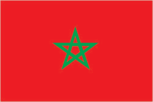
red with a green pentacle (five-pointed, linear star) known as Sulayman's (Solomon's) seal in the center of the flag; red and green are traditional colors in Arab flags, although the use of red is more commonly associated with the Arab states of the Persian Gulf; the pentacle represents the five pillars of Islam and signifies the association between God and the nation; design dates to 1912
Government type
parliamentary constitutional monarchy
Independence
2 March 1956 (from France)
International law organization participation
has not submitted an ICJ jurisdiction declaration; non-party state to the ICCt
International organization participation
ABEDA, AfDB, AFESD, AMF, AMU, AU, CAEU, CD, EBRD, FAO, G-11, G-77, IAEA, IBRD, ICAO, ICC (national committees), ICRM, IDA, IDB, IFAD, IFC, IFRCS, IHO, ILO, IMF, IMO, IMSO, Interpol, IOC, IOM, IPU, ISO, ITSO, ITU, ITUC (NGOs), LAS, MIGA, MONUSCO, NAM, OAS (observer), OIC, OIF, OPCW, OSCE (partner), Pacific Alliance (observer), Paris Club (associate), PCA, SICA (observer), UN, UNCTAD, UNESCO, UNHCR, UNIDO, UNOCI, UNOOSA, UNSC (temporary), UNWTO, UPU, WCO, WHO, WIPO, WMO, WTO
Judicial branch
- highest court(s)
- Supreme Court or Court of Cassation (consists of 5-judge panels organized into civil, family matters, commercial, administrative, social, and criminal sections); Constitutional Court (consists of 12 members)
- judge selection and term of office
- Supreme Court judges appointed by the Superior Council of Judicial Power, a 20-member body presided over by the monarch, which includes the Supreme Court president, the prosecutor general, representatives of the appeals and first instance courts (among them 1 woman magistrate), the president of the National Council for Human Rights (CNDH), and 5 "notable persons" appointed by the monarch; judges appointed for life; Constitutional Court members - 6 designated by the monarch and 6 elected by Parliament; court president appointed by the monarch from among the court members; members serve 9-year nonrenewable terms
- subordinate courts
- courts of appeal; High Court of Justice; administrative and commercial courts; regional and Sadad courts (for religious, civil and administrative, and penal adjudication); first instance courts
Legal system
mixed legal system of civil law based on French civil law and Islamic (sharia) law; judicial review of legislative acts by Constitutional Court
Legislative branch
- description
- bicameral Parliament consists of:House of Councillors or Majlis al-Mustacharine (120 seats; members indirectly elected by an electoral college of local councils, professional organizations, and labor unions; members serve 6-year terms)House of Representatives or Majlis al-Nuwab (395 seats; 305 members directly elected in multi-seat constituencies by proportional representation vote and 90 directly elected in a single nationwide constituency by proportional representation vote; members serve 5-year terms); note - 60 seats reserved for women and 30 seats for those under age 40 in regional multi-seat constituencies, with the seats divided proportionally among the 12 regions by population size of the region
- election results
- House of Councillors - percent of vote by party - NA; seats by party - RNI 27, PAM 19, PI 17, MP 12, USFP 8, UGIM 6, CDT 3, PJD 3, UC 2, UMT 2, Amal 1, FDT 1, MDS 1, PRD 1, independent 1; composition as of October 2021) men 105, women 15, percent of women 12.5% House of Representatives - percent of vote by party NA; seats by party - RNI 102, PAM 87, PI 81, USFP 34, MP 28, PPS 22, UC 18, PJD 13, MDS 5, other 5; composition as of July 2022 - men 305, women 90, percent of women 24.1%; note - overall percent of women in Parliament 21.4%
- elections
- House of Councillors - last held on 5 October 2021 (next to be held by 31 October 2027)House of Representatives - last held on 8 September 2021 (next to be held by 30 September 2026)
National anthem
- lyrics/music
- Ali Squalli HOUSSAINI/Leo MORGAN
- name
- "Hymne Cherifien" (Hymn of the Sharif)
- note
- note: music adopted 1956, lyrics adopted 1970
National heritage
- selected World Heritage Site locales
- Medina of Fez; Medina of Marrakesh; Ksar of Ait-Ben-Haddou; Historic City of Meknes; Archaeological Site of Volubilis; Medina of Tétouan (formerly known as Titawin); Medina of Essaouira (formerly Mogador); Portuguese City of Mazagan (El Jadida); Historic and Modern Rabat
- total World Heritage Sites
- 9 (all cultural)
National holiday
Throne Day (accession of King MOHAMMED VI to the throne), 30 July (1999)
National symbol(s)
pentacle symbol, lion; national colors: red, green
Political parties and leaders
Action Party or PA [Mohammed EL IDRISSI]Amal (hope) Party [Mohamed BANI]An-Nahj Ad-Dimocrati or An-Nahj or Democratic Way [Mustapha BRAHMA]Authenticity and Modernity Party or PAM [Abdellatif OUAHBI]Constitutional Union Party or UC [Mohamed JOUDAR]Democratic and Social Movement or MDS [Abdessamad ARCHANE]Democratic Forces Front or FFD [Mustapha BENALI]Environment and Sustainable Development Party or PEDD [Karim HRITANE]Federation of the Democratic Left or FGD [Abdesalam EL AZIZ]Green Left Party or PGV [Mohamed FARES]Istiqlal (Independence) Party or PI [Nizar BARAKA]Moroccan Liberal Party or PML [Isaac CHARIA]Moroccan Union for Democracy or UMD [Jamal MANDRI]National Democratic Party [Moussa SAADI]National Rally of Independents or RNI [Aziz AKHANNOUCH]Neo-Democrats Party [Mohamed DARIF]Party of Development Reform or PRD [Abderrahmane EL KOHEN]Party of Justice and Development or PJD [Abdelilah BENKIRANE]Party of Liberty and Social Justice or PLJS [Miloud MOUSSAOUI]Party of Progress and Socialism or PPS [Nabil BENABDELLAH]Popular Movement or MP [Mohammed OUZZINE]Renaissance and Virtue Party or PRV [Mohamed KHALIDI]Renaissance Party [Said EL GHENNIOUI]Renewal and Equity Party or PRE [Chakir ACHEHABAR]Shoura (consultation) and Istiqlal Party [Ahmed BELGHAZI]Socialist Union of Popular Forces or USFP [Driss LACHGAR]Unified Socialist Party or GSU [Nabila MOUNIB]Unity and Democracy Party [Ahmed FITRI]
Suffrage
18 years of age; universal
Economy
Agricultural products
wheat, sugar beet, milk, potatoes, olives, tangerines/mandarins, tomatoes, oranges, barley, onions
Average household expenditures
- on alcohol and tobacco
- 1.4% of household expenditures (2018 est.)
- on food
- 34% of household expenditures (2018 est.)
Budget
- expenditures
- $35.591 billion (2019 est.)
- revenues
- $30.697 billion (2019 est.)
Budget surplus (+) or deficit (-)
-3.6% (of GDP) (2017 est.)
Credit ratings
- Fitch rating
- BB+ (2020)
- Moody's rating
- Ba1 (1999)
- note
- note: The year refers to the year in which the current credit rating was first obtained.
- Standard & Poors rating
- BBB- (2010)
Current account balance
- Current account balance 2019
- -$4.407 billion (2019 est.)
- Current account balance 2020
- -$1.368 billion (2020 est.)
- Current account balance 2021
- -$3.261 billion (2021 est.)
Debt - external
- Debt - external 2018
- $51.851 billion (2018 est.)
- Debt - external 2019
- $52.957 billion (2019 est.)
Economic overview
lower middle-income North African economy; ongoing recovery from recent drought; rebounding via tourism, manufacturing, and aeronautics industries; major US free trade agreement; developing energy exporter
Exchange rates
- Currency
- Moroccan dirhams (MAD) per US dollar -
- Exchange rates 2017
- 9.692 (2017 est.)
- Exchange rates 2018
- 9.386 (2018 est.)
- Exchange rates 2019
- 9.617 (2019 est.)
- Exchange rates 2020
- 9.497 (2020 est.)
- Exchange rates 2021
- 8.988 (2021 est.)
Exports
- Exports 2019
- $44.048 billion (2019 est.) note: data are in current year dollars
- Exports 2020
- $37.545 billion (2020 est.) note: data are in current year dollars
- Exports 2021
- $47.078 billion (2021 est.) note: data are in current year dollars
Exports - commodities
cars, fertilizers, insulated wiring, phosphoric acid, clothing and apparel (2021)
Exports - partners
Spain 20%, France 19%, India 5%, Brazil 5%, Italy 5% (2021)
Fiscal year
calendar year
GDP - composition, by end use
- exports of goods and services
- 37.1% (2017 est.)
- government consumption
- 18.9% (2017 est.)
- household consumption
- 58% (2017 est.)
- imports of goods and services
- -46.6% (2017 est.)
- investment in fixed capital
- 28.4% (2017 est.)
- investment in inventories
- 4.2% (2017 est.)
GDP - composition, by sector of origin
- agriculture
- 14% (2017 est.)
- industry
- 29.5% (2017 est.)
- services
- 56.5% (2017 est.)
GDP (official exchange rate)
$118.858 billion (2019 est.)
Gini Index coefficient - distribution of family income
- Gini Index coefficient - distribution of family income 2013
- 39.5 (2013 est.)
Household income or consumption by percentage share
- highest 10%
- 33.2% (2007)
- lowest 10%
- 2.7%
Imports
- Imports 2019
- $54.097 billion (2019 est.) note: data are in current year dollars
- Imports 2020
- $46.358 billion (2020 est.) note: data are in current year dollars
- Imports 2021
- $60.047 billion (2021 est.) note: data are in current year dollars
Imports - commodities
refined petroleum, cars and vehicle parts, natural gas, wheat, coal (2021)
Imports - partners
Spain 19%, France 11%, China 9%, United States 7%, Germany 5%, Turkey 5%, Italy 5% (2019)
Industrial production growth rate
6.84% (2021 est.)
Industries
automotive parts, phosphate mining and processing, aerospace, food processing, leather goods, textiles, construction, energy, tourism
Inflation rate (consumer prices)
- Inflation rate (consumer prices) 2019
- 0.3% (2019 est.)
- Inflation rate (consumer prices) 2020
- 0.71% (2020 est.)
- Inflation rate (consumer prices) 2021
- 1.4% (2021 est.)
Labor force
11.814 million (2021 est.)
Labor force - by occupation
- agriculture
- 39.1%
- industry
- 20.3%
- services
- 40.5% (2014 est.)
Population below poverty line
4.8% (2013 est.)
Public debt
- Public debt 2016
- 64.9% of GDP (2016 est.)
- Public debt 2017
- 65.1% of GDP (2017 est.)
Real GDP (purchasing power parity)
- note
- note: data are in 2017 dollars
- Real GDP (purchasing power parity) 2019
- $302.813 billion (2019 est.)
- Real GDP (purchasing power parity) 2020
- $281.049 billion (2020 est.)
- Real GDP (purchasing power parity) 2021
- $303.336 billion (2021 est.)
Real GDP growth rate
- Real GDP growth rate 2019
- 2.89% (2019 est.)
- Real GDP growth rate 2020
- -7.19% (2020 est.)
- Real GDP growth rate 2021
- 7.93% (2021 est.)
Real GDP per capita
- note
- note: data are in 2017 dollars
- Real GDP per capita 2019
- $8,200 (2019 est.)
- Real GDP per capita 2020
- $7,500 (2020 est.)
- Real GDP per capita 2021
- $8,100 (2021 est.)
Reserves of foreign exchange and gold
- Reserves of foreign exchange and gold 31 December 2019
- $26.413 billion (31 December 2019 est.)
- Reserves of foreign exchange and gold 31 December 2020
- $35.998 billion (31 December 2020 est.)
- Reserves of foreign exchange and gold 31 December 2021
- $35.648 billion (31 December 2021 est.)
Taxes and other revenues
20.02% (of GDP) (2020 est.)
Unemployment rate
- Unemployment rate 2019
- 9.28% (2019 est.)
- Unemployment rate 2020
- 11.45% (2020 est.)
- Unemployment rate 2021
- 11.47% (2021 est.)
Youth unemployment rate (ages 15-24)
- female
- 28.7%
- male
- 26.7%
- note
- note: does not include data from the former Western Sahara
- total
- 27.2% (2021 est.)
Energy
Carbon dioxide emissions
- from coal and metallurgical coke
- 20.267 million metric tonnes of CO2 (2019 est.)
- from consumed natural gas
- 2.099 million metric tonnes of CO2 (2019 est.)
- from petroleum and other liquids
- 37.834 million metric tonnes of CO2 (2019 est.)
- total emissions
- 60.2 million metric tonnes of CO2 (2019 est.)
Coal
- consumption
- 9.321 million metric tons (2020 est.)
- exports
- 0 metric tons (2020 est.)
- imports
- 9.321 million metric tons (2020 est.)
- production
- 0 metric tons (2020 est.)
- proven reserves
- 14 million metric tons (2019 est.)
Electricity
- consumption
- 29,447,883,000 kWh (2019 est.)
- exports
- 624 million kWh (2020 est.)
- imports
- 856 million kWh (2020 est.)
- installed generating capacity
- 14.187 million kW (2020 est.)
- transmission/distribution losses
- 6.703 billion kWh (2019 est.)
Electricity access
- electrification - total population
- 100% (2021)
Electricity generation sources
- biomass and waste
- 0% of total installed capacity (2020 est.)
- fossil fuels
- 81.6% of total installed capacity (2020 est.)
- geothermal
- 0% of total installed capacity (2020 est.)
- hydroelectricity
- 4.4% of total installed capacity (2020 est.)
- nuclear
- 0% of total installed capacity (2020 est.)
- solar
- 1.1% of total installed capacity (2020 est.)
- tide and wave
- 0% of total installed capacity (2020 est.)
- wind
- 13% of total installed capacity (2020 est.)
Energy consumption per capita
- Total energy consumption per capita 2019
- 24.59 million Btu/person (2019 est.)
Natural gas
- consumption
- 1,051,658,000 cubic meters (2019 est.)
- exports
- 0 cubic meters (2021 est.)
- imports
- 950.765 million cubic meters (2019 est.)
- production
- 105.678 million cubic meters (2019 est.)
- proven reserves
- 1.444 billion cubic meters (2021 est.)
Petroleum
- crude oil and lease condensate exports
- 0 bbl/day (2018 est.)
- crude oil and lease condensate imports
- 0 bbl/day (2018 est.)
- crude oil estimated reserves
- 700,000 barrels (2021 est.)
- refined petroleum consumption
- 307,500 bbl/day (2019 est.)
- total petroleum production
- 0 bbl/day (2021 est.)
Refined petroleum products - exports
9,504 bbl/day (2015 est.)
Refined petroleum products - imports
229,300 bbl/day (2015 est.)
Refined petroleum products - production
66,230 bbl/day (2017 est.)
Communications
Broadband - fixed subscriptions
- subscriptions per 100 inhabitants
- 6 (2020 est.)
- total
- 2,102,434 (2020 est.)
Broadcast media
2 TV broadcast networks with state-run Radio-Television Marocaine (RTM) operating one network and the state partially owning the other; foreign TV broadcasts are available via satellite dish; 3 radio broadcast networks with RTM operating one; the government-owned network includes 10 regional radio channels in addition to its national service (2019)
Communications - note
the University of al-Quarawiyyin Library in Fez is recognized as the oldest existing, continually operating library in the world, dating back to A.D. 859; among its holdings are approximately 4,000 ancient Islamic manuscripts
Internet country code
.ma
Internet users
- percent of population
- 88% (2021 est.)
- total
- 32.56 million (2021 est.)
Telecommunication systems
- domestic
- fixed-line teledensity is 7 per 100 persons and mobile-cellular subscribership is 139 per 100 persons (2021)
- general assessment
- national network nearly 100% digital using fiber-optic links; improved rural service employs microwave radio relay; one of the most state-of-the-art markets in Africa; high mobile penetration rates in the region with low cost for broadband Internet access; improvement in LTE reach and capabilities; service providers have all successfully completed 5G proofs of concept and are currently lining up 5G equipment providers for both radio and core technology; regulatory agency expects to conduct the 5G spectrum auction in 2023; mobile Internet accounts for 93% of all Internet connections; World Bank provided funds for Morocco’s digital transformation; government supported digital education during pandemic; submarine cables and satellite provide connectivity to Asia, Africa, the Middle East, Europe, and Australia (2022)
- international
- country code - 212; landing point for the Atlas Offshore, Estepona-Tetouan, Canalink and SEA-ME-WE-3 fiber-optic telecommunications undersea cables that provide connectivity to Asia, Africa, the Middle East, Europe and Australia; satellite earth stations - 2 Intelsat (Atlantic Ocean) and 1 Arabsat; microwave radio relay to Gibraltar, Spain, and Western Sahara (2019)
Telephones - fixed lines
- subscriptions per 100 inhabitants
- 7 (2021 est.)
- total subscriptions
- 2,460,155 (2021 est.)
Telephones - mobile cellular
- subscriptions per 100 inhabitants
- 139 (2021 est.)
- total subscriptions
- 52.012 million (2021 est.)
Transportation
Airports
62 (2021)
Airports - with paved runways
- civil airports
- 7
- joint use (civil-military) airports
- 4
- military airports
- 5
- note
- note: paved runways have a concrete or asphalt surface but not all have facilities for refueling, maintenance, or air traffic control; the length of a runway required for aircraft to safely operate depends on a number of factors including the type of aircraft, the takeoff weight (including passengers, cargo, and fuel), engine types, flap settings, landing speed, elevation of the airport, and average maximum daily air temperature; paved runways can reach a length of 5,000 m (16,000 ft.), but the “typical” length of a commercial airline runway is between 2,500-4,000 m (8,000-13,000 ft.)
- other airports
- 20
- total
- 36
Airports - with unpaved runways
- 26
- note
- note: unpaved runways have a surface composition such as grass or packed earth and are most suited to the operation of light aircraft; unpaved runways are usually short, often less than 1,000 m (3,280 ft.) in length; airports with unpaved runways often lack facilities for refueling, maintenance, or air traffic control
Civil aircraft registration country code prefix
CN
Heliports
1 (2021)
Merchant marine
- by type
- container ship 6, general cargo 5, oil tanker 2, other 80
- total
- 93 (2022)
National air transport system
- annual freight traffic on registered air carriers
- 97.71 million (2018) mt-km
- annual passenger traffic on registered air carriers
- 8,132,917 (2018)
- inventory of registered aircraft operated by air carriers
- 76
- number of registered air carriers
- 3 (2020)
Pipelines
944 km gas, 270 km oil, 175 km refined products (2013)
Ports and terminals
- container port(s) (TEUs)
- Tangier (7,173,870) (2021)
- LNG terminal(s) (import)
- Jorf Lasfar (planned)
- major seaport(s)
- Ad Dakhla, Agadir, Casablanca, Jorf Lasfar, Laayoune (El Aaiun), Mohammedia, Safi, Tangier
Railways
- standard gauge
- 2,067 km (2014) 1.435-m gauge (1,022 km electrified)
- total
- 2,067 km (2014)
Roadways
- total
- 57,300 km (2018)
Military and Security
Military - note
the Royal Armed Forces (FAR) are responsible for defending Morocco’s territorial integrity; key areas of concern for the FAR include regional challenges such as the Polisario Front in Western Sahara and Algeria; Morocco claims the territory of Western Sahara and administers the territory that it controls; the Polisario Front (Popular Front for the Liberation of Saguia el Hamra and Rio de Oro), an organization that seeks the territory’s independence, disputes Morocco’s claim of sovereignty over the territory; Moroccan and Polisario forces fought intermittently from 1975, when Spain relinquished colonial authority over the territory, until a 1991 cease-fire and the establishment of a UN peacekeeping mission; the Polisario withdrew from the cease-fire in November 2020, and since then there have been reports of intermittent indirect fire between the FAR and Polisario fighters across the 2,500-kilometer-long berm built in 1987 that separates the two sides; Algeria is considered a regional rival and has openly backed the Polisario Frontthe FAR is a professional military and has experience in counterinsurgency, desert warfare, and international peacekeeping and security operations; it participates in both bilateral and multinational exercises and has relations with a variety of partners including the militaries of France, Spain, and the US, as well as NATO, the Arab League, and the African Union; the FAR provided fighter aircraft to the Saudi-led coalition in Yemen from 2015-2019; Morocco has Major Non-NATO Ally (MNNA) status with the US, a designation under US law that provides foreign partners with certain benefits in the areas of defense trade and security cooperationthe Royal Army has considerable artillery, armored, mechanized infantry, and motorized infantry forces formed as brigades, regiments, and independent battalions that are mostly deployed in two geographic commands focused on Western Sahara in the south and Algeria in the east and north; its armored forces include some 400 modern US-made tanks purchased since 2012; the Army also has brigades of airborne and security troops; the Navy's warships include about 6 frigates and more than 20 offshore patrol craft of varying size and capabilities; it also has a small force of naval infantry; the Air Force has approximately 100 French- and US-made combat aircraft the FAR was created in May 1956; large numbers of Moroccans were recruited for service in the Spahi and Tirailleur regiments of the French Army of Africa during the period of the French protectorate (1912-1956); many Moroccans fought under the French Army during both World Wars; after World War II, Moroccans formed part of the French Far East Expeditionary Corps during the First Indochina War (1946-1954); the Spanish Army recruited Moroccans from the Spanish Protectorate during both the Rif War (1921-26) and the Spanish Civil War (1936-39)the UN Mission for the Referendum in Western Sahara (MINURSO) was established by Security Council resolution 690 in April 1991 in accordance with settlement proposals accepted in August 1988 by Morocco and the Polisario Front; MINURSO was unable to carry out all the original settlement proposals, but as of 2022 continued to monitor the cease-fire and reduce the threat of mines and unexploded ordnance, and has provided logistic support to the Office of the UN High Commissioner for Refugees (UNHCR) with personnel and air and ground assets (2023)
Military and security forces
- Royal Armed Forces (FAR): Royal Moroccan Army (includes the Moroccan Royal Guard), Royal Moroccan Navy (includes Coast Guard, marines), Royal Moroccan Air Force; Royal Moroccan Gendarmerie (2023)
- note
- note 1: the Moroccan Royal Guard is officially part of the Royal Moroccan Army, but is under the direct operational control of the Royal Military Household of His Majesty the King; it provides for the security and safety of the King and royal family; it was established in the 11th century and is considered one of the world's oldest active units still in military servicenote 2: Morocco's security apparatus includes several police and paramilitary organizations with overlapping authority; the National Police (Ministry of Interior) manages internal law enforcement in cities; the Royal Gendarmerie (Administration of National Defense) is responsible for law enforcement in rural regions and on national highways; the Gendarmerie operates mobile and fixed checkpoints along the roads in border areas and at the entrances to major municipalities; it also has a counterterrorism role; the Auxiliary Forces (Ministry of Interior) provide support to the Gendarmerie and National Police; it includes a Mobile Intervention Corps, a motorized paramilitary security force that supplements the military and the police as needed
Military and security service personnel strengths
approximately 200,000 active personnel (175,000 Army; 10,000 Navy; 15,000 Air Force); estimated 20,000 Gendarmerie; estimated 5,000 Mobile Intervention Corps; estimated 25-30,000 Auxiliary Forces (2023)
Military deployments
775 Central African Republic (MINUSCA); 925 Democratic Republic of the Congo (MONUSCO) (2023)
Military equipment inventories and acquisitions
the Moroccan military's inventory is comprised of mostly older French and US equipment, although in recent years, it has received quantities of more modern equipment from a variety of countries with France and the US continuing to be the leading suppliers (2023)
Military expenditures
- Military Expenditures 2018
- 3.3% of GDP (2018 est.)
- Military Expenditures 2019
- 3.4% of GDP (2019 est.)
- Military Expenditures 2020
- 4.5% of GDP (2020 est.)
- Military Expenditures 2021
- 4.5% of GDP (2021 est.)
- Military Expenditures 2022
- 4.5% of GDP (2022 est.)
Military service age and obligation
19-25 years of age for 12-month compulsory and voluntary military service for men and women (conscription abolished 2006 and reintroduced in 2019) (2023)
Transnational Issues
Disputes - international
Morocco-Algeria: Algeria's border with Morocco remains an irritant to bilateral relations, each nation accusing the other of harboring militants and arms smuggling Morocco-Mauritania: tensions arose in 2016 when Mauritanian soldiers were deployed to Lagouira, a city in the southernmost part of Morocco, and raised their flag Morocco-Spain: Morocco protests Spain's control over the coastal enclaves of Ceuta, Melilla, and Penon de Velez de la Gomera, the islands of Penon de Alhucemas and Islas Chafarinas, and surrounding waters; both countries claim Isla Perejil (Leila Island); discussions have not progressed on a comprehensive maritime delimitation, setting limits on resource exploration and refugee interdiction, since Morocco's 2002 rejection of Spain's unilateral designation of a median line from the Canary Islands; Morocco serves as one of the primary launching areas of illegal migration into Spain from North Africa
Illicit drugs
one of the world’s largest cannabis-producing country with Europe as the main market; hashish is smuggled to South America and the Caribbean where it is exchanged for cocaine which is distributed in Europe; MDMA (ecstasy), originating in Belgium and the Netherlands is smuggled into northern Morocco for sale on the domestic market
Refugees and internally displaced persons
- refugees (country of origin)
- 5,250 (Syria) (mid-year 2022)
Space
Space agency/agencies
Morocco Royal Center for Remote Sensing (Centre Royal de Télédétection Spatiale, CRTS; established 1989) (2023)
Space program overview
- has a small space program largely focused on the acquisition of remote sensing (RS) satellites; designs, jointly builds RS microsatellites and exploits imagery applications; has relations with a variety of space agencies and commercial space industries, including those of Algeria, Egypt, Tunisia, the European Space Agency and some individual member states (particularly France, Germany, Italy, and the UK), Russia, and the US; also a member of the Arab Space Cooperation Group, established by the UAE in 2019 (2023)
- note
- note: further details about the key activities, programs, and milestones of the country’s space program, as well as government spending estimates on the space sector, appear in Appendix S
Terrorism
Terrorist group(s)
- Islamic State of Iraq and ash-Sham (ISIS)
- note
- note: details about the history, aims, leadership, organization, areas of operation, tactics, targets, weapons, size, and sources of support of the group(s) appear(s) in Appendix-T
Environment
Air pollutants
- carbon dioxide emissions
- 61.28 megatons (2016 est.)
- methane emissions
- 17.16 megatons (2020 est.)
- note
- note: data does not include former Western Sahara
- particulate matter emissions
- 13.44 micrograms per cubic meter (2019 est.)
Climate
- Mediterranean in the north, becoming more extreme in the interior; in the south, hot, dry desert; rain is rare; cold offshore air currents produce fog and heavy dew
- note
- note: data does not include former Western Sahara
Environment - current issues
- in the north, land degradation/desertification (soil erosion resulting from farming of marginal areas, overgrazing, destruction of vegetation); water and soil pollution due to dumping of industrial wastes into the ocean and inland water sources, and onto the land; in the south, desertification; overgrazing; sparse water and lack of arable land
- note
- note: data does not include former Western Sahara
Environment - international agreements
- party to
- Biodiversity, Climate Change, Climate Change-Kyoto Protocol, Climate Change-Paris Agreement, Comprehensive Nuclear Test Ban, Desertification, Endangered Species, Hazardous Wastes, Law of the Sea, Marine Dumping-London Convention, Marine Dumping-London Protocol, Nuclear Test Ban, Ozone Layer Protection, Ship Pollution, Wetlands, Whaling
- signed, but not ratified
- Environmental Modification
Land use
- agricultural land
- 67.5% (2018 est.)
- agricultural land: arable land
- arable land: 17.5% (2018 est.)
- agricultural land: permanent crops
- permanent crops: 2.9% (2018 est.)
- agricultural land: permanent pasture
- permanent pasture: 47.1% (2018 est.)
- forest
- 11.5% (2018 est.)
- note
- note: does not include the area of the former Western Sahara, which is almost exclusively desert
- other
- 21% (2018 est.)
Major rivers (by length in km)
Draa - 1,100 km
Revenue from coal
0% of GDP (2018 est.)
Revenue from forest resources
0.13% of GDP (2018 est.)
Total renewable water resources
- 29 billion cubic meters (2020 est.)
- note
- note: data does not include former Western Sahara
Total water withdrawal
- agricultural
- 9.16 billion cubic meters (2020 est.)
- industrial
- 210 million cubic meters (2020 est.)
- municipal
- 1.06 billion cubic meters (2020 est.)
- note
- note: data does not include former Western Sahara
Urbanization
- note
- note: data does not include former Western Sahara
- rate of urbanization
- 1.88% annual rate of change (2020-25 est.)
- urban population
- 65.1% of total population (2023)
Waste and recycling
- municipal solid waste generated annually
- 6.852 million tons (2014 est.)
- municipal solid waste recycled annually
- 548,160 tons (2014 est.)
- note
- note: data does not include former Western Sahara
- percent of municipal solid waste recycled
- 8% (2014 est.)