2025 Edition Primary
Edition Builder
Introduction
Background
<p>Malawi shares its name with the Chewa word for flames and is linked to the Maravi people from whom the Chewa language originated. The Maravi settled in what is now Malawi around 1400, during one of the later waves of Bantu migration across central and southern Africa. A powerful Maravi kingdom established around 1500 reached its zenith around 1700, when it controlled what is now southern and central Malawi and portions of neighboring Mozambique and Zambia. The kingdom eventually declined because of destabilization from the escalating global trade in enslaved people. In the early 1800s, widespread conflict in southern Africa displaced various ethnic Ngoni groups, some of which moved into Malawi and further undermined the Maravi. Members of the Yao ethnic group -- which had long traded with Malawi from Mozambique -- introduced Islam and began to settle in Malawi in significant numbers in the mid-1800s, followed by members of the Lomwe ethnic group. British missionary and trading activity increased in the area around Lake Nyasa in the mid-1800s, and in 1891, Britain declared a protectorate called British Central Africa over what is now Malawi. The British renamed the territory Nyasaland in 1907, and it was part of the colonial Federation of Rhodesia and Nyasaland -- including present-day Zambia and Zimbabwe -- from 1953 to 1963 before gaining independence as Malawi in 1964.</p> <p>Hastings Kamuzu BANDA served as prime minister at independence and then as president when the country became a republic in 1966. He later instituted one-party rule under his Malawi Congress Party (MCP) and was declared president for life. After three decades of one-party rule, the country held multiparty presidential and parliamentary elections in 1994 under a provisional constitution that came into full effect the following year. Bakili MULUZI of the United Democratic Front party became the first freely elected president of Malawi when he defeated BANDA at the polls in 1994; he won reelection in 1999. President Bingu wa MUTHARIKA was elected in 2004 and reelected to a second term in 2009. He died abruptly in 2012 and was succeeded by Vice President Joyce BANDA. MUTHARIKA's brother, Peter MUTHARIKA, defeated BANDA in the election in 2014. Peter MUTHARIKA was reelected in a disputed election in 2019 that resulted in countrywide protests. The courts ordered a new election, and in 2020, Lazarus CHAKWERA of the MCP was elected president. Population growth, increasing pressure on agricultural lands, corruption, and HIV/AIDS pose major problems for Malawi.</p>
Geography
Area
- Land
- 94,080 sq km
- Total
- 118,484 sq km
- Water
- 24,404 sq km
Area - comparative
slightly smaller than Pennsylvania
Climate
sub-tropical; rainy season (November to May); dry season (May to November)
Coastline
0 km (landlocked)
Continent
Africa
Elevation
- Highest point
- Sapitwa (Mount Mlanje) 3,002 m
- Lowest point
- junction of the Shire River and international boundary with Mozambique 37 m
- Mean elevation
- 779 m
Geographic coordinates
13 30 S, 34 00 E
Geography - note
landlocked; Lake Nyasa, about 580 km (360 mi) long, is the country's most prominent physical feature; it contains more fish species than any other lake on earth
Irrigated land
740 sq km (2012)
Land boundaries
- Border countries
- Mozambique 1,498 km; Tanzania 512 km; Zambia 847 km
- number of neighbors
- 3
- Total
- 2,857 km
Land use
- Agricultural land
- 64.2% (2023 est.)
- Agricultural land: arable land
- arable land: 42.4% (2023 est.)
- Agricultural land: permanent crops
- permanent crops: 2.1% (2023 est.)
- Agricultural land: permanent pasture
- permanent pasture: 19.6% (2023 est.)
- arable land
- 42.43%
- Forest
- 22.4% (2023 est.)
- Other
- 13.4% (2023 est.)
- permanent crops
- 2.12%
Landlocked
Yes
Location
Southern Africa, east of Zambia, west and north of Mozambique
Major lakes (area sq km)
- Fresh water lake(s)
- Lake Malawi (shared with Mozambique and Tanzania) - 22,490
- Salt water lake(s)
- Lake Chilwa - 1,040 sq km
Major rivers (by length in km)
Zambezi (shared with Zambia [s], Angola, Zimbabwe, Namibia, Tanzania, and Mozambique [m]) - 2,740 km<br><br><strong>note:</strong> [s] after country name indicates river source; [m] after country name indicates river mouth
Major watersheds (area sq km)
- Atlantic Ocean drainage
- Congo (3,730,881 sq km)
- Indian Ocean drainage
- Zambezi (1,332,412 sq km)
Map links
- Google Maps
- https://goo.gl/maps/mc6z83pW9m98X2Ef6
- OpenStreetMap
- https://www.openstreetmap.org/relation/195290
Map references
Africa
Maritime claims
none (landlocked)
Natural hazards
flooding; droughts; earthquakes
Natural resources
limestone, arable land, hydropower, unexploited deposits of uranium, coal, and bauxite
Population distribution
population density is highest south of Lake Nyasa, as shown in this population distribution map
Subregion
Eastern Africa
Terrain
narrow elongated plateau with rolling plains, rounded hills, some mountains
Time zone
- UTC+02:00
- number of time zones
- 1
People and Society
Age structure
- 0-14 years
- 37.7% (male 4,080,567/female 4,132,710)
- 15-64 years
- 58.4% (male 6,217,761/female 6,487,273)
- 65 years and over
- 3.9% (2024 est.) (male 376,266/female 468,732)
Alcohol consumption per capita
- Beer
- 0.08 liters of pure alcohol (2019 est.)
- Other alcohols
- 1.7 liters of pure alcohol (2019 est.)
- Spirits
- 0.25 liters of pure alcohol (2019 est.)
- Total
- 2.04 liters of pure alcohol (2019 est.)
- Wine
- 0 liters of pure alcohol (2019 est.)
Birth rate
28.04 births/1,000 population (2025 est.)
Child marriage
- Men married by age 18
- 7% (2020)
- Women married by age 15
- 7.5% (2020)
- Women married by age 18
- 37.7% (2020)
Children under the age of 5 years underweight
11.6% (2020 est.)
Currently married women (ages 15-49)
62.1% (2020 est.)
Death rate
- 3.57 deaths/1,000 population (2025 est.)
- adult female
- 164 per 1,000
- adult male
- 275 per 1,000
Dependency ratios
- Elderly dependency ratio
- 6.7 (2024 est.)
- Potential support ratio
- 15 (2024 est.)
- Total dependency ratio
- 71.3 (2024 est.)
- Youth dependency ratio
- 64.6 (2024 est.)
Drinking water source
- improved total
- 18.18%
- Improved: rural
- rural: 68.8% of population (2022 est.)
- Improved: total
- total: 71.9% of population (2022 est.)
- Improved: urban
- urban: 85.9% of population (2022 est.)
- Unimproved: rural
- rural: 31.2% of population (2022 est.)
- Unimproved: total
- total: 28.1% of population (2022 est.)
- Unimproved: urban
- urban: 14.1% of population (2022 est.)
Education expenditure
- Education expenditure (% GDP)
- 2.7% of GDP (2022 est.)
- Education expenditure (% national budget)
- 16% national budget (2024 est.)
Education expenditures
3 % of GDP
Ethnic groups
Chewa 34.3%, Lomwe 18.8%, Yao 13.2%, Ngoni 10.4%, Tumbuka 9.2%, Sena 3.8%, Mang'anja 3.2%, Tonga 1.8%, Nyanja 1.8%, Nkhonde 1%, other 2.2%, foreign 0.3% (2018 est.)
Gross reproduction rate
1.65 (2025 est.)
Health expenditure
- 7 % of GDP
- Health expenditure (as % of GDP)
- 7.4% of GDP (2021)
- Health expenditure (as % of national budget)
- 3.3% of national budget (2022 est.)
HIV/AIDS - adult prevalence rate
0.92%
Infant mortality rate
- Female
- 27.4 deaths/1,000 live births
- Male
- 36.4 deaths/1,000 live births
- neonatal
- 19 deaths/1,000 live births
- Total
- 28.9 deaths/1,000 live births (2025 est.)
Languages
- English (official), Chewa (dominant), Lambya, Lomwe, Ngoni, Nkhonde, Nyakyusa, Nyanja, Sena, Tonga, Tumbuka, Yao
- languages
- English, Chewa
- note
- <strong>note</strong>: Chewa and Nyanja are mutually intelligible dialects; Nkhonde and Nyakyusa are mutually intelligible dialects
- number of languages
- 2
Life expectancy at birth
- Female
- 76.1 years
- Male
- 69.9 years
- Total population
- 73 years (2024 est.)
Literacy
- Female
- 62.7% (2020 est.)
- Male
- 78.6% (2020 est.)
- Total population
- 70.2% (2020 est.)
Major urban areas - population
1.276 million LILONGWE (capital), 1.031 million Blantyre-Limbe (2023)
Maternal mortality ratio
225 deaths/100,000 live births (2023 est.)
Median age
- Female
- 20.6 years
- Male
- 20 years
- Total
- 19.4 years (2025 est.)
Mother's mean age at first birth
- 19.1 years (2015/16 est.)
- note
- <strong>note:</strong> data represents median age at first birth among women 20-49
Nationality
- Adjective
- Malawian
- Noun
- Malawian(s)
Net migration rate
-2.9 migrant(s)/1,000 population (2025 est.)
Obesity - adult prevalence rate
5.8% (2016)
Physician density
0.05 physicians/1,000 population (2022)
Population
- Female
- 11,088,715
- Male
- 10,674,594
- Total
- 21,763,309 (2024 est.)
Population growth rate
2.16% (2025 est.)
Religions
Protestant 33.5% (includes Church of Central Africa Presbyterian 14.2%, Seventh Day Adventist/Baptist 9.4%, Pentecostal 7.6%, Anglican 2.3%), Roman Catholic 17.2%, other Christian 26.6%, Muslim 13.8%, traditionalist 1.1%, other 5.6%, none 2.1% (2018 est.)
Sanitation facility access
- improved total
- 46.15%
- Improved: rural
- rural: 73.4% of population (2022 est.)
- Improved: total
- total: 75.8% of population (2022 est.)
- Improved: urban
- urban: 87.1% of population (2022 est.)
- Unimproved: rural
- rural: 26.6% of population (2022 est.)
- Unimproved: total
- total: 24.2% of population (2022 est.)
- Unimproved: urban
- urban: 12.9% of population (2022 est.)
School life expectancy (primary to tertiary education)
- Female
- 10 years (2021 est.)
- Male
- 10 years (2021 est.)
- Total
- 10 years (2021 est.)
Sex ratio
- 0-14 years
- 0.99 male(s)/female
- 15-64 years
- 0.96 male(s)/female
- 65 years and over
- 0.8 male(s)/female
- At birth
- 1.01 male(s)/female
- Total population
- 0.96 male(s)/female (2024 est.)
Tobacco use
- Female
- 1.4% (2025 est.)
- Male
- 11.7% (2025 est.)
- Total
- 6.3% (2025 est.)
Total fertility rate
3.33 children born/woman (2025 est.)
Urbanization
- Rate of urbanization
- 4.41% annual rate of change (2020-25 est.)
- Urban population
- 18.3% of total population (2023)
Vaccination rate
- measles
- 89%
Government
Administrative divisions
28 districts; Balaka, Blantyre, Chikwawa, Chiradzulu, Chitipa, Dedza, Dowa, Karonga, Kasungu, Likoma, Lilongwe, Machinga, Mangochi, Mchinji, Mulanje, Mwanza, Mzimba, Neno, Ntcheu, Nkhata Bay, Nkhotakota, Nsanje, Ntchisi, Phalombe, Rumphi, Salima, Thyolo, Zomba
Capital
- Etymology
- named after the Lilongwe River that flows through the city; the origin of the river's name is unclear
- Geographic coordinates
- 13 58 S, 33 47 E
- Name
- Lilongwe
- Time difference
- UTC+2 (7 hours ahead of Washington, DC, during Standard Time)
Citizenship
- Citizenship by birth
- no
- Citizenship by descent only
- at least one parent must be a citizen of Malawi
- Dual citizenship recognized
- no
- Residency requirement for naturalization
- 7 years
Coat of arms
- svg
- https://mainfacts.com/media/images/coats_of_arms/mw.svg
Constitution
- Amendment process
- proposed by the National Assembly; passage of amendments affecting constitutional articles, including the sovereignty and territory of the state, fundamental constitutional principles, human rights, voting rights, and the judiciary, requires majority approval in a referendum and majority approval by the Assembly; passage of other amendments requires at least two-thirds majority vote of the Assembly
- History
- previous 1953 (pre-independence), 1964, 1966; latest drafted January to May 1994, approved 16 May 1994, entered into force 18 May 1995
Country name
- alternative spellings
- MW, Republic of Malawi
- Conventional long form
- Republic of Malawi
- Conventional short form
- Malawi
- Etymology
- named for the Maravi people who inhabited the area since the 14th century; the word <em>maravi </em>means "flames"
- FIFA code
- MWI
- Former
- British Central African Protectorate, Nyasaland Protectorate, Nyasaland
- Local long form
- Dziko la Malawi
- local long form (eng)
- Republic of Malawi
- Local short form
- Malawi
Diplomatic representation from the US
- Chief of mission
- Ambassador (vacant); Chargé d’Affaires Jonathan FISCHER (since 8 August 2025)
- Email address and website
- <br>LilongweConsular@state.gov<br><br>https://mw.usembassy.gov/
- Embassy
- 16 Jomo Kenyatta Road, Lilongwe 3
- FAX
- [265] (0) 177-0471
- Mailing address
- 2280 Lilongwe Place, Washington DC 20521-2280
- Telephone
- [265] (0) 177-3166
Diplomatic representation in the US
- Chancery
- 2408 Massachusetts Avenue NW, Washington, DC 20008
- Chief of mission
- Ambassador Esme Jynet CHOMBO (since 19 April 2022)
- Email address and website
- <br>malawidc@aol.com<br><br>Home | Malawi Embassy USA
- Telephone
- [1] (202) 451- 0409
Executive branch
- Cabinet
- Cabinet named by the president
- Chief of state
- President Peter MUTHARIKA (since 4 October 2025)
- Election results
- 2025: Peter MUTHARIKA elected president; percent of vote- Peter MUTHARIKA (DPP) 56.8%, Lazarus CHAKWERA (MCP) 33.0%, Dalitso KABAMBE (UTM) 3.95, Atupele MULUZI (UDF) 1.92%, Joyce BANDA (PP) 1.61%, other 2.72%<br><br><em>2020: </em>Lazarus CHAKWERA elected president; Lazarus CHAKWERA (MCP) 59.3%, Peter Mutharika (DPP) 39.9%, other 0.8%
- Election/appointment process
- president directly elected by simple-majority popular vote for a 5-year term (eligible for a second term)
- Expected date of next election
- September 2030
- Head of government
- President Peter MUTHARIKA (since 4 October 2025)
- Most recent election date
- September 2030
- Note
- <strong>note:</strong> the president is both chief of state and head of government
Flag
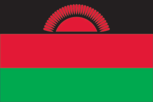
<strong>description: </strong>three equal horizontal bands of black (top), red, and green, with a rising red sun centered on the black band<br><br><strong>meaning:</strong> black stands for ethnic groups, red for the blood shed in the struggle for freedom, and green for nature; the sun represents the hope of freedom for the continent of Africa
Flag description
The flag of Malawi is composed of three equal horizontal bands of black, red and green. The top half of a red sun with thirty-one visible rays is centered in the black band.
Flag image
- svg
- https://flagcdn.com/mw.svg
Government type
presidential republic
Independence
6 July 1964 (from the UK)
International law organization participation
accepts compulsory ICJ jurisdiction with reservations; accepts ICCt jurisdiction
International organization participation
ACP, AfDB, AU, C, CD, COMESA, FAO, G-77, IAEA, IBRD, ICAO, ICCt, ICRM, IDA, IFAD, IFC, IFRCS, ILO, IMF, IMO, Interpol, IOC, IOM, IPU, ISO (correspondent), ITSO, ITU, ITUC (NGOs), MIGA, MINURSO, MONUSCO, NAM, OPCW, SADC, UN, UNCTAD, UNESCO, UNHCR, UNHRC, UNIDO, UNISFA, UNOCI, UNWTO, UPU, WCO, WFTU (NGOs), WHO, WIPO, WMO, WTO
Judicial branch
- Highest court(s)
- Supreme Court of Appeal (consists of the chief justice and at least 3 judges)
- Judge selection and term of office
- Supreme Court chief justice appointed by the president and confirmed by the National Assembly; other judges appointed by the president on the recommendation of the Judicial Service Commission, which regulates judicial officers; judges serve until age 65
- Subordinate courts
- High Court; magistrate courts; Industrial Relations Court; district and city traditional or local courts
Legal system
mixed system of English common law and customary law; Supreme Court of Appeal reviews legislative acts
Legislative branch
- Electoral system
- plurality/majority
- Expected date of next election
- September 2025
- Legislative structure
- unicameral
- Legislature name
- National Assembly
- Most recent election date
- 9/16/2025
- Number of seats
- 229 (all directly elected)
- Parties elected and seats per party
- Democratic Progressive Party (DPP) (78); Malawi Congress Party (MCP) (52); Independents (73); Other (21)
- Percentage of women in chamber
- 21.4%
- Scope of elections
- full renewal
- Term in office
- 5 years
National color(s)
black, red, green
National heritage
- Selected World Heritage Site locales
- Lake Malawi National Park (n); Chongoni Rock-Art Area (c); Mount Mulanje Cultural Landscape (c)
- Total World Heritage Sites
- 3 (2 cultural, 1 natural)
National holiday
- Independence Day, 6 July (1964)
- note
- <strong>note:</strong> also called Republic Day since 6 July 1966
National symbol(s)
lion
Political parties
Democratic Progressive Party or DPP <br>Malawi Congress Party or MCP <br>People's Party or PP <br>United Democratic Front or UDF<br>United Transformation Movement or UTM
Start of week
Monday
Suffrage
18 years of age; universal
UN Member
Yes
Economy
Agricultural products
- sweet potatoes, cassava, maize, sugarcane, mangoes/guavas, potatoes, tomatoes, pigeon peas, pumpkins/squash, plantains (2023)
- note
- <b>note:</b> top ten agricultural products based on tonnage
Budget
- Expenditures
- $3.523 billion (2022 est.)
- Note
- <b>note:</b> central government revenues and expenses (excluding grants/extrabudgetary units/social security funds) converted to US dollars at average official exchange rate for year indicated
- Revenues
- $2.208 billion (2022 est.)
Currency
- code
- MWK
- name
- Malawian kwacha (MWK) [MK]
Current account balance
- $-2,125,281,058
- Current account balance 2021
- -$1.918 billion (2021 est.)
- Current account balance 2022
- -$2.218 billion (2022 est.)
- Current account balance 2023
- -$2.276 billion (2023 est.)
- Note
- <b>note:</b> balance of payments - net trade and primary/secondary income in current dollars
Debt - external
- $3.74 billion
- Debt - external 2023
- $2.269 billion (2023 est.)
- Note
- <b>note:</b> present value of external debt in current US dollars
Economic overview
low-income East African economy; primarily agrarian; investing in human capital; urban poverty increasing due to COVID-19; high public debt; endemic corruption and poor property rights; poor hydroelectric grid; localized pharmaceutical industry
Exchange rates
- Currency
- Malawian kwachas (MWK) per US dollar -
- Exchange rates 2019
- 745.541 (2019 est.)
- Exchange rates 2020
- 749.527 (2020 est.)
- Exchange rates 2021
- 805.9 (2021 est.)
- Exchange rates 2022
- 949.039 (2022 est.)
- Exchange rates 2023
- 1,161.094 (2023 est.)
Exports
- $1.5 billion
- Exports 2021
- $1.587 billion (2021 est.)
- Exports 2022
- $1.487 billion (2022 est.)
- Exports 2023
- $1.526 billion (2023 est.)
- Note
- <b>note:</b> balance of payments - exports of goods and services in current dollars
Exports - commodities
- tobacco, tea, dried legumes, soybean meal, raw sugar (2023)
- note
- <b>note:</b> top five export commodities based on value in dollars
Exports - partners
- Germany 11%, India 7%, Zimbabwe 6%, South Africa 5%, USA 5% (2023)
- note
- <b>note:</b> top five export partners based on percentage share of exports
Foreign direct investment
- net inflows
- $681.28 million
GDP - composition, by sector of origin
- Agriculture
- 32.4% (2024 est.)
- Industry
- 16% (2024 est.)
- Note
- <b>note:</b> figures may not total 100% due to non-allocated consumption not captured in sector-reported data
- Services
- 44.9% (2024 est.)
GDP (official exchange rate)
- $11.009 billion (2024 est.)
- note
- <b>note:</b> data in current dollars at official exchange rate
GDP per capita (nominal)
$523
Gini Index coefficient - distribution of family income
- 44.7 (2016)
- Gini Index coefficient - distribution of family income 2019
- 38.5 (2019 est.)
- Note
- <b>note:</b> index (0-100) of income distribution; higher values represent greater inequality
GNI (gross national income)
$11.12 billion
GNI per capita
$570
Gross domestic investment
14 % of GDP
Household income or consumption by percentage share
- Highest 10%
- 31% (2019 est.)
- Lowest 10%
- 2.9% (2019 est.)
- Note
- <b>note:</b> % share of income accruing to lowest and highest 10% of population
Imports
- $4.17 billion
- Imports 2021
- $3.768 billion (2021 est.)
- Imports 2022
- $3.834 billion (2022 est.)
- Imports 2023
- $3.995 billion (2023 est.)
- Note
- <b>note:</b> balance of payments - imports of goods and services in current dollars
Imports - commodities
- refined petroleum, fertilizers, plastics, garments, postage stamps/documents (2023)
- note
- <b>note:</b> top five import commodities based on value in dollars
Imports - partners
- China 17%, South Africa 16%, UAE 12%, India 7%, Tanzania 7% (2023)
- note
- <b>note:</b> top five import partners based on percentage share of imports
Industrial production growth rate
- 2.1% (2024 est.)
- note
- <b>note:</b> annual % change in industrial value added based on constant local currency
Industries
tobacco, tea, sugar, sawmill products, cement, consumer goods
Inflation rate (consumer prices)
- 32.18%
- Inflation rate (consumer prices) 2022
- 21% (2022 est.)
- Inflation rate (consumer prices) 2023
- 28.8% (2023 est.)
- Inflation rate (consumer prices) 2024
- 32.2% (2024 est.)
- Note
- <b>note:</b> annual % change based on consumer prices
Labor force
- 8.602 million (2024 est.)
- note
- <b>note:</b> number of people ages 15 or older who are employed or seeking work
- total
- 8.32 million persons
Labor force - by occupation
- agriculture
- 64.98%
- industry
- 7.34%
- services
- 27.68%
Population below poverty line
- 50.7% (2019 est.)
- note
- <b>note:</b> % of population with income below national poverty line
Public debt
- 56 % of GDP
- Note
- <b>note:</b> central government debt as a % of GDP
- Public debt 2022
- 55.6% of GDP (2022 est.)
Real GDP (purchasing power parity)
- $40.23 billion
- Note
- <b>note:</b> data in 2021 dollars
- Real GDP (purchasing power parity) 2022
- $34.143 billion (2022 est.)
- Real GDP (purchasing power parity) 2023
- $34.789 billion (2023 est.)
- Real GDP (purchasing power parity) 2024
- $35.425 billion (2024 est.)
Real GDP growth rate
- 1.67%
- Note
- <b>note:</b> annual GDP % growth based on constant local currency
- Real GDP growth rate 2022
- 0.9% (2022 est.)
- Real GDP growth rate 2023
- 1.9% (2023 est.)
- Real GDP growth rate 2024
- 1.8% (2024 est.)
Real GDP per capita
- $1,858
- Note
- <b>note:</b> data in 2021 dollars
- Real GDP per capita 2022
- $1,700 (2022 est.)
- Real GDP per capita 2023
- $1,600 (2023 est.)
- Real GDP per capita 2024
- $1,600 (2024 est.)
Remittances
- $186.77 million
- Note
- <b>note:</b> personal transfers and compensation between resident and non-resident individuals/households/entities
- Remittances 2021
- 2.6% of GDP (2021 est.)
- Remittances 2022
- 2.1% of GDP (2022 est.)
- Remittances 2023
- 1.4% of GDP (2023 est.)
Reserves of foreign exchange and gold
- Note
- <b>note:</b> holdings of gold (year-end prices)/foreign exchange/special drawing rights in current dollars
- Reserves of foreign exchange and gold 2018
- $766.155 million (2018 est.)
- Reserves of foreign exchange and gold 2019
- $846.84 million (2019 est.)
- Reserves of foreign exchange and gold 2020
- $594.498 million (2020 est.)
Revenue (excl grants)
14 % of GDP
Tax revenue
14 % of GDP
Taxes and other revenues
- 13.5% (of GDP) (2022 est.)
- note
- <b>note:</b> central government tax revenue as a % of GDP
Unemployment rate
- 5.07%
- Note
- <b>note:</b> % of labor force seeking employment
- Unemployment rate 2022
- 5.1% (2022 est.)
- Unemployment rate 2023
- 5.1% (2023 est.)
- Unemployment rate 2024
- 5.1% (2024 est.)
Youth unemployment rate (ages 15-24)
- Female
- 7.1% (2024 est.)
- Male
- 6.4% (2024 est.)
- Note
- <b>note:</b> % of labor force ages 15-24 seeking employment
- Total
- 6.8% (2024 est.)
Energy
Coal
- Consumption
- 22,000 metric tons (2023 est.)
- Imports
- 19,000 metric tons (2023 est.)
- Production
- 3,000 metric tons (2023 est.)
- Proven reserves
- 801.999 million metric tons (2023 est.)
Electricity
- Consumption
- 1.585 billion kWh (2023 est.)
- Exports
- 19.938 million kWh (2023 est.)
- Installed generating capacity
- 731,000 kW (2023 est.)
- Transmission/distribution losses
- 231.785 million kWh (2023 est.)
Electricity access
- Electrification - rural areas
- 5.6%
- Electrification - total population
- 14% (2022 est.)
- Electrification - urban areas
- 54%
Electricity generation sources
- Biomass and waste
- 3% of total installed capacity (2023 est.)
- Fossil fuels
- 4.2% of total installed capacity (2023 est.)
- hydroelectric
- 72.45%
- Hydroelectricity
- 92.2% of total installed capacity (2023 est.)
- nuclear
- 0%
- renewable
- 80.06%
- Solar
- 0.7% of total installed capacity (2023 est.)
Energy consumption per capita
- Total energy consumption per capita 2023
- 1.792 million Btu/person (2023 est.)
Petroleum
- Refined petroleum consumption
- 15,000 bbl/day (2023 est.)
Renewable energy consumption
62.9%
Communications
Broadband - fixed subscriptions
- per 100 inhabitants
- 0 per 100
- Subscriptions per 100 inhabitants
- (2023 est.) less than 1
- Total
- 17,000 (2023 est.)
Broadcast media
radio is the main broadcast medium; privately owned Zodiak radio has the widest national reach, followed by state-run radio; numerous private and community radio stations broadcast in cities and towns; the largest TV network is state-owned, but at least 4 private TV networks broadcast in urban areas; relays of multiple international broadcasters are available (2019)
Internet country code
.mw
Internet users
- Percent of population
- 18% (2023 est.)
Telephone calling code
+265
Telephones - fixed lines
- Subscriptions per 100 inhabitants
- (2023 est.) less than 1
- Total subscriptions
- 5,000 (2023 est.)
Telephones - mobile cellular
- subscriptions per 100
- 61 per 100
- Subscriptions per 100 inhabitants
- 69 (2024 est.)
- Total subscriptions
- 15 million (2024 est.)
Transportation
Air transport
- passengers carried
- 3,507 passengers
- registered carrier departures
- 1,002 departures
Airports
27 (2025)
Civil aircraft registration country code prefix
7Q
Driving side
Left
Railways
- Narrow gauge
- 767 km (2014) 1.067-m gauge
- Total
- 767 km (2014)
Vehicle registration code
MW
Military and Security
Military - note
the MDF’s primary responsibility is external security; it is also tasked as necessary with providing support to civilian authorities during emergencies, supporting the Police Service, protecting national forest reserves, and participating in regional peacekeeping missions, as well as assisting with infrastructure development; key areas of concern include border security, regional conflict, and international terrorism; the MDF participates in exercises with foreign partners and contributes regularly to African Union and UN peace support operations; Malawi contributes regularly to African Union and UN peace support operations<br><br>the MDF was established in 1964 from elements of the Kings African Rifles (KAR), a British colonial regiment raised from Great Britain's various possessions in East Africa from 1902 until independence in the 1960s; the KAR conducted both military and internal security functions within the colonial territories, and served outside the territories during the World Wars (2025)
Military and security forces
- Malawi Defense Force (MDF): Malawi Army (Land Forces), Malawi Maritime Force (MMF), Malawi Air Force (MAF), Malawi National Service (MNS)<br><br>Ministry of Homeland Security: Malawi Police Service (2025)
- active duty personnel
- 15,000
- note
- <strong>note:</strong> the MDF reports directly to the president as commander in chief
- percent of total labor force
- 0.20 %
Military and security service personnel strengths
estimated 10,000 active Malawi Defense Forces (2025)
Military deployments
750 Democratic Republic of the Congo (MONUSCO) (2025)
Military equipment inventories and acquisitions
the MDF's inventory is comprised of mostly older or secondhand armaments originating from such countries as China, France, Israel, South Africa, and the UK (2025)
Military expenditures
- 1 % of GDP
- current USD
- $117,589,995
- Military Expenditures 2020
- 0.9% of GDP (2020 est.)
- Military Expenditures 2021
- 0.9% of GDP (2021 est.)
- Military Expenditures 2022
- 0.8% of GDP (2022 est.)
- Military Expenditures 2023
- 1% of GDP (2023 est.)
- Military Expenditures 2024
- 0.8% of GDP (2024 est.)
- percent of central government expenditure
- 3.50 %
- percent of GDP
- 1.02 % of GDP
Military service age and obligation
18-24 years of age for men and women for voluntary military service (2025)
Transnational Issues
Refugees and internally displaced persons
- IDPs
- 135,728 (2024 est.)
- Refugees
- 56,659 (2024 est.)
Environment
Carbon dioxide emissions
- From coal and metallurgical coke
- 65,000 metric tonnes of CO2 (2023 est.)
- From petroleum and other liquids
- 2.2 million metric tonnes of CO2 (2023 est.)
- Total emissions
- 2.265 million metric tonnes of CO2 (2023 est.)
Environmental issues
deforestation; land degradation; water pollution from agricultural runoff, sewage, industrial wastes; siltation of fish spawning grounds; high temperatures and changing precipitation patterns
International environmental agreements
- Party to
- Biodiversity, Climate Change, Climate Change-Kyoto Protocol, Climate Change-Paris Agreement, Comprehensive Nuclear Test Ban, Desertification, Endangered Species, Environmental Modification, Hazardous Wastes, Law of the Sea, Marine Life Conservation, Nuclear Test Ban, Ozone Layer Protection, Ship Pollution, Wetlands
- Signed, but not ratified
- none of the selected agreements
Particulate matter emissions
18.5 micrograms per cubic meter (2019 est.)
Protected areas
23 % of total land area
Renewable electricity output
8 % of total
Total renewable water resources
17.28 billion cubic meters (2022 est.)
Total water withdrawal
- 8 % of internal resources
- Agricultural
- 1.166 billion cubic meters (2022 est.)
- Industrial
- 47.7 million cubic meters (2022 est.)
- Municipal
- 143.1 million cubic meters (2022 est.)
Waste and recycling
- Municipal solid waste generated annually
- 1.298 million tons (2024 est.)
- Percent of municipal solid waste recycled
- 9.6% (2022 est.)