2007 Edition
CIA World Factbook 2007 (Project Gutenberg)
Introduction
Administrative divisions
10 counties (apskritys, singular - apskritis); Alytaus, Kauno, Klaipedos, Marijampoles, Panevezio, Siauliu, Taurages, Telsiu, Utenos, Vilniaus
Age structure
0-14 years: 15.5% (male 284,888/female 270,458) 15-64 years: 69.1% (male 1,210,557/female 1,265,542) 65 years and over: 15.5% (male 190,496/female 363,965) (2006 est.)
Agriculture - products
grain, potatoes, sugar beets, flax, vegetables; beef, milk, eggs; fish
Airports
91 (2006)
Airports - with paved runways
- over 3,047 m
- 4 2,438 to 3,047 m: 1 1,524 to 2,437 m: 7 914 to 1,523 m: 2
- total
- 34
- under 914 m
- 20 (2006)
Airports - with unpaved runways
- total
- 57 1,524 to 2,437 m: 1 914 to 1,523 m: 3
- under 914 m
- 53 (2006)
Area
- land
- NA sq km
- total
- 65,200 sq km
- water
- NA sq km
Area - comparative
slightly larger than West Virginia
Background
Independent between the two World Wars, Lithuania was annexed by the USSR in 1940 - an action never recognized by the US. On 11 March 1990, Lithuania became the first of the Soviet republics to declare its independence, but Moscow did not recognize this proclamation until September of 1991 (following the abortive coup in Moscow). The last Russian troops withdrew in 1993. Lithuania subsequently restructured its economy for integration into Western European institutions; it joined both NATO and the EU in the spring of 2004. Geography Lithuania
Birth rate
8.75 births/1,000 population (2006 est.)
Budget
- expenditures
- $9.761 billion; including capital expenditures of $NA (2006 est.)
- revenues
- $9.415 billion
Capital
- daylight saving time
- +1hr, begins last Sunday in March; ends last Sunday in October
- geographic coordinates
- 54 41 N, 25 19 E
- name
- Vilnius
- time difference
- UTC+2 (7 hours ahead of Washington, DC during Standard Time)
Climate
transitional, between maritime and continental; wet, moderate winters and summers
Coastline
90 km
Constitution
adopted 25 October 1992
Country name
- conventional long form
- Republic of Lithuania
- conventional short form
- Lithuania
- former
- Lithuanian Soviet Socialist Republic
- local long form
- Lietuvos Respublika
- local short form
- Lietuva
Currency (code)
litas (LTL)
Currency code
LTL
Current account balance
$-2.572 billion (2006 est.)
Death rate
10.98 deaths/1,000 population (2006 est.)
Debt - external
$15.12 billion (30 June 2006 est.)
Diplomatic representation from the US
- chief of mission
- Ambassador John A. CLOUD
- embassy
- Akmenu Gatve 6, Vilnius, LT-03106
- mailing address
- American Embassy, Akmenu Gatve 6, Vilnius LT-03106
- telephone
- [370] (5) 266 5500
Diplomatic representation in the US
- chancery
- 4590 MacArthur Blvd. NW, Suite 200, Washington, DC 20007
- chief of mission
- Ambassador (vacant); Charge d'Affaires Kornelija JURGAITIENE
- telephone
- [1] (202) 234-5860
Disputes - international
Lithuania and Russia committed to demarcating their boundary in 2006 in accordance with the land and maritime treaty ratified by Russia in May 2003 and by Lithuania in 1999; Lithuania operates a simplified transit regime for Russian nationals traveling from the Kaliningrad coastal exclave into Russia, while still conforming, as a EU member state having an external border with a non-EU member, to strict Schengen border rules; the Latvian parliament has not ratified its 1998 maritime boundary treaty with Lithuania, primarily due to concerns over potential hydrocarbons; as of January 2007, ground demarcation of the boundary with Belarus was complete and mapped with final ratification documents in preparation
Distribution of family income - Gini index
32.5 (2003)
Economic aid - recipient
$1.6 billion (1995)
Economy - overview
Lithuania, the Baltic state that has conducted the most trade with Russia, has slowly rebounded from the 1998 Russian financial crisis. Unemployment dropped from 11% in 2003 to 4.5% in 2006. Growing domestic consumption and increased investment have furthered recovery. Trade has been increasingly oriented toward the West. Lithuania has gained membership in the World Trade Organization and joined the EU in May 2004. Privatization of the large, state-owned utilities, particularly in the energy sector, is nearing completion. Overall, more than 80% of enterprises have been privatized. Foreign government and business support have helped in the transition from the old command economy to a market economy.
Electricity - consumption
9.358 billion kWh (2004)
Electricity - exports
11.49 billion kWh (2004)
Electricity - imports
4.293 billion kWh (2004)
Electricity - production
17.8 billion kWh (2004)
Electricity - production by source
- fossil fuel
- 16.5%
- hydro
- 5.7%
- nuclear
- 77.7%
- other
- 0% (2001)
Elevation extremes
- highest point
- Juozapines Kalnas 293.6 m
- lowest point
- Baltic Sea 0 m
Environment - current issues
contamination of soil and groundwater with petroleum products and chemicals at military bases
Environment - international agreements
- party to
- Air Pollution, Biodiversity, Climate Change, Climate Change-Kyoto Protocol, Endangered Species, Hazardous Wastes, Law of the Sea, Ozone Layer Protection, Ship Pollution, Wetlands
- signed, but not ratified
- Air Pollution-Persistent Organic Pollutants
Ethnic groups
Lithuanian 83.4%, Polish 6.7%, Russian 6.3%, other or unspecified 3.6% (2001 census)
Exchange rates
litai per US dollar - 2.7508 (2006), 2.774 (2005), 2.7806 (2004), 3.0609 (2003), 3.677 (2002)
Executive branch
- cabinet
- Council of Ministers appointed by the president on the nomination of the prime minister
- chief of state
- President Valdas ADAMKUS (since 12 July 2004)
- election results
- Valdas ADAMKUS elected president; percent of vote - Valdas ADAMKUS 52.2%, Kazimiera PRUNSKIENE 47.8%; Gediminas KIRKILAS approved by Parliament 85-13, with 5 abstentions
- elections
- president elected by popular vote for a five-year term (eligible for a second term); election last held 13 and 27 June 2004 (next to be held June 2009); prime minister appointed by the president on the approval of the Parliament
- head of government
- Prime Minister Gediminas KIRKILAS (since 4 July 2006)
Exports
$14.64 billion f.o.b. (2006 est.)
Exports - commodities
mineral products 23%, textiles and clothing 16%, machinery and equipment 11%, chemicals 6%, wood and wood products 5%, foodstuffs 5% (2001)
Exports - partners
Russia 10.4%, Latvia 10.2%, Germany 9.4%, France 7.1%, Estonia 5.9%, Poland 5.5%, Sweden 5%, US 4.7%, UK 4.7%, Denmark 4.3% (2005)
FAX
- [1] (202) 328-0466
- [370] (5) 266 5510
- consulate(s) general
- Chicago, New York
Fiscal year
calendar year Communications Lithuania
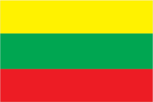
Flag description
three equal horizontal bands of yellow (top), green, and red Economy Lithuania
GDP - composition by sector
- agriculture
- 5.5%
- industry
- 33.3%
- services
- 61.2% (2006 est.)
GDP - per capita (PPP)
$15,100 (2006 est.)
GDP - real growth rate
7.2% (2006 est.)
GDP (official exchange rate)
$25.78 billion (2006 est.)
GDP (purchasing power parity)
$54.03 billion (2006 est.)
Geographic coordinates
56 00 N, 24 00 E
Geography - note
fertile central plains are separated by hilly uplands that are ancient glacial deposits People Lithuania
Government type
parliamentary democracy
HIV/AIDS - adult prevalence rate
0.1% (2001 est.)
HIV/AIDS - deaths
less than 200 (2003 est.)
HIV/AIDS - people living with HIV/AIDS
1,300 (2003 est.)
Household income or consumption by percentage share
- highest 10%
- 24.9% (2000)
- lowest 10%
- 3.2%
Illicit drugs
transshipment point for opiates and other illicit drugs from Southwest Asia, Latin America, and Western Europe to Western Europe and Scandinavia; limited production of methamphetamine and ecstasy; susceptible to money laundering despite changes to banking legislation This page was last updated on 8 February, 2007
Imports
$18.25 billion f.o.b. (2006 est.)
Imports - commodities
mineral products, machinery and equipment, transport equipment, chemicals, textiles and clothing, metals
Imports - partners
Russia 27.9%, Germany 15.1%, Poland 8.3% (2005)
Independence
11 March 1990 (independence declared from Soviet Union); 6 September 1991 (Soviet Union recognizes Lithuania's independence)
Industrial production growth rate
7% (2006 est.)
Industries
metal-cutting machine tools, electric motors, television sets, refrigerators and freezers, petroleum refining, shipbuilding (small ships), furniture making, textiles, food processing, fertilizers, agricultural machinery, optical equipment, electronic components, computers, amber jewelry
Infant mortality rate
- female
- 5.37 deaths/1,000 live births (2006 est.)
- male
- 8.12 deaths/1,000 live births
- total
- 6.78 deaths/1,000 live births
Inflation rate (consumer prices)
3.6% (2006 est.)
International organization participation
ACCT (observer), Australia Group, BA, BIS, CBSS, CE, EAPC, EBRD, EIB, EU, FAO, IAEA, IBRD, ICAO, ICC, ICCt, ICRM, IFC, IFRCS, ILO, IMF, IMO, Interpol, IOC, IOM, IPU, ISO (correspondent), ITU, ITUC, MIGA, NATO, NIB, NSG, OIF (observer), OPCW, OSCE, PCA, UN, UNCTAD, UNESCO, UNIDO, UNWTO, UPU, WCL, WCO, WEU (associate partner), WHO, WIPO, WMO, WTO
Internet country code
.lt
Internet hosts
148,675 (2006)
Internet Service Providers (ISPs)
32 (2001)
Internet users
1,221,700 (2005) Transportation Lithuania
Investment (gross fixed)
23% of GDP (2006 est.)
Irrigated land
70 sq km (2003)
Judicial branch
Constitutional Court; Supreme Court; Court of Appeal; judges for all courts appointed by the President
Labor force
1.617 million (2006 est.)
Labor force - by occupation
- agriculture
- 15.8%
- industry
- 28.2%
- services
- 56% (2004)
Land boundaries
- border countries
- Belarus 653.5 km, Latvia 588 km, Poland 103.7 km, Russia (Kaliningrad) 267.8 km
- total
- 1,613 km
Land use
- arable land
- 44.81%
- other
- 54.29% (2005)
- permanent crops
- 0.9%
Languages
Lithuanian (official) 82%, Russian 8%, Polish 5.6%, other and unspecified 4.4% (2001 census)
Legal system
based on civil law system; legislative acts can be appealed to the constitutional court
Legislative branch
- unicameral Parliament or Seimas (141 seats, 71 members are directly elected by popular vote, 70 are elected by proportional representation; members serve four-year terms)
- election results
- percent of vote by party - Labor 28.6%, Working for Lithuania (Social Democrats and Social Liberals) 20.7%, TS 14.6%, For Order and Justice (Liberal Democrats and Lithuanian People's Union) 11.4%, Liberal and Center Union 9.1%, Farmers and New Democracy Union 6.6%, other 9%; seats by faction - Labor 29, Homeland Union 26, Social Democrats 23, Civil Democracy (split from Labor) 11, Liberal Movement (formerly Liberal Political Group) 11, National Farmer's Union (formerly Farmers and New Democracy Union) 11, Social Liberal 10, Liberal Democrats 9, Liberal and Center Union 8, independents 3 (as of late-July 2006)
- elections
- last held 10 and 24 October 2004 (next to be held October 2008)
Life expectancy at birth
- female
- 79.49 years (2006 est.)
- male
- 69.2 years
- total population
- 74.2 years
Literacy
- definition
- age 15 and over can read and write
- female
- 99.6% (2003 est.) Government Lithuania
- male
- 99.7%
- total population
- 99.6%
Location
Eastern Europe, bordering the Baltic Sea, between Latvia and Russia
Manpower available for military service
- females age 19-49
- 830,524 (2005 est.)
- males age 19-49
- 830,368
Manpower fit for military service
- females age 19-49
- 676,102 (2005 est.)
- males age 19-49
- 590,606
Manpower reaching military service age annually
- females age 19-49
- 28,543 (2005 est.)
- males age 18-49
- 29,689
Map references
Europe
Maritime claims
- territorial sea
- 12 nm
Median age
- female
- 40.8 years (2006 est.)
- male
- 35.7 years
- total
- 38.2 years
Merchant marine
- by type
- bulk carrier 6, cargo 20, chemical tanker 1, container 1, passenger/cargo 5, petroleum tanker 1, refrigerated cargo 14, roll on/roll off 1
- foreign-owned
- 10 (Denmark 10)
- registered in other countries
- 17 (Antigua and Barbuda 3, Belize 1, North Korea 1, Norway 1, Panama 5, Saint Vincent and the Grenadines 3, unknown 3) (2006)
- total
- 49 ships (1000 GRT or over) 353,094 GRT/352,883 DWT
Military branches
Ground Forces, Naval Force, Lithuanian Military Air Forces, National Defense Volunteer Forces (2005)
Military expenditures - dollar figure
$230.8 million (FY01)
Military expenditures - percent of GDP
1.9% (FY01) Transnational Issues Lithuania
Military service age and obligation
19-45 years of age for compulsory military service, conscript service obligation - 12 months; 18 years of age for volunteers (2004)
National holiday
Independence Day, 16 February (1918); note - 16 February 1918 is the date Lithuania declared its independence from Soviet Russia and established its statehood; 11 March 1990 is the date it declared its independence from the Soviet Union
Nationality
- adjective
- Lithuanian
- noun
- Lithuanian(s)
Natural gas - consumption
2.92 billion cu m (2004 est.)
Natural gas - exports
0 cu m (2004 est.)
Natural gas - imports
2.92 billion cu m (2004 est.)
Natural gas - production
0 cu m (2004)
Natural hazards
NA
Natural resources
peat, arable land, amber
Net migration rate
-0.71 migrant(s)/1,000 population (2006 est.)
Oil - consumption
56,000 bbl/day (2004 est.)
Oil - exports
0 bbl/day (2004)
Oil - imports
93,000 bbl/day (2004)
Oil - production
14,000 bbl/day (2004 est.)
Pipelines
gas 1,696 km; oil 228 km; refined products 121 km (2006)
Political parties and leaders
Civil Democracy Party [Viktor MUNTIANAS, chairman]; Electoral Action of Lithuanian Poles [Valdemar TOMASZEVSKI, chairman]; National Farmer's Union [Kazimiera PRUNSKIENE, chairwoman]; Homeland Union/Conservative Party or TS [Andrius KUBILIUS, chairman]; Labor Party [Kestutis DAUKSYS, chairman]; Liberal and Center Union [Arturas ZUOKAS, chairman]; Liberal Democratic Party [Rolandas PAKSAS, chairman]; Liberal Movement [Petras AUSTREVICIUS, chairman]; Lithuanian Christian Democrats or LKD [Valentinas STUNDYS, chairman]; Lithuanian People's Union for a Fair Lithuania [Julius VESELKA, chairman]; Lithuanian Social Democratic Party [Algirdas BRAZAUSKAS, chairman]; Social Liberal/New Union [Arturas PAULAUSKAS, chairman]; Social Union of Christian Conservatives [Gediminas VAGNORIUS, chairman]; Young Lithuania and New Nationalists [Stanislovas BUSKEVICIUS, chairman]
Political pressure groups and leaders
NA
Population
3,585,906 (July 2006 est.)
Population below poverty line
4%
Population growth rate
-0.3% (2006 est.)
Ports and terminals
Klaipeda Military Lithuania
Public debt
18% of GDP (2006 est.)
Radio broadcast stations
AM 29, FM 142, shortwave 1 (2001)
Radios
1.9 million (1997)
Railways
- broad gauge
- 1,749 km 1.524-m gauge (122 km electrified)
- standard gauge
- 22 km 1.435-m gauge (2005)
- total
- 1,771 km
Religions
Roman Catholic 79%, Russian Orthodox 4.1%, Protestant (including Lutheran and Evangelical Christian Baptist) 1.9%, other or unspecified 5.5%, none 9.5% (2001 census)
Reserves of foreign exchange and gold
$5.22 billion (2006 est.)
Roadways
- paved
- 70,549 km (including 417 km of expressways)
- total
- 79,497 km
- unpaved
- 8,948 km (2005)
Sex ratio
- at birth
- 1.06 male(s)/female
- total population
- 0.89 male(s)/female (2006 est.)
- under 15 years
- 1.05 male(s)/female 15-64 years: 0.96 male(s)/female 65 years and over: 0.52 male(s)/female
Suffrage
18 years of age; universal
Telephone system
- domestic
- a national, fiber-optic cable, interurban, trunk system is nearing completion; rural exchanges are being improved and expanded; mobile cellular systems are being installed; access to the Internet is available; still many unsatisfied telephone subscriber applications
- general assessment
- inadequate, but is being modernized to provide an improved international capability and better residential access
- international
- country code - 370; landline connections to Latvia and Poland; major international connections to Denmark, Sweden, and Norway by submarine cable for further transmission by satellite
Telephones - main lines in use
801,100 (2005)
Telephones - mobile cellular
4.353 million (2005)
Television broadcast stations
- 27
- note
- Lithuania has approximately 27 broadcasting stations, but may have as many as 100 transmitters, including repeater stations (2001)
Televisions
1.7 million (1997)
Terrain
lowland, many scattered small lakes, fertile soil
Total fertility rate
1.2 children born/woman (2006 est.)
Unemployment rate
4.5% (2006 est.)
Waterways
425 km (2005)