2007 Edition
CIA World Factbook 2007 (Project Gutenberg)
Introduction
Administrative divisions
10 districts; Berea, Butha-Buthe, Leribe, Mafeteng, Maseru, Mohale's Hoek, Mokhotlong, Qacha's Nek, Quthing, Thaba-Tseka
Age structure
0-14 years: 36.8% (male 374,102/female 369,527) 15-64 years: 58.3% (male 572,957/female 606,846) 65 years and over: 4.9% (male 39,461/female 59,438) (2006 est.)
Agriculture - products
corn, wheat, pulses, sorghum, barley; livestock
Airports
28 (2006)
Airports - with paved runways
- over 3,047 m
- 1 914 to 1,523 m: 1
- total
- 3
- under 914 m
- 1 (2006)
Airports - with unpaved runways
- total
- 25 914 to 1,523 m: 4
- under 914 m
- 21 (2006)
Area
- land
- 30,355 sq km
- total
- 30,355 sq km
- water
- 0 sq km
Area - comparative
slightly smaller than Maryland
Background
Basutoland was renamed the Kingdom of Lesotho upon independence from the UK in 1966. The Basuto National Party ruled for the first two decades. King MOSHOESHOE was exiled in 1990, but returned to Lesotho in 1992 and reinstated in 1995. Constitutional government was restored in 1993 after 7 years of military rule. In 1998, violent protests and a military mutiny following a contentious election prompted a brief but bloody intervention by South African and Botswanan military forces under the aegis of the Southern African Development Community. Constitutional reforms have since restored political stability; peaceful parliamentary elections were held in 2002. Geography Lesotho
Birth rate
24.75 births/1,000 population (2006 est.)
Budget
- expenditures
- $734.7 million; including capital expenditures of NA (2006 est.)
- revenues
- $778.9 million
Capital
- geographic coordinates
- 29 28 S, 27 30 E
- name
- Maseru
- time difference
- UTC+2 (7 hours ahead of Washington, DC during Standard Time)
Climate
temperate; cool to cold, dry winters; hot, wet summers
Coastline
0 km (landlocked)
Constitution
2 April 1993
Country name
- conventional long form
- Kingdom of Lesotho
- conventional short form
- Lesotho
- former
- Basutoland
- local long form
- Kingdom of Lesotho
- local short form
- Lesotho
Currency (code)
loti (LSL); South African rand (ZAR)
Currency code
LSL; ZAR
Current account balance
$-75.44 million (2006 est.)
Death rate
28.71 deaths/1,000 population (2006 est.)
Debt - external
$735 million (2002)
Diplomatic representation from the US
- chief of mission
- Ambassador June Carter PERRY
- embassy
- 254 Kingsway, Maseru West (Consular Section)
- mailing address
- P. O. Box 333, Maseru 100, Lesotho
- telephone
- [266] 22 312666
Diplomatic representation in the US
- chancery
- 2511 Massachusetts Avenue NW, Washington, DC 20008
- chief of mission
- Ambassador Molelekeng E. RAPOLAKI
- telephone
- [1] (202) 797-5533 through 5536
Disputes - international
none This page was last updated on 8 February, 2007
Distribution of family income - Gini index
63.2 (1995)
Economic aid - donor
ODA, $4.4 million
Economic aid - recipient
$41.5 million (2000)
Economy - overview
Small, landlocked, and mountainous, Lesotho relies on remittances from miners employed in South Africa and customs duties from the Southern Africa Customs Union for the majority of government revenue. However, the government has recently strengthened its tax system to reduce dependency on customs duties. Completion of a major hydropower facility in January 1998 now permits the sale of water to South Africa, also generating royalties for Lesotho. As the number of mineworkers has declined steadily over the past several years, a small manufacturing base has developed based on farm products that support the milling, canning, leather, and jute industries, as well as a rapidly expanding apparel-assembly sector. The latter has grown significantly, mainly due to Lesotho qualifying for the trade benefits contained in the Africa Growth and Opportunity Act. The economy is still primarily based on subsistence agriculture, especially livestock, although drought has decreased agricultural activity. The extreme inequality in the distribution of income remains a major drawback. Lesotho has signed an Interim Poverty Reduction and Growth Facility with the IMF.
Electricity - consumption
244.5 million kWh (2004)
Electricity - exports
0 kWh (2004)
Electricity - imports
12 million kWh; note - electricity supplied by South Africa (2004)
Electricity - production
250 million kWh; note - electricity supplied by South Africa (2004)
Elevation extremes
- highest point
- Thabana Ntlenyana 3,482 m
- lowest point
- junction of the Orange and Makhaleng Rivers 1,400 m
Environment - current issues
population pressure forcing settlement in marginal areas results in overgrazing, severe soil erosion, and soil exhaustion; desertification; Highlands Water Project controls, stores, and redirects water to South Africa
Environment - international agreements
- party to
- Biodiversity, Climate Change, Climate Change-Kyoto Protocol, Desertification, Endangered Species, Hazardous Wastes, Marine Life Conservation, Ozone Layer Protection, Wetlands
- signed, but not ratified
- Law of the Sea
Ethnic groups
Sotho 99.7%, Europeans, Asians, and other 0.3%,
Exchange rates
maloti per US dollar - 6.6 (2006), 6.3593 (2005), 6.4597 (2004), 7.5648 (2003), 10.5407 (2002)
Executive branch
- cabinet
- Cabinet
- chief of state
- King LETSIE III (since 7 February 1996); note - King LETSIE III formerly occupied the throne from November 1990 to February 1995, while his father was in exile
- elections
- none - according to the constitution, the leader of the majority party in the Assembly automatically becomes prime minister; the monarch is hereditary, but, under the terms of the constitution, which came into effect after the March 1993 election, the monarch is a "living symbol of national unity" with no executive or legislative powers; under traditional law the college of chiefs has the power to depose the monarch, determine who is next in the line of succession, or who shall serve as regent in the event that the successor is not of mature age
- head of government
- Prime Minister Pakalitha MOSISILI (since 23 May 1998)
Exports
$779.1 million f.o.b. (2006 est.)
Exports - commodities
manufactures 75% (clothing, footwear, road vehicles), wool and mohair, food and live animals (2000)
Exports - partners
Hong Kong 41.8%, China 33.9%, Germany 7.9% (2005)
FAX
- [1] (202) 234-6815
- [266] 22 310116
Fiscal year
1 April - 31 March Communications Lesotho
Flag description
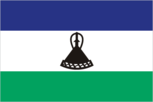
three horizontal stripes of blue (top), white, and green in the proportions of 3:4:3; the colors represent rain, peace, and prosperity respectively; centered in the white stripe is a black Basotho hat representing the indigenous people; the flag was unfurled in October 2006 to celebrate 40 years of independence Economy Lesotho
GDP - composition by sector
- agriculture
- 16.1%
- industry
- 43%
- services
- 40.9% (2006 est.)
GDP - per capita (PPP)
$2,600 (2006 est.)
GDP - real growth rate
1.7% (2006 est.)
GDP (official exchange rate)
$1.419 billion (2006 est.)
GDP (purchasing power parity)
$5.195 billion (2006 est.)
Geographic coordinates
29 30 S, 28 30 E
Geography - note
landlocked, completely surrounded by South Africa; mountainous, more than 80% of the country is 1,800 meters above sea level People Lesotho
Government type
parliamentary constitutional monarchy
HIV/AIDS - adult prevalence rate
28.9% (2003 est.)
HIV/AIDS - deaths
29,000 (2003 est.)
HIV/AIDS - people living with HIV/AIDS
320,000 (2003 est.)
Household income or consumption by percentage share
- highest 10%
- 43.4%
- lowest 10%
- 0.9%
Imports
$1.401 billion f.o.b. (2006 est.)
Imports - commodities
food; building materials, vehicles, machinery, medicines, petroleum products (2000)
Imports - partners
US 83.9%, Belgium 12.7%, Canada 2.4% (2005)
Independence
4 October 1966 (from UK)
Industrial production growth rate
15.5% (1999)
Industries
food, beverages, textiles, apparel assembly, handicrafts, construction, tourism
Infant mortality rate
- female
- 82.28 deaths/1,000 live births (2006 est.)
- male
- 92.04 deaths/1,000 live births
- total
- 87.24 deaths/1,000 live births
Inflation rate (consumer prices)
5% (2006 est.)
International organization participation
ACP, AfDB, AU, C, FAO, G-77, IBRD, ICAO, ICCt, ICRM, IDA, IFAD, IFC, IFRCS, ILO, IMF, Interpol, IOC, ISO (subscriber), ITU, MIGA, NAM, OPCW, SACU, SADC, UN, UNCTAD, UNESCO, UNHCR, UNIDO, UNWTO, UPU, WCO, WFTU, WHO, WIPO, WMO, WTO
Internet country code
.ls
Internet hosts
168 (2006)
Internet Service Providers (ISPs)
1 (2000)
Internet users
43,000 (2005) Transportation Lesotho
Investment (gross fixed)
32% of GDP (2006 est.)
Irrigated land
30 sq km (2003)
Judicial branch
High Court (chief justice appointed by the monarch acting on the advice of the Prime Minister); Court of Appeal; Magistrate Courts; customary or traditional court
Labor force
838,000 (2000)
Labor force - by occupation
- agriculture
- 86% of resident population engaged in subsistence agriculture; roughly 35% of the active male wage earners work in South Africa
- industry and services
- 14%
Land boundaries
- border countries
- South Africa 909 km
- total
- 909 km
Land use
- arable land
- 10.87%
- other
- 89% (2005)
- permanent crops
- 0.13%
Languages
Sesotho (southern Sotho), English (official), Zulu, Xhosa
Legal system
based on English common law and Roman-Dutch law; judicial review of legislative acts in High Court and Court of Appeal; accepts compulsory ICJ jurisdiction, with reservations
Legislative branch
- bicameral Parliament consists of the Senate (33 members - 22 principal chiefs and 11 other members appointed by the ruling party) and the Assembly (120 seats, 80 by direct popular vote and 40 by proportional vote; members elected by popular vote for five-year terms); note - number of seats in the Assembly rose from 80 to 120 in the May 2002 election
- election results
- percent of vote by party - LCD 54.9%, BNP 22.4%, LPC 5.8%, NIP 5.5% other 11.5%; seats by party - LCD 77, BNP 21, LPC 5, NIP 5, other 10
- elections
- last held 25 May 2002 (next to be held 17 February 2007)
Lesotho Defense Force (LDF)
Army and Air Wing
Life expectancy at birth
- female
- 33.21 years (2006 est.)
- male
- 35.55 years
- total population
- 34.4 years
Literacy
- definition
- age 15 and over can read and write
- female
- 94.5% (2003 est.) Government Lesotho
- male
- 74.5%
- total population
- 84.8%
Location
Southern Africa, an enclave of South Africa
Manpower available for military service
- females age 18-49
- 440,102 (2005 est.)
- males age 18-49
- 428,982
Manpower fit for military service
- females age 18-49
- 160,681 (2005 est.)
- males age 18-49
- 180,797
Map references
Africa
Maritime claims
none (landlocked)
Median age
- female
- 21 years (2006 est.)
- male
- 19.7 years
- total
- 20.3 years
Military - note
the Lesotho Government in 1999 began an open debate on the future structure, size, and role of the armed forces, especially considering the Lesotho Defense Force's (LDF) history of intervening in political affairs Transnational Issues Lesotho
Military expenditures - dollar figure
$41.1 million (2005 est.)
Military expenditures - percent of GDP
2.1% (2005 est.)
Military service age and obligation
18 years of age (est.); no conscription (2001)
National holiday
Independence Day, 4 October (1966)
Nationality
- adjective
- Basotho
- noun
- Mosotho (singular), Basotho (plural)
Natural gas - consumption
0 cu m (2004 est.)
Natural gas - production
0 cu m (2004 est.)
Natural hazards
periodic droughts
Natural resources
water, agricultural and grazing land, diamonds, sand, clay, building stone
Net migration rate
-0.68 migrant(s)/1,000 population (2006 est.)
Oil - consumption
1,400 bbl/day (2004)
Oil - exports
NA bbl/day (2001)
Oil - imports
NA bbl/day (2001)
Oil - production
0 bbl/day (2004 est.)
Political parties and leaders
All Basotho Convention or ABC [Thomas THABANE]; Basotholand African Congress or BAC [Khauhelo RALITAPOLE]; Basotho Congress Party or BCP [Ntsukunyane MPHANYA]; Basotho National Party or BNP [Maj. Gen. Justin Metsing LEKHANYA]; Kopanang Basotho Party or KPB [Pheelo MOSALA]; Lesotho Congress for Democracy or LCD [Pakalitha MOSISILI] (the governing party); Lesotho Education Party or LEP [Thabo PITSO]; Lesotho People's Congress or LPC [Kelebone MAOPE]; Lesotho Workers Party or LWP [Macaefa BILLY]; Marematlou Freedom Party or MFP [Vincent MALEBO]; National Democratic Party [J.S. Bereng]; National Independent Party or NIP [Anthony MANYELI]; National Progressive Party or NPP [Chief Peete Nkoebe PEETE]; New Lesotho Freedom Party or NLFP [Manapo MAJARA]; Popular Front for Democracy or PFD [Lekhetho RAKUOANE]; Sefate Democratic Union or SDU [Bofihla NKUEBE]; Social Democratic Party of SDP [Masitise SELESO]; United Democratic Party or UDP [C.D. MOFELI]; United Party or UP [Makara SEKAUTU]
Political pressure groups and leaders
NA
Population
- 2,022,331
- note
- estimates for this country explicitly take into account the effects of excess mortality due to AIDS; this can result in lower life expectancy, higher infant mortality and death rates, lower population and growth rates, and changes in the distribution of population by age and sex than would otherwise be expected (July 2006 est.)
Population below poverty line
49% (1999)
Population growth rate
-0.46% (2006 est.)
Radio broadcast stations
AM 1, FM 2, shortwave 1 (1998)
Radios
NA (2002)
Religions
Christian 80%, indigenous beliefs 20%
Reserves of foreign exchange and gold
$528.2 million (2006 est.)
Roadways
- paved
- 1,087 km
- total
- 5,940 km
- unpaved
- 4,853 km (1999) Military Lesotho
Sex ratio
- at birth
- 1.03 male(s)/female
- total population
- 0.95 male(s)/female (2006 est.)
- under 15 years
- 1.01 male(s)/female 15-64 years: 0.94 male(s)/female 65 years and over: 0.66 male(s)/female
Suffrage
18 years of age; universal
Telephone system
- domestic
- consists of a modest but growing number of landlines, a small microwave radio relay system, and a minor radiotelephone communication system; a cellular mobile telephone system is growing
- general assessment
- rudimentary system
- international
- country code - 266; satellite earth station - 1 Intelsat (Atlantic Ocean)
Telephones - main lines in use
48,000 (2005)
Telephones - mobile cellular
245,100 (2005)
Television broadcast stations
1 (2000)
Televisions
NA
Terrain
mostly highland with plateaus, hills, and mountains
Total fertility rate
3.28 children born/woman (2006 est.)
Unemployment rate
45% (2002)