2003 Edition
CIA World Factbook 2003 (Project Gutenberg)
Introduction
Administrative divisions
51 prefectures (nomoi, singular - nomos)and 1 autonomous region*; Agion Oros* (Mt. Athos), Achaia, Aitolia kai Akarmania, Argolis, Arkadia, Arta, Attiki, Chalkidiki, Chanion, Chios, Dodekanisos, Drama, Evros, Evrytania, Evvoia, Florina, Fokidos, Fthiotis, Grevena, Ileia, Imathia, Ioannina, Irakleion, Karditsa, Kastoria, Kavala, Kefallinia, Kerkyra, Kilkis, Korinthia, Kozani, Kyklades, Lakonia, Larisa, Lasithi, Lefkas, Lesvos, Magnisia, Messinia, Pella, Pieria, Preveza, Rethynnis, Rodopi, Samos, Serrai, Thesprotia, Thessaloniki, Trikala, Voiotia, Xanthi, Zakynthos
Age structure
0-14 years: 14.7% (male 811,080; female 761,728) 15-64 years: 67% (male 3,578,320; female 3,557,800) 65 years and over: 18.3% (male 866,425; female 1,090,636) (2003 est.)
Agriculture - products
wheat, corn, barley, sugar beets, olives, tomatoes, wine, tobacco, potatoes; beef, dairy products
Airports
79 (note - new Athens airport at Spata opened in March 2001) (2002)
Airports - with paved runways
- over 3,047 m
- 6 2,438 to 3,047 m: 15 914 to 1,523 m: 17
- total
- 66
- under 914 m
- 9 (2002) 1,524 to 2,437 m: 19
Airports - with unpaved runways
- total
- 13 914 to 1,523 m: 3
- under 914 m
- 10 (2002)
Area
- land
- 130,800 sq km
- total
- 131,940 sq km
- water
- 1,140 sq km
Area - comparative
slightly smaller than Alabama
Background
Greece achieved its independence from the Ottoman Empire in 1829. During the second half of the 19th century and the first half of the 20th century, it gradually added neighboring islands and territories, most with Greek-speaking populations. Following the defeat of Communist rebels in 1949, Greece joined NATO in 1952. A military dictatorship, which in 1967 suspended many political liberties and forced the king to flee the country, lasted seven years. Democratic elections in 1974 and a referendum created a parliamentary republic and abolished the monarchy; Greece joined the European Community or EC in 1981 (which became the EU in 1992). Geography Greece
Birth rate
9.79 births/1,000 population (2003 est.)
Budget
- expenditures
- $47.6 billion, including capital expenditures of $NA (1998 est.)
- revenues
- $45 billion
Capital
Athens
Climate
temperate; mild, wet winters; hot, dry summers
Coastline
13,676 km
Constitution
11 June 1975; amended March 1986 and April 2001
Country name
- conventional long form
- Hellenic Republic
- conventional short form
- Greece
- former
- Kingdom of Greece
- local long form
- Elliniki Dhimokratia
- local short form
- Ellas or Ellada
Currency
- euro (EUR)
- note
- on 1 January 1999, the European Monetary Union introduced the euro as a common currency to be used by financial institutions of member countries; on 1 January 2002, the euro became the sole currency for everyday transactions within the member countries
Currency code
EUR
Death rate
9.86 deaths/1,000 population (2003 est.)
Debt - external
$63.4 billion (2002 est.)
Diplomatic representation from the US
- chief of mission
- Ambassador Thomas J. MILLER
- embassy
- 91 Vasilissis Sophias Avenue, 101 60 Athens
- mailing address
- PSC 108, APO AE 09842-0108
- telephone
- [30] (210) 721-2951
Diplomatic representation in the US
- chief of mission
- Ambassador Yeoryious SAVVAIDES
- consulate(s)
- Atlanta, Houston, and New Orleans
- consulate(s) general
- Boston, Chicago, Los Angeles, New York, and San Francisco
Disputes - international
Greece and Turkey have resumed discussions to resolve their complex maritime, air, territorial, and boundary disputes in the Aegean Sea; Cyprus question with Turkey; dispute with The Former Yugoslav Republic of Macedonia over its name
Distribution of family income - Gini index
32.7 (1993)
Economic aid - recipient
$5.4 billion from EU
Economy - overview
Greece has a mixed capitalist economy with the public sector accounting for half of GDP and with per capita GDP 70% of the leading euro-zone economies. Tourism provides 15% of GDP. Immigrants make up nearly one-fifth of the work force, mainly in menial jobs. Greece is a major beneficiary of EU aid, equal to about 3.3% of GDP. The economy has improved steadily with economic growth averaging 4% since 1997, exceeding EU growth by more than 1 percentage point. Remaining challenges include the reduction of the public debt, inflation, and unemployment; and further restructuring of the economy, including privatizing several state enterprises, undertaking pension and other reforms, and minimizing bureaucratic inefficiencies. The Olympic Games will be held in Athens in mid-2004.
Electricity - consumption
48.8 billion kWh (2001)
Electricity - exports
1.062 billion kWh (2001)
Electricity - imports
3.562 billion kWh (2001)
Electricity - production
49.79 billion kWh (2001)
Electricity - production by source
- fossil fuel
- 94.5%
- hydro
- 3.8%
- nuclear
- 0%
- other
- 1.7% (2001)
Elevation extremes
- highest point
- Mount Olympus 2,917 m
- lowest point
- Mediterranean Sea 0 m
Environment - current issues
air pollution; water pollution
Environment - international agreements
- party to
- Air Pollution, Air Pollution-Nitrogen Oxides, Air Pollution-Sulphur 94, Antarctic-Environmental Protocol, Antarctic-Marine Living Resources, Biodiversity, Climate Change, Desertification, Endangered Species, Environmental Modification, Hazardous Wastes, Law of the Sea, Marine Dumping, Nuclear Test Ban, Ozone Layer Protection, Ship Pollution, Tropical Timber 83, Tropical Timber 94, Wetlands
- signed, but not ratified
- Air Pollution-Persistent Organic Pollutants, Air Pollution-Volatile Organic Compounds, Antarctic Treaty, Climate Change-Kyoto Protocol
Ethnic groups
- Greek 98%, other 2%
- note
- the Greek Government states there are no ethnic divisions in Greece
Exchange rates
- euros per US dollar - 1.06 (2002), 1.12 (2001), 365.4 (2000), 305.65 (1999), 295.53 (1998)
- note
- in January 2001, the drachma became a participating currency within the Eurosystem, and the euro market rate became applicable to all transactions
Executive branch
- cabinet
- Cabinet appointed by the president on the recommendation of the prime minister
- chief of state
- President Konstandinos (Kostis) STEPHANOPOULOS (since 10 March 1995)
- election results
- Konstandinos STEPHANOPOULOS reelected president; percent of Parliament vote - 90%
- elections
- president elected by Parliament for a five-year term; election last held 8 February 2000 (next to be held by NA February 2005); prime minister appointed by the president
- head of government
- Prime Minister Konstandinos SIMITIS (since 19 January 1996)
Exports
$12.6 billion f.o.b. (2002)
Exports - commodities
food and beverages, manufactured goods, petroleum products, chemicals, textiles
Exports - partners
Germany 10.4%, Italy 8.5%, UK 6.3%, Bulgaria 5.4%, US 5.3%, Cyprus 4.7% (2002)
FAX
- [1] (202) 939-1324
- [30] (210) 645-6282
- chancery
- 2221 Massachusetts Avenue NW, Washington, DC 20008
- consulate(s) general
- Thessaloniki
- telephone
- [1] (202) 939-1300
Fiscal year
calendar year Communications Greece
Flag description
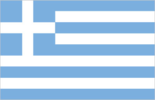
nine equal horizontal stripes of blue alternating with white; there is a blue square in the upper hoist-side corner bearing a white cross; the cross symbolizes Greek Orthodoxy, the established religion of the country Economy Greece
GDP
purchasing power parity - $203.3 billion (2002 est.)
GDP - composition by sector
- agriculture
- 8.1%
- industry
- 22.3%
- services
- 69.3% (2002 est.)
GDP - per capita
purchasing power parity - $19,100 (2002 est.)
GDP - real growth rate
4% (2002 est.)
Geographic coordinates
39 00 N, 22 00 E
Geography - note
strategic location dominating the Aegean Sea and southern approach to Turkish Straits; a peninsular country, possessing an archipelago of about 2,000 islands People Greece
Government type
parliamentary republic; monarchy rejected by referendum 8 December 1974
Heliports
7 (2002) Military Greece
Highways
- paved
- 107,406 km (including 470 km of expressways)
- total
- 117,000 km
- unpaved
- 9,594 km (1999 est.)
HIV/AIDS - adult prevalence rate
0.2% (2001 est.)
HIV/AIDS - deaths
less than 100 (2001 est.)
HIV/AIDS - people living with HIV/AIDS
8,800 (2001 est.)
Household income or consumption by percentage share
- highest 10%
- 25.3% (1993 est.)
- lowest 10%
- 3%
Illicit drugs
a gateway to Europe for traffickers smuggling cannabis and heroin from the Middle East and Southwest Asia to the West and precursor chemicals to the East; some South American cocaine transits or is consumed in Greece; money laundering related to drug trafficking and organized crime This page was last updated on 18 December, 2003
Imports
$31.4 billion f.o.b. (2002)
Imports - commodities
machinery, transport equipment, fuels, chemicals
Imports - partners
Germany 12.2%, Italy 11.5%, Russia 7.4%, South Korea 6%, France 5.7%, Netherlands 5.6%, US 4.7%, Belgium 4.3%, UK 4.1% (2002)
Independence
1829 (from the Ottoman Empire)
Industrial production growth rate
7% (2000 est.)
Industries
tourism; food and tobacco processing, textiles; chemicals, metal products; mining, petroleum
Infant mortality rate
- female
- 5.57 deaths/1,000 live births (2003 est.)
- male
- 6.64 deaths/1,000 live births
- total
- 6.12 deaths/1,000 live births
Inflation rate (consumer prices)
3.6% (2002 est.)
International organization participation
Australia Group, BIS, BSEC, CE, CERN, EAPC, EBRD, ECE, EIB, EMU, EU, FAO, G- 6, IAEA, IBRD, ICAO, ICC, ICCt, ICFTU, ICRM, IDA, IEA, IFAD, IFC, IFRCS, IHO, ILO, IMF, IMO, Interpol, IOC, IOM, ISO, ITU, MINURSO, NAM (guest), NATO, NEA, NSG, OAS (observer), OECD, OPCW, OSCE, PCA, UN, UNCTAD, UNESCO, UNHCR, UNIDO, UNIKOM, UNMEE, UNMIBH, UNMIK, UNOMIG, UPU, WCO, WEU, WFTU, WHO, WIPO, WMO, WToO, WTrO, ZC
Internet country code
.gr
Internet Service Providers (ISPs)
27 (2000)
Internet users
1.4 million (2002) Transportation Greece
Irrigated land
14,220 sq km (1998 est.)
Judicial branch
Supreme Judicial Court; Special Supreme Tribunal; all judges appointed for life by the president after consultation with a judicial council
Labor force
4.37 million (2002 est.)
Labor force - by occupation
industry 20%, agriculture 20%, services 59% (2000 est.)
Land boundaries
- border countries
- Albania 282 km, Bulgaria 494 km, Turkey 206 km, The Former Yugoslav Republic of Macedonia 246 km
- total
- 1,228 km
Land use
- arable land
- 22.12%
- other
- 69.41% (1998 est.)
- permanent crops
- 8.47%
Languages
Greek 99% (official), English, French
Legal system
based on codified Roman law; judiciary divided into civil, criminal, and administrative courts
Legislative branch
- unicameral Parliament or Vouli ton Ellinon (300 seats; members are elected by direct popular vote to serve four-year terms)
- election results
- percent of vote by party - PASOK 43.8%, ND 42.7%, KKE 5.5%, Coalition of the Left and Progress 3.2%; seats by party - PASOK 158, ND 125, KKE 11, Coalition of the Left and Progress 6; note - seats by party as of January 2002 - PASOK 156, ND 122, KKE 11, Coalition of the Left and Progress 6, independents 5
- elections
- elections last held 9 April 2000 (next to be held by NA May 2004)
Life expectancy at birth
- female
- 81.65 years (2003 est.)
- male
- 76.32 years
- total population
- 78.89 years
Literacy
- definition
- age 15 and over can read and write
- female
- 96.5% (2003 est.) Government Greece
- male
- 98.6%
- total population
- 97.5%
Location
Southern Europe, bordering the Aegean Sea, Ionian Sea, and the Mediterranean Sea, between Albania and Turkey
Map references
Europe
Maritime claims
- continental shelf
- 200-m depth or to the depth of exploitation
- territorial sea
- 6 NM
Median age
- female
- 41 years (2002)
- male
- 38.6 years
- total
- 39.8 years
Merchant marine
- convenience
- Ireland 1, Japan 1, Liberia 1, Norway 1, Panama 2, Russia 1, Saudi Arabia 1, United Kingdom 1 (2002 est.)
- note
- includes some foreign-owned ships registered here as a flag of
- ships by type
- bulk 289, cargo 59, chemical tanker 32, combination bulk 6, combination ore/oil 4, container 47, liquefied gas 7, passenger 14, petroleum tanker 281, refrigerated cargo 1, roll on/roll off 18, short-sea passenger 49, specialized tanker 4, vehicle carrier 2
- total
- 813 ships (1,000 GRT or over) 29,173,608 GRT/51,184,723 DWT
Military branches
Hellenic Army, Hellenic Navy, Hellenic Air Force, Police, National Guard
Military expenditures - dollar figure
$6.12 billion (FY99/00 est.)
Military expenditures - percent of GDP
4.91% (FY99/00 est.) Transnational Issues Greece
Military manpower - availability
- males age 15-49
- 2,662,208 (2003 est.)
Military manpower - fit for military service
- males age 15-49
- 2,026,409 (2003 est.)
Military manpower - military age
21 years of age (2003 est.)
Military manpower - reaching military age annually
- males
- 74,650 (2003 est.)
National holiday
Independence Day, 25 March (1821)
Nationality
- adjective
- Greek
- noun
- Greek(s)
Natural gas - consumption
2.021 billion cu m (2001 est.)
Natural gas - exports
0 cu m (2001 est.)
Natural gas - imports
2.018 billion cu m (2001 est.)
Natural gas - production
35 million cu m (2001 est.)
Natural gas - proved reserves
254.9 million cu m (37257)
Natural hazards
severe earthquakes
Natural resources
bauxite, lignite, magnesite, petroleum, marble, hydropower potential
Net migration rate
1.96 migrant(s)/1,000 population (2003 est.)
Oil - consumption
405,700 bbl/day (2001 est.)
Oil - exports
84,720 bbl/day (2001)
Oil - imports
468,300 bbl/day (2001)
Oil - production
5,992 bbl/day (2001 est.)
Oil - proved reserves
4.5 million bbl (37257)
Pipelines
gas 1,531 km; oil 108 km (2003)
Political parties and leaders
Coalition of the Left and Progress (Synaspismos) [Nikolaos KONSTANTOPOULOS]; Communist Party of Greece or KKE [Aleka PAPARIGA]; New Democracy or ND (conservative) [Konstandinos KARAMANLIS]; Panhellenic Socialist Movement or PASOK [Konstandinos SIMITIS]
Political pressure groups and leaders
NA
Population
10,665,989 (July 2003 est.)
Population below poverty line
NA%
Population growth rate
0.19% (2003 est.)
Ports and harbors
Alexandroupolis, Elefsis, Irakleion (Crete), Kavala, Kerkyra, Chalkis, Igoumenitsa, Lavrion, Patrai, Peiraiefs (Piraeus), Thessaloniki, Volos
Radio broadcast stations
AM 26, FM 88, shortwave 4 (1998)
Radios
5.02 million (1997)
Railways
- dual gauge
- 23 km combined 1.435-m and 1.000-m gauges (three rail system) (2002)
- narrow gauge
- 961 km 1.000-m gauge; 22 km 0.750-m gauge
- standard gauge
- 1,565 km 1.435-m gauge
- total
- 2,571 km (764 km electrified)
Religions
Greek Orthodox 98%, Muslim 1.3%, other 0.7%
Sex ratio
- at birth
- 1.07 male(s)/female
- total population
- 0.97 male(s)/female (2003 est.)
- under 15 years
- 1.07 male(s)/female 15-64 years: 1.01 male(s)/female 65 years and over: 0.79 male(s)/female
Suffrage
18 years of age; universal and compulsory
Telephone system
- domestic
- microwave radio relay trunk system; extensive open-wire connections; submarine cable to offshore islands
- general assessment
- adequate, modern networks reach all areas; good mobile telephone and international service
- international
- tropospheric scatter; 8 submarine cables; satellite earth stations - 2 Intelsat (1 Atlantic Ocean and 1 Indian Ocean), 1 Eutelsat, and 1 Inmarsat (Indian Ocean region)
Telephones - main lines in use
5.431 million (1997)
Telephones - mobile cellular
937,700 (1997)
Television broadcast stations
36 (plus 1,341 low-power repeaters); also two stations in the US Armed Forces Radio and Television Service (1995)
Televisions
2.54 million (1997)
Terrain
mostly mountains with ranges extending into the sea as peninsulas or chains of islands
Total fertility rate
1.35 children born/woman (2003 est.)
Unemployment rate
10.3% (2002 est.)
Waterways
- 80 km
- note
- system consists of three coastal canals including the Corinth Canal (6 km) which crosses the Isthmus of Corinth connecting the Gulf of Corinth with the Saronic Gulf and shortens the sea voyage from the Adriatic to Peiraiefs (Piraeus) by 325 km; there are also three unconnected rivers