2007 Edition
CIA World Factbook 2007 (Project Gutenberg)
Introduction
Administrative divisions
10 regions; Ashanti, Brong-Ahafo, Central, Eastern, Greater Accra, Northern, Upper East, Upper West, Volta, Western
Age structure
0-14 years: 38.8% (male 4,395,744/female 4,288,720) 15-64 years: 57.7% (male 6,450,828/female 6,483,781) 65 years and over: 3.5% (male 371,428/female 419,071) (2006 est.)
Area
- land
- 230,940 sq km
- total
- 239,460 sq km
- water
- 8,520 sq km
Area - comparative
slightly smaller than Oregon
Background
Formed from the merger of the British colony of the Gold Coast and the Togoland trust territory, Ghana in 1957 became the first sub-Saharan country in colonial Africa to gain its independence. A long series of coups resulted in the suspension of the constitution in 1981 and a ban on political parties. A new constitution, restoring multiparty politics, was approved in 1992. Lt. Jerry RAWLINGS, head of state since 1981, won presidential elections in 1992 and 1996, but was constitutionally prevented from running for a third term in 2000. John KUFUOR, who defeated former Vice President John ATTA-MILLS in a free and fair election, succeeded him. Geography Ghana
Birth rate
30.52 births/1,000 population (2006 est.)
Capital
- geographic coordinates
- 5 33 N, 0 13 W
- name
- Accra
- time difference
- UTC 0 (5 hours ahead of Washington, DC during Standard Time)
Climate
tropical; warm and comparatively dry along southeast coast; hot and humid in southwest; hot and dry in north
Coastline
539 km
Constitution
approved 28 April 1992
Country name
- conventional long form
- Republic of Ghana
- conventional short form
- Ghana
- former
- Gold Coast
Death rate
9.72 deaths/1,000 population (2006 est.)
Elevation extremes
- highest point
- Mount Afadjato 880 m
- lowest point
- Atlantic Ocean 0 m
Environment - current issues
recurrent drought in north severely affects agricultural activities; deforestation; overgrazing; soil erosion; poaching and habitat destruction threatens wildlife populations; water pollution; inadequate supplies of potable water
Environment - international agreements
- party to
- Biodiversity, Climate Change, Climate Change-Kyoto Protocol, Desertification, Endangered Species, Environmental Modification, Hazardous Wastes, Law of the Sea, Ozone Layer Protection, Ship Pollution, Tropical Timber 83, Tropical Timber 94, Wetlands
- signed, but not ratified
- Marine Life Conservation
Ethnic groups
African 98.5% (includes Akan 44%, Moshi-Dagomba 16%, Ewe 13%, Ga 8%, Gurma 3%, Yoruba 1%), European and other 1.5% (1998)
Executive branch
- chief of state
- President John Agyekum KUFUOR (since 7 January 2001); Vice President Alhaji Aliu MAHAMA (since 7 January 2001); note - the president is both the chief of state and head of
Geographic coordinates
8 00 N, 2 00 W
Geography - note
Lake Volta is the world's largest artificial lake People Ghana
Government type
constitutional democracy
HIV/AIDS - adult prevalence rate
3.1% (2003 est.)
HIV/AIDS - deaths
30,000 (2003 est.)
HIV/AIDS - people living with HIV/AIDS
350,000 (2003 est.)
Independence
6 March 1957 (from UK)
Infant mortality rate
- female
- 50.33 deaths/1,000 live births (2006 est.)
- male
- 59.56 deaths/1,000 live births
- total
- 55.02 deaths/1,000 live births
Irrigated land
310 sq km (2003)
Land boundaries
- border countries
- Burkina Faso 549 km, Cote d'Ivoire 668 km, Togo 877 km
- total
- 2,094 km
Land use
- arable land
- 17.54%
- other
- 73.24% (2005)
- permanent crops
- 9.22%
Languages
English (official), African languages (including Akan, Moshi-Dagomba, Ewe, and Ga)
Legal system
based on English common law and customary law; has not accepted compulsory ICJ jurisdiction
Life expectancy at birth
- female
- 59.69 years (2006 est.)
- male
- 58.07 years
- total population
- 58.87 years
Literacy
- definition
- age 15 and over can read and write
- female
- 67.1% (2003 est.) Government Ghana
- male
- 82.7%
- total population
- 74.8%
Location
Western Africa, bordering the Gulf of Guinea, between Cote d'Ivoire and Togo
Major infectious diseases
- degree of risk
- very high
- food or waterborne diseases
- bacterial and protozoal diarrhea, hepatitis A, and typhoid fever
- respiratory disease
- meningococcal meningitis (2007)
- vectorborne diseases
- malaria and yellow fever are high risks in some locations
- water contact disease
- schistosomiasis
Map references
Africa
Maritime claims
- contiguous zone
- 24 nm
- continental shelf
- 200 nm
- exclusive economic zone
- 200 nm
- territorial sea
- 12 nm
Median age
- female
- 20.1 years (2006 est.)
- male
- 19.7 years
- total
- 19.9 years
National holiday
Independence Day, 6 March (1957)
Nationality
- adjective
- Ghanaian
- noun
- Ghanaian(s)
Natural hazards
dry, dusty, northeastern harmattan winds occur from January to March; droughts
Natural resources
gold, timber, industrial diamonds, bauxite, manganese, fish, rubber, hydropower, petroleum, silver, salt, limestone
Net migration rate
-0.11 migrant(s)/1,000 population (2006 est.)
Population
- 22,409,572
- note
- estimates for this country explicitly take into account the effects of excess mortality due to AIDS; this can result in lower life expectancy, higher infant mortality and death rates, lower population and growth rates, and changes in the distribution of population by age and sex than would otherwise be expected (July 2006 est.)
Population growth rate
2.07% (2006 est.)
Religions
Christian 63%, Muslim 16%, indigenous beliefs 21%
Sex ratio
- at birth
- 1.03 male(s)/female
- total population
- 1 male(s)/female (2006 est.)
- under 15 years
- 1.03 male(s)/female 15-64 years: 1 male(s)/female 65 years and over: 0.89 male(s)/female
Suffrage
18 years of age; universal
Terrain
mostly low plains with dissected plateau in south-central area
Total fertility rate
3.99 children born/woman (2006 est.)
Government
Agriculture - products
cocoa, rice, coffee, cassava (tapioca), peanuts, corn, shea nuts, bananas; timber
Airports
12 (2006)
Airports - with paved runways
- over 3,047 m
- 1 1,524 to 2,437 m: 4 914 to 1,523 m: 2 (2006)
- total
- 7
Airports - with unpaved runways
- total
- 5 914 to 1,523 m: 3
- under 914 m
- 2 (2006)
Budget
- expenditures
- $3.947 billion; including capital expenditures of $NA (2006 est.)
- revenues
- $3.616 billion
Currency (code)
cedi (GHC)
Currency code
GHC
Current account balance
$-219 million (2006 est.)
Debt - external
$3.546 billion (2006 est.)
Diplomatic representation from the US
- chief of mission
- Ambassador Pamela BRIDGEWATER
- embassy
- 6th and 10th Lanes, 798/1 Osu, Accra
- mailing address
- P. O. Box 194, Accra
- telephone
- [233] (21) 775-347, 775-348
Diplomatic representation in the US
- chancery
- 1156 15th St. NW #905, Washington, DC 20005
- chief of mission
- Ambassador Fritz Kwabena POKU
- telephone
- [1] (202) 785-1379
Disputes - international
Ghana struggles to accommodate returning nationals who worked in the cocoa plantations and escaped fighting in Cote d'Ivoire
Distribution of family income - Gini index
30 (1999)
Economic aid - recipient
$6.9 billion
Economy - overview
Well endowed with natural resources, Ghana has roughly twice the per capita output of the poorest countries in West Africa. Even so, Ghana remains heavily dependent on international financial and technical assistance. Gold, timber, and cocoa production are major sources of foreign exchange. The domestic economy continues to revolve around subsistence agriculture, which accounts for 34% of GDP and employs 60% of the work force, mainly small landholders. Ghana opted for debt relief under the Heavily Indebted Poor Country (HIPC) program in 2002, but was included in a G-8 debt relief program decided upon at the Gleneagles Summit in July 2005. Priorities under its current $38 million Poverty Reduction and Growth Facility (PRGF) include tighter monetary and fiscal policies, accelerated privatization, and improvement of social services. Receipts from the gold sector helped sustain GDP growth in 2006 along with record high prices for Ghana's largest cocoa crop to date. Ghana received a Millennium Challenge Corporation (MCC) grant in 2006, which aims to assist in transforming Ghana's agricultural export sector.
Electricity - consumption
7.095 billion kWh (2004)
Electricity - exports
900 million kWh (2004)
Electricity - imports
1.96 billion kWh (2004)
Electricity - production
6.489 billion kWh (2004)
Electricity - production by source
- fossil fuel
- 5%
- hydro
- 95%
- nuclear
- 0%
- other
- 0% (2001)
Exchange rates
cedis per US dollar - 9,178.85 (2006), 9,072.5 (2005), 9,004.6 (2004), 8,677.4 (2003), 7,932.7 (2002)
Exports
$3.286 billion f.o.b. (2006 est.)
Exports - commodities
gold, cocoa, timber, tuna, bauxite, aluminum, manganese ore, diamonds
Exports - partners
Netherlands 12.5%, UK 8.3%, US 6.7%, Belgium 5.8%, France 5.6%, Germany 4.4% (2005)
FAX
- [1] (202) 785-1430
- [233] (21) 701-813
- consulate(s) general
- New York
Fiscal year
calendar year Communications Ghana
Flag description
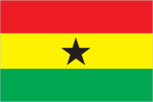
three equal horizontal bands of red (top), yellow, and green with a large black five-pointed star centered in the yellow band; uses the popular pan-African colors of Ethiopia; similar to the flag of Bolivia, which has a coat of arms centered in the yellow band Economy Ghana
GDP - composition by sector
- agriculture
- 37.3%
- industry
- 25.3%
- services
- 37.5% (2006 est.)
GDP - per capita (PPP)
$2,600 (2006 est.)
GDP - real growth rate
5.7% (2006 est.)
GDP (official exchange rate)
$10.18 billion (2006 est.)
GDP (purchasing power parity)
$59.15 billion (2006 est.)
Household income or consumption by percentage share
- highest 10%
- 30.1% (1999)
- lowest 10%
- 2.2%
Illicit drugs
illicit producer of cannabis for the international drug trade; major transit hub for Southwest and Southeast Asian heroin and, to a lesser extent, South American cocaine destined for Europe and the US; widespread crime and money laundering problem, but the lack of a well-developed financial infrastructure limits the country's utility as a money-laundering center This page was last updated on 8 February, 2007
Imports
$5.666 billion f.o.b. (2006 est.)
Imports - commodities
capital equipment, petroleum, foodstuffs
Imports - partners
Nigeria 15.2%, China 12.5%, US 6.3%, UK 5.2%, South Africa 4.5%, Brazil 4.1%, Netherlands 4% (2005)
Industrial production growth rate
3.8% (2000 est.)
Industries
mining, lumbering, light manufacturing, aluminum smelting, food processing, cement, small commercial ship building
Inflation rate (consumer prices)
10.9% (2006 est.)
International organization participation
ACP, AfDB, AU, C, ECOWAS, FAO, G-24, G-77, IAEA, IBRD, ICAO, ICC, ICCt, ICRM, IDA, IFAD, IFC, IFRCS, ILO, IMF, IMO, Interpol, IOC, IOM, IPU, ISO, ITU, ITUC, MIGA, MINURSO, MONUC, NAM, OAS (observer), OIF, ONUB, OPCW, UN, UNCTAD, UNESCO, UNHCR, UNIDO, UNIFIL, UNITAR, UNMEE, UNMIL, UNOCI, UNWTO, UPU, WCL, WCO, WFTU, WHO, WIPO, WMO, WTO
Internet country code
.gh
Internet hosts
380 (2006)
Internet Service Providers (ISPs)
12 (2000)
Internet users
401,300 (2005) Transportation Ghana
Investment (gross fixed)
29% of GDP (2006 est.)
Judicial branch
Supreme Court
Labor force
10.87 million (2006 est.)
Labor force - by occupation
- agriculture
- 60%
- industry
- 15%
- services
- 25% (1999 est.)
Legislative branch
- unicameral Parliament (230 seats; note - increased from 200 seats in last election; members are elected by direct, popular vote to serve four-year terms)
- election results
- percent of vote by party - NA; seats by party - NPP 128, NDC 92, other 10
- elections
- last held 7 December 2004 (next to be held December 2008)
Manpower available for military service
- females age 18-49
- 4,762,459 (2005 est.)
- males age 18-49
- 4,808,451
Manpower fit for military service
- females age 18-49
- 2,991,551 (2005 est.)
- males age 18-49
- 3,011,081
Manpower reaching military service age annually
- females age 18-49
- 247,777 (2005 est.)
- males age 18-49
- 251,056
Merchant marine
- by type
- cargo 1, petroleum tanker 1, refrigerated cargo 2
- foreign-owned
- 1 (Brazil 1) (2006)
- total
- 4 ships (1000 GRT or over) 6,308 GRT/9,418 DWT
Military branches
Ghanaian Army, Ghanaian Navy, Ghanaian Air Force (2006)
Military expenditures - dollar figure
$83.65 million (2005 est.)
Military expenditures - percent of GDP
0.8% (2005 est.) Transnational Issues Ghana
Military service age and obligation
18 years of age for compulsory and volunteer military service (2001)
Natural gas - consumption
0 cu m (2004 est.)
Natural gas - production
0 cu m (2004 est.)
Natural gas - proved reserves
23.79 billion cu m (1 January 2005 est.)
Oil - consumption
44,000 bbl/day (2004 est.)
Oil - exports
NA bbl/day
Oil - imports
NA bbl/day
Oil - production
7,477 bbl/day (2004 est.)
Oil - proved reserves
8.255 million bbl (1 January 2002)
Pipelines
oil 13 km; refined products 316 km (2006)
Political parties and leaders
Convention People's Party or CPP [Nii Noi DOWUONA, general secretary]; Democratic Freedom Party or DFP [Obed ASAMOAH, chairman]; Every Ghanaian Living Everywhere or EGLE [Owuraku AMOFA, chairman]; Great Consolidated Popular Party or GCPP [Dan LARTY]; National Convention Party or NCP [Sarpong KUMA-KUMA]; National Democratic Congress or NDC [Dr. Huudu YAHAYA, general secretary]; New Patriotic Party or NPP [Samuel Arthur ODOI-SYKES]; People's Convention Party or PCP [P. K. DONKOH-AYIFI, acting chairman]; People's Heritage Party or PHP [Emmanuel Alexander ERSKINE]; People's National Convention or PNC [Edward MAHAMA]; Reform Party [Kyeretwie OPUKU, general secretary]; United Renaissance Party or URP [Charles Wayo, chairman]
Political pressure groups and leaders
NA
Population below poverty line
31.4% (1992 est.)
Ports and terminals
Takoradi, Tema Military Ghana
Public debt
38.6% of GDP (2006 est.)
Radio broadcast stations
AM 0, FM 49, shortwave 3 (2001)
Radios
12.5 million (2001)
Railways
- narrow gauge
- 953 km 1.067-m gauge (2005)
- total
- 953 km
Refugees and internally displaced persons
- refugees (country of origin)
- 38,684 (Liberia), 14,136 (Togo) (2006)
Reserves of foreign exchange and gold
$2.098 billion (2006 est.)
Roadways
- paved
- 3,267 km
- total
- 42,623 km
- unpaved
- 39,356 km (2004)
Telephone system
- domestic
- primarily microwave radio relay; wireless local loop has been installed
- general assessment
- poor to fair system; Internet accessible; many rural communities not yet connected; expansion of services is underway
- international
- country code - 233; satellite earth stations - 4 Intelsat (Atlantic Ocean); microwave radio relay link to Panaftel system connects Ghana to its neighbors; fiber optic submarine cable (SAT-3/WASC) provides connectivity to Europe and Asia
Telephones - main lines in use
321,500 (2005)
Telephones - mobile cellular
2.842 million (2005)
Television broadcast stations
10 (2001)
Televisions
1.9 million (2001)
Unemployment rate
20% (1997 est.)
Waterways
- 1,293 km
- note
- 168 km for launches and lighters on Volta, Ankobra, and Tano rivers; 1,125 km of arterial and feeder waterways on Lake Volta (2005)