1996 Edition
CIA World Factbook 1996 (Project Gutenberg)
Introduction
Description
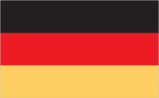
three equal horizontal bands of black (top), red, and yellow
Location
51 00 N, 9 00 E -- Central Europe, bordering the Baltic Sea and the North Sea, between the Netherlands and Poland, south of Denmark Flag ----
Geography
Area
- comparative area
- slightly smaller than Montana
- land area
- 349,520 sq km
- note
- includes the formerly separate Federal Republic of Germany, the German Democratic Republic, and Berlin, following formal unification on 3 October 1990
- total area
- 356,910 sq km
Climate
temperate and marine; cool, cloudy, wet winters and summers; occasional warm, tropical foehn wind; high relative humidity
Coastline
2,389 km
Environment
- current issues
- emissions from coal-burning utilities and industries and lead emissions from vehicle exhausts (the result of continued use of leaded fuels) contribute to air pollution; acid rain, resulting from sulfur dioxide emissions, is damaging forests; heavy pollution in the Baltic Sea from raw sewage and industrial effluents from rivers in eastern Germany
- international agreements
- party to - Air Pollution, Air Pollution-Nitrogen Oxides, Air Pollution-Sulphur 85, Air Pollution-Volatile Organic Compounds, Antarctic-Environmental Protocol, Antarctic Treaty, Biodiversity, Climate Change, Endangered Species, Environmental Modification, Hazardous Wastes, Law of the Sea, Marine Dumping, Nuclear Test Ban, Ozone Layer Protection, Ship Pollution, Tropical Timber 83, Wetlands; signed, but not ratified - Air Pollution-Sulphur 94, Desertification, Tropical Timber 94
- natural hazards
- NA
Geographic coordinates
51 00 N, 9 00 E
Geographic note
strategic location on North European Plain and along the entrance to the Baltic Sea
International disputes
none
Irrigated land
4,800 sq km (1989 est.)
Land boundaries
- border countries
- Austria 784 km, Belgium 167 km, Czech Republic 646 km, Denmark 68 km, France 451 km, Luxembourg 138 km, Netherlands 577 km, Poland 456 km, Switzerland 334 km
- total
- 3,621 km
Land use
- arable land
- 34%
- forest and woodland
- 30%
- meadows and pastures
- 16%
- other
- 19%
- permanent crops
- 1%
Location
Central Europe, bordering the Baltic Sea and the North Sea, between the Netherlands and Poland, south of Denmark
Map references
Europe
Maritime claims
- continental shelf
- 200-m depth or to the depth of exploitation
- exclusive economic zone
- 200 nm
- territorial sea
- 12 nm
Natural resources
iron ore, coal, potash, timber, lignite, uranium, copper, natural gas, salt, nickel
Terrain
- lowlands in north, uplands in center, Bavarian Alps in south
- highest point
- Zugspitze 2,962 m
- lowest point
- Freepsum Lake -2 m
People and Society
Age structure
0-14 years: 16.15% (male 6,928,750; female 6,563,026) 15-64 years: 68.52% (male 29,339,780; female 27,902,549) 65 years and over: 15.33% (male 4,658,014; female 8,143,996) (July 1996 est.)
Birth rate
9.66 births/1,000 population (1996 est.)
Death rate
12.21 deaths/1,000 population (1996 est.)
Ethnic divisions
German 95.1%, Turkish 2.3%, Italians 0.7%, Greeks 0.4%, Poles 0.4%, other 1.1% (made up largely of people fleeing the war in the former Yugoslavia)
Infant mortality rate
6 deaths/1,000 live births (1996 est.)
Languages
German
Life expectancy at birth
- female
- 79.27 years (1996 est.)
- male
- 72.8 years
- total population
- 75.95 years
Literacy
- age 15 and over can read and write (1977 est.)
- female
- NA%
- male
- NA%
- total population
- 99%
Nationality
- adjective
- German
- noun
- German(s)
Net migration rate
8.25 migrant(s)/1,000 population (1996 est.)
Population
83,536,115 (July 1996 est.)
Population growth rate
0.67% (1996 est.)
Religions
Protestant 45%, Roman Catholic 37%, unaffiliated or other 18%
Sex ratio
- all ages
- 0.96 male(s)/female (1996 est.)
- at birth
- 1.06 male(s)/female
- under 15 years
- 1.06 male(s)/female 15-64 years: 1.05 male(s)/female 65 years and over: 0.57 male(s)/female
Total fertility rate
1.3 children born/woman (1996 est.)
Government
Administrative divisions
16 states (laender, singular - land); Baden-Wuerttemberg, Bayern, Berlin, Brandenburg, Bremen, Hamburg, Hessen, Mecklenburg-Vorpommern, Niedersachsen, Nordrhein-Westfalen, Rheinland-Pfalz, Saarland, Sachsen, Sachsen-Anhalt, Schleswig-Holstein, Thueringen
Capital
- Berlin
- note
- the shift from Bonn to Berlin will take place over a period of years, with Bonn retaining many administrative functions and several ministries
Constitution
23 May 1949, known as Basic Law; became constitution of the united German people 3 October 1990
Data code
GM
Diplomatic representation in US
- chancery
- 4645 Reservoir Road NW, Washington, DC 20007
- chief of mission
- Ambassador Juergen CHROBOG
- telephone
- [1] (202) 298-4000
Executive branch
- cabinet
- Cabinet was appointed by the president upon the proposal of the chancellor
- chief of state
- President Roman HERZOG (since 1 July 1994) was elected by the Federal Convention including members of the Bundestag and an equal number of members elected by the Land Parliaments
- head of government
- Chancellor Dr. Helmut KOHL (since 4 October 1982) was elected by an absolute majority of the Bundestag
FAX
- [1] (202) 298-4249
- [49] (228) 339-2663
- branch office
- Berlin
- consulate(s) general
- Atlanta, Boston, Chicago, Detroit, Houston, Los Angeles, Miami, New York, San Francisco, Seattle
- consulate(s) general
- Dusseldorf, Frankfurt, Hamburg, Leipzig, Munich, and Stuttgart
Federal Assembly (Bundestag)
election last held 16 October 1994 (next to be held by NA 1998); results - CDU 34.2%, SPD 36.4%, Alliance 90/Greens 7.3%, CSU 7.3%, FDP 6.9%, PDS 4.4%, Republicans 1.9%; seats - (usually 656 total, but 672 for the 1994 term) CDU 244, SPD 252, Alliance 90/Greens 49, CSU 50, FDP 47, PDS 30; elected by direct popular vote under a system combining direct and proportional representation; a party must win 5% of the national vote or three direct mandates to gain representation
Federal Council (Bundesrat)
State governments are directly represented by votes; each has 3 to 6 votes depending on size and are required to vote as a block; current composition: votes - (68 total) SPD-led states 41, CDU-led states 27
Flag
three equal horizontal bands of black (top), red, and yellow
Independence
18 January 1871 (German Empire unification); divided into four zones of occupation (UK, US, USSR, and later, France) in 1945 following World War II; Federal Republic of Germany (FRG or West Germany) proclaimed 23 May 1949 and included the former UK, US, and French zones; German Democratic Republic (GDR or East Germany) proclaimed 7 October 1949 and included the former USSR zone; unification of West Germany and East Germany took place 3 October 1990; all four power rights formally relinquished 15 March 1991
International organization participation
AfDB, AG (observer), AsDB, Australia Group, BDEAC, BIS, CBSS, CCC, CDB (non-regional), CE, CERN, EBRD, ECE, EIB, ESA, EU, FAO, G- 5, G- 7, G-10, IADB, IAEA, IBRD, ICAO, ICC, ICFTU, ICRM, IDA, IEA, IFAD, IFC, IFRCS, ILO, IMF, IMO, Inmarsat, Intelsat, Interpol, IOC, IOM, ISO, ITU, MINURSO, MTCR, NACC, NAM (guest), NATO, NEA, NSG, OAS (observer), OECD, OSCE, PCA, UN, UN Security Council (temporary), UNAMIR, UNCRO, UNCTAD, UNESCO, UNHCR, UNIDO, UNITAR, UNOMIG, UNPROFOR, UPU, WEU, WHO, WIPO, WMO, WToO, WTrO, ZC
Judicial branch
Federal Constitutional Court (Bundesverfassungsgericht), half the judges are elected by the Bundestag and half by the Bundesrat
Legal system
civil law system with indigenous concepts; judicial review of legislative acts in the Federal Constitutional Court; has not accepted compulsory ICJ jurisdiction
Legislative branch
bicameral chamber (no official name for the two chambers as a whole)
Name of country
- conventional long form
- Federal Republic of Germany
- conventional short form
- Germany
- local long form
- Bundesrepublik Deutschland
- local short form
- Deutschland
National holiday
German Unity Day (Day of Unity), 3 October (1990)
Other political or pressure groups
expellee, refugee, and veterans groups
Political parties and leaders
Christian Democratic Union (CDU), Helmut KOHL, chairman; Christian Social Union (CSU), Theo WAIGEL, chairman; Free Democratic Party (FDP), Wolfgang GERHARDT, chairman; Social Democratic Party (SPD), Oskar LA FONTAINE, chairman; Alliance '90/Greens, Krista SAGER, Juergen TRITTIN, cochairpersons; Party of Democratic Socialism (PDS), Lothar BISKY, chairman; Republikaner, Rolf SCHLIERER, chairman; National Democratic Party (NPD), Ellen-Doris SCHERER; Communist Party (DKP), Rolf PRIEMER and Heinz STEHR, cochairpersons
Suffrage
18 years of age; universal
Type of government
federal republic
US diplomatic representation
- chief of mission
- Ambassador Charles E. REDMAN
- embassy
- Deichmanns Aue 29, 53170 Bonn
- mailing address
- APO AE 09080, PSC 117, Bonn
- telephone
- [49] (228) 3391
Economy
Agriculture
- eastern
- wheat, rye, barley, potatoes, sugar beets, fruit; pork, beef, chicken, milk, hides
- western
- potatoes, wheat, barley, sugar beets, fruit, cabbage; cattle, pigs, poultry
Budget
- expenditures
- $780 billion, including capital expenditures of $96.5 billion (1994)
- revenues
- $690 billion
Currency
1 deutsche mark (DM) = 100 pfennige
Economic aid
- donor
- ODA, $6.954 billion (1993)
Economic overview
Germany, the world's third-most powerful economy, faces its own unique problem of bringing its eastern area up to scratch after 45 years of communist rule. Despite substantial progress toward economic integration, the eastern states will continue to rely on subsidies from the federal government into the next century. Assistance to the east of about $100 billion annually has helped the region average nearly 8% annual economic growth since 1991, even though the overall German economy has averaged less than 2% growth. The economic recovery in the east has been led by the construction industries, with growth increasingly supported by the service sectors and light manufacturing industries. Western Germany, which accounts for 90% of overall German GDP and has three times the per capita income of eastern Germany, is perennially the first- or second-largest exporter, after the US, in the world. Nonetheless, business and political leaders have in recent years become increasingly concerned about Germany's apparent decline in attractiveness as a business location. They cite the increasing preference of German companies to locate manufacturing facilities - long the strength of the postwar economy - to foreign countries, including the US, rather than in Germany, so they can be closer to their markets and avoid Germany's high production costs. The conditions under which European economic integration - especially movement toward a single European currency - will proceed will be another key issue facing Germany in the next few years.
Electricity
- capacity
- 115,430,000 kW
- consumption per capita
- 5,683 kWh (1993)
- production
- 493 billion kWh
Exchange rates
deutsche marks (DM) per US$1 - 1.4617 (January 1996), 1.4331 (1995), 1.6228 (1994), 1.6533 (1993), 1.5617 (1992), 1.6595 (1991)
Exports
- $437 billion (f.o.b., 1994)
- commodities
- manufactures 89.3% (including machines and machine tools, chemicals, motor vehicles, iron and steel products), agricultural products 5.5%, raw materials 2.7%, fuels 1.3% (1993)
- partners
- EC 47.9% (France 11.7%, Netherlands 7.4%, Italy 7.5%, UK 7.7%, Belgium-Luxembourg 6.6%), EFTA 15.5%, US 7.7%, Eastern Europe 5.2%, OPEC 3.0% (1993)
External debt
$NA
Fiscal year
calendar year
GDP composition by sector
- agriculture
- 1%
- industry
- 34.2%
- services
- 64.8% (1994)
Germany
- purchasing power parity - $1.4522 trillion (1995 est.)
- 1.8% (1995 est.)
- $17,900 (1995 est.)
- eastern
- purchasing power parity - $120.4 billion (1995 est.)
- eastern
- 6.3% (1995 est.)
- eastern
- $6,600 (1995 est.)
- western
- purchasing power parity - $1.3318 trillion (1995 est.)
- western
- 1.5% (1995 est.)
- western
- $21,100 (1995 est.)
Illicit drugs
source of precursor chemicals for South American cocaine processors; transshipment point for Southwest Asian heroin and Latin American cocaine for West European markets
Imports
- $362 billion (f.o.b., 1994)
- commodities
- manufactures 75.1%, agricultural products 10.0%, fuels 8.3%, raw materials 5.0% (1993)
- partners
- EC 46.4% (France 11.3%, Netherlands 8.4%, Italy 8.1%, UK 6.0%, Belgium-Luxembourg 5.7%), EFTA 14.3%, US 7.3%, Japan 6.3%, Eastern Europe 5.1%, OPEC 2.6% (1993)
Industrial production growth rate
- eastern
- NA%
- western
- 2.8% (1994)
Industries
- eastern
- metal fabrication, chemicals, brown coal, shipbuilding, machine building, food and beverages, textiles, petroleum refining
- western
- among world's largest and technologically advanced producers of iron, steel, coal, cement, chemicals, machinery, vehicles, machine tools, electronics, food and beverages
Inflation rate (consumer prices)
- eastern
- 2% (1995 est.)
- western
- 2% (1995 est.)
Labor force
- 36.75 million
- by occupation
- industry 41%, agriculture 6%, other 53% (1987)
Unemployment rate
- eastern
- 14.9% (December 1995)
- western
- 8.7% (December 1995)
Communications
Branches
Army, Navy (includes Naval Air Arm), Air Force, Border Police, Coast Guard
Defense expenditures
exchange rate conversion - $42.8 billion, 1.5% of GDP (1995)
Manpower availability
- males age 15-49
- 21,540,919
- males fit for military service
- 18,537,347
- males reach military age (18) annually
- 449,292 (1996 est.)
Radio broadcast stations
- eastern
- AM 23, FM 17, shortwave 0
- western
- AM 80, FM 470, shortwave 0
Radios
70 million (1991 est.)
Telephone system
- Germany has one of the world's most technologically advanced telecommunications systems; as a result of intensive capital expenditures since reunification, the formerly backward system of the eastern part of the country is being rapidly modernized and integrated with that of the western part
- domestic
- the region which was formerly West Germany is served by an extensive system of automatic telephone exchanges connected by modern networks of fiber-optic cable, coaxial cable, microwave radio relay, and a domestic satellite system; cellular telephone service is widely available and includes roaming service to many foreign countries; since the reunification of Germany, the telephone system of the eastern region has been upgraded and enjoys many of the advantages of the national system
- international
- satellite earth stations - 14 Intelsat (12 Atlantic Ocean and 2 Indian Ocean), 1 Eutelsat, 1 Inmarsat (Atlantic Ocean region), 2 Intersputnik (1 Atlantic Ocean region and 1 Indian Ocean region); 6 submarine cable connections; 2 HF radiotelephone communication centers; tropospheric scatter links
Telephones
44 million
Television broadcast stations
246 (repeaters 6,000); note - there are 15 Russian repeaters in eastern Germany
Televisions
44.8 million (1992 est.) Defense
Transportation
Airports
- total
- 617
- with paved runways 1 524 to 2 437 m
- 67
- with paved runways 2 438 to 3 047 m
- 65
- with paved runways 914 to 1 523 m
- 51
- with paved runways over 3 047 m
- 13
- with paved runways under 914 m
- 351
- with unpaved runways 1 524 to 2 437 m
- 7
- with unpaved runways 2 438 to 3 047 m
- 6
- with unpaved runways 914 to 1 523 m
- 55 (1995 est.)
- with unpaved runways over 3 047 m
- 2
Heliports
55 (1995 est.)
Highways
- paved
- 531,018 km (including 10,955 km of expressways)
- total
- 636,282 km
- unpaved
- 105,264 km (1991 est.)
Merchant marine
- ships by type
- bulk 6, cargo 193, chemical tanker 15, combination bulk 4, combination ore/oil 5, container 166, liquefied gas tanker 12, multifunction large-load carrier 6, oil tanker 11, passenger 3, railcar carrier 3, refrigerated cargo 7, roll-on/roll-off cargo 14, short-sea passenger 7 (1995 est.)
- total
- 452 ships (1,000 GRT or over) totaling 5,054,327 GRT/6,367,036 DWT
Pipelines
crude oil 3,644 km; petroleum products 3,946 km; natural gas 97,564 km (1988)
Ports
Berlin, Bonn, Brake, Bremen, Bremerhaven, Cologne, Dresden, Duisburg, Emden, Hamburg, Karlsruhe, Kiel, Lubeck, Magdeburg, Mannheim, Rostock, Stuttgart
Railways
- narrow gauge
- 389 km 1.000-m gauge (DB operates 146 km of 1.000-m gauge); 7 km 0.900-m gauge; 39 km 0.750-m gauge
- note
- in addition to the DB system there are 54 privately-owned industrial or excursion railways, ranging in route length from 2 km to 632 km, with a total length of 3,465 km (1995)
- standard gauge
- 43,531 km 1.435-m; 40,355 km are owned by Deutsche Bahn AG (DB); 17,015 km of the DB system are electrified and 16,941 km are double- or more-tracked
- total
- 43,966 km
Waterways
- eastern
- 2,319 km (1988)
- western
- 5,222 km, of which almost 70% are usable by craft of 1,000-metric-ton capacity or larger; major rivers include the Rhine and Elbe; Kiel Canal is an important connection between the Baltic Sea and North Sea