2005 Edition
CIA World Factbook 2005 (Project Gutenberg)
Introduction
Administrative divisions
none (part of the Kingdom of Denmark; self-governing overseas administrative division of Denmark); there are no first-order administrative divisions as defined by the US Government, but there are 49 municipalities
Age structure
0-14 years: 21.3% (male 4,997/female 4,999) 15-64 years: 64.9% (male 16,120/female 14,360) 65 years and over: 13.8% (male 2,923/female 3,563) (2005 est.)
Agriculture - products
milk, potatoes, vegetables; sheep; salmon, other fish
Airports
1 (2004 est.)
Airports - with paved runways
- total
- 1 914 to 1,523 m: 1 (2004 est.) Military Faroe Islands
Area
- land
- 1,399 sq km
- total
- 1,399 sq km
- water
- 0 sq km (some lakes and streams)
Area - comparative
eight times the size of Washington, DC
Background
The population of the Faroe Islands is largely descended from Viking settlers who arrived in the 9th century. The islands have been connected politically to Denmark since the 14th century. A high degree of self-government was attained in 1948. Geography Faroe Islands
Birth rate
13.97 births/1,000 population (2005 est.)
Budget
- expenditures
- $484 million, including capital expenditures of $21 million (1999)
- revenues
- $488 million
Capital
Torshavn
Climate
mild winters, cool summers; usually overcast; foggy, windy
Coastline
1,117 km
Constitution
5 June 1953 (Danish constitution)
Country name
- conventional long form
- none
- conventional short form
- Faroe Islands
- local long form
- none
- local short form
- Foroyar
Currency (code)
Danish krone (DKK)
Currency code
DKK
Death rate
8.69 deaths/1,000 population (2005 est.)
Debt - external
$64 million (1999)
Dependency status
part of the Kingdom of Denmark; self-governing overseas administrative division of Denmark since 1948
Diplomatic representation from the US
none (self-governing overseas administrative division of Denmark)
Diplomatic representation in the US
none (self-governing overseas administrative division of Denmark)
Disputes - international
because anticipated offshore hydrocarbon resources have not been realized, earlier Faroese proposals for full independence have been deferred; Iceland disputes the Faroe Islands' fisheries median line boundary; Iceland, the UK, and Ireland dispute Denmark's claim that the Faroe Islands' continental shelf extends beyond 200 nm This page was last updated on 20 October, 2005 ======================================================================
Economic aid - recipient
$135 million (annual subsidy from Denmark) (1998)
Economy - overview
The Faroese economy has had a strong performance since 1994, mostly as a result of increasing fish landings and high and stable export prices. Unemployment is minimal and there are signs of labor shortages in several sectors. The positive economic development has helped the Faroese Home Rule Government produce increasing budget surpluses, which in turn has helped to reduce the large public debt, most of it owed to Denmark. However, the total dependence on fishing makes the Faroese economy extremely vulnerable, and the present fishing efforts appear in excess of what is a sustainable level of fishing in the long term. Oil finds close to the Faroese area give hope for deposits in the immediate Faroese area, which may eventually lay the basis for a more diversified economy and thus lessen dependence on Danish economic assistance. Aided by a substantial annual subsidy (15% of GDP) from Denmark, the Faroese have a standard of living not far below the Danes and other Scandinavians.
Electricity - consumption
204.6 million kWh (2002)
Electricity - exports
0 kWh (2002)
Electricity - imports
0 kWh (2002)
Electricity - production
220 million kWh (2002)
Electricity - production by source
- fossil fuel
- 62.4%
- hydro
- 37.6%
- nuclear
- 0%
- other
- 0% (2001)
Elevation extremes
- highest point
- Slaettaratindur 882 m
- lowest point
- Atlantic Ocean 0 m
Environment - current issues
NA
Ethnic groups
Scandinavian
Exchange rates
Danish kroner per US dollar - 5.9911 (2004), 6.5877 (2003), 7.8947 (2002), 8.3228 (2001), 8.0831 (2000)
Executive branch
- cabinet
- Landsstyri appointed by the prime minister
- chief of state
- Queen MARGRETHE II of Denmark (since 14 January 1972), represented by High Commissioner Birgit KLEIS, chief administrative officer (since 1 November 2001)
- election results
- Joannes EIDESGAARD elected prime minister; percent of parliamentary vote - NA% note: coalition of Social Democrats, Union Party, and People's Party
- elections
- the monarch is hereditary; high commissioner appointed by the monarch; following legislative elections, the leader of the majority party or the leader of the majority coalition is usually elected prime minister by the Faroese Parliament; election last held 20 January 2004 (next to be held no later than January 2008)
- head of government
- Prime Minister Joannes EIDESGAARD (since 3 February 2004)
Exports
$408 million f.o.b. (2002)
Exports - commodities
fish and fish products 94%, stamps, ships (1999)
Exports - partners
Denmark 33.5%, UK 29.7%, Norway 8.4%, Nigeria 7.2% (2004)
Fiscal year
calendar year Communications Faroe Islands
Flag description
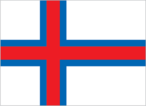
white with a red cross outlined in blue extending to the edges of the flag; the vertical part of the cross is shifted toward the hoist side in the style of the Dannebrog (Danish flag) Economy Faroe Islands
GDP - composition by sector
- agriculture
- 27%
- industry
- 11%
- services
- 62% (1999)
GDP - per capita
purchasing power parity - $22,000 (2001 est.)
GDP - real growth rate
10% (2001 est.)
GDP (purchasing power parity)
$1 billion (2001 est.)
Geographic coordinates
62 00 N, 7 00 W
Geography - note
archipelago of 17 inhabited islands and one uninhabited island, and a few uninhabited islets; strategically located along important sea lanes in northeastern Atlantic; precipitous terrain limits habitation to small coastal lowlands People Faroe Islands
Government type
NA
Highways
- paved
- 454 km
- total
- 463 km
- unpaved
- 9 km (1999)
HIV/AIDS - adult prevalence rate
NA%
HIV/AIDS - deaths
NA
HIV/AIDS - people living with HIV/AIDS
NA
Household income or consumption by percentage share
lowest 10%: NA% highest 10%: NA%
Imports
$466 million c.i.f. (2002)
Imports - commodities
machinery and transport equipment 29%, consumer goods 36%, raw materials and semi-manufactures 32%, fuels, fish and salt (1999)
Imports - partners
Denmark 52.8%, Norway 18.3%, Iceland 4.4%, Sweden 4.2% (2004)
Independence
none (part of the Kingdom of Denmark; self-governing overseas administrative division of Denmark)
Industrial production growth rate
8% (1999 est.)
Industries
fishing, fish processing, small ship repair and refurbishment, handicrafts
Infant mortality rate
- female
- 4.93 deaths/1,000 live births (2005 est.)
- male
- 7.54 deaths/1,000 live births
- total
- 6.24 deaths/1,000 live births
Inflation rate (consumer prices)
5.1% (1999)
International organization participation
IMO (associate), NC, NIB, UPU
Internet country code
.fo
Internet Service Providers (ISPs)
2 (2000)
Internet users
25,000 (2002) Transportation Faroe Islands
Irrigated land
0 sq km (1998 est.)
Judicial branch
none
Labor force
24,250 (October 2000)
Labor force - by occupation
fishing, fish processing, and manufacturing 33%, construction and private services 33%, public services 34%
Land boundaries
0 km
Land use
- arable land
- 2.14%
- other
- 97.86% (2001)
- permanent crops
- 0%
Languages
Faroese (derived from Old Norse), Danish
Legal system
Danish
Legislative branch
- unicameral Faroese Parliament or Logting (32 seats; members are elected by popular vote on a proportional basis from the seven constituencies to serve four-year terms)
- election results
- percent of vote by party - Union Party 23.7%, Social Democrats 21.8%, Republican Party 21.7%, People's Party 20.6%, Center Party 5.2%, Independence Party 4.6%; seats by party - Union Party 7, Social Democrats 7, Republican Party 8, People's Party 7, Center Party 2, Independence Party 1 note: election of 2 seats to the Danish Parliament was last held on 8 February 2005 (next to be held February 2009); results - percent of vote by party - NA; seats by party - Republican Party 1, People's Party 1
- elections
- last held 20 January 2004 (next to be held no later than January 2008)
Life expectancy at birth
- female
- 82.67 years (2005 est.)
- male
- 75.77 years
- total population
- 79.21 years
Literacy
- definition: NA
- female
- NA% note: probably the same as Denmark proper Government Faroe Islands
- male
- NA%
- total population
- NA%
Location
Northern Europe, island group between the Norwegian Sea and the North Atlantic Ocean, about one-half of the way from Iceland to Norway
Map references
Europe
Maritime claims
- continental shelf
- 200 nm or agreed boundaries or median line
- exclusive fishing zone
- 200 nm or agreed boundaries or median line
- territorial sea
- 3 nm
Median age
- female
- 35.68 years (2005 est.)
- male
- 34.64 years
- total
- 35.11 years
Merchant marine
- by type
- cargo 6, container 1, passenger/cargo 5, petroleum tanker 2
- foreign-owned
- 8 (Denmark 2, Germany 1, Iceland 2, Norway 2, United Kingdom 1) (2005)
- total
- 14 ships (1,000 GRT or over) 24,051 GRT/11,998 DWT
Military - note
defense is the responsibility of Denmark Transnational Issues Faroe Islands
Military branches
no regular military forces
Military expenditures - dollar figure
$NA
Military expenditures - percent of GDP
NA
National holiday
Olaifest (Olavasoka), 29 July
Nationality
- adjective
- Faroese
- noun
- Faroese (singular and plural)
Natural hazards
NA
Natural resources
fish, whales, hydropower, possible oil and gas
Net migration rate
0.94 migrant(s)/1,000 population (2005 est.)
Oil - consumption
4,500 bbl/day (2001 est.)
Oil - exports
NA
Oil - imports
NA
Oil - production
0 bbl/day (2001 est.)
Political parties and leaders
Center Party [Jenis A. RANA]; Independence Party [Kari P. HOJGAARD]; People's Party [Anfinn KALLSBERG]; Republican Party [Hogni HOYDAL]; Social Democratic Party [Joannes EIDESGAARD]; Union Party [Kaj Oeo JOHANNESEN]
Political pressure groups and leaders
NA
Population
46,962 (July 2005 est.)
Population below poverty line
NA%
Population growth rate
0.62% (2005 est.)
Ports and harbors
Torshavn
Radio broadcast stations
AM 1, FM 13, shortwave 0 (1998)
Radios
26,000 (1997)
Religions
Evangelical Lutheran
Sex ratio
- at birth
- 1 male(s)/female under 15 years: 1 male(s)/female 15-64 years: 1.12 male(s)/female 65 years and over: 0.82 male(s)/female
- total population
- 1.05 male(s)/female (2005 est.)
Suffrage
18 years of age; universal
Telephone system
- domestic
- digitalization was completed in 1998; both NMT (analog) and GSM (digital) mobile telephone systems are installed
- general assessment
- good international communications; good domestic facilities
- international
- country code - 298; satellite earth stations - 1 Orion; 1 fiber-optic submarine cable to the Shetland Islands, linking the Faroe Islands with Denmark and Iceland; fiber-optic submarine cable connection to Canada-Europe cable
Telephones - main lines in use
23,000 (2002)
Telephones - mobile cellular
30,700 (2002)
Television broadcast stations
3 (plus 43 low-power repeaters) (September 1995)
Televisions
15,000 (1997)
Terrain
rugged, rocky, some low peaks; cliffs along most of coast
Total fertility rate
2.2 children born/woman (2005 est.)
Unemployment rate
1% (October 2000)