2001 Edition
CIA World Factbook 2001 (Project Gutenberg)
Introduction
Administrative divisions
22 provinces (provincias, singular - provincia); Azuay, Bolivar, Canar, Carchi, Chimborazo, Cotopaxi, El Oro, Esmeraldas, Galapagos, Guayas, Imbabura, Loja, Los Rios, Manabi, Morona-Santiago, Napo, Orellana, Pastaza, Pichincha, Sucumbios, Tungurahua, Zamora-Chinchipe
Age structure
0-14 years: 35.8% (male 2,398,801; female 2,320,537) 15-64 years: 59.81% (male 3,900,193; female 3,984,797) 65 years and over: 4.39% (male 269,372; female 310,278) (2001 est.)
Agriculture - products
bananas, coffee, cocoa, rice, potatoes, manioc (tapioca), plantains, sugarcane; cattle, sheep, pigs, beef, pork, dairy products; balsa wood; fish, shrimp
Airports
180 (2000 est.)
Airports - with paved runways
total: 59 over 3,047 m: 2 2,438 to 3,047 m: 5 1,524 to 2,437 m: 18 914 to 1,523 m: 15 under 914 m: 19 (2000 est.)
Airports - with unpaved runways
total: 121 914 to 1,523 m: 32 under 914 m: 89 (2000 est.)
Area
total: 283,560 sq km land: 276,840 sq km water: 6,720 sq km note: includes Galapagos Islands
Area - comparative
slightly smaller than Nevada
Background
The "Republic of the Equator" was one of three countries that emerged from the collapse of Gran Colombia in 1830 (the others being Colombia and Venezuela). Between 1904 and 1942, Ecuador lost territories in a series of conflicts with its neighbors. A border war with Peru that flared in 1995 was resolved in 1999. Ecuador Geography
Birth rate
25.99 births/1,000 population (2001 est.)
Budget
revenues: planned $5.1 billion (not including revenue from potential privatizations) expenditures: $5.1 billion, including capital expenditures of $NA (1999)
Capital
Quito
Climate
tropical along coast, becoming cooler inland at higher elevations; tropical in Amazonian jungle lowlands
Coastline
2,237 km
Constitution
10 August 1998
Country name
conventional long form: Republic of Ecuador conventional short form: Ecuador local long form: Republica del Ecuador local short form: Ecuador
Currency
US dollar (USD)
Currency code
USD
Death rate
5.44 deaths/1,000 population (2001 est.)
Debt - external
$15 billion (1999)
Diplomatic representation from the US
chief of mission: Ambassador Gwen C. CLARE embassy: Avenida 12 de Octubre y Avenida Patria, Quito mailing address: APO AA 34039 telephone: [593] (2) 562-890
Diplomatic representation in the US
chief of mission: Ambassador Ivonne A-BAKI chancery: 2535 15th Street NW, Washington, DC 20009 telephone: [1] (202) 234-7200
Disputes - international
none
Economic aid - recipient
$695.7 million (1995)
Economy - overview
Ecuador has substantial oil resources and rich agricultural areas. Because the country exports primary products such as oil, bananas, and shrimp, fluctuations in world market prices can have a substantial domestic impact. Ecuador joined the World Trade Organization in 1996, but has failed to comply with many of its accession commitments. In recent years, growth has been uneven due to ill-conceived fiscal stabilization measures. The aftermath of El Nino and depressed oil market of 1997-98 drove Ecuador's economy into a free-fall in 1999. The beginning of 1999 saw the banking sector collapse, which helped precipitate an unprecedented default on external loans later that year. Continued economic instability drove a 70% depreciation of the currency throughout 1999, which eventually forced a desperate government to "dollarize" the currency regime in 2000. The move stabilized the currency, but did not stave off the ouster of the government. The new president, Gustavo NOBOA has yet to complete negotiations for a long sought IMF accord. He will find it difficult to push through the reforms necessary to make "dollarization" work in the long run.
Electricity - consumption
9.386 billion kWh (1999)
Electricity - exports
0 kWh (1999)
Electricity - imports
25 million kWh (1999)
Electricity - production
10.065 billion kWh (1999)
Electricity - production by source
fossil fuel: 29.51% hydro: 70.49% nuclear: 0% other: 0% (1999)
Elevation extremes
lowest point: Pacific Ocean 0 m highest point: Chimborazo 6,267 m
Environment - current issues
deforestation; soil erosion; desertification; water pollution; pollution from oil production wastes
Environment - international agreements
party to: Antarctic-Environmental Protocol, Antarctic Treaty, Biodiversity, Climate Change, Climate Change-Kyoto Protocol, Desertification, Endangered Species, Hazardous Wastes, Nuclear Test Ban, Ozone Layer Protection, Ship Pollution, Tropical Timber 83, Tropical Timber 94, Wetlands signed, but not ratified: none of the selected agreements
Ethnic groups
mestizo (mixed Amerindian and white) 65%, Amerindian 25%, Spanish and others 7%, black 3%
Exchange rates
sucres per US dollar - 25,000 (January 2001), 24,988.4 (2000), 11,786.8 (1999), 5,446.6 (1998), 3,988.3 (1997), 3,189.5 (1996) note: on 7 January 2000, the government passed a decree "dollarizing" the economy; on 13 March 2000, the National Congress approved a new exchange system whereby the US dollar is adopted as the main legal tender in Ecuador for all purposes; on 20 March 2000, the Central Bank of Ecuador started to exchange sucres for US dollars at a fixed rate of 25,000 sucres per US dollar; since 30 April 2000, all transactions are denominated in US dollars
Executive branch
chief of state: President Gustavo NOBOA Bejarano (since 22 January 2000) selected president following coup that deposed President MAHUAD; Vice President Pedro PINTO Rubianes (since 28 January 2000) elected by National Congress from a slate of candidates submitted by President NABOA; note - the president is both the chief of state and head of government head of government: President Gustavo NOBOA Bejarano (since 22 January 2000) selected president following coup that deposed President MAHUAD; Vice President Pedro PINTO Rubianes (since 28 January 2000) elected by National Congress from a slate of candidates submitted by President NABOA; note - the president is both the chief of state and head of government cabinet: Cabinet appointed by the president elections: president and vice president elected on the same ticket by popular vote for four-year term (no reelection); election last held 31 May 1998; runoff election held 12 July 1998 (next to be held NA 2002) election results: results of the last election prior to the coup were: Jamil MAHUAD elected president; percent of vote - 51% note: a military-indigenous coup toppled democratically elected President Jamil MAHAUD on 21 January 2000; the military quickly handed power over to Vice President Gustavo NOBOA on 22 January; National Congress then elected a new vice president from a slate of candidates submitted by NOBOA; the new administration is scheduled to complete the remainder of MAHAUD's term, due to expire in January 2003
Exports
$5.6 billion (f.o.b., 2000 est.)
Exports - commodities
petroleum, bananas, shrimp, coffee, cocoa, cut flowers, fish
Exports - partners
US 37%, Colombia 5%, Italy 5%, Chile 5%, Peru 4% (1999)
FAX
- [1] (202) 667-3482 consulate(s) general: Chicago, Houston, Los Angeles, Miami, New Orleans, New York, Newark, Philadelphia, and San Francisco
- [593] (2) 502-052 consulate(s) general: Guayaquil
Fiscal year
calendar year Ecuador Communications
Flag description
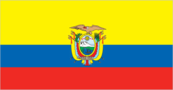
three horizontal bands of yellow (top, double width), blue, and red with the coat of arms superimposed at the center of the flag; similar to the flag of Colombia which is shorter and does not bear a coat of arms Ecuador Economy
GDP
purchasing power parity - $37.2 billion (2000 est.)
GDP - composition by sector
agriculture: 14% industry: 36% services: 50% (1999 est.)
GDP - per capita
purchasing power parity - $2,900 (2000 est.)
GDP - real growth rate
0.8% (2000 est.)
Geographic coordinates
2 00 S, 77 30 W
Geography - note
Cotopaxi in Andes is highest active volcano in world Ecuador People
Government type
republic
Heliports
1 (2000 est.) Ecuador Military
Highways
total: 43,197 km paved: 8,165 km unpaved: 35,032 km (1999 est.)
HIV/AIDS - adult prevalence rate
0.29% (1999 est.)
HIV/AIDS - deaths
1,400 (1999 est.)
HIV/AIDS - people living with HIV/AIDS
19,000 (1999 est.)
Household income or consumption by percentage share
lowest 10%: 2.2% highest 10%: 33.8% (1995)
Illicit drugs
significant transit country for cocaine and derivatives of coca originating in Colombia and Peru; importer of precursor chemicals used in production of illicit narcotics; important money-laundering hub; increased activity on the northern frontier by trafficking groups and Colombian insurgents
Imports
$3.4 billion (f.o.b., 2000 est.)
Imports - commodities
machinery and equipment, raw materials, fuels; consumer goods
Imports - partners
US 30%, Colombia 13%, Venezuela 6%, Japan 5%, Venezuela 6%, Mexico 3% (1998)
Independence
24 May 1822 (from Spain)
Industrial production growth rate
2.4% (1997 est.)
Industries
petroleum, food processing, textiles, metal work, paper products, wood products, chemicals, plastics, fishing, lumber
Infant mortality rate
34.08 deaths/1,000 live births (2001 est.)
Inflation rate (consumer prices)
96% (2000 est.)
International organization participation
CAN, CCC, ECLAC, FAO, G-11, G-77, IADB, IAEA, IBRD, ICAO, ICC, ICFTU, ICRM, IDA, IFAD, IFC, IFRCS, IHO, ILO, IMF, IMO, Intelsat, Interpol, IOC, IOM, ISO, ITU, LAES, LAIA, NAM, OAS, OPANAL, OPCW, PCA, RG, UN, UNCTAD, UNESCO, UNIDO, UPU, WCL, WFTU, WHO, WIPO, WMO, WToO, WTrO
Internet country code
.ec
Internet Service Providers (ISPs)
13 (2000)
Internet users
20,000 (2000) Ecuador Transportation
Irrigated land
5,560 sq km (1993 est.)
Judicial branch
Supreme Court or Corte Suprema (new justices are elected by the full Supreme Court)
Labor force
4.2 million
Labor force - by occupation
agriculture 30%, industry 25%, services 45% (1999 est.)
Land boundaries
total: 2,010 km border countries: Colombia 590 km, Peru 1,420 km
Land use
arable land: 6% permanent crops: 5% permanent pastures: 18% forests and woodland: 56% other: 15% (1993 est.)
Languages
Spanish (official), Amerindian languages (especially Quechua)
Legal system
based on civil law system; has not accepted compulsory ICJ jurisdiction
Legislative branch
unicameral National Congress or Congreso Nacional (121 seats; 79 members are popularly elected at-large nationally to serve four-year terms; 42 members are popularly elected by province - two per province - for four-year terms) elections: last held 31 May 1998 (next to be held NA 2002) election results: percent of vote by party - NA%; seats by party - DP 32, PSC 27, PRE 24, ID 18, P-NP 9, FRA 5, PCE 3, MPD 2, CFP 1; note - defections by members of National Congress are commonplace, resulting in frequent changes in the numbers of seats held by the various parties
Life expectancy at birth
total population: 71.33 years male: 68.52 years female: 74.28 years (2001 est.)
Literacy
definition: age 15 and over can read and write total population: 90.1% male: 92% female: 88.2% (1995 est.) Ecuador Government
Location
Western South America, bordering the Pacific Ocean at the Equator, between Colombia and Peru
Map references
South America
Maritime claims
continental shelf: claims continental shelf between mainland and Galapagos Islands territorial sea: 200 NM
Merchant marine
total: 30 ships (1,000 GRT or over) totaling 233,312 GRT/385,784 DWT ships by type: cargo 2, chemical tanker 1, liquefied gas 1, passenger 3, petroleum tanker 22, specialized tanker 1 (2000 est.)
Military branches
Army (Ejercito Ecuatoriano), Navy (Armada Ecuatoriana, includes Marines), Air Force (Fuerza Aerea Ecuatoriana), National Police (Policia Nacional)
Military expenditures - dollar figure
$720 million (FY98)
Military expenditures - percent of GDP
3.4% (FY98) Ecuador Transnational Issues
Military manpower - availability
males age 15-49: 3,382,567 (2001 est.)
Military manpower - fit for military service
males age 15-49: 2,280,899 (2001 est.)
Military manpower - military age
20 years of age
Military manpower - reaching military age annually
males: 132,978 (2001 est.)
National holiday
Independence Day (independence of Quito), 10 August (1809)
Nationality
noun: Ecuadorian(s) adjective: Ecuadorian
Natural hazards
frequent earthquakes, landslides, volcanic activity; periodic droughts
Natural resources
petroleum, fish, timber, hydropower
Net migration rate
-0.55 migrant(s)/1,000 population (2001 est.)
Pipelines
crude oil 800 km; petroleum products 1,358 km
Political parties and leaders
Concentration of Popular Forces or CFP [Averroes BUCARAM]; Democratic Left or ID [Rodrigo BORJA Cevallos]; Ecuadorian Conservative Party or PCE [Sixto DURAN Ballen]; Independent National Movement or MIN [leader NA]; Pachakutik-New Country or P-NP [Rafael PANDAM]; Popular Democracy or DP [Ramiro RIVERA]; Popular Democratic Movement or MPD [leader NA]; Radical Alfarista Front or FRA [Fabian ALARCON, director]; Roldosist Party or PRE [Abdala BUCARAM Ortiz, director]; Social Christian Party or PSC [Jaime NEBOT Saadi, president]
Political pressure groups and leaders
Confederation of Indigenous Nationalities of Ecuador or CONAIE [Antonio VARGAS]; Coordinator of Social Movements or CMS [F. Napoleon SANTOS]; Popular Front or FP [Luis VILLACIS]
Population
13,183,978 (July 2001 est.)
Population below poverty line
50% (1999 est.)
Population growth rate
2% (2001 est.)
Ports and harbors
Esmeraldas, Guayaquil, La Libertad, Manta, Puerto Bolivar, San Lorenzo
Radio broadcast stations
AM 392, FM 27, shortwave 29 (1998)
Radios
4.15 million (1997)
Railways
total: 965 km narrow gauge: 965 km 1.067-m gauge (2000)
Religions
Roman Catholic 95%
Sex ratio
at birth: 1.05 male(s)/female under 15 years: 1.03 male(s)/female 15-64 years: 0.98 male(s)/female 65 years and over: 0.87 male(s)/female total population: 0.99 male(s)/female (2001 est.)
Suffrage
18 years of age; universal, compulsory for literate persons ages 18-65, optional for other eligible voters
Telephone system
general assessment: NA domestic: facilities generally inadequate and unreliable international: satellite earth station - 1 Intelsat (Atlantic Ocean)
Telephones - main lines in use
899,000 (1997)
Telephones - mobile cellular
160,061 (1997)
Television broadcast stations
15 (including one station on the Galapagos Islands) (1997)
Televisions
1.55 million (1997)
Terrain
coastal plain (costa), inter-Andean central highlands (sierra), and flat to rolling eastern jungle (oriente)
Total fertility rate
3.12 children born/woman (2001 est.)
Unemployment rate
13%; note - widespread underemployment (2000 est.)
Waterways
1,500 km