1989 Edition
CIA World Factbook 1989 (Internet Archive)
Countries
182
Data Records
15,825
Categories
5
Source
CIA World Factbook 1989 (Internet Archive)
Geography
Climate
- tropical; moderated by northeast trade winds; heavy rainfall
- tropical maritime; little seasonal temperature variation
Coastline
- 148 km
- 1,288 km
Comparative area
- slightly more than four times the size of Washington, DC
- slightly more than twice the size of New Hampshire Land boundary 275 km with Haiti
Contiguous zone
- 24 nm
- 24 nm
Continental shelf
outer edge of continental margin or 200 nm
Environment
- flash floods a constant hazard; occasional hurricanes
- subject to occasional hurricanes (July to October); deforestation
Extended economic zone
- 200 nm
- 200 nm
Land boundaries
none
Land use
- 9% arable land; 1 3% permanent crops; 3% meadows and pastures; 41% forest and woodland; 34% other
- 23% arable land; 7% permanent crops; 43% meadows and pastures; 13% forest and woodland; 14% other; includes 4% irrigated
Natural resources
- timber
- nickel, bauxite, gold, silver
Note
- located 550 km southeast of Puerto Rico in the Caribbean Sea
- shares island of Hispaniola with Haiti (western one-third is Haiti, eastern two-thirds is the Dominican Republic)
Terrain
- rugged mountains of volcanic origin
- rugged highlands and mountains with fertile valleys interspersed
Territorial sea
- 1 2 nm
- 6 nm
Total area
- 750 km2; land area: 750 km2
- 48,730 km2; land area: 48,380 km2
People and Society
Birth rate
- 26 births/ 1 ,000 population (1990)
- 28 births/ 1,000 population (1990)
Death rate
- 5 deaths/ 1 ,000 population (1990)
- 7 deaths/ 1,000 population (1990)
Ethnic divisions
- mostly black; some Carib Indians
- 73% mixed, 16% white, 11% black
Infant mortality rate
- 13 deaths/ 1,000 live births (1990)
- 62 deaths/ 1,000 live births (1990)
Labor force
- 25,000; 40% agriculture, 32% industry and commerce, 28% services (1984) Organized labor 25% of labor force
- 2,300,000-2,600,000; 49% agriculture, 33% services, 18% industry (1986)
Language
- English (official); French patois widely spoken
- Spanish
Life expectancy at birth
- 73 years male, 79 years female (1990)
- 65 years male, 69 years female (1990)
Literacy
- 80% (est.)
- 74%
Nationality
- noun — Dominican(s); adjective— Dominican
- noun — Dominican(s); adjective— Dominican
Net migration rate
- —4 migrants/ 1 ,000 population (1990)
- — 1 migrant/ 1 ,000 population (1990)
Organized labor
12% of labor force (1989 est.)
Population
- 84,854 (July 1990), growth rate 1.7% (1990)
- 7,240,793 (July 1990), growth rate 2.0% (1990)
Religion
- 80% Roman Catholic; Anglican, Methodist
- 95% Roman Catholic
Total fertility rate
- 2.6 children born/ woman (1990)
- 3.2 children born/ woman (1990)
Government
Administrative divisions
- 10 parishes; Saint Andrew, Saint David, Saint George, Saint John, Saint Joseph, Saint Luke, Saint Mark, Saint Patrick, Saint Paul, Saint Peter
- 29 provinces (provincias, singular — provincia) and 1 district* (distrito); Azua, Baoruco, Barahona, Dajabdn, Distrito Nacional*, Duarte, Elias Pitta, El Seibo, Espaillat, Hato Mayor, Independencia, La Altagracia, La Romana, La Vega, Maria Trinidad Sanchez, Monsefior Nouel, Monte Cristi, Monte Plata, Pedernales, Peravia, Puerto Plata, Salcedo, Samana, Sanchez Ramirez, San Cristobal, San Juan, San Pedro De Macoris, Santiago, Santiago Rodriguez, Valverde
Capital
- Roseau
- Santo Domingo
Communists
- negligible
- an estimated 8,000 to 10,000 members in several legal and illegal factions; effectiveness limited by ideological differences and organizational inadequacies
Constitution
- 3 November 1978
- 28 November 1966
Diplomatic representation
- there is no Chancery in the US; US — no official presence since the Ambassador resides in Bridgetown (Barbados), but travels frequently to Dominica
- Ambassador Carlos A. MORALES Troncoso (serves concurrently as Vice President); Chancery at 1715 22nd Street NW, Washington DC 20008; telephone (202) 332-6280; there are Dominican Consulates General in Boston, Chicago, Los Angeles, Mayaguez (Puerto Rico), Miami, New Orleans, New York, Philadelphia, San Juan (Puerto Rico), and Consulates in Charlotte Amalie (Virgin Islands), Detroit, Houston, Jacksonville, Minneapolis, Mobile, Ponce (Puerto Rico), and San Francisco; US — Ambassador Paul D. TAYLOR; Embassy at the corner of Calle Cesar Nicolas Penson and Calle Leopoldo Navarro, Santo Domingo (mailing address is APO Miami 34041-0008); telephone [809] 541-2171
Elections
- President — last held 20 December 1988 (next to be held December 1993); the president is elected by the House of Assembly; House of Assembly — last held 1 July 1985 (next to be held July 1990); resultspercent of vote by party NA; seats — (21 total) DFP 17, LPD 4
- President — last held 16 May 1986 (next to be held May 1990); results — Joaquin Balaguer (PRSC) 41.8%, Jacobo Majluta (PRO) 39.7%, Juan Bosch Gavifio(PLD) 18.5%; Senate — last held 16 May 1986 (next to be held May 1990); results — percent of vote by party NA; seats— (30 total) PRSC 21, PRO 7, PLD2; Chamber of Deputies — last held 16 May 1986 (next to be held May 1990); results— PRSC 40.6%, PRO 33.5%, PLD 18.3%, LE 5.3%, other 2.3%; seats— (120 total) PRSC 56, PRO 48, PLD 16
Executive branch
- president, prime minister, Cabinet
- president, vice president, Cabinet
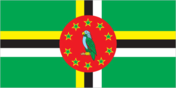
Flag
- green with a centered cross of three equal bands — the vertical part is yellow (hoist side), black, and white — the horizontal part is yellow (top), black, and white; superimposed in the center of the cross is a red disk bearing a sisserou parrot encircled by 10 green five-pointed stars edged in yellow; the 10 stars represent the 10 administrative divisions (parishes)
- a centered white cross that extends to the edges, divides the flag into four rectangles — the top ones are blue (hoist side) and red, the bottom ones are red (hoist side) and blue; a small coat of arms is at the center of the cross
Independence
- 3 November 1978 (from UK)
- 27 February 1 844 (from Haiti)
Judicial branch
- Eastern Caribbean Supreme Court
- Supreme Court (Corte Suprema)
Leaders
- Chief of State — President Sir Clarence Augustus SEIGNORET (since 19 December 1983); Head of Government — Prime Minister (Mary) Eugenia CHARLES (since 21 July 1980) Political parties and leaders: Dominica Freedom Party (DFP), (Mary) Eugenia Charles; Labor Party of Dominica (LPD, a leftist-dominated coalition), Michael Douglas; United Workers Party (UWP), Edison James
- Chief of State and Head of Government— President Joaquin BALAGUER Ricardo (since 16 August 1986); Vice President Carlos A. MORALES Troncoso (since 16 August 1986) Political parties and leaders: Major parties — Social Christian Reformist Party (PRSC), Joaquin Balaguer Ricardo; Dominican Revolutionary Party (PRD), which fractured in May 1989 with the understanding that leading rivals Jacobo Majluta and Jose Francisco Pefia Gomez would run separately for president at the head of the Independent Revolutionary Party (PRI) and the Social Democratic Institutional Bloc (BIS), respectively, and try to reconstitute the PRD after the election; Dominican Liberation Party (PLD), Juan Bosch Gavifto; Dominican Republic (continued) Minor parties — National Veterans and Civilian Party (PNVC), Juan Rene Beauchanps Javier; The Structure (LE), Andres Van Der Horst; Democratic Quisqueyan Party (PQD), Elias Wessin Chavez; Constitutional Action Party (PAC), Luis Arzeno Rodriguez; National Progressive Force (FNP), Marino Vinicio Castillo; Popular Christian Party (PPC), Rogelio Delgado Bogaert; Dominican Communist Party (PCD), Narciso Isa Conde; AntiImperialist Patriotic Union (UPA), Ivan Rodriguez; in 1983 several leftist parties, including the PCD, joined to form the Dominican Leftist Front (FID); however, they still retain individual party structures
Legal system
- based on English common law
- based on French civil codes
Legislative branch
- unicameral House of Assembly (includes 9 appointed senators and 21 elected representatives)
- bicameral National Congress (Congreso Nacional) consists of an upper chamber or Senate (Senado) and lower chamber or Chamber of Deputies (Camara de Diputados)
Long-form name
- Commonwealth of Dominica
- Dominican Republic (no short-form name)
Member of
- ACP, CARICOM, Commonwealth, FAO, GATT (de facto), G-77, IBRD, IDA, IFAD, IFC, ILO, IMF, IMO, INTERPOL, OAS, OECS, UN, UNESCO, UPU, WHO, WMO
- FAO, G-77, GATT, IADB, IAEA, IBA, IBRD, ICAO, ICO, IDA, IDB — Inter-American Development Bank, IFAD, IFC, IHO, ILO, IMF, IMO, INTELSAT, INTERPOL, IOOC, IRC, ISO, ITU, OAS, PAHO, SELA, UN, UNESCO, UPU, WFTU, WHO, WMO, WTO
National holiday
- Independence Day, 3 November (1978)
- Independence Day, 27 February (1844)
Other political or pressure groups
Dominica Liberation Movement (DLM), a small leftist group
Suffrage
- universal at age 18
- universal and compulsory at age 1 8 or if married; members of the armed forces and police cannot vote
Type
- parliamentary democracy
- republic
Economy
Agriculture
- accounts for 30% of GDP; principal crops — bananas, citrus fruit, coconuts, root crops; bananas provide the bulk of export earnings; forestry and fisheries potential not exploited Dominican Republic
- accounts for 18% of GDP and employs 49% of labor force; sugarcane most important commercial crop, followed by coffee, cotton, and cocoa; food crops — rice, beans, potatoes, corn, bananas; animal output — cattle, hogs, dairy products, meat, eggs; not self-sufficient in food
Aid
- Western (non-US) countries, ODA and OOF bilateral commitments (197087), $109 million
- US commitments, including Ex-Im (FY70-88), $1.1 billion; Western (non-US) countries, ODA and OOF bilateral commitments (1970-87), $529 million
Budget
- revenues $60 million; expenditures $52 million, including capital expenditures of $18 million (FY88)
- revenues $413 million; expenditures $522 million, including capital expenditures of $218 million (1988)
Currency
- East Caribbean dollar (plural — dollars); 1 EC dollar (EC$) = 100 cents
- Dominican peso (plural — pesos); 1 Dominican peso (RD$) = 100 centavos
Electricity
- 7,000 kW capacity; 16 million kWh produced, 190 kWh per capita (1989)
- 1,376,000 kW capacity; 4,000 million kWh produced, 560 kWh per capita (1989)
Exchange rates
- East Caribbean dollars (ECS) per US$1— 2.70 (fixed rate since 1976) Fiscal yean 1 July-30 June
- Dominican pesos per US$1— 6.3400 (January 1990), 6.3400 (1989), 6.1 125 (1988), 3.8448 (1987), 2.9043(1986), 3.1126(1985)
Exports
- $46 million (f.o.b., 1987); commodities— bananas, coconuts, grapefruit, soap, galvanized sheets; partners — UK 72%, Jamaica 10%, OECS 6%, US 3%, other 9%
- $711 million (f.o.b., 1988); commodities— sugar, coffee, cocoa, gold, ferronickel; partners — US, including Puerto Rico, 74%
External debt
- $63.6 million (December 1987)
- $3.6 billion (1989) est.
Fiscal year
calendar year
GDP
- $137 million, per capita $1,408; real growth rate 5.6% (1988 est.)
- $5.1 billion, per capita $790; real growth rate 0.5% (1988)
Imports
- $66.0 million (c.i.f., 1987); commodities— food, oils and fats, chemicals, fuels and lubricants, manufactured goods, machinery and equipment; partners — US 23%, UK 18%, CARICOM 15%, OECS 15%, Japan 5%, Canada 3%, other 21%
- $1.8 billion (c.i.f.. 1988); commodities— foodstuffs, petroleum, cotton and fabrics, chemicals and pharmaceuticals; partners — US, including Puerto Rico, 37% (1985)
Industrial production
- growth rate 5.9% in manufacturing (1987)
- growth rate 30% (1987 est.)
Industries
- agricultural processing, tourism, soap and other coconut-based products, cigars, pumice mining
- tourism, sugar processing, ferronickel and gold mining, textiles, cement, tobacco
Inflation rate (consumer prices)
- 4.9% (1987)
- 57.6% (1988)
Overview
- The economy is dependent on agriculture and thus is highly vulnerable to climatic conditions. Agriculture accounts for about 30% of GDP and employs 40% of the labor force. Principal products include bananas, coconuts, citrus, and root crops. In 1988 the economy achieved a 5.6% growth in real GDP on the strength of a boost in construction, higher agricultural production, and growth of the small manufacturing sector based on soap and garment industries. The tourist industry remains undeveloped because of a rugged coastline and the lack of an international-class airport.
- The economy is largely dependent on the agricultural sector, which employs 50% of the labor force and provides about half of export revenues. The principal commercial crop is sugarcane, followed by coffee, cocoa, and tobacco. Industry is based on the processing of agricultural products, durable consumer goods, minerals, and chemicals. Rapid growth of free trade zones has established a significant expansion of manufacturing for export, especially wearing apparel. Over the past decade tourism has also increased in importance and is a significant earner of foreign exchange and a source of new jobs. Unemployment is officially reported at about 25%, but underemployment may be much higher.
Unemployment rate
- 10% (1989 est.)
- 25% (1988)
Communications
Airports
- 2 total, 2 usable; 2 with permanent-surface runways; none with runways over 2,439 m; 1 with runways 1,220-2,439 m
- 44 total, 30 usable; 14 with permanent-surface runways; none with runways over 3,659 m; 3 with runways 2,440-3,659 m; 9 with runways 1,220-2,439 m
Branches
- Commonwealth of Dominica Police Force Military manpower NA
- Army, Navy, Air Force Military manpower males 15-49, 1,912,101; 1,210,172 fit for military service; 80,290 reach military age (18) annually
Civil air
14 major transport aircraft
Defense expenditures
- NA North Atlantic Ocean .Puerto Plata hia de Samana Critto Hi'spaniola *u VBo« EMM Pin. Liffo Cnriquilla DOMINGO M'Buev Caribbean Sea
- 1.2% of GDP, or $61 million (1989 est.)
Highways
- 750 km total; 370 km paved, 380 km gravel and earth
- 12,000 km total; 5,800 km paved, 5,600 km gravel and improved earth, 600 km unimproved
Merchant marine
4 cargo ships (1,000 GRT or over) totaling 23,335 GRT/ 40,297 DWT
Pipelines
crude oil, 96 km; refined products, 8 km
Ports
- Roseau, Portsmouth Civil air NA
- Santo Domingo, Haina, San Pedro de Macoris, Puerto Plata
Railroads
1,655 km total in numerous segments; 4 different gauges from 0.558 m to 1.435 m
Telecommunications
- 4,600 telephones in fully automatic network; VHP and UHF link to St. Lucia; new SHF links to Martinique and Guadeloupe; stations — 3 AM, 2 FM, 1 cable TV Defense Forces
- relatively efficient domestic system based on islandwide radio relay network; 190,000 telephones; stations—120 AM, no FM, 18 TV, 6 shortwave; 1 coaxial submarine cable; 1 Atlantic Ocean INTELSAT earth station Defense Forces