2025 Edition Primary
Edition Builder
Introduction
Background
Various small kingdoms ruled the area of Cote d'Ivoire between the 15th and 19th centuries, when European explorers arrived and then began to expand their presence. In 1844, France established a protectorate. During this period, many of these kingdoms and tribes fought to maintain their cultural identities -- some well into the 20th century. For example, the Sanwi kingdom -- originally founded in the 17th century -- tried to break away from Cote d’Ivoire and establish an independent state in 1969. <br><br>Cote d’Ivoire achieved independence from France in 1960 but has maintained close ties. Foreign investment and the export and production of cocoa drove economic growth that led Cote d’Ivoire to become one of the most prosperous states in West Africa. Then in 1999, a military coup overthrew the government, and a year later, junta leader Robert GUEI held rigged elections and declared himself the winner. Popular protests forced him to step aside, and Laurent GBAGBO was elected. Ivoirian dissidents and members of the military launched a failed coup in 2002 that developed into a civil war. In 2003, a cease-fire resulted in rebels holding the north, the government holding the south, and peacekeeping forces occupying a buffer zone in the middle. In 2007, President GBAGBO and former rebel leader Guillaume SORO signed an agreement in which SORO joined GBAGBO's government as prime minister. The two agreed to reunite the country by dismantling the buffer zone, integrating rebel forces into the national armed forces, and holding elections. <br><br>In 2010, Alassane Dramane OUATTARA won the presidential election, but GBAGBO refused to hand over power, resulting in five months of violent conflict. Armed OUATTARA supporters and UN and French troops eventually forced GBAGBO to step down in 2011. OUATTARA won a second term in 2015 and a controversial third term in 2020 -- despite the two-term limit in the Ivoirian constitution -- in an election boycotted by the opposition. Through political compromise with OUATTARA, the opposition participated peacefully in 2021 legislative elections and won a substantial minority of seats. Also in 2021, the International Criminal Court in The Hague ruled on a final acquittal for GBAGBO, who was on trial for crimes against humanity, paving the way for GBAGBO’s return to Abidjan the same year. GBAGBO has publicly met with OUATTARA since his return as a demonstration of political reconciliation.
Geography
Area
- Land
- 318,003 sq km
- Total
- 322,463 sq km
- Water
- 4,460 sq km
Area - comparative
slightly larger than New Mexico
Climate
tropical along coast, semiarid in far north; three seasons - warm and dry (November to March), hot and dry (March to May), hot and wet (June to October)
Coastline
515 km
Continent
Africa
Elevation
- Highest point
- Monts Nimba 1,752 m
- Lowest point
- Gulf of Guinea 0 m
- Mean elevation
- 250 m
Geographic coordinates
8 00 N, 5 00 W
Geography - note
most of the inhabitants live along the sandy coastal region; apart from the capital area, the forested interior is sparsely populated
Irrigated land
730 sq km (2012)
Land boundaries
- Border countries
- Burkina Faso 545 km; Ghana 720 km; Guinea 816 km; Liberia 778 km; Mali 599 km
- number of neighbors
- 5
- Total
- 3,458 km
Land use
- Agricultural land
- 86.5% (2023 est.)
- Agricultural land: arable land
- arable land: 15.1% (2023 est.)
- Agricultural land: permanent crops
- permanent crops: 29.9% (2023 est.)
- Agricultural land: permanent pasture
- permanent pasture: 41.5% (2023 est.)
- arable land
- 15.1%
- Forest
- 12.4% (2023 est.)
- Other
- 1.1% (2023 est.)
- permanent crops
- 29.86%
Landlocked
No
Location
Western Africa, bordering the North Atlantic Ocean, between Ghana and Liberia
Major lakes (area sq km)
- Salt water lake(s)
- Lagune Aby - 780 sq km
Major watersheds (area sq km)
- Atlantic Ocean drainage
- Niger (2,261,741 sq km), Volta (410,991 sq km)
Map links
- Google Maps
- https://goo.gl/maps/wKsmN7f5qAeNtGjP6
- OpenStreetMap
- https://www.openstreetmap.org/relation/192779
Map references
Africa
Maritime claims
- Continental shelf
- 200 nm
- Exclusive economic zone
- 200 nm
- Territorial sea
- 12 nm
Natural hazards
coast has heavy surf and no natural harbors; during the rainy season torrential flooding is possible
Natural resources
petroleum, natural gas, diamonds, manganese, iron ore, cobalt, bauxite, copper, gold, nickel, tantalum, silica sand, clay, cocoa beans, coffee, palm oil, hydropower
Population distribution
the population is primarily located in the forested south, with the highest concentration of people residing in and around the cities on the Atlantic coast; most of the northern savanna remains sparsely populated, with higher concentrations located along transportation corridors, as shown in this population distribution map
Subregion
Western Africa
Terrain
mostly flat to undulating plains; mountains in northwest
Time zone
- UTC
- number of time zones
- 1
People and Society
Age structure
- 0-14 years
- 36.1% (male 5,437,108/female 5,390,782)
- 15-64 years
- 60.9% (male 9,200,957/female 9,060,748)
- 65 years and over
- 3% (2024 est.) (male 401,967/female 490,196)
Alcohol consumption per capita
- Beer
- 1.13 liters of pure alcohol (2019 est.)
- Other alcohols
- 0.04 liters of pure alcohol (2019 est.)
- Spirits
- 0.2 liters of pure alcohol (2019 est.)
- Total
- 1.7 liters of pure alcohol (2019 est.)
- Wine
- 0.33 liters of pure alcohol (2019 est.)
Birth rate
29.87 births/1,000 population (2025 est.)
Child marriage
- Men married by age 18
- 1.9% (2021)
- Women married by age 15
- 7.4% (2021)
- Women married by age 18
- 25.8% (2021)
Children under 5 years underweight
23.4%
Children under the age of 5 years underweight
13.6% (2021 est.)
Currently married women (ages 15-49)
62.7% (2021 est.)
Death rate
- 6.93 deaths/1,000 population (2025 est.)
- adult female
- 264 per 1,000
- adult male
- 320 per 1,000
Dependency ratios
- Elderly dependency ratio
- 4.7 (2025 est.)
- Potential support ratio
- 21.2 (2025 est.)
- Total dependency ratio
- 72.2 (2025 est.)
- Youth dependency ratio
- 67.5 (2025 est.)
Drinking water source
- improved total
- 36.45%
- Improved: rural
- rural: 58% of population (2022 est.)
- Improved: total
- total: 72.9% of population (2022 est.)
- Improved: urban
- urban: 86.2% of population (2022 est.)
- Unimproved: rural
- rural: 42% of population (2022 est.)
- Unimproved: total
- total: 27.1% of population (2022 est.)
- Unimproved: urban
- urban: 13.8% of population (2022 est.)
Education expenditure
- Education expenditure (% GDP)
- 3.4% of GDP (2023 est.)
- Education expenditure (% national budget)
- 17.6% national budget (2024 est.)
Education expenditures
3 % of GDP
Ethnic groups
Akan 38%, Voltaique or Gur 22%, Northern Mande 22%, Kru 9.1%, Southern Mande 8.6%, other 0.3% (2021 est.)
Gross reproduction rate
1.9 (2025 est.)
Health expenditure
- 3 % of GDP
- Health expenditure (as % of GDP)
- 3.1% of GDP (2021)
- Health expenditure (as % of national budget)
- 6.2% of national budget (2022 est.)
HIV/AIDS - adult prevalence rate
0.41%
Infant mortality rate
- Female
- 45.2 deaths/1,000 live births
- Male
- 59.5 deaths/1,000 live births
- neonatal
- 28 deaths/1,000 live births
- Total
- 52.3 deaths/1,000 live births (2025 est.)
Languages
- Languages
- French (official), 60 native dialects of which Dioula is the most widely spoken
- Major-language sample(s)
- <br>The World Factbook, une source indispensable d'informations de base. (French)<br><br>The World Factbook, the indispensable source for basic information.
- number of languages
- 1
Life expectancy at birth
- Female
- 65.4 years
- Male
- 60.9 years
- Total population
- 63.2 years (2024 est.)
Literacy
- Female
- 40.3% (2021 est.)
- Male
- 60.2% (2021 est.)
- Total population
- 50% (2021 est.)
Major urban areas - population
231,000 YAMOUSSOUKRO (capital) (2018), 5.686 million ABIDJAN (seat of government) (2023)
Maternal mortality ratio
359 deaths/100,000 live births (2023 est.)
Median age
- Female
- 21.2 years
- Male
- 21.2 years
- Total
- 20 years (2025 est.)
Mother's mean age at first birth
- 19.6 years (2011/12 est.)
- note
- <strong>note:</strong> data represents median age at first birth among women 20-49
Nationality
- Adjective
- Ivoirian
- Noun
- Ivoirian(s)
Net migration rate
0.39 migrant(s)/1,000 population (2025 est.)
Obesity - adult prevalence rate
10.3% (2016)
Physician density
0.17 physicians/1,000 population (2023)
Population
- Female
- 15,863,065
- Male
- 15,992,906
- Total
- 31,855,971 (2025 est.)
Population growth rate
2.33% (2025 est.)
Religions
- Muslim 42.9%, Catholic 17.2%, Evangelical 11.8%, Methodist 1.7%, other Christian 3.2%, animist 3.6%, other religion 0.5%, none 19.1% (2014 est.)
- note
- <strong>note:</strong> the majority of foreign migrant workers are Muslim (72.7%) and Christian (17.7%)
Sanitation facility access
- improved total
- 27.1%
- Improved: rural
- rural: 41.5% of population (2022 est.)
- Improved: total
- total: 64.2% of population (2022 est.)
- Improved: urban
- urban: 84.6% of population (2022 est.)
- Unimproved: rural
- rural: 58.5% of population (2022 est.)
- Unimproved: total
- total: 35.8% of population (2022 est.)
- Unimproved: urban
- urban: 15.4% of population (2022 est.)
School life expectancy (primary to tertiary education)
- Female
- 11 years (2023 est.)
- Male
- 11 years (2023 est.)
- Total
- 11 years (2023 est.)
Sex ratio
- 0-14 years
- 1.01 male(s)/female
- 15-64 years
- 1.02 male(s)/female
- 65 years and over
- 0.82 male(s)/female
- At birth
- 1.03 male(s)/female
- Total population
- 1.01 male(s)/female (2024 est.)
Tobacco use
- Female
- 0.6% (2025 est.)
- Male
- 14.9% (2025 est.)
- Total
- 7.8% (2025 est.)
Total fertility rate
3.85 children born/woman (2025 est.)
Urbanization
- Rate of urbanization
- 3.38% annual rate of change (2020-25 est.)
- Urban population
- 53.1% of total population (2023)
Vaccination rate
- measles
- 75%
Government
Administrative divisions
12 districts and 2 autonomous districts*; Abidjan*, Bas-Sassandra, Comoe, Denguele, Goh-Djiboua, Lacs, Lagunes, Montagnes, Sassandra-Marahoue, Savanes, Vallée du Bandama, Woroba, Yamoussoukro*, Zanzan
Capital
- Etymology
- formerly a village named N'Gokro, Yamoussoukro is named after Queen YAMOUSSOU, who ruled during the early 20th century; Abidjan's name may have come from a misunderstanding when a French explorer asked a group of women the name of the village -- thinking it was a question about what they were doing, they replied "t'chan m’bi djan," which in the Ebrie language means "I return from cutting leaves," so the explorer recorded the name of the locale as Abidjan
- Geographic coordinates
- 6 49 N, 5 16 W
- Name
- Yamoussoukro (legislative capital), Abidjan (administrative and economic capital); note - the US Embassy is in Abidjan
- Time difference
- UTC 0 (5 hours ahead of Washington, DC, during Standard Time)
Citizenship
- Citizenship by birth
- no
- Citizenship by descent only
- at least one parent must be a citizen of Cote d'Ivoire
- Dual citizenship recognized
- no
- Residency requirement for naturalization
- 5 years
Coat of arms
- svg
- https://mainfacts.com/media/images/coats_of_arms/ci.svg
Constitution
- Amendment process
- proposed by the president of the republic or by Parliament; consideration of drafts or proposals requires an absolute majority vote by the parliamentary membership; passage of amendments affecting presidential elections, presidential term of office and vacancies, and amendment procedures requires approval by absolute majority in a referendum; passage of other proposals by the president requires at least four-fifths majority vote by Parliament; constitutional articles on the sovereignty of the state and its republican and secular form of government cannot be amended
- History
- previous 1960, 2000; latest draft completed 24 September 2016, approved by the National Assembly 11 October 2016, approved by referendum 30 October 2016, promulgated 8 November 2016
Country name
- alternative spellings
- CI, Côte d'Ivoire, Ivory Coast, Republic of Côte d'Ivoire, République de Côte d'Ivoire
- Conventional long form
- Republic of Côte d'Ivoire
- Conventional short form
- Côte d'Ivoire
- Etymology
- name, which means "Ivory Coast" in French, reflects the ivory trade in the region from the 15th to 17th centuries; the French version of the name has been used internationally since 1986, at the country's request
- FIFA code
- CIV
- Former
- Ivory Coast
- Local long form
- République de Côte d'Ivoire
- local long form (fra)
- République de Côte d'Ivoire
- Local short form
- Cote d'Ivoire
- Note
- <strong>note:</strong> pronounced coat-div-whar
Diplomatic representation from the US
- Chief of mission
- Ambassador Jessica Davis BA (since 2 March 2023)
- Email address and website
- <br>AbjAmCit@state.gov<br><br>https://ci.usembassy.gov/
- Embassy
- B.P. 730 Abidjan Cidex 03
- FAX
- [225] 27-22-49-43-23
- Mailing address
- 2010 Abidjan Place, Washington DC 20521-2010
- Telephone
- [225] 27-22-49-40-00
Diplomatic representation in the US
- Chancery
- 2424 Massachusetts Avenue NW, Washington, DC 20008
- Chief of mission
- Ambassador Ibrahima TOURE (since 13 January 2022)
- Email address and website
- <br>info@ambacidc.org<br><br>Ambassade de Cote D’ivoire aux USA (ambaciusa.org)
- FAX
- [1] (202) 204-3967
- Telephone
- [1] (202) 797-0300
Executive branch
- Cabinet
- Council of Ministers appointed by the president
- Chief of state
- President Alassane Dramane OUATTARA (since 25 October 2025)
- Election results
- <em>2025: </em>Alassane OUATTARA reelected president; percent of vote - Alassane OUATTARA (RDR) 91.2%, Jean Louis BILLON (DC) 3.1%, Simone Gbagbo (MCG) 2.4%, Ahoua Don MELLO (Ind.) 2.0%, other 1.3% <br><em><br>2020: </em>Alassane OUATTARA reelected president; percent of vote - Alassane OUATTARA (RDR) 94.3%, Kouadio Konan BERTIN (PDCI-RDA) 2.0%, other 3.7%
- Election/appointment process
- president directly elected by absolute-majority popular vote in 2 rounds, if needed, for a single renewable 5-year term; vice president elected on same ballot as president; prime minister appointed by the president
- Expected date of next election
- October 2030
- Head of government
- Prime Minister Robert BREUGRE MAMBE (since 17 October 2023)
- Most recent election date
- October 2030
- Note
- <strong>note:</strong> because President OUATTARA promulgated the new constitution in 2016, he has claimed that the clock is reset on term limits, allowing him to run for up to two additional terms
Flag
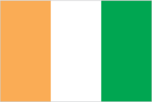
- <strong>description:</strong> three equal vertical bands of orange (left side), white, and green<br><br><strong>meaning:</strong> orange stands for the savannah and fertility, white for peace and unity, green for the forests of the south and the hope for a bright future; design based on France's flag
- note
- <strong>note:</strong> similar to the flag of Ireland, which is wider and has the colors reversed -- green (left side), white, and orange; also similar to the flag of Italy, which is green (left side), white, and red
Flag description
The flag of Ivory Coast is composed of three equal vertical bands of orange, white and green.
Flag image
- svg
- https://flagcdn.com/ci.svg
Government type
presidential republic
Independence
7 August 1960 (from France)
International law organization participation
accepts compulsory ICJ jurisdiction with reservations; accepts ICCt jurisdiction
International organization participation
ACP, AfDB, AU, ECOWAS, EITI (compliant country), Entente, FAO, FZ, G-24, G-77, IAEA, IBRD, ICAO, ICC, ICCt, ICRM, IDA, IDB, IFAD, IFC, IFRCS, ILO, IMF, IMO, Interpol, IOC, IOM, IPU, ISO, ITSO, ITU, ITUC (NGOs), MIGA, MINUSCA, MONUSCO, NAM, OIC, OIF, OPCW, UN, UNCTAD, UNESCO, UNHCR, UNHRC, UNIDO, UNMISS, Union Latina, UNWTO, UPU, WADB (regional), WAEMU, WCO, WFTU (NGOs), WHO, WIPO, WMO, WTO
Judicial branch
- Highest court(s)
- Supreme Court or Cour Supreme (organized into Judicial, Audit, Constitutional, and Administrative Chambers; consists of the court president, 3 vice presidents for the Judicial, Audit, and Administrative chambers, and 9 associate justices or magistrates)
- Judge selection and term of office
- judges nominated by the Superior Council of the Magistrature, a 7-member body consisting of the national president (chairman), 3 "bench" judges, and 3 public prosecutors; judges appointed for life
- Subordinate courts
- Courts of Appeal (organized into civil, criminal, and social chambers); first instance courts; peace courts
Legal system
civil law system based on the French civil code; Constitutional Chamber of the Supreme Court reviews legislation
Legislative branch
- Legislative structure
- bicameral
- Legislature name
- Parliament (Parlement)
- Note
- <br><br>
Legislative branch - lower chamber
- Chamber name
- National Assembly (Assemblée nationale)
- Electoral system
- plurality/majority
- Expected date of next election
- December 2025
- Most recent election date
- 3/6/2021 to 6/12/2021
- Number of seats
- 255 (all directly elected)
- Parties elected and seats per party
- Rally of Houphouetists for Democracy and Peace (RHDP) (139); Democratic Party of Côte d'Ivoire-African Democratic Rally (PDCI-RDA)-Together for Democracy and Sovereignty (EDS) (49); Democratic Party of Côte d'Ivoire-African Democratic Rally (PDCI-RDA) (23); Independents (26); Other (18)
- Percentage of women in chamber
- 13.4%
- Scope of elections
- full renewal
- Term in office
- 5 years
Legislative branch - upper chamber
- Chamber name
- Senate (Sénat)
- Expected date of next election
- September 2028
- Most recent election date
- 9/16/2023
- Number of seats
- 99 (66 indirectly elected; 33 appointed)
- Percentage of women in chamber
- 24.5%
- Scope of elections
- full renewal
- Term in office
- 5 years
National color(s)
orange, white, green
National heritage
- Selected World Heritage Site locales
- Comoé National Park (n); Historic Grand-Bassam (c); Mount Nimba Strict Nature Reserve (n); Sudanese-style Mosques (c); Taï National Park (n)
- Total World Heritage Sites
- 5 (2 cultural, 3 natural)
National holiday
Independence Day, 7 August (1960)
National symbol(s)
elephant
Political parties
African Peoples' Party-Cote d'Ivoire or PPA-CI <br>Democratic Party of Cote d'Ivoire or PDCI <br>Ivorian Popular Front or FPI <br>Liberty and Democracy for the Republic or LIDER <br>Movement of the Future Forces or MFA <br>Pan-African Congress for People's Justice and Equality or COJEP <br>Rally of Houphouetists for Democracy and Peace or RHDP <br>Rally of the Republicans or RDR<br>Together for Democracy and Sovereignty or EDS <br>Together to Build (UDPCI, FPI,and allies) <br>Union for Cote d'Ivoire or UPCI <br>Union for Democracy and Peace in Cote d'Ivoire or UDPCI
Start of week
Monday
Suffrage
18 years of age; universal
UN Member
Yes
Economy
Agricultural products
- yams, cassava, oil palm fruit, cocoa beans, sugarcane, plantains, rice, rubber, maize, cashews (2023)
- note
- <b>note:</b> top ten agricultural products based on tonnage
Average household expenditures
- On alcohol and tobacco
- 3.2% of household expenditures (2023 est.)
- On food
- 37.7% of household expenditures (2023 est.)
Budget
- Expenditures
- $16.03 billion (2023 est.)
- Note
- <b>note:</b> central government revenues (excluding grants) and expenditures converted to US dollars at average official exchange rate for year indicated
- Revenues
- $12.351 billion (2023 est.)
Currency
- code
- XOF
- name
- West African CFA franc (XOF) [Fr]
Current account balance
- $-9,208,027,599
- Current account balance 2020
- -$1.974 billion (2020 est.)
- Current account balance 2021
- -$2.874 billion (2021 est.)
- Current account balance 2022
- -$5.394 billion (2022 est.)
- Note
- <b>note:</b> balance of payments - net trade and primary/secondary income in current dollars
Debt - external
- $40.56 billion
- Debt - external 2023
- $26.576 billion (2023 est.)
- Note
- <b>note:</b> present value of external debt in current US dollars
Economic overview
one of West Africa’s most influential, stable, and rapidly developing economies; poverty declines in urban but increases in rural areas; strong construction sector and increasingly diverse economic portfolio; increasing but manageable public debt; large labor force in agriculture
Exchange rates
- Currency
- Communaute Financiere Africaine francs (XOF) per US dollar -
- Exchange rates 2020
- 575.586 (2020 est.)
- Exchange rates 2021
- 554.531 (2021 est.)
- Exchange rates 2022
- 623.76 (2022 est.)
- Exchange rates 2023
- 606.57 (2023 est.)
- Exchange rates 2024
- 606.345 (2024 est.)
Exports
- $22.67 billion
- Exports 2020
- $13.232 billion (2020 est.)
- Exports 2021
- $16.23 billion (2021 est.)
- Exports 2022
- $17.211 billion (2022 est.)
- Note
- <b>note:</b> balance of payments - exports of goods and services in current dollars
Exports - commodities
- gold, cocoa beans, rubber, refined petroleum, coconuts/brazil nuts/cashews (2023)
- note
- <b>note:</b> top five export commodities based on value in dollars
Exports - partners
- Switzerland 17%, Netherlands 9%, Mali 7%, USA 5%, Malaysia 4% (2023)
- note
- <b>note:</b> top five export partners based on percentage share of exports
Foreign direct investment
- net inflows
- $3.12 billion
GDP - composition, by end use
- Exports of goods and services
- 27.6% (2024 est.)
- Government consumption
- 9% (2024 est.)
- Household consumption
- 66% (2024 est.)
- Imports of goods and services
- -27.1% (2024 est.)
- Investment in fixed capital
- 24.5% (2024 est.)
- Investment in inventories
- 0% (2024 est.)
- Note
- <b>note:</b> figures may not total 100% due to rounding or gaps in data collection
GDP - composition, by sector of origin
- Agriculture
- 17.9% (2024 est.)
- Industry
- 22.1% (2024 est.)
- Note
- <b>note:</b> figures may not total 100% due to non-allocated consumption not captured in sector-reported data
- Services
- 53.9% (2024 est.)
GDP (official exchange rate)
- $86.538 billion (2024 est.)
- note
- <b>note:</b> data in current dollars at official exchange rate
GDP per capita (nominal)
$2,728
Gini Index coefficient - distribution of family income
- 41.5 (2015)
- Gini Index coefficient - distribution of family income 2021
- 35.3 (2021 est.)
- Note
- <b>note:</b> index (0-100) of income distribution; higher values represent greater inequality
GNI (gross national income)
$83.63 billion
GNI per capita
$2,530
Gross domestic investment
21 % of GDP
Household income or consumption by percentage share
- Highest 10%
- 27.8% (2021 est.)
- Lowest 10%
- 3.1% (2021 est.)
- Note
- <b>note:</b> % share of income accruing to lowest and highest 10% of population
Imports
- $21.98 billion
- Imports 2020
- $12.66 billion (2020 est.)
- Imports 2021
- $16.191 billion (2021 est.)
- Imports 2022
- $19.948 billion (2022 est.)
- Note
- <b>note:</b> balance of payments - imports of goods and services in current dollars
Imports - commodities
- crude petroleum, ships, refined petroleum, fish, rice (2023)
- note
- <b>note:</b> top five import commodities based on value in dollars
Imports - partners
- China 16%, Nigeria 12%, France 6%, India 5%, USA 4% (2023)
- note
- <b>note:</b> top five import partners based on percentage share of imports
Industrial production growth rate
- 2.8% (2024 est.)
- note
- <b>note:</b> annual % change in industrial value added based on constant local currency
Industries
foodstuffs, beverages; wood products, oil refining, gold mining, truck and bus assembly, textiles, fertilizer, building materials, electricity
Inflation rate (consumer prices)
- 3.45%
- Inflation rate (consumer prices) 2022
- 5.3% (2022 est.)
- Inflation rate (consumer prices) 2023
- 4.4% (2023 est.)
- Inflation rate (consumer prices) 2024
- 3.5% (2024 est.)
- Note
- <b>note:</b> annual % change based on consumer prices
Labor force
- 12.595 million (2024 est.)
- note
- <b>note:</b> number of people ages 15 or older who are employed or seeking work
- total
- 13.07 million persons
Labor force - by occupation
- agriculture
- 45.37%
- industry
- 14.33%
- services
- 40.3%
Population below poverty line
- 37.5% (2021 est.)
- note
- <b>note:</b> % of population with income below national poverty line
Public debt
- Public debt 2016
- 47% of GDP (2016 est.)
Real GDP (purchasing power parity)
- $244.91 billion
- Note
- <b>note:</b> data in 2021 dollars
- Real GDP (purchasing power parity) 2022
- $190.645 billion (2022 est.)
- Real GDP (purchasing power parity) 2023
- $202.943 billion (2023 est.)
- Real GDP (purchasing power parity) 2024
- $215.018 billion (2024 est.)
Real GDP growth rate
- 6.02%
- Note
- <b>note:</b> annual GDP % growth based on constant local currency
- Real GDP growth rate 2022
- 6.4% (2022 est.)
- Real GDP growth rate 2023
- 6.5% (2023 est.)
- Real GDP growth rate 2024
- 6% (2024 est.)
Real GDP per capita
- $7,669
- Note
- <b>note:</b> data in 2021 dollars
- Real GDP per capita 2022
- $6,300 (2022 est.)
- Real GDP per capita 2023
- $6,500 (2023 est.)
- Real GDP per capita 2024
- $6,700 (2024 est.)
Remittances
- $1.77 billion
- Note
- <b>note:</b> personal transfers and compensation between resident and non-resident individuals/households/entities
- Remittances 2021
- 0.6% of GDP (2021 est.)
- Remittances 2022
- 1.5% of GDP (2022 est.)
- Remittances 2023
- 1.3% of GDP (2023 est.)
Revenue (excl grants)
13 % of GDP
Tax revenue
13 % of GDP
Taxes and other revenues
- 13.2% (of GDP) (2023 est.)
- note
- <b>note:</b> central government tax revenue as a % of GDP
Unemployment rate
- 2.32%
- Note
- <b>note:</b> % of labor force seeking employment
- Unemployment rate 2022
- 2.4% (2022 est.)
- Unemployment rate 2023
- 2.3% (2023 est.)
- Unemployment rate 2024
- 2.3% (2024 est.)
Youth unemployment rate (ages 15-24)
- Female
- 4.4% (2024 est.)
- Male
- 3.5% (2024 est.)
- Note
- <b>note:</b> % of labor force ages 15-24 seeking employment
- Total
- 3.9% (2024 est.)
Energy
Electricity
- Consumption
- 8.746 billion kWh (2023 est.)
- consumption per capita
- 324 kWh
- Exports
- 971 million kWh (2023 est.)
- Imports
- 222.79 million kWh (2023 est.)
- Installed generating capacity
- 2.315 million kW (2023 est.)
- Transmission/distribution losses
- 1.638 billion kWh (2023 est.)
Electricity access
- Electrification - rural areas
- 45.3%
- Electrification - total population
- 70.4% (2022 est.)
- Electrification - urban areas
- 95%
Electricity generation sources
- Biomass and waste
- 0.8% of total installed capacity (2023 est.)
- Fossil fuels
- 68.9% of total installed capacity (2023 est.)
- hydroelectric
- 22.84%
- Hydroelectricity
- 30.1% of total installed capacity (2023 est.)
- nuclear
- 0%
- renewable
- 22.79%
- Solar
- 0.2% of total installed capacity (2023 est.)
Energy consumption per capita
- 472 kg of oil equivalent
- Total energy consumption per capita 2023
- 8.489 million Btu/person (2023 est.)
Natural gas
- Consumption
- 2.474 billion cubic meters (2023 est.)
- Production
- 2.474 billion cubic meters (2023 est.)
- Proven reserves
- 28.317 billion cubic meters (2021 est.)
Petroleum
- Crude oil estimated reserves
- 100 million barrels (2021 est.)
- Refined petroleum consumption
- 87,000 bbl/day (2023 est.)
- Total petroleum production
- 29,000 bbl/day (2023 est.)
Renewable energy consumption
58.2%
Communications
Broadband - fixed subscriptions
- per 100 inhabitants
- 1 per 100
- Subscriptions per 100 inhabitants
- 1 (2023 est.)
- Total
- 425,000 (2023 est.)
Broadcast media
state-controlled Radiodiffusion Télévision Ivoirienne (RTI) is made up of 2 radio stations (Radio Cote d'Ivoire and Fréquence2) and 2 TV stations (RTI1 and RTI2) with nationwide coverage, broadcasting mainly in French; 178 proximity radio stations, 16 religious radio stations, 5 commercial radio stations, and 5 international radio stations; government now runs radio station UNOCIFM, previously owned by the UN Operation in Cote d'Ivoire; in 2016, 4 media companies were granted licenses: Live TV, Optimum Media Cote d'Ivoire, the Audiovisual Company of Cote d'Ivoire (Sedaci), and Sorano-CI (2019)
Internet country code
.ci
Internet users
- Percent of population
- 41% (2023 est.)
Telephone calling code
+225
Telephones - fixed lines
- Subscriptions per 100 inhabitants
- (2024 est.) less than 1
- Total subscriptions
- 245,000 (2024 est.)
Telephones - mobile cellular
- subscriptions per 100
- 172 per 100
- Subscriptions per 100 inhabitants
- 184 (2024 est.)
- Total subscriptions
- 58.7 million (2024 est.)
Transportation
Air transport
- passengers carried
- 716,233 passengers
- registered carrier departures
- 13,609 departures
Airports
29 (2025)
Civil aircraft registration country code prefix
TU
Driving side
Right
Heliports
1 (2025)
Merchant marine
- By type
- oil tanker 2, other 23
- Total
- 25 (2023)
Ports
- Key ports
- Abidjan, Baobab Marine Terminal, Espoir Marine Terminal, Port Bouet, San Pedro
- Large
- 1
- Medium
- 0
- Ports with oil terminals
- 5
- Small
- 0
- Total ports
- 5 (2024)
- Very small
- 4
Railways
- Narrow gauge
- 660 km (2008) 1.000-m gauge
- Note
- <strong>note:</strong> an additional 622 km of this railroad extends into Burkina Faso
- Total
- 660 km (2008)
Vehicle registration code
CI
Military and Security
Land forces
- armored vehicles
- tanks
Military - note
the military (FACI) is responsible for external defense but also has a considerable internal role supporting the National Gendarmerie and other internal security forces; key areas of focus for the FACI are the country's porous international borders and the threat posed by Islamic militants associated with the al-Qa’ida in the Islamic Maghreb (AQIM) terrorist group operating across the border in Burkina Faso and Mali; AQIM militants conducted attacks in the country in 2016 and 2020; Côte d’Ivoire since 2016 has stepped up border security and completed building a joint counter-terrorism training center with France near Abidjan in 2020; Cote d'Ivoire has long maintained a close security relationship with France <br><br>the FACI has mutinied several times since the late 1990s, most recently in 2017, and has had a large role in the country’s political turmoil; it was established in 1960 from home defense units the French colonial government began standing up in 1950 (2025)
Military and security forces
- Armed Forces of Cote d'Ivoire (Forces Armees de Cote d'Ivoire, FACI; aka Republican Forces of Ivory Coast, FRCI): Army, National Navy, Air Force, Special Forces; National Gendarmerie <br><br>Ministry of Security and Civil Protection: National Police (2025)
- active duty personnel
- 27,000
- note
- <strong>note:</strong> the National Gendarmerie is a paramilitary force under the Ministry of Defense that is responsible for ensuring public safety, maintaining order, enforcing laws, and protecting institutions, people, and property; it is organized into mobile and territorial components; the Mobile Gendarmerie is responsible for maintaining and restoring order and is considered the backbone of the country’s domestic security; the Territorial Gendarmerie is responsible for the administrative, judicial, and military police; the Gendarmerie also has separate specialized units for security, intervention (counterterrorism, hostage rescue, etc), VIP protection, and surveillance
- percent of total labor force
- 0.25 %
Military and security service personnel strengths
approximately 25-30,000 active FACI, including Gendarmerie personnel (2025)
Military deployments
180 Central African Republic (MINUSCA) (2025)
Military equipment inventories and acquisitions
- the inventory of the FACI consists mostly of older or secondhand armaments, typically of French or Soviet-era origin; in recent years, it has received small quantities of newer and secondhand equipment from a variety of suppliers, including Bulgaria, China, France, Israel, South Africa, and the US (2025)
- note
- <strong>note:</strong> Cote d'Ivoire was under a partial UN arms embargo from 2004 to 2016
Military expenditures
- 1 % of GDP
- current USD
- $658,353,218
- Military Expenditures 2020
- 1.1% of GDP (2020 est.)
- Military Expenditures 2021
- 1.1% of GDP (2021 est.)
- Military Expenditures 2022
- 0.9% of GDP (2022 est.)
- Military Expenditures 2023
- 0.9% of GDP (2023 est.)
- Military Expenditures 2024
- 0.8% of GDP (2024 est.)
- percent of central government expenditure
- 3.66 %
- percent of GDP
- 0.76 % of GDP
Military service age and obligation
18-26 (up to 35 for healthcare professionals) years of age for voluntary military service for men and women; conscription is authorized but reportedly not enforced (2025)
Military strength ranking
- PowerIndex score
- 2.3884
Transnational Issues
Refugees and internally displaced persons
- Refugees
- 69,176 (2024 est.)
- Stateless persons
- 930,978 (2024 est.)
Space
Key space-program milestones
2023 - hosted an Africa-wide space industry conference; announced plans to acquire and launch first small remote sensing satellite (Yam-Sat- CI 01) <br><br>2024 - began joint project with Tanzania to build a technology-demonstrator cube satellite (TanSat-1)
Space agency/agencies
- National Office for Technical Studies and Development (Bureau d'Études Techniques et de Développement or BNETD); Côte d’Ivoire Geographic and Digital Information Center (CIGN) (2025)
- note
- <strong>note:</strong> in mid-2025, Côte d’Ivoire announced that it would establish the Space Agency of Côte d’Ivoire (ASCI) in 2026 under the Minister of Higher Education and Scientific Research
Space program overview
has a small, nascent program focused on satellite technology and geospatial information systems, as well as exploitation for resource management, environmental challenges, agricultural sector support, and national security; member of the African Space Agency and cooperates bilaterally with member states such as Tanzania (2025)
Terrorism
Terrorist group(s)
- al-Qa'ida in the Islamic Maghreb (AQIM); Jama’at Nusrat al Islam wal Muslimeen (JNIM)
- note
- <strong>note:</strong> details about the history, aims, leadership, organization, areas of operation, tactics, targets, weapons, size, and sources of support of the group(s) appear(s) in the Terrorism reference guide
Environment
Carbon dioxide emissions
- From consumed natural gas
- 4.639 million metric tonnes of CO2 (2023 est.)
- From petroleum and other liquids
- 11.641 million metric tonnes of CO2 (2023 est.)
- Total emissions
- 16.28 million metric tonnes of CO2 (2023 est.)
Environmental issues
deforestation; water pollution from sewage and from industrial, mining, and agricultural effluents
International environmental agreements
- Party to
- Biodiversity, Climate Change, Climate Change-Kyoto Protocol, Climate Change-Paris Agreement, Comprehensive Nuclear Test Ban, Desertification, Endangered Species, Hazardous Wastes, Law of the Sea, Marine Dumping-London Convention, Nuclear Test Ban, Ozone Layer Protection, Ship Pollution, Tropical Timber 2006, Wetlands, Whaling
- Signed, but not ratified
- none of the selected agreements
Methane emissions
- Agriculture
- 192 kt (2019-2021 est.)
- Energy
- 187.7 kt (2022-2024 est.)
- Other
- 28.9 kt (2019-2021 est.)
- Waste
- 199.9 kt (2019-2021 est.)
Particulate matter emissions
36 micrograms per cubic meter (2019 est.)
Protected areas
15 % of total land area
Renewable electricity output
0 % of total
Total renewable water resources
84.14 billion cubic meters (2022 est.)
Total water withdrawal
- 2 % of internal resources
- Agricultural
- 600 million cubic meters (2022 est.)
- Industrial
- 242 million cubic meters (2022 est.)
- Municipal
- 320 million cubic meters (2022 est.)
Waste and recycling
- Municipal solid waste generated annually
- 4.441 million tons (2024 est.)
- Percent of municipal solid waste recycled
- 13.3% (2022 est.)