2015 Edition
CIA World Factbook 2015 Archive (Wayback Machine ZIP)
Introduction
Background
Close ties to France following independence in 1960, the development of cocoa production for export, and foreign investment all made Cote d'Ivoire one of the most prosperous of the West African states but did not protect it from political turmoil. In December 1999, a military coup - the first ever in Cote d'Ivoire's history - overthrew the government. Junta leader Robert GUEI blatantly rigged elections held in late 2000 and declared himself the winner. Popular protest forced him to step aside and brought Laurent GBAGBO into power. Ivorian dissidents and disaffected members of the military launched a failed coup attempt in September 2002 that developed into a rebellion and then a civil war. The war ended in 2003 with a cease-fire that left the country divided with the rebels holding the north, the government the south, and peacekeeping forces a buffer zone between the two. In March 2007, President GBAGBO and former New Forces rebel leader Guillaume SORO signed an agreement in which SORO joined GBAGBO's government as prime minister and the two agreed to reunite the country by dismantling the buffer zone, integrating rebel forces into the national armed forces, and holding elections. Difficulties in preparing electoral registers delayed balloting until 2010. In November 2010, Alassane Dramane OUATTARA won the presidential election over GBAGBO, but GBAGBO refused to hand over power, resulting in a five-month stand-off. In April 2011, after widespread fighting, GBAGBO was formally forced from office by armed OUATTARA supporters with the help of UN and French forces. Several thousand UN peacekeepers and several hundred French troops remain in Cote d'Ivoire to support the transition process. OUATTARA is focused on rebuilding the country's economy and infrastructure while rebuilding the security forces. GBAGBO is in The Hague awaiting trial for crimes against humanity.
Geography
Area
- land
- 318,003 sq km
- total
- 322,463 sq km
- water
- 4,460 sq km
Area - comparative
slightly larger than New Mexico
Climate
tropical along coast, semiarid in far north; three seasons - warm and dry (November to March), hot and dry (March to May), hot and wet (June to October)
Coastline
515 km
Elevation extremes
- highest point
- Monts Nimba 1,752 m
- lowest point
- Gulf of Guinea 0 m
Environment - current issues
deforestation (most of the country's forests - once the largest in West Africa - have been heavily logged); water pollution from sewage and industrial and agricultural effluents
Environment - international agreements
- party to
- Biodiversity, Climate Change, Climate Change-Kyoto Protocol, Desertification, Endangered Species, Hazardous Wastes, Law of the Sea, Marine Dumping, Ozone Layer Protection, Ship Pollution, Tropical Timber 83, Tropical Timber 94, Wetlands, Whaling
- signed, but not ratified
- none of the selected agreements
Freshwater withdrawal (domestic/industrial/agricultural)
- per capita
- 83.07 cu m/yr (2008)
- total
- 1.55 cu km/yr (41%/21%/38%)
Geographic coordinates
8 00 N, 5 00 W
Geography - note
most of the inhabitants live along the sandy coastal region; apart from the capital area, the forested interior is sparsely populated
Irrigated land
727.5 sq km (2003)
Land boundaries
- border countries (5)
- Burkina Faso 545 km, Ghana 720 km, Guinea 816 km, Liberia 778 km, Mali 599 km
- total
- 3,458 km
Land use
- arable land 9.1%; permanent crops 14.2%; permanent pasture 41.5%
- agricultural land
- 64.8%
- forest
- 32.7%
- other
- 2.5% (2011 est.)
Location
Western Africa, bordering the North Atlantic Ocean, between Ghana and Liberia
Map references
Africa
Maritime claims
- continental shelf
- 200 nm
- exclusive economic zone
- 200 nm
- territorial sea
- 12 nm
Natural hazards
coast has heavy surf and no natural harbors; during the rainy season torrential flooding is possible
Natural resources
petroleum, natural gas, diamonds, manganese, iron ore, cobalt, bauxite, copper, gold, nickel, tantalum, silica sand, clay, cocoa beans, coffee, palm oil, hydropower
Terrain
mostly flat to undulating plains; mountains in northwest
Total renewable water resources
81.14 cu km (2011)
People and Society
Age structure
- 0-14 years
- 37.94% (male 4,456,646/female 4,381,907)
- 15-24 years
- 20.95% (male 2,459,156/female 2,420,284)
- 25-54 years
- 33.53% (male 3,997,615/female 3,812,563)
- 55-64 years
- 4.25% (male 495,177/female 493,854)
- 65 years and over
- 3.34% (male 375,276/female 402,824) (2015 est.)
Birth rate
28.67 births/1,000 population (2015 est.)
Child labor - children ages 5-14
- percentage
- 35% (2006 est.)
- total number
- 1,796,802
Children under the age of 5 years underweight
15.7% (2012)
Contraceptive prevalence rate
18.2% (2011/12)
Death rate
9.55 deaths/1,000 population (2015 est.)
Dependency ratios
- elderly dependency ratio
- 5.6%
- potential support ratio
- 18% (2015 est.)
- total dependency ratio
- 83.5%
- youth dependency ratio
- 77.9%
Drinking water source
- urban: 93.1% of population
- rural: 68.8% of population
- total: 81.9% of population
- urban: 6.9% of population
- rural: 31.2% of population
- total: 18.1% of population (2015 est.)
Education expenditures
4.6% of GDP (2008)
Ethnic groups
Akan 42.1%, Voltaiques or Gur 17.6%, Northern Mandes 16.5%, Krous 11%, Southern Mandes 10%, other 2.8% (includes 130,000 Lebanese and 14,000 French) (1998)
Health expenditures
5.7% of GDP (2013)
HIV/AIDS - adult prevalence rate
2.67% (2013 est.)
HIV/AIDS - deaths
27,900 (2013 est.)
HIV/AIDS - people living with HIV/AIDS
371,600 (2013 est.)
Hospital bed density
0.4 beds/1,000 population (2006)
Infant mortality rate
- female
- 52.44 deaths/1,000 live births (2015 est.)
- male
- 64.77 deaths/1,000 live births
- total
- 58.7 deaths/1,000 live births
Languages
French (official), 60 native dialects of which Dioula is the most widely spoken
Life expectancy at birth
- female
- 59.51 years (2015 est.)
- male
- 57.21 years
- total population
- 58.34 years
Literacy
- definition
- age 15 and over can read and write
- female
- 32.5% (2015 est.)
- male
- 53.1%
- total population
- 43.1%
Major infectious diseases
- animal contact disease
- rabies
- degree of risk
- very high
- food or waterborne diseases
- bacterial diarrhea, hepatitis A, and typhoid fever
- note
- highly pathogenic H5N1 avian influenza has been identified in this country; it poses a negligible risk with extremely rare cases possible among US citizens who have close contact with birds (2013)
- respiratory disease
- meningococcal meningitis
- vectorborne diseases
- malaria, dengue fever, and yellow fever
- water contact disease
- schistosomiasis
Major urban areas - population
YAMOUSSOUKRO (capital) 259,000 (2014); ABIDJAN (seat of government) 4.86 million; Bouake 762,000 (2015)
Median age
- female
- 20.2 years (2014 est.)
- male
- 20.3 years
- total
- 20.3 years
Nationality
- adjective
- Ivoirian
- noun
- Ivoirian(s)
Net migration rate
0 migrant(s)/1,000 population (2015 est.)
Obesity - adult prevalence rate
8% (2014)
Physicians density
0.14 physicians/1,000 population (2008)
Population
- 23,295,302
- note
- estimates for this country explicitly take into account the effects of excess mortality due to AIDS; this can result in lower life expectancy, higher infant mortality, higher death rates, lower population growth rates, and changes in the distribution of population by age and sex than would otherwise be expected (July 2015 est.)
Population growth rate
1.91% (2015 est.)
Religions
- Muslim 38.6%, Christian 32.8%, indigenous 11.9%, none 16.7% (2008 est.)
- note
- the majority of foreigners (migratory workers) are Muslim (70%) and Christian (20%)
Sanitation facility access
- urban: 32.8% of population
- rural: 10.3% of population
- total: 22.5% of population
- urban: 67.2% of population
- rural: 89.7% of population
- total: 77.5% of population (2015 est.)
School life expectancy (primary to tertiary education)
- female
- 8 years (2013)
- male
- 10 years
- total
- 9 years
Sex ratio
- 0-14 years
- 1.02 male(s)/female
- 15-24 years
- 1.02 male(s)/female
- 25-54 years
- 1.05 male(s)/female
- 55-64 years
- 1 male(s)/female
- 65 years and over
- 0.93 male(s)/female
- at birth
- 1.03 male(s)/female
- total population
- 1.02 male(s)/female (2015 est.)
Total fertility rate
3.54 children born/woman (2015 est.)
Urbanization
- rate of urbanization
- 3.69% annual rate of change (2010-15 est.)
- urban population
- 54.2% of total population (2015)
Government
Administrative divisions
12 districts and 2 autonomous districts*; Abidjan*, Bas-Sassandra, Comoe, Denguele, Goh-Djiboua, Lacs, Lagunes, Montagnes, Sassandra-Marahoue, Savanes, Vallee du Bandama, Woroba, Yamoussoukro*, Zanzan
Capital
- geographic coordinates
- 6 49 N, 5 16 W
- name
- Yamoussoukro; note - although Yamoussoukro has been the official capital since 1983, Abidjan remains the commercial and administrative center; the US, like other countries, maintains its Embassy in Abidjan
- time difference
- UTC 0 (5 hours ahead of Washington, DC, during Standard Time)
Constitution
previous 1960; latest approved by referendum 23 July 2000; amended 2012 (2012)
Country name
- conventional long form
- Republic of Cote d'Ivoire
- conventional short form
- Cote d'Ivoire
- former
- Ivory Coast
- local long form
- Republique de Cote d'Ivoire
- local short form
- Cote d'Ivoire
- note
- pronounced coat-div-whar
Diplomatic representation from the US
- chief of mission
- Ambassador Terence Patrick MCCULLEY (since 21 November 2013)
- embassy
- Cocody Riviera Golf 01, Abidjan
- FAX
- [225] 22 49 42 02
- mailing address
- B. P. 1712, Abidjan 01
- telephone
- [225] 22 49 40 00
Diplomatic representation in the US
- chancery
- 2424 Massachusetts Avenue NW, Washington, DC 20008
- chief of mission
- Ambassador Daouda DIABATE (since 11 February 2011)
- FAX
- [1] (202) 462-9444
- telephone
- [1] (202) 797-0300
Executive branch
- cabinet
- Council of Ministers appointed by the president
- chief of state
- President Alassane Dramane OUATTARA (since 4 December 2010)
- election results
- Alassane OUATTARA elected president; percent of vote - Alassane OUATTARA (RDR) 54.1%, Laurent GBAGBO (FPI) 45.9%; note - Prime Minister SORO resigned from the incumbent administration and was subsequently appointed to the same position by OUATTARA; on 12 March 2011, SORO was elected to the National Assembly and resigned as prime minister the same day; former president GBAGBO refused to cede office, resulting in a 5-month standoff, but was finally forced to stand down in April 2011
- elections/appointments
- president directly elected by absolute majority popular vote in 2 rounds if needed for a 5-year term (no term limits); election last held on 31 October and 28 November 2010 (next to be held in 2015); prime minister appointed by the president
- head of government
- Prime Minister Daniel Kablan DUNCAN (since 21 November 2012)
Flag description
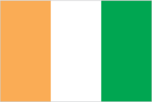
- three equal vertical bands of orange (hoist side), white, and green; orange symbolizes the land (savannah) of the north and fertility, white stands for peace and unity, green represents the forests of the south and the hope for a bright future
- note
- similar to the flag of Ireland, which is longer and has the colors reversed - green (hoist side), white, and orange; also similar to the flag of Italy, which is green (hoist side), white, and red; design was based on the flag of France
Government type
republic; multiparty presidential regime established 1960
Independence
7 August 1960 (from France)
International law organization participation
accepts compulsory ICJ jurisdiction with reservations; accepts ICCt jurisdiction
International organization participation
ACP, AfDB, AU, ECOWAS, EITI (compliant country), Entente, FAO, FZ, G-24, G-77, IAEA, IBRD, ICAO, ICC, ICCt, ICRM, IDA, IDB, IFAD, IFC, IFRCS, ILO, IMF, IMO, Interpol, IOC, IOM, IPU, ISO, ITSO, ITU, ITUC (NGOs), MIGA, MINUSMA, MONUSCO, NAM, OIC, OIF, OPCW, UN, UNCTAD, UNESCO, UNHCR, UNIDO, Union Latina, UNWTO, UPU, WADB (regional), WAEMU, WCO, WFTU (NGOs), WHO, WIPO, WMO, WTO
Judicial branch
- highest court(s)
- Supreme Court or Cour Supreme (organized into Judicial, Audit, Constitutional, and Administrative Chambers; consists of the court president, 3 vice-presidents for the Judicial, Audit, and Administrative chambers, and 9 associate justices or magistrates)
- judge selection and term offfice
- judges nominated by the Superior Council of the Magistrature, a 7-member body consisting of the national president (chairman), 3 "bench" judges, and 3 public prosecutors; judges appointed for life
- subordinate courts
- Courts of Appeal (organized into civil, criminal, and social chambers); first instance courts; peace courts
Legal system
civil law system based on the French civil code; judicial review of legislation held in the Constitutional Chamber of the Supreme Court
Legislative branch
- description
- unicameral National Assembly or Assemblee Nationale (225 seats; members directly elected in single- and multi-seat constituencies by simple majority vote to serve 5-year terms)
- election results
- percent of vote by party - RDR 42.1%, PDCI 28.6%, UDPCI 3.1%, RDP 1.7%, other 24.5% ; seats by party - RDR 127, PDCI 76, UDPCI 7, RDP 4, other 2, independents 39
- elections
- last held on 11 December 2011 (next to be held in 2016)
National anthem
- lyrics/music
- Mathieu EKRA, Joachim BONY, and Pierre Marie COTY/Pierre Marie COTY and Pierre Michel PANGO
- name
- "L'Abidjanaise" (Song of Abidjan)
- note
- adopted 1960; although the nation's capital city moved from Abidjan to Yamoussoukro in 1983, the anthem still owes its name to the former capital
National holiday
Independence Day, 7 August (1960)
National symbol(s)
elephant; national colors: orange, white, green
Political parties and leaders
- Citizen's Democratic Union or UDCY [Theodore MEL EG]
- Democracy and Liberty for the Republic or LIDER [Mamadou KOULIBALY]
- Democratic Party of Cote d'Ivoire or PDCI [Henri Konan BEDIE]
- Ivorian Popular Front or FPI [Pascal AFFI NGUESSAN]
- Ivorian Worker's Party or PIT [Daniel AKA AHIZ]
- Movement of the Future Forces or MFA [Innocent Augustin ANAKY KOBENA]
- Rally of the Republicans or RDR [Alassane OUATTARA]
- Union for Democracy and Peace in Cote d'Ivoire or UDPCI [Toikeuse MABRI]
- over 144 smaller registered parties
Political pressure groups and leaders
- Federation of University and High School Students of Cote d'Ivoire or FESCI [Augustin MIAN]
- National Congress for the Resistance and Democracy or CNRD [Bernard DADIE]
- Panafrican Congress for Justice and Peoples Equality or COJEP [Roselin BLY]
- Rally of Houphouetists for Democracy and Peace or RHDP
Suffrage
18 years of age; universal
Economy
Agriculture - products
coffee, cocoa beans, bananas, palm kernels, corn, rice, cassava (manioc, tapioca), sweet potatoes, sugar, cotton, rubber; timber
Budget
- expenditures
- $8.173 billion (2014 est.)
- revenues
- $7.218 billion
Budget surplus (+) or deficit (-)
-2.8% of GDP (2014 est.)
Central bank discount rate
- 4.25% (31 December 2010)
- 4.25% (31 December 2009)
Commercial bank prime lending rate
- 3.5% (31 December 2014 est.)
- 3.5% (31 December 2013 est.)
Current account balance
- -$1.113 billion (2014 est.)
- -$350.2 million (2013 est.)
Debt - external
- $11.5 billion (31 December 2014 est.)
- $10.26 billion (31 December 2013 est.)
Distribution of family income - Gini index
- 41.5 (2008)
- 36.7 (1995)
Economy - overview
Cote d'Ivoire is heavily dependent on agriculture and related activities, which engage roughly two-thirds of the population. Cote d'Ivoire is the world's largest producer and exporter of cocoa beans and a significant producer and exporter of coffee and palm oil. Consequently, the economy is highly sensitive to fluctuations in international prices for these products and in climatic conditions. Cocoa, oil, and coffee are the country's top export revenue earners, but the country is also mining gold. The country boasted two offshore oil finds in 2012. Following the end of more than a decade of civil conflict in 2011, Cote d’Ivoire has experienced a boom in foreign investment and economic growth. In June 2012, the IMF and the World Bank announced $4.4 billion in debt relief for Cote d'Ivoire under the Highly Indebted Poor Countries Initiative.
Exchange rates
- Communaute Financiere Africaine francs (XOF) per US dollar -
- 491.2 (2014 est.)
- 494.04 (2013 est.)
- 510.29 (2012 est.)
- 471.87 (2011 est.)
- 495.28 (2010 est.)
Exports
- $14.58 billion (2014 est.)
- $12.87 billion (2013 est.)
Exports - commodities
cocoa, coffee, timber, petroleum, cotton, bananas, pineapples, palm oil, fish
Exports - partners
Ghana 8.8%, Netherlands 8.5%, Nigeria 8.4%, US 6.8%, Germany 6.1%, Gabon 5.7%, France 5.1%, Belgium 4.5% (2013)
Fiscal year
calendar year
GDP - composition, by end use
- (2014 est.)
- exports of goods and services
- 49.6%
- government consumption
- 12.4%
- household consumption
- 65.5%
- imports of goods and services
- -45.6%
- investment in fixed capital
- 18.2%
- investment in inventories
- 0%
GDP - composition, by sector of origin
- agriculture
- 25.9%
- industry
- 21.9%
- services
- 52.1% (2014 est.)
GDP - per capita (PPP)
- $3,100 (2014 est.)
- $2,900 (2013 est.)
- $2,700 (2012 est.)
- note
- data are in 2014 US dollars
GDP - real growth rate
- 7.5% (2014 est.)
- 8.7% (2013 est.)
- 10.7% (2012 est.)
GDP (official exchange rate)
$33.96 billion (2014 est.)
GDP (purchasing power parity)
- $71.12 billion (2014 est.)
- $66.17 billion (2013 est.)
- $60.88 billion (2012 est.)
- note
- data are in 2014 US dollars
Gross national saving
- 13.7% of GDP (2014 est.)
- 12.1% of GDP (2013 est.)
- 15.3% of GDP (2012 est.)
Household income or consumption by percentage share
- highest 10%
- 31.8% (2008)
- lowest 10%
- 2.2%
Imports
- $9.788 billion (2014 est.)
- $8.976 billion (2013 est.)
Imports - commodities
fuel, capital equipment, foodstuffs
Imports - partners
Nigeria 23.1%, France 12.1%, China 8.7%, Bahamas, The 6.4% (2013)
Industrial production growth rate
8.4% (2014 est.)
Industries
foodstuffs, beverages; wood products, oil refining, gold mining, truck and bus assembly, textiles, fertilizer, building materials, electricity
Inflation rate (consumer prices)
- 0.4% (2014 est.)
- 2.6% (2013 est.)
Labor force
8.118 million (2014 est.)
Labor force - by occupation
- agriculture
- 68%
- industry and services
- NA% (2007 est.)
Market value of publicly traded shares
- $7.829 billion (31 December 2012 est.)
- $6.288 billion (31 December 2011)
- $7.099 billion (31 December 2010 est.)
Population below poverty line
42% (2006 est.)
Public debt
- 42.9% of GDP (2014 est.)
- 44.6% of GDP (2013 est.)
Reserves of foreign exchange and gold
- $4.752 billion (31 December 2014 est.)
- $4.243 billion (31 December 2013 est.)
Stock of broad money
- $12.23 billion (31 December 2014 est.)
- $11.5 billion (31 December 2013 est.)
Stock of direct foreign investment - abroad
$NA
Stock of direct foreign investment - at home
$NA
Stock of domestic credit
- $9.294 billion (31 December 2014 est.)
- $8.693 billion (31 December 2013 est.)
Stock of narrow money
- $8.227 billion (31 December 2014 est.)
- $7.72 billion (31 December 2013 est.)
Taxes and other revenues
21.3% of GDP (2014 est.)
Unemployment rate
NA%
Energy
Carbon dioxide emissions from consumption of energy
6.403 million Mt (2012 est.)
Crude oil - exports
32,190 bbl/day (2010 est.)
Crude oil - imports
49,780 bbl/day (2010 est.)
Crude oil - production
37,000 bbl/day (2013 est.)
Crude oil - proved reserves
100 million bbl (1 January 2014 est.)
Electricity - consumption
3.89 billion kWh (2011 est.)
Electricity - exports
615 million kWh (2011 est.)
Electricity - from fossil fuels
60.3% of total installed capacity (2011 est.)
Electricity - from hydroelectric plants
39.7% of total installed capacity (2011 est.)
Electricity - from nuclear fuels
0% of total installed capacity (2011 est.)
Electricity - from other renewable sources
0% of total installed capacity (2011 est.)
Electricity - imports
0 kWh (2011 est.)
Electricity - installed generating capacity
1.522 million kW (2011 est.)
Electricity - production
5.87 billion kWh (2011 est.)
Natural gas - consumption
1.619 billion cu m (2012 est.)
Natural gas - exports
0 cu m (2012 est.)
Natural gas - imports
0 cu m (2012 est.)
Natural gas - production
1.619 billion cu m (2012 est.)
Natural gas - proved reserves
28.32 billion cu m (1 January 2014 est.)
Refined petroleum products - consumption
22,760 bbl/day (2013 est.)
Refined petroleum products - exports
38,300 bbl/day (2010 est.)
Refined petroleum products - imports
4,810 bbl/day (2010 est.)
Refined petroleum products - production
55,890 bbl/day (2010 est.)
Communications
Broadcast media
2 state-owned TV stations; no private terrestrial TV stations, but satellite TV subscription service is available; 2 state-owned radio stations; some private radio stations; transmissions of several international broadcasters are available (2007)
Internet country code
.ci
Internet users
- percent of population
- 2.7% (2014 est.)
- total
- 621,500
Radio broadcast stations
AM 2, FM 9, shortwave 3 (1998)
Telephone system
- domestic
- with multiple mobile-cellular service providers competing in the market, usage has increased sharply to roughly 80 per 100 persons
- general assessment
- well-developed by African standards; telecommunications sector privatized in late 1990s and operational fixed lines have increased since that time with two fixed-line providers operating over open-wire lines, microwave radio relay, and fiber-optics; 90% digitalized
- international
- country code - 225; landing point for the SAT-3/WASC fiber-optic submarine cable that provides connectivity to Europe and Asia; satellite earth stations - 2 Intelsat (1 Atlantic Ocean and 1 Indian Ocean) (2011)
Telephones - fixed lines
- subscriptions per 100 inhabitants
- 1 (2014 est.)
- total subscriptions
- 240,000
Telephones - mobile cellular
- subscriptions per 100 inhabitants
- 97 (2014 est.)
- total
- 22.1 million
Television broadcast stations
14 (1998)
Transportation
Airports
27 (2013)
Airports - with paved runways
- 1,524 to 2,437 m
- 4 (2013)
- 2,438 to 3,047 m
- 2
- over 3,047 m
- 1
- total
- 7
Airports - with unpaved runways
- 3 (2013)
- 1,524 to 2,437 m
- 6
- 914 to 1,523 m
- 11
- total
- 20
Heliports
1 (2013)
Pipelines
condensate 101 km; gas 256 km; oil 118 km; oil/gas/water 5 km; water 7 km (2013)
Ports and terminals
- major seaport(s)
- Abidjan, San-Pedro
- oil terminal(s)
- Espoir Offshore Terminal
Railways
- narrow gauge
- 660 km 1.000-m gauge
- note
- an additional 622 km of this railroad extends into Burkina Faso (2008)
- total
- 660 km
Roadways
- note
- includes intercity and urban roads; another 20,000 km of dirt roads are in poor condition and 150,000 km of dirt roads are impassable (2007)
- paved
- 6,502 km
- total
- 81,996 km
- unpaved
- 75,494 km
Waterways
980 km (navigable rivers, canals, and numerous coastal lagoons) (2011)
Military and Security
Manpower available for military service
- females age 16-49
- 5,047,901 (2010 est.)
- males age 16-49
- 5,247,522
Manpower fit for military service
- females age 16-49
- 3,196,033 (2010 est.)
- males age 16-49
- 3,360,087
Manpower reaching militarily significant age annually
- female
- 242,958 (2010 est.)
- male
- 247,011
Military branches
Republican Forces of Cote d'Ivoire (Force Republiques de Cote d'Ivoire, FRCI): Army, Navy, Cote d'Ivoire Air Force (Force Aerienne de la Cote d'Ivoire) (2015)
Military expenditures
- 1.65% of GDP (2012)
- 1.49% of GDP (2011)
- 1.65% of GDP (2010)
Military service age and obligation
18-25 years of age for compulsory and voluntary male and female military service; conscription is not enforced; voluntary recruitment of former rebels into the new national army is restricted to ages 22-29 (2012)
Transnational Issues
Disputes - international
disputed maritime border between Cote d'Ivoire and Ghana
Illicit drugs
illicit producer of cannabis, mostly for local consumption; utility as a narcotic transshipment point to Europe reduced by ongoing political instability; while rampant corruption and inadequate supervision leave the banking system vulnerable to money laundering, the lack of a developed financial system limits the country's utility as a major money-laundering center (2008)
Refugees and internally displaced persons
- IDPs
- 300,900 (post-election conflict in 2010-2011, as well as civil war from 2002-2004; most pronounced in western and southwestern regions) (2015)
- stateless persons
- 700,000 (2014); note - many Ivoirians lack documentation proving their nationality, which prevent them from accessing education and healthcare; birth on Ivorian soil does not automatically result in citizenship; disputes over citizenship and the associated rights of the large population descended from migrants from neighboring countries is an ongoing source of tension and contributed to the country's 2002 civil war; some observers believe the government's mass naturalizations of thousands of people over the last couple of years is intended to boost its electoral support base; the government in October 2013 acceded to international conventions on statelessness and in August 2013 reformed its nationality law, key steps to clarify the nationality of thousands of residents