2012 Edition
CIA World Factbook 2012 Archive (HTML)
Introduction
Background
- Although explored by the Spanish early in the 16th century, initial attempts at colonizing Costa Rica proved unsuccessful due to a combination of factors, including: disease from mosquito-infested swamps, brutal heat, resistance by natives, and pirate raids. It was not until 1563 that a permanent settlement of Cartago was established in the cooler, fertile central highlands. The area remained a colony for some two and a half centuries. In 1821, Costa Rica became one of several Central American provinces that jointly declared their independence from Spain. Two years later it joined the United Provinces of Central America, but this federation disintegrated in 1838, at which time Costa Rica proclaimed its sovereignty and independence. Since the late 19th century, only two brief periods of violence have marred the country's democratic development. In 1949, Costa Rica dissolved its armed forces. Although it still maintains a large agricultural sector, Costa Rica has expanded its economy to include strong technology and tourism industries. The standard of living is relatively high. Land ownership is widespread.
- Although explored by the Spanish early in the 16th century, initial attempts at colonizing Costa Rica proved unsuccessful due to a combination of factors, including
- disease from mosquito-infested swamps, brutal heat, resistance by natives, and pirate raids. It was not until 1563 that a permanent settlement of Cartago was established in the cooler, fertile central highlands. The area remained a colony for some two and a half centuries. In 1821, Costa Rica became one of several Central American provinces that jointly declared their independence from Spain. Two years later it joined the United Provinces of Central America, but this federation disintegrated in 1838, at which time Costa Rica proclaimed its sovereignty and independence. Since the late 19th century, only two brief periods of violence have marred the country's democratic development. In 1949, Costa Rica dissolved its armed forces. Although it still maintains a large agricultural sector, Costa Rica has expanded its economy to include strong technology and tourism industries. The standard of living is relatively high. Land ownership is widespread.
Geography
Area
- 51,100 sq km 51,060 sq km 40 sq km includes Isla del Coco
- total
- 51,100 sq km
- water
- 40 sq km
Area - comparative
slightly smaller than West Virginia
Climate
tropical and subtropical; dry season (December to April); rainy season (May to November); cooler in highlands
Coastline
1,290 km
Elevation extremes
- Pacific Ocean 0 m Cerro Chirripo 3,810 m
- highest point
- Cerro Chirripo 3,810 m
- lowest point
- Pacific Ocean 0 m
Environment - current issues
deforestation and land use change, largely a result of the clearing of land for cattle ranching and agriculture; soil erosion; coastal marine pollution; fisheries protection; solid waste management; air pollution
Environment - international agreements
- Biodiversity, Climate Change, Climate Change-Kyoto Protocol, Desertification, Endangered Species, Environmental Modification, Hazardous Wastes, Law of the Sea, Marine Dumping, Ozone Layer Protection, Wetlands, Whaling Marine Life Conservation
- party to
- Biodiversity, Climate Change, Climate Change-Kyoto Protocol, Desertification, Endangered Species, Environmental Modification, Hazardous Wastes, Law of the Sea, Marine Dumping, Ozone Layer Protection, Wetlands, Whaling
- signed, but not ratified
- Marine Life Conservation
Freshwater withdrawal (domestic/industrial/agricultural)
- 2.68 cu km/yr (29%/17%/53%) 619 cu m/yr (2000)
- per capita
- 619 cu m/yr (2000)
- total
- 2.68 cu km/yr (29%/17%/53%)
Geographic coordinates
10 00 N, 84 00 W
Geography - note
four volcanoes, two of them active, rise near the capital of San Jose in the center of the country; one of the volcanoes, Irazu, erupted destructively in 1963-65
Irrigated land
1,080 sq km (2003)
Land boundaries
- 639 km Nicaragua 309 km, Panama 330 km
- border countries
- Nicaragua 309 km, Panama 330 km
- total
- 639 km
Land use
- 4.4% 5.87% 89.73% (2005)
- arable land
- 4.4%
- other
- 89.73% (2005)
- permanent crops
- 5.87%
Location
Central America, bordering both the Caribbean Sea and the North Pacific Ocean, between Nicaragua and Panama
Map references
Central America and the Caribbean
Maritime claims
- 12 nm 200 nm 200 nm
- continental shelf
- 200 nm
- exclusive economic zone
- 200 nm
- territorial sea
- 12 nm
Natural hazards
- occasional earthquakes, hurricanes along Atlantic coast; frequent flooding of lowlands at onset of rainy season and landslides; active volcanoes Arenal (elev. 1,670 m), which erupted in 2010, is the most active volcano in Costa Rica; a 1968 eruption destroyed the town of Tabacon; Irazu (elev. 3,432 m), situated just east of San Jose, has the potential to spew ash over the capital city as it did between 1963 and 1965; other historically active volcanoes include Miravalles, Poas, Rincon de la Vieja, and Turrialba
- volcanism
- Arenal (elev. 1,670 m), which erupted in 2010, is the most active volcano in Costa Rica; a 1968 eruption destroyed the town of Tabacon; Irazu (elev. 3,432 m), situated just east of San Jose, has the potential to spew ash over the capital city as it did between 1963 and 1965; other historically active volcanoes include Miravalles, Poas, Rincon de la Vieja, and Turrialba
Natural resources
hydropower
Terrain
coastal plains separated by rugged mountains including over 100 volcanic cones, of which several are major volcanoes
Total renewable water resources
112.4 cu km (2000)
People and Society
Age structure
- 24.2% (male 572,665/ female 547,458) 69.3% (male 1,614,495/ female 1,597,010) 6.6% (male 141,075/ female 163,645) (2012 est.)
- 0-14 years
- 24.2% (male 572,665/ female 547,458)
- 15-64 years
- 69.3% (male 1,614,495/ female 1,597,010)
- 65 years and over
- 6.6% (male 141,075/ female 163,645) (2012 est.)
Birth rate
16.4 births/1,000 population (2012 est.)
Death rate
4.38 deaths/1,000 population (July 2012 est.)
Demographic profile
Costa Rica's political stability, high standard of living, and well-developed social benefits system set it apart from its Central American neighbors. Through the government's sustained social spending - almost 20% of GDP annually - Costa Rica has made tremendous progress toward achieving its goal of providing universal access to education, healthcare, clean water, sanitation, and electricity. Since the 1970s, expansion of these services has led to a rapid decline in infant mortality, an increase in life expectancy at birth, and a sharp decrease in the birth rate. The average number of children born per women has fallen from about 7 in the 1960s to 3.5 in the early 1980s to below replacement level today. Costa Rica's poverty rate is lower than in most Latin American countries, but it has stalled at around 20% for almost two decades. Costa Rica is a popular regional immigration destination because of its job opportunities and social programs. Almost 9% of the population is foreign-born, with Nicaraguans comprising nearly three-quarters of the foreign population. Many Nicaraguans who perform unskilled seasonal labor enter Costa Rica illegally or overstay their visas, which continues to be a source of tension. Less than 3% of Costa Rica's population lives abroad. The overwhelming majority of expatriates have settled in the United States after completing a university degree or in order to work in a highly skilled field.
Education expenditures
6.3% of GDP (2009)
Ethnic groups
white (including mestizo) 94%, black 3%, Amerindian 1%, Chinese 1%, other 1%
Health expenditures
10.5% of GDP (2009)
HIV/AIDS - adult prevalence rate
0.3% (2009 est.)
HIV/AIDS - deaths
fewer than 500 (2009 est.)
HIV/AIDS - people living with HIV/AIDS
9,800 (2009 est.)
Hospital bed density
1.2 beds/1,000 population (2008)
Infant mortality rate
- 9.2 deaths/1,000 live births 10.03 deaths/1,000 live births 8.32 deaths/1,000 live births (2012 est.)
- female
- 8.32 deaths/1,000 live births (2012 est.)
- total
- 9.2 deaths/1,000 live births
Languages
Spanish (official), English
Life expectancy at birth
- 77.89 years 75.26 years 80.65 years (2012 est.)
- female
- 80.65 years (2012 est.)
- total population
- 77.89 years
Literacy
- age 15 and over can read and write 94.9% 94.7% 95.1% (2000 census)
- definition
- age 15 and over can read and write
- female
- 95.1% (2000 census)
- male
- 94.7%
- total population
- 94.9%
Major cities - population
SAN JOSE (capital) 1.416 million (2009)
Major infectious diseases
- intermediate bacterial diarrhea dengue fever (2009)
- degree of risk
- intermediate
- food or waterborne diseases
- bacterial diarrhea
- vectorborne diseases
- dengue fever (2009)
Maternal mortality rate
40 deaths/100,000 live births (2010)
Median age
- 29.2 years 28.7 years 29.6 years (2012 est.)
- female
- 29.6 years (2012 est.)
- male
- 28.7 years
- total
- 29.2 years
Nationality
- Costa Rican(s) Costa Rican
- adjective
- Costa Rican
- noun
- Costa Rican(s)
Net migration rate
0.86 migrant(s)/1,000 population (2012 est.)
Physicians density
1.32 physicians/1,000 population (2000)
Population
4,636,348 (July 2012 est.)
Population growth rate
1.288% (2012 est.)
Religions
Roman Catholic 76.3%, Evangelical 13.7%, Jehovah's Witnesses 1.3%, other Protestant 0.7%, other 4.8%, none 3.2%
Sanitation facility access
- urban: 95% of population rural: 96% of population total: 95% of population urban: 5% of population rural: 4% of population total: 5% of population
- rural
- 4% of population
- total
- 5% of population
- urban
- 5% of population
School life expectancy (primary to tertiary education)
- 12 years 12 years 12 years (2005)
- female
- 12 years (2005)
- male
- 12 years
- total
- 12 years
Sex ratio
- 1.05 male(s)/female 1.05 male(s)/female 1.01 male(s)/female 0.86 male(s)/female 1.01 male(s)/female (2011 est.)
- 15-64 years
- 1.01 male(s)/female
- 65 years and over
- 0.86 male(s)/female
- at birth
- 1.05 male(s)/female
- total population
- 1.01 male(s)/female (2011 est.)
- under 15 years
- 1.05 male(s)/female
Total fertility rate
1.92 children born/woman (2012 est.)
Unemployment, youth ages 15-24
- 11% 9.6% 13.4% (2008)
- female
- 13.4% (2008)
- total
- 11%
Urbanization
- 64% of total population (2010) 2.1% annual rate of change (2010-15 est.)
- rate of urbanization
- 2.1% annual rate of change (2010-15 est.)
- urban population
- 64% of total population (2010)
Government
Administrative divisions
7 provinces (provincias, singular - provincia); Alajuela, Cartago, Guanacaste, Heredia, Limon, Puntarenas, San Jose
Capital
- San Jose 9 56 N, 84 05 W UTC-6 (1 hour behind Washington, DC during Standard Time)
- geographic coordinates
- 9 56 N, 84 05 W
- name
- San Jose
- time difference
- UTC-6 (1 hour behind Washington, DC during Standard Time)
Constitution
7 November 1949
Country name
- Republic of Costa Rica Costa Rica Republica de Costa Rica Costa Rica
- conventional long form
- Republic of Costa Rica
- conventional short form
- Costa Rica
- local long form
- Republica de Costa Rica
- local short form
- Costa Rica
Diplomatic representation from the US
- Ambassador Anne Slaughter ANDREW Calle 120 Avenida O, Pavas, San Jose APO AA 34020 [506] 2519-2000 [506] 2519-2305
- chief of mission
- Ambassador Anne Slaughter ANDREW
- embassy
- Calle 120 Avenida O, Pavas, San Jose
- FAX
- [506] 2519-2305
- mailing address
- APO AA 34020
- telephone
- [506] 2519-2000
Diplomatic representation in the US
- Ambassador Shanon Muni FIGUERES Boggs 2114 S Street NW, Washington, DC 20008 [1] (202) 480-2200 [1] (202) 265-4795 Atlanta, Chicago, Houston, Los Angeles, Miami, New Orleans, New York, San Francisco, San Juan (Puerto Rico)
- chancery
- 2114 S Street NW, Washington, DC 20008
- chief of mission
- Ambassador Shanon Muni FIGUERES Boggs
- consulate(s) general
- Atlanta, Chicago, Houston, Los Angeles, Miami, New Orleans, New York, San Francisco, San Juan (Puerto Rico)
- FAX
- [1] (202) 265-4795
- telephone
- [1] (202) 480-2200
Executive branch
- President Laura CHINCHILLA Miranda (since 8 May 2010); First Vice President Alfio PIVA Mesen (since 8 May 2010); Second Vice President Luis LIBERMAN Ginsburg (since 8 May 2010); note - the president is both the chief of state and head of government President Laura CHINCHILLA Miranda (since 8 May 2010); First Vice President Alfio PIVA Mesen (since 8 May 2010); Second Vice President Luis LIBERMAN Ginsburg (since 8 May 2010) Cabinet selected by the president president and vice presidents elected on the same ticket by popular vote for a single four-year term; election last held on 7 February 2010 (next to be held in February 2014) Laura CHINCHILLA Miranda elected president; percent of vote - Laura CHINCHILLA Miranda (PLN) 46.7%; Otton SOLIS (PAC) 25.1%, Otto GUEVARA Guth (ML) 20.8%
- cabinet
- Cabinet selected by the president
- chief of state
- President Laura CHINCHILLA Miranda (since 8 May 2010); First Vice President Alfio PIVA Mesen (since 8 May 2010); Second Vice President Luis LIBERMAN Ginsburg (since 8 May 2010); note - the president is both the chief of state and head of government
- election results
- Laura CHINCHILLA Miranda elected president; percent of vote - Laura CHINCHILLA Miranda (PLN) 46.7%; Otton SOLIS (PAC) 25.1%, Otto GUEVARA Guth (ML) 20.8%
- elections
- president and vice presidents elected on the same ticket by popular vote for a single four-year term; election last held on 7 February 2010 (next to be held in February 2014)
- head of government
- President Laura CHINCHILLA Miranda (since 8 May 2010); First Vice President Alfio PIVA Mesen (since 8 May 2010); Second Vice President Luis LIBERMAN Ginsburg (since 8 May 2010)
Flag description
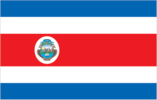
five horizontal bands of blue (top), white, red (double width), white, and blue, with the coat of arms in a white elliptical disk toward the hoist side of the red band; Costa Rica retained the earlier blue-white-blue flag of Central America until 1848 when, in response to revolutionary activity in Europe, it was decided to incorporate the French colors into the national flag and a central red stripe was added; today the blue color is said to stand for the sky, opportunity, and perseverance, white denotes peace, happiness, and wisdom, while red represents the blood shed for freedom, as well as the generosity and vibrancy of the people somewhat resembles the flag of North Korea; similar to the flag of Thailand but with the blue and red colors reversed
Government type
democratic republic
Independence
15 September 1821 (from Spain)
International law organization participation
accepts compulsory ICJ jurisdiction; accepts ICCt jurisdiction
International organization participation
BCIE, CACM, CD, CELAC, FAO, G-77, IADB, IAEA, IBRD, ICAO, ICC (national committees), ICRM, IDA, IFAD, IFC, IFRCS, ILO, IMF, IMO, IMSO, Interpol, IOC, IOM, IPU, ISO, ITSO, ITU, ITUC (NGOs), LAES, LAIA (observer), MIGA, NAM (observer), OAS, OPANAL, OPCW, PCA, SICA, UN, UNCTAD, UNESCO, UNHCR, UNIDO, Union Latina, UNWTO, UPU, WCO, WFTU (NGOs), WHO, WIPO, WMO, WTO
Judicial branch
Supreme Court or Corte Suprema (22 justices are elected for renewable eight-year terms by the Legislative Assembly)
Legal system
civil law system based on Spanish civil code; judicial review of legislative acts in the Supreme Court
Legislative branch
- unicameral Legislative Assembly or Asamblea Legislativa (57 seats; members elected by direct, popular vote to serve four-year terms) last held on 7 February 2010 (next to be held in February 2014) percent of vote by party - NA; seats by party - PLN 24, PAC 11, ML 9, PUSC 6, PASE 4, other 3
- election results
- percent of vote by party - NA; seats by party - PLN 24, PAC 11, ML 9, PUSC 6, PASE 4, other 3
- elections
- last held on 7 February 2010 (next to be held in February 2014)
National anthem
- "Himno Nacional de Costa Rica" (National Anthem of Costa Rica) Jose Maria ZELEDON Brenes/Manuel Maria GUTIERREZ adopted 1949; the anthem's music was originally written for an 1853 welcome ceremony for diplomatic missions from the United States and United Kingdom; the lyrics were added in 1903
- lyrics/music
- Jose Maria ZELEDON Brenes/Manuel Maria GUTIERREZ
- name
- "Himno Nacional de Costa Rica" (National Anthem of Costa Rica)
National holiday
Independence Day, 15 September (1821)
National symbol(s)
clay-colored robin known as Yiguirro
Political parties and leaders
Accessibility Without Exclusion or PASE [Oscar Andres LOPEZ Arias]; Citizen Action Party or PAC [Elizabeth FONSECA]; Costa Rican Renovation Party or PRC [Gerardo Justo OROZCO Alvarez]; Broad Front (Frente Amplio) or PFA [Jose MERINO del Rio]; Libertarian Movement Party or PML [Otto GUEVARA Guth]; National Integration Party or PIN [Walter MUNOZ Cespedes]; National Liberation Party or PLN [Bernal JIMENEZ]; National Restoration Party or PRN; Patriotic Alliance [Mariano FIGUERES Olsen]; Popular Vanguard [Trino BARRANTES Araya]; Social Christian Unity Party or PUSC [Gerardo VARGAS]
Political pressure groups and leaders
Authentic Confederation of Democratic Workers or CATD (Communist Party affiliate); Chamber of Coffee Growers; Confederated Union of Workers or CUT (Communist Party affiliate); Costa Rican Confederation of Democratic Workers or CCTD (Liberation Party affiliate); Costa Rican Exporter's Chamber or CADEXCO; Costa Rican Solidarity Movement; Costa Rican Union of Private Sector Enterprises or UCCAEP; Federation of Public Service Workers or FTSP; National Association for Economic Development or ANFE; National Association of Educators or ANDE; National Association of Public and Private Employees or ANEP; Rerum Novarum or CTRN (PLN affiliate)
Suffrage
18 years of age; universal and compulsory
Economy
Agriculture - products
bananas, pineapples, coffee, melons, ornamental plants, sugar, corn, rice, beans, potatoes; beef, poultry, dairy; timber
Budget
- $6.949 billion $8.937 billion (2012 est.)
- expenditures
- $8.937 billion (2012 est.)
- revenues
- $6.949 billion
Budget surplus (+) or deficit (-)
-4.4% of GDP (2012 est.)
Central bank discount rate
21.5% (31 December 2010 est.) 23% (31 December 2009 est.)
Commercial bank prime lending rate
16% (31 December 2012 est.) 16.15% (31 December 2011 est.)
Current account balance
-$2.556 billion (2012 est.) -$2.2 billion (2011 est.)
Debt - external
$12.04 billion (31 December 2012 est.) $10.75 billion (31 December 2011 est.)
Distribution of family income - Gini index
50.3 (2009) 45.9 (1997)
Economy - overview
Prior to the global economic crisis, Costa Rica enjoyed stable economic growth. The economy contracted 1.3% in 2009 but resumed growth at about 4.5% per year in 2010-12. While the traditional agricultural exports of bananas, coffee, sugar, and beef are still the backbone of commodity export trade, a variety of industrial and specialized agricultural products have broadened export trade in recent years. High value added goods and services, including microchips, have further bolstered exports. Tourism continues to bring in foreign exchange, as Costa Rica's impressive biodiversity makes it a key destination for ecotourism. Foreign investors remain attracted by the country's political stability and relatively high education levels, as well as the incentives offered in the free-trade zones; and Costa Rica has attracted one of the highest levels of foreign direct investment per capita in Latin America. However, many business impediments remain such as high levels of bureaucracy, legal uncertainty due to overlapping and at times conflicting responsibilities between agencies, difficulty of enforcing contracts, and weak investor protection. Poverty has remained around 15-20% for nearly 20 years, and the strong social safety net that had been put into place by the government has eroded due to increased financial constraints on government expenditures. Unlike the rest of Central America, Costa Rica is not highly dependent on remittances as they only represent about 2% of GDP. Immigration from Nicaragua has increasingly become a concern for the government. The estimated 300,000-500,000 Nicaraguans in Costa Rica legally and illegally are an important source of mostly unskilled labor but also place heavy demands on the social welfare system. The US-Central American-Dominican Republic Free Trade Agreement (CAFTA-DR) entered into force on 1 January 2009 after significant delays within the Costa Rican legislature. CAFTA-DR has increased foreign direct investment in key sectors of the economy, including the insurance and telecommunications sectors recently opened to private investors. President CHINCHILLA was not able to gain legislative approval for fiscal reform, her top priority, though she continued to pursue fiscal reform in 2012. President CHINCHILLA and the PLN were successful in passing a tax on corporations to fund an increase for security services.
Exchange rates
Costa Rican colones (CRC) per US dollar - 504.5 (2012 est.) 505.66 (2011 est.) 525.83 (2010 est.) 573.29 (2009) 530.41 (2008)
Exports
$11.47 billion (2012 est.) $10.38 billion (2011 est.)
Exports - commodities
bananas, pineapples, coffee, melons, ornamental plants, sugar; beef; seafood; electronic components, medical equipment
Exports - partners
US 30.4%, China 11.3%, Netherlands 10.9%, UK 9.6%, Mexico 8.5% (2011)
Fiscal year
calendar year
GDP - composition by sector
- 6.2% 21.1% 72.7% (2012 est.)
- agriculture
- 6.2%
- industry
- 21.1%
- services
- 72.7% (2012 est.)
GDP - per capita (PPP)
$12,600 (2012 est.) $12,100 (2011 est.) $11,800 (2010 est.) data are in 2012 US dollars
GDP - real growth rate
4.8% (2012 est.) 4.2% (2011 est.) 4.7% (2010 est.)
GDP (official exchange rate)
$44.88 billion (2012 est.)
GDP (purchasing power parity)
$58.6 billion (2012 est.) $55.92 billion (2011 est.) $53.68 billion (2010 est.) data are in 2012 US dollars
Household income or consumption by percentage share
- 1.2% 39.5% (2009 est.)
- highest 10%
- 39.5% (2009 est.)
- lowest 10%
- 1.2%
Imports
$16.79 billion (2012 est.) $15.53 billion (2011 est.)
Imports - commodities
raw materials, consumer goods, capital equipment, petroleum, construction materials
Imports - partners
US 43%, Mexico 7%, China 6.2%, Japan 6% (2011)
Industrial production growth rate
2.8% (2011 est.)
Inflation rate (consumer prices)
4.5% (2012 est.) 4.9% (2011 est.)
Investment (gross fixed)
19.9% of GDP (2012 est.)
Labor force
2.196 million this official estimate excludes Nicaraguans living in Costa Rica (2012 est.)
Labor force - by occupation
- 14% 22% 64% (2006 est.)
- agriculture
- 14%
- industry
- 22%
- services
- 64% (2006 est.)
Market value of publicly traded shares
$1.443 billion (31 December 2011) $1.445 billion (31 December 2010) $1.452 billion (31 December 2009)
Population below poverty line
24.2% (2010 est.)
Public debt
47.4% of GDP (2012 est.) 44.9% of GDP (2011 est.)
Reserves of foreign exchange and gold
$5.461 billion (31 December 2012 est.) $4.756 billion (31 December 2011 est.)
Stock of broad money
$20.09 billion (31 December 2011 est.) $18.68 billion (31 December 2010 est.)
Stock of direct foreign investment - abroad
$729.3 million (31 December 2012 est.) $704.3 million (31 December 2011 est.)
Stock of direct foreign investment - at home
$18.59 billion (31 December 2012 est.) $16.34 billion (31 December 2011 est.)
Stock of domestic credit
$23.33 billion (31 December 2012 est.) $19.21 billion (31 December 2011 est.)
Stock of narrow money
$4.209 billion (31 December 2012 est.) $3.693 billion (31 December 2011 est.)
Taxes and other revenues
15.5% of GDP (2012 est.)
Unemployment rate
7.9% (2012 est.) 6.5% (2011 est.)
Energy
Carbon dioxide emissions from consumption of energy
6.411 million Mt (2010 est.)
Crude oil - exports
0 bbl/day (2009 est.)
Crude oil - imports
7,361 bbl/day (2009 est.)
Crude oil - production
0 bbl/day (2011 est.)
Crude oil - proved reserves
0 bbl (1 January 2012 est.)
Electricity - consumption
8.144 billion kWh (2009 est.)
Electricity - exports
38 million kWh (2010 est.)
Electricity - from fossil fuels
24.8% of total installed capacity (2009 est.)
Electricity - from hydroelectric plants
61.5% of total installed capacity (2009 est.)
Electricity - from nuclear fuels
0% of total installed capacity (2009 est.)
Electricity - from other renewable sources
13.7% of total installed capacity (2009 est.)
Electricity - imports
62 million kWh (2010 est.)
Electricity - installed generating capacity
2.49 million kW (2009 est.)
Electricity - production
9.113 billion kWh (2009 est.)
Natural gas - consumption
0 cu m (2010 est.)
Natural gas - exports
0 cu m (2010 est.)
Natural gas - imports
0 cu m (2010 est.)
Natural gas - production
0 cu m (2010 est.)
Natural gas - proved reserves
0 cu m (1 January 2012 est.)
Refined petroleum products - consumption
50,200 bbl/day (2011 est.)
Refined petroleum products - exports
737 bbl/day (2008 est.)
Refined petroleum products - imports
39,200 bbl/day (2008 est.)
Refined petroleum products - production
12,090 bbl/day (2008 est.)
Communications
Broadcast media
multiple privately-owned TV stations and 1 publicly-owned TV station; cable network services are widely available; more than 100 privately-owned radio stations and a public radio network (2007)
Internet country code
.cr
Internet hosts
147,258 (2012)
Internet users
1.485 million (2009)
Telephone system
- good domestic telephone service in terms of breadth of coverage; under the terms of CAFTA-DR, the state-run telecommunications monopoly is scheduled to be opened to competition from domestic and international firms, but has been slow to open to competition point-to-point and point-to-multi-point microwave, fiber-optic, and coaxial cable link rural areas; Internet service is available country code - 506; landing points for the Americas Region Caribbean Ring System (ARCOS-1), MAYA-1, and the Pan American Crossing submarine cables that provide links to South and Central America, parts of the Caribbean, and the US; connected to Central American Microwave System; satellite earth stations - 2 Intelsat (Atlantic Ocean) (2011)
- domestic
- point-to-point and point-to-multi-point microwave, fiber-optic, and coaxial cable link rural areas; Internet service is available
- general assessment
- good domestic telephone service in terms of breadth of coverage; under the terms of CAFTA-DR, the state-run telecommunications monopoly is scheduled to be opened to competition from domestic and international firms, but has been slow to open to competition
- international
- country code - 506; landing points for the Americas Region Caribbean Ring System (ARCOS-1), MAYA-1, and the Pan American Crossing submarine cables that provide links to South and Central America, parts of the Caribbean, and the US; connected to Central American Microwave System; satellite earth stations - 2 Intelsat (Atlantic Ocean) (2011)
Telephones - main lines in use
1.234 million (2011)
Telephones - mobile cellular
4.358 million (2011)
Transportation
Airports
153 (2012)
Airports - with paved runways
- 14 (2012)
- 1,524 to 2,437 m
- 2
- 2,438 to 3,047 m
- 2
- 914 to 1,523 m
- 23
- total
- 41
- under 914 m
- 14 (2012)
Airports - with unpaved runways
- 93 (2012)
- 914 to 1,523 m
- 19
- total
- 112
- under 914 m
- 93 (2012)
Merchant marine
- passenger/cargo 1 (2010)
- total
- 1
Pipelines
refined products 662 km (2010)
Ports and terminals
Caldera, Puerto Limon
Railways
- 278 km 278 km 1.067-m gauge none of the railway network is in use (2008)
- total
- 278 km
Roadways
- 38,049 km 9,619 km 28,430 km (2004)
- total
- 38,049 km
- unpaved
- 28,430 km (2004)
Waterways
730 km (seasonally navigable by small craft) (2011)
Military and Security
Manpower available for military service
- 1,255,798 1,230,202 (2010 est.)
- females age 16-49
- 1,230,202 (2010 est.)
- males age 16-49
- 1,255,798
Manpower fit for military service
- 1,058,419 1,037,053 (2010 est.)
- females age 16-49
- 1,037,053 (2010 est.)
- males age 16-49
- 1,058,419
Manpower reaching militarily significant age annually
- 42,201 40,444 (2010 est.)
- female
- 40,444 (2010 est.)
- male
- 42,201
Military branches
no regular military forces; Ministry of Public Security, Government, and Police (2011)
Military expenditures
0.6% of GDP includes public security and police expenditures (2009)
Transnational Issues
Disputes - international
the ICJ had given Costa Rica until January 2008 to reply and Nicaragua until July 2008 to rejoin before rendering its decision on the navigation, security, and commercial rights of Costa Rican vessels on the Rio San Juan over which Nicaragua retains sovereignty
Illicit drugs
transshipment country for cocaine and heroin from South America; illicit production of cannabis in remote areas; domestic cocaine consumption, particularly crack cocaine, is rising; significant consumption of amphetamines; seizures of smuggled cash in Costa Rica and at the main border crossing to enter Costa Rica from Nicaragua have risen in recent years (2008)
Refugees and internally displaced persons
- 10,297 (Colombia) (2011)
- refugees (country of origin)
- 10,297 (Colombia) (2011)