2003 Edition
CIA World Factbook 2003 (Project Gutenberg)
Introduction
Administrative divisions
7 provinces (provincias, singular - provincia); Alajuela, Cartago, Guanacaste, Heredia, Limon, Puntarenas, San Jose
Age structure
0-14 years: 30.1% (male 600,812; female 573,375) 15-64 years: 64.4% (male 1,269,667; female 1,241,097) 65 years and over: 5.4% (male 98,156; female 112,985) (2003 est.)
Agriculture - products
coffee, pineapples, bananas, sugar, corn, rice, beans, potatoes; beef; timber
Airports
151 (2002)
Airports - with paved runways
- total
- 30 2,438 to 3,047 m: 2 1,524 to 2,437 m: 1 914 to 1,523 m: 19
- under 914 m
- 8 (2002)
Airports - with unpaved runways
- total
- 121 914 to 1,523 m: 28
- under 914 m
- 93 (2002) Military Costa Rica
Area
- land
- 50,660 sq km
- note
- includes Isla del Coco
- total
- 51,100 sq km
- water
- 440 sq km
Area - comparative
slightly smaller than West Virginia
Birth rate
19.4 births/1,000 population (2003 est.)
Budget
- expenditures
- $2.35 billion, including capital expenditures of $NA (2000 est.)
- revenues
- $1.91 billion
Capital
San Jose
Climate
tropical and subtropical; dry season (December to April); rainy season (May to November); cooler in highlands
Coastline
1,290 km
Constitution
7 November 1949
Costa Rica is a Central American success story
since the late 19th century, only two brief periods of violence have marred its democratic development. Although still a largely agricultural country, it has expanded its economy to include strong technology and tourism sectors. The standard of living is relatively high. Land ownership is widespread. Geography Costa Rica
Country name
- conventional long form
- Republic of Costa Rica
- conventional short form
- Costa Rica
- local long form
- Republica de Costa Rica
- local short form
- Costa Rica
Currency
Costa Rican colon (CRC)
Currency code
CRC
Death rate
4.31 deaths/1,000 population (2003 est.)
Debt - external
$4.8 billion (2002 est.)
Diplomatic representation from the US
- chief of mission
- Ambassador John J. DANILOVICH
- embassy
- Calle 120 Avenida O, Pavas, San Jose
- mailing address
- APO AA 34020
- telephone
- [506] 220-3939
Diplomatic representation in the US
- chancery
- 2114 S Street NW, Washington, DC 20008
- chief of mission
- Ambassador Jaime DAREMBLUM Rosenstein
- consulate(s)
- Austin
- consulate(s) general
- Atlanta, Chicago, Denver, Durham (North Carolina), Houston, Los Angeles, Miami, New Orleans, New York, Phoenix, San Antonio, San Francisco, St. Paul, and Tampa
Disputes - international
legal dispute over navigational rights of Rio San Juan on border with Nicaragua
Distribution of family income - Gini index
45.9 (1997)
Economy - overview
Costa Rica's basically stable economy depends on tourism, agriculture, and electronics exports. Poverty has been substantially reduced over the past 15 years, and a strong social safety net has been put into place. At the same time, distribution of income remains severely unequal. Foreign investors remain attracted by the country's political stability and high education levels, and tourism continues to bring in foreign exchange. However, traditional export sectors have not kept pace. Low coffee prices and an overabundance of bananas have hurt the agricultural sector. The government continues to grapple with its large deficit and massive internal debt, with the need to modernize the state-owned electricity and telecommunications sector, and with the problem of bringing down inflation.
Electricity - consumption
6.109 billion kWh (2001)
Electricity - exports
379 million kWh (2001)
Electricity - imports
128 million kWh (2001)
Electricity - production
6.839 billion kWh (2001)
Electricity - production by source
- fossil fuel
- 1.5%
- hydro
- 81.9%
- nuclear
- 0%
- other
- 16.6% (2001)
Elevation extremes
- highest point
- Cerro Chirripo 3,810 m
- lowest point
- Pacific Ocean 0 m
Environment - current issues
deforestation and land use change, largely a result of the clearing of land for cattle ranching and agriculture; soil erosion; coastal marine pollution; fisheries protection; solid waste management; air pollution
Environment - international agreements
- party to
- Biodiversity, Climate Change, Desertification, Endangered Species, Environmental Modification, Hazardous Wastes, Law of the Sea, Marine Dumping, Nuclear Test Ban, Ozone Layer Protection, Wetlands, Whaling
- signed, but not ratified
- Climate Change-Kyoto Protocol, Marine Life Conservation
Ethnic groups
white (including mestizo) 94%, black 3%, Amerindian 1%, Chinese 1%, other 1%
Exchange rates
Costa Rican colones per US dollar - 359.82 (2002), 328.87 (2001), 308.19 (2000), 285.69 (1999), 257.23 (1998)
Executive branch
- cabinet
- Cabinet selected by the president
- chief of state
- President Abel PACHECO (since 8 May 2002); First Vice President Lineth SABORIO (since NA May 2002); Second Vice President Luis FISHMAN (since NA May 2002); note - the president is both the chief of state and head of government
- election results
- Abel PACHECO elected president; percent of vote - Abel PACHECO (PUSC) 58%; Rolando ARAYA (PLN) 42%
- elections
- president and vice presidents elected on the same ticket by popular vote for four-year terms; election last held 3 February 2002; run-off election held 7 April 2002 (next to be held NA February 2006)
- head of government
- President Abel PACHECO (since 8 May 2002); First Vice President Lineth SABORIO (since NA May 2002); Second Vice President Luis FISHMAN (since NA May 2002); note - the president is both the chief of state and head of government
Exports
$5.1 billion (2002)
Exports - commodities
coffee, bananas, sugar; pineapples; textiles, electronic components, medical equipment
Exports - partners
US 31.5%, Netherlands 8.9%, UK 4.5% (2002)
FAX
- [1] (202) 265-4795
- [506] 220-2305
- telephone
- [1] (202) 234-2945
Fiscal year
calendar year Communications Costa Rica
Flag description
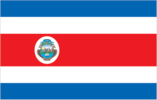
five horizontal bands of blue (top), white, red (double width), white, and blue, with the coat of arms in a white elliptical disk on the hoist side of the red band; above the coat of arms a light blue ribbon contains the words, AMERICA CENTRAL, and just below it near the top of the coat of arms is a white ribbon with the words, REPUBLICA COSTA RICA Economy Costa Rica
GDP
purchasing power parity - $32 billion (2002 est.)
GDP - composition by sector
- agriculture
- 9%
- industry
- 30%
- services
- 61% (2002 est.)
GDP - per capita
purchasing power parity - $8,300 (2002 est.)
GDP - real growth rate
2.8% (2002 est.)
Geographic coordinates
10 00 N, 84 00 W
Geography - note
four volcanoes, two of them active, rise near the capital of San Jose in the center of the country; one of the volcanoes, Irazu, erupted destructively in 1963-65 People Costa Rica
Government type
democratic republic
Highways
- paved
- 7,896 km
- total
- 35,892 km
- unpaved
- 27,996 km (2000)
HIV/AIDS - adult prevalence rate
0.6% (2001 est.)
HIV/AIDS - deaths
890 (2001 est.)
HIV/AIDS - people living with HIV/AIDS
11,000 (2001 est.)
Household income or consumption by percentage share
- highest 10%
- 34.6% (2001)
- lowest 10%
- 1.7%
Illicit drugs
transshipment country for cocaine and heroin from South America; illicit production of cannabis on small, scattered plots; domestic cocaine consumption is rising, particularly crack cocaine This page was last updated on 18 December, 2003
Imports
$6.4 billion (2002)
Imports - commodities
raw materials, consumer goods, capital equipment, petroleum
Imports - partners
US 36.7%, Japan 4.4%, Mexico 4.2% (2002)
Independence
15 September 1821 (from Spain)
Industrial production growth rate
2.9% (2002 est.)
Industries
microprocessors, food processing, textiles and clothing, construction materials, fertilizer, plastic products
Infant mortality rate
- female
- 9.59 deaths/1,000 live births (2003 est.)
- male
- 11.49 deaths/1,000 live births
- total
- 10.56 deaths/1,000 live births
Inflation rate (consumer prices)
9.1% (2002 est.)
International organization participation
BCIE, CACM, ECLAC, FAO, G-77, IADB, IAEA, IBRD, ICAO, ICC, ICCt, ICFTU, ICRM, IDA, IFAD, IFC, IFRCS, ILO, IMF, IMO, Interpol, IOC, IOM, ISO, ITU, LAES, LAIA (observer), NAM (observer), OAS, OPANAL, OPCW, PCA, RG, UN, UNCTAD, UNESCO, UNIDO, UNU, UPU, WCL, WCO, WFTU, WHO, WIPO, WMO, WToO, WTrO
Internet country code
.cr
Internet Service Providers (ISPs)
3 (of which only one is legal) (2000)
Internet users
384,000 (2002) Transportation Costa Rica
Irrigated land
1,260 sq km (1998 est.)
Judicial branch
Supreme Court or Corte Suprema (22 justices are elected for eight-year terms by the Legislative Assembly)
Labor force
1.9 million (1999)
Labor force - by occupation
agriculture 20%, industry 22%, services 58% (1999 est.)
Land boundaries
- border countries
- Nicaragua 309 km, Panama 330 km
- total
- 639 km
Land use
- arable land
- 4.41%
- other
- 90.11% (1998 est.)
- permanent crops
- 5.48%
Languages
Spanish (official), English
Legal system
based on Spanish civil law system; judicial review of legislative acts in the Supreme Court; has accepted compulsory ICJ jurisdiction
Legislative branch
- unicameral Legislative Assembly or Asamblea Legislativa (57 seats; members are elected by direct, popular vote to serve four-year terms)
- election results
- percent of vote by party - NA; seats by party - PUSC 19, PLN 17, PAC 14, PML 6, PRC 1
- elections
- last held 3 February 2002 (next to be held 3 February 2006)
Life expectancy at birth
- female
- 79.11 years (2003 est.)
- male
- 73.87 years
- total population
- 76.43 years
Literacy
- definition
- age 15 and over can read and write
- female
- 96.1% (2003 est.) Government Costa Rica
- male
- 95.9%
- total population
- 96%
Location
Middle America, bordering both the Caribbean Sea and the North Pacific Ocean, between Nicaragua and Panama
Map references
Central America and the Caribbean
Maritime claims
- continental shelf
- 200 NM
- exclusive economic zone
- 200 NM
- territorial sea
- 12 NM
Median age
- female
- 25.8 years (2002)
- male
- 24.9 years
- total
- 25.4 years
Merchant marine
- ships by type
- passenger 1 (2002 est.)
- total
- 1 ships (1,000 GRT or over) 1,716 GRT/ DWT
Military branches
no regular indigenous military forces; Air Section, Ministry of Public Forces (Fuerza Publica)
Military expenditures - dollar figure
$69 million (FY99)
Military expenditures - percent of GDP
1.6% (FY99) Transnational Issues Costa Rica
Military manpower - availability
- males age 15-49
- 1,080,254 (2003 est.)
Military manpower - fit for military service
- males age 15-49
- 722,043 (2003 est.)
Military manpower - military age
18 years of age (2003 est.)
Military manpower - reaching military age annually
- males
- 41,453 (2003 est.)
National holiday
Independence Day, 15 September (1821)
Nationality
- adjective
- Costa Rican
- noun
- Costa Rican(s)
Natural hazards
occasional earthquakes, hurricanes along Atlantic coast; frequent flooding of lowlands at onset of rainy season and landslides; active volcanoes
Natural resources
hydropower
Net migration rate
0.51 migrant(s)/1,000 population (2003 est.)
Oil - consumption
37,000 bbl/day (2001 est.)
Oil - exports
NA (2001)
Oil - imports
NA (2001)
Oil - production
0 bbl/day (2001 est.)
Pipelines
refined products 421 km (2003)
Political parties and leaders
- Agricultural Labor Action or PALA [Carlos Alberto SOLIS Blanco]; Citizen Action Party or PAC [Otton SOLIS]; Costa Rican Renovation Party or PRC [Justo OROZCO]; Democratic Force Party or PFD [Jose M. NUNEZ]; Libertarian Movement Party or PML [Otto GUEVARA Guth]; National Christian Alliance Party or ANC [Alejandro MADRIGAL]; National Independent Party or PNI [Jorge GONZALEZ Marten]; National Integration Party or PIN [Walter MUNOZ Cespedes]; National Liberation Party or PLN [Sonia PICADO]; Social Christian Unity Party or PUSC [Luis Manuel CHACON]
- note
- mainly a two-party system - PUSC and PLN - until the 3 February 2002 election in which the PAC captured a significant percentage, forcing a run-off in April 2002
Political pressure groups and leaders
Authentic Confederation of Democratic Workers or CATD (Communist Party affiliate); Chamber of Coffee Growers; Confederated Union of Workers or CUT (Communist Party affiliate); Costa Rican Confederation of Democratic Workers or CCTD (Liberation Party affiliate); Federation of Public Service Workers or FTSP; National Association for Economic Development or ANFE; National Association of Educators or ANDE; Rerum Novarum or CTRN (PLN affiliate) [Gilbert Brown]
Population
3,896,092 (July 2003 est.)
Population below poverty line
20.6% (1999 est.)
Population growth rate
1.56% (2003 est.)
Ports and harbors
Caldera, Golfito, Moin, Puerto Limon, Puerto Quepos, Puntarenas
Radio broadcast stations
AM 50, FM 43, shortwave 19 (1998)
Radios
980,000 (1997)
Railways
- narrow gauge
- 950 km 1.067-m gauge (260 km electrified) (2002)
- total
- 950 km
Religions
Roman Catholic 76.3%, Evangelical 13.7%, Jehovah's Witnesses 1.3%, other Protestant 0.7%, other 4.8%, none 3.2%
Sex ratio
- at birth
- 1.05 male(s)/female
- total population
- 1.02 male(s)/female (2003 est.)
- under 15 years
- 1.05 male(s)/female 15-64 years: 1.02 male(s)/female 65 years and over: 0.87 male(s)/female
Suffrage
18 years of age; universal and compulsory
Telephone system
- domestic
- point-to-point and point-to-multi-point microwave, fiber-optic, and coaxial cable link rural areas; Internet service is available
- general assessment
- very good domestic telephone service
- international
- connected to Central American Microwave System; satellite earth stations - 2 Intelsat (Atlantic Ocean); two submarine cables (1999)
Telephones - main lines in use
- 450,000 (1998)
- note
- 584,000 installed in 1997, but only about 450,000 were in use in 1998
Telephones - mobile cellular
143,000 (2000)
Television broadcast stations
6 (plus 11 repeaters) (1997)
Televisions
525,000 (1997)
Terrain
coastal plains separated by rugged mountains including over 100 volcanic cones, of which several are major volcanoes
Total fertility rate
2.38 children born/woman (2003 est.)
Unemployment rate
6.3% (2002 est.)
Waterways
730 km (seasonally navigable)