2005 Edition
CIA World Factbook 2005 (Project Gutenberg)
Introduction
Administrative divisions
28 provinces (oblasti, singular - oblast); Blagoevgrad, Burgas, Dobrich, Gabrovo, Khaskovo, Kurdzhali, Kyustendil, Lovech, Montana, Pazardzhik, Pernik, Pleven, Plovdiv, Razgrad, Ruse, Shumen, Silistra, Sliven, Smolyan, Sofiya, Sofiya-Grad, Stara Zagora, Turgovishte, Varna, Veliko Turnovo, Vidin, Vratsa, Yambol
Age structure
0-14 years: 14.1% (male 539,005/female 512,762) 15-64 years: 68.7% (male 2,516,368/female 2,599,524) 65 years and over: 17.2% (male 531,008/female 751,682) (2005 est.)
Agriculture - products
vegetables, fruits, tobacco, livestock, wine, wheat, barley, sunflowers, sugar beets
Airports
213 (2004 est.)
Airports - with paved runways
- total
- 128 over 3,047 m: 1 2,438 to 3,047 m: 19 1,524 to 2,437 m: 15 914 to 1,523 m: 1 under 914 m: 92 (2004 est.)
Airports - with unpaved runways
- total
- 85 1,524 to 2,437 m: 2 914 to 1,523 m: 11 under 914 m: 72 (2004 est.)
Area
- land
- 110,550 sq km
- total
- 110,910 sq km
- water
- 360 sq km
Area - comparative
slightly larger than Tennessee
Background
The Bulgars, a Central Asian Turkic tribe, merged with the local Slavic inhabitants in the late 7th century to form the first Bulgarian state. In succeeding centuries, Bulgaria struggled with the Byzantine Empire to assert its place in the Balkans, but by the end of the 14th century the country was overrun by the Ottoman Turks. Northern Bulgaria attained autonomy in 1878 and all of Bulgaria became independent in 1908. Having fought on the losing side in both World Wars, Bulgaria fell within the Soviet sphere of influence and became a People's Republic in 1946. Communist domination ended in 1990, when Bulgaria held its first multiparty election since World War II and began the contentious process of moving toward political democracy and a market economy while combating inflation, unemployment, corruption, and crime. Today, reforms and democratization keep Bulgaria on a path toward eventual integration into the EU. The country joined NATO in 2004. Geography Bulgaria
Birth rate
9.66 births/1,000 population (2005 est.)
Budget
- expenditures
- $9.619 billion, including capital expenditures of NA (2004 est.)
- revenues
- $9.67 billion
Capital
Sofia
Climate
temperate; cold, damp winters; hot, dry summers
Coastline
354 km
Constitution
adopted 12 July 1991
Country name
- conventional long form
- Republic of Bulgaria
- conventional short form
- Bulgaria
Currency (code)
lev (BGL)
Currency code
BGN
Current account balance
$682.9 million (2004 est.)
Death rate
14.26 deaths/1,000 population (2005 est.)
Debt - external
$16.1 billion (November 2004 est.)
Diplomatic representation from the US
- chief of mission
- Ambassador James William PARDEW
- embassy
- 16 Kozyak Street, Sofia 1407
- FAX
- [359] (2) 937-5230
- mailing address
- American Embassy Sofia, Department of State, 5740 Sofia Place, Washington, DC 20521-5740
- telephone
- [359] (2) 937-5100
Diplomatic representation in the US
- chancery
- 1621 22nd Street NW, Washington, DC 20008
- chief of mission
- Ambassador Elena B. POPTODOROVA
- consulate(s)
- Los Angeles
- consulate(s) general
- Chicago and New York
- FAX
- [1] (202) 234-7973
- telephone
- [1] (202) 387-0174
Disputes - international
none
Distribution of family income - Gini index
26.4 (2001)
Economic aid - recipient
$300 million (2000 est.)
Economy - overview
Bulgaria, a former communist country striving to enter the European Union, has experienced macroeconomic stability and strong growth since a major economic downturn in 1996 led to the fall of the then socialist government. As a result, the government became committed to economic reform and responsible fiscal planning. Minerals, including coal, copper, and zinc play an important role in industry. In 1997, macroeconomic stability was reinforced by the imposition of a fixed exchange rate of the lev against the German D-mark and the negotiation of an IMF standby agreement. Low inflation and steady progress on structural reforms improved the business environment; Bulgaria has averaged 4% growth since 2000 and has begun to attract significant amounts of foreign direct investment. Corruption in the public administration, a weak judiciary, and the presence of organized crime remain the largest challenges for Bulgaria.
Electricity - consumption
32.71 billion kWh (2002)
Electricity - exports
8.3 billion kWh (2002)
Electricity - imports
960 million kWh (2002)
Electricity - production
43.07 billion kWh (2002)
Electricity - production by source
- fossil fuel
- 47.8%
- hydro
- 8.1%
- nuclear
- 44.1%
- other
- 0% (2001)
Elevation extremes
- highest point
- Musala 2,925 m
- lowest point
- Black Sea 0 m
Environment - current issues
air pollution from industrial emissions; rivers polluted from raw sewage, heavy metals, detergents; deforestation; forest damage from air pollution and resulting acid rain; soil contamination from heavy metals from metallurgical plants and industrial wastes
Environment - international agreements
- party to
- Air Pollution, Air Pollution-Nitrogen Oxides, Air Pollution-Persistent Organic Pollutants, Air Pollution-Sulfur 85, Air Pollution-Volatile Organic Compounds, Antarctic-Environmental Protocol, Antarctic-Marine Living Resources, Antarctic Treaty, Biodiversity, Climate Change, Climate Change-Kyoto Protocol, Desertification, Endangered Species, Environmental Modification, Hazardous Wastes, Law of the Sea, Ozone Layer Protection, Ship Pollution, Wetlands signed, but not ratified: Air Pollution-Sulfur 94
Ethnic groups
Bulgarian 83.9%, Turk 9.4%, Roma 4.7%, other 2% (including Macedonian, Armenian, Tatar, Circassian) (2001 census)
Exchange rates
leva per US dollar - 1.5751 (2004), 1.7327 (2003), 2.077 (2002), 2.1847 (2001), 2.1233 (2000) note: on 5 July 1999, the lev was redenominated; the post-5 July 1999 lev is equal to 1,000 of the pre-5 July 1999 lev
Executive branch
- cabinet
- Council of Ministers nominated by the prime minister and elected by the National Assembly
- chief of state
- President Georgi PURVANOV (since 22 January 2002); Vice President Angel MARIN (since 22 January 2002)
- election results
- Georgi PURVANOV elected president; percent of vote - Georgi PURVANOV 54.13%, Petar STOYANOV 45.87%; Sergei STANISHEV elected prime minister, result of legislative vote - 168 to 67
- elections
- president and vice president elected on the same ticket by popular vote for five-year terms; election last held 11 and 18 November 2001 (next to be held NA 2006); chairman of the Council of Ministers (prime minister) nominated by the president and elected by the National Assembly; deputy prime ministers nominated by the prime minister and elected by the National Assembly
- head of government
- Prime Minister Sergei STANISHEV (since 16 August 2005); Deputy Prime Minister Ivaylo KALFIN (since 16 August 2005)
Exports
$9.134 billion f.o.b. (2004 est.)
Exports - commodities
clothing, footwear, iron and steel, machinery and equipment, fuels
Exports - partners
Italy 13.1%, Germany 11.6%, Turkey 9.3%, Belgium 6.1%, Greece 5.6%, US 5.3%, France 4.9% (2004)
Fiscal year
calendar year Communications Bulgaria
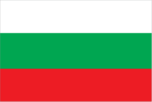
Flag description
three equal horizontal bands of white (top), green, and red; note - the national emblem, formerly on the hoist side of the white stripe, has been removed Economy Bulgaria
GDP - composition by sector
- agriculture
- 11.5%
- industry
- 30.1%
- services
- 58.4% (2004 est.)
GDP - per capita
purchasing power parity - $8,200 (2004 est.)
GDP - real growth rate
5.3% (2004 est.)
GDP (purchasing power parity)
$61.63 billion (2004 est.)
Geographic coordinates
43 00 N, 25 00 E
Geography - note
strategic location near Turkish Straits; controls key land routes from Europe to Middle East and Asia People Bulgaria
Government type
parliamentary democracy
Heliports
1 (2004 est.) Military Bulgaria
Highways
- paved
- 34,111 km (including 328 km of expressways)
- total
- 37,077 km
- unpaved
- 2,966 km (2002)
HIV/AIDS - adult prevalence rate
less than 0.1% - note - no country specific models provided (2001 est.)
HIV/AIDS - deaths
100 (2001 est.)
HIV/AIDS - people living with HIV/AIDS
346 (2001 est.)
Household income or consumption by percentage share
lowest 10%: 4.5% highest 10%: 22.8% (1997)
Illicit drugs
major European transshipment point for Southwest Asian heroin and, to a lesser degree, South American cocaine for the European market; limited producer of precursor chemicals; some money laundering of drug-related proceeds through financial institutions This page was last updated on 20 October, 2005 ======================================================================
Imports
$12.23 billion f.o.b. (2004 est.)
Imports - commodities
machinery and equipment; metals and ores; chemicals and plastics; fuels, minerals, and raw materials
Imports - partners
Germany 15.1%, Italy 10.2%, Russia 7.9%, Greece 7.5%, Turkey 6.9%, France 4.4% (2004)
Independence
3 March 1878 (as an autonomous principality within the Ottoman Empire); 22 September 1908 (complete independence from the Ottoman Empire)
Industrial production growth rate
5.2% (2004 est.)
Industries
electricity, gas and water; food, beverages and tobacco; machinery and equipment, base metals, chemical products, coke, refined petroleum, nuclear fuel
Infant mortality rate
- female
- 16.56 deaths/1,000 live births (2005 est.)
- male
- 24.31 deaths/1,000 live births
- total
- 20.55 deaths/1,000 live births
Inflation rate (consumer prices)
6.1% (2004 est.)
International organization participation
ACCT, Australia Group, BIS, BSEC, CE, CEI, CERN, EAPC, EBRD, EU (applicant), FAO, G- 9, IAEA, IBRD, ICAO, ICCt, ICFTU, ICRM, IFC, IFRCS, IHO (pending member), ILO, IMF, IMO, Interpol, IOC, IOM, ISO, ITU, MIGA, NAM (guest), NATO, NSG, OAS (observer), OPCW, OSCE, PCA, UN, UNCTAD, UNESCO, UNIDO, UNMEE, UNMIK, UNMIL, UPU, WCL, WCO, WEU (associate affiliate), WFTU, WHO, WIPO, WMO, WToO, WTO, ZC
Internet country code
.bg
Internet hosts
53,421 (2004)
Internet Service Providers (ISPs)
200 (2001)
Internet users
630,000 (2002) Transportation Bulgaria
Investment (gross fixed)
18.6% of GDP (2004 est.)
Irrigated land
8,000 sq km (1998 est.)
Judicial branch
Supreme Administrative Court; Supreme Court of Cassation; Constitutional Court (12 justices appointed or elected for nine-year terms); Supreme Judicial Council (consists of the chairmen of the two Supreme Courts, the Chief Prosecutor, and 22 other members; responsible for appointing the justices, prosecutors, and investigating magistrates in the justice system; members of the Supreme Judicial Council elected for five-year terms, 11 elected by the National Assembly and 11 by bodies of the judiciary)
Labor force
3.398 million (2004 est.)
Labor force - by occupation
agriculture 11%, industry 32.7%, services 56.3% (3rd quarter 2004 est.)
Land boundaries
- border countries
- Greece 494 km, Macedonia 148 km, Romania 608 km, Serbia and Montenegro 318 km, Turkey 240 km
- total
- 1,808 km
Land use
- arable land
- 40.02%
- other
- 58.06% (2001)
- permanent crops
- 1.92%
Languages
Bulgarian 84.5%, Turkish 9.6%, Roma 4.1%, other and unspecified 1.8% (2001 census)
Legal system
civil law and criminal law based on Roman law; accepts compulsory ICJ jurisdiction
Legislative branch
- unicameral National Assembly or Narodno Sobranie (240 seats; members elected by popular vote to serve four-year terms)
- election results
- percent of vote by party - CfB 31.1%, NMS2 19.9%, MRF 12.7%, ATAKA 8.2%, UDF 7.7%, DSB 6.5%, BPU 5.2%; seats by party - CfB 83, NMS2 53, MRF 33, ATAKA 21, UDF 20, DSB 17, BPU 13
- elections
- last held 25 June 2005 (next to be held June 2009)
Life expectancy at birth
- female
- 75.87 years (2005 est.)
- male
- 68.41 years
- total population
- 72.03 years
Literacy
- definition: age 15 and over can read and write
- female
- 98.2% (2003 est.) Government Bulgaria
- male
- 99.1%
- total population
- 98.6%
Location
Southeastern Europe, bordering the Black Sea, between Romania and Turkey
Manpower available for military service
males age 18-49: 1,661,211 (2005 est.)
Manpower fit for military service
males age 18-49: 1,302,037 (2005 est.)
Manpower reaching military service age annually
- males
- 51,023 (2005 est.)
Map references
Europe
Maritime claims
- contiguous zone
- 24 nm
- exclusive economic zone
- 200 nm
- territorial sea
- 12 nm
Median age
- female
- 42.66 years (2005 est.)
- male
- 38.59 years
- total
- 40.66 years
Merchant marine
- by type
- bulk carrier 34, cargo 13, chemical tanker 4, container 6, passenger/cargo 1, petroleum tanker 3, roll on/roll off 3
- registered in other countries
- 45 (2005)
- total
- 64 ships (1,000 GRT or over) 757,972 GRT/1,115,238 DWT
Military branches
Ground Forces, Naval Forces, Air and Air Defense Forces
Military expenditures - dollar figure
$356 million (FY02)
Military expenditures - percent of GDP
2.6% (2003) Transnational Issues Bulgaria
Military service age and obligation
18 years of age for compulsory and voluntary military service; conscript service obligation - 9 months (2004)
National holiday
Liberation Day, 3 March (1878)
Nationality
- adjective
- Bulgarian
- noun
- Bulgarian(s)
Natural gas - consumption
5.804 billion cu m (2001 est.)
Natural gas - exports
0 cu m (2001 est.)
Natural gas - imports
5.8 billion cu m (2001 est.)
Natural gas - production
4 million cu m (2001 est.)
Natural gas - proved reserves
3.724 billion cu m (1 January 2002)
Natural hazards
earthquakes, landslides
Natural resources
bauxite, copper, lead, zinc, coal, timber, arable land
Net migration rate
-4.3 migrant(s)/1,000 population (2005 est.)
Oil - consumption
94,000 bbl/day (2001 est.)
Oil - exports
NA
Oil - imports
NA
Oil - production
603 bbl/day (2001 est.)
Oil - proved reserves
8.1 million bbl (1 January 2002)
Pipelines
gas 2,425 km; oil 339 km; refined products 156 km (2004)
Political parties and leaders
Attack National Union [Volen Siderov]; ATAKA (Attack Coalition) (coalition of parties headed by the Attack National Union); Bulgarian Agrarian National Union-People's Union or BANU [Anastasia MOZER]; Bulgarian People's Union or BPU (coalition of UFD, IMRO, and BANU); Bulgarian Socialist Party or BSP [Sergei STANISHEV]; Coalition for Bulgaria or CfB (coalition of parties dominated by BSP) [Sergei STANISHEV]; Democrats for a Strong Bulgaria or DSB [Ivan KOSTOV]; Internal Macedonian Revolutionary Organization or IMRO [Krasimir KARAKACHANOV]; Movement for Rights and Freedoms or MRF [Ahmed DOGAN]; National Movement for Simeon II or NMS2 [Simeon SAXE-COBURG-GOTHA]; New Time [Emil KOSHLUKOV]; Union of Democratic Forces or UDF [Nadezhda MIKHAYLOVA]; Union of Free Democrats or UFD [Stefan SOFIYANSKI]; United Democratic Forces or UtDF (a coalition of center-right parties dominated by UDF)
Political pressure groups and leaders
Confederation of Independent Trade Unions of Bulgaria or CITUB; Podkrepa Labor Confederation; numerous regional, ethnic, and national interest groups with various agendas
Population
7,450,349 (July 2005 est.)
Population below poverty line
13.4% (2002 est.)
Population growth rate
-0.89% (2005 est.)
Ports and harbors
Burgas, Varna
Public debt
41.9% of GDP (2004 est.)
Radio broadcast stations
AM 31, FM 63, shortwave 2 (2001)
Radios
4.51 million (1997)
Railways
- narrow gauge
- 245 km 0.760-m gauge (2004)
- standard gauge
- 4,049 km 1.435-m gauge (2,710 km electrified)
- total
- 4,294 km
Religions
Bulgarian Orthodox 82.6%, Muslim 12.2%, other Christian 1.2%, other 4% (2001 census)
Reserves of foreign exchange and gold
$7.526 billion (2004 est.)
Sex ratio
- at birth
- 1.06 male(s)/female under 15 years: 1.05 male(s)/female 15-64 years: 0.97 male(s)/female 65 years and over: 0.71 male(s)/female
- total population
- 0.93 male(s)/female (2005 est.)
Suffrage
18 years of age; universal
Telephone system
- domestic
- more than two-thirds of the lines are residential; telephone service is available in most villages; a fairly modern digital cable trunk line now connects switching centers in most of the regions, the others are connected by digital microwave radio relay
- general assessment
- extensive but antiquated
- international
- country code - 359; direct dialing to 58 countries; satellite earth stations - 1 Intersputnik (Atlantic Ocean region); 2 Intelsat (Atlantic and Indian Ocean regions)
Telephones - main lines in use
2,868,200 (2002)
Telephones - mobile cellular
2,597,500 (2002)
Television broadcast stations
39 (plus 1,242 repeaters) (2001)
Televisions
3.31 million (1997)
Terrain
mostly mountains with lowlands in north and southeast
Total fertility rate
1.38 children born/woman (2005 est.)
Unemployment rate
12.7% (2004 est.)
Waterways
470 km (2004)