1992 Edition
CIA World Factbook 1992 (Project Gutenberg)
Geography
Climate
- subtropical; humid; temperatures moderated by trade winds
- subtropical, tempered by easterly tradewinds, relatively low humidity, little seasonal temperature variation; rainy season May to November
Coastline
- 80 km
- 188 km
Comparative area
- about 0.8 times the size of Washington, DC
- slightly less than twice the size of Washington, DC
Contiguous zone
12 nm
Continental shelf
200 m (depth)
Disputes
- none
- none
Environment
- subject to hurricanes and tropical storms from July to October
- rarely affected by hurricanes; subject to frequent severe droughts, floods, earthquakes; lack of natural freshwater resources
Exclusive economic zone
200 nm
Exclusive fishing zone
200 nm
Land area
- 150 km2; includes the island of Anegada
- 349 km2
Land boundaries
none
Land use
- arable land 20%; permanent crops 7%; meadows and pastures 33%; forest and woodland 7%; other 33%
- arable land 15%; permanent crops 6%; meadows and pastures 26%; forest and woodland 6%; other 47%
Natural resources
- negligible
- sun, sand, sea, surf
Note
- strong ties to nearby US Virgin Islands and Puerto Rico
- important location 1,770 km southeast of Miami and 65 km east of Puerto Rico, along the Anegada Passage - a key shipping lane for the Panama Canal; Saint Thomas has one of the best natural, deepwater harbors in the Caribbean
Terrain
- coral islands relatively flat; volcanic islands steep, hilly
- mostly hilly to rugged and mountainous with little level land
Territorial sea
- 3 nm
- 12 nm
Total area
- 150 km2
- 352 km2
People and Society
Birth rate
- 20 births/1,000 population (1992)
- 21 births/1,000 population (1992)
Death rate
- 6 deaths/1,000 population (1992)
- 5 deaths/1,000 population (1992)
Ethnic divisions
- over 90% black, remainder of white and Asian origin
- West Indian (45% born in the Virgin Islands and 29% born elsewhere in the West Indies) 74%, US mainland 13%, Puerto Rican 5%, other 8%; black 80%, white 15%, other 5%; Hispanic origin 14%
Infant mortality rate
- 20 deaths/1,000 live births (1992)
- 13 deaths/1,000 live births (1992)
Labor force
- 4,911 (1980)
- 45,500 (1988)
Languages
- English (official)
- English (official), but Spanish and Creole are widely spoken
Life expectancy at birth
- 71 years male, 75 years female (1992)
- 74 years male, 77 years female (1992)
Literacy
- 98% (male 98%, female 98%) age 15 and over can read and write (1970)
- NA% (male NA%, female NA%)
Nationality
- noun - British Virgin Islander(s); adjective - British Virgin Islander
- noun - Virgin Islander(s); adjective - Virgin Islander; US citizens
Net migration rate
- --2 migrants/1,000 population (1992)
- -26 migrants/1,000 population (1992)
Organized labor
- NA% of labor force
- 90% of the government labor force
Population
- 12,555 (July 1992), growth rate 1.2% (1992)
- 98,942 (July 1992), growth rate -1.0% (1992)
Religions
- Protestant 86% (Methodist 45%, Anglican 21%, Church of God 7%, Seventh-Day Adventist 5%, Baptist 4%, Jehovah's Witnesses 2%, other 2%), Roman Catholic 6%, none 2%, other 6% (1981)
- Baptist 42%, Roman Catholic 34%, Episcopalian 17%, other 7%
Total fertility rate
- 2.3 children born/woman (1992)
- 2.7 children born/woman (1992)
Government
Administrative divisions
- none (dependent territory of the UK)
- none (territory of the US)
Capital
- Road Town
- Charlotte Amalie
Chief of State
Queen ELIZABETH II (since 6 February 1952), represented by Governor P. A. PENFOLD (since NA 1991)
Chief of State and Head of Government
President George BUSH (since 20 January 1989); Governor Alexander A. FARRELLY (since 5 January 1987); Lieutenant Governor Derek M. HODGE (since 5 January 1987)
Constitution
- 1 June 1977
- Revised Organic Act of 22 July 1954
Diplomatic representation
- none (dependent territory of UK)
- none (territory of the US)
Executive branch
- British monarch, governor, chief minister, Executive Council (cabinet)
- US president, popularly elected governor and lieutenant governor
Flag
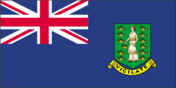
- blue with the flag of the UK in the upper hoist-side quadrant and the Virgin Islander coat of arms centered in the outer half of the flag; the coat of arms depicts a woman flanked on either side by a vertical column of six oil lamps above a scroll bearing the Latin word VIGILATE (Be Watchful)
- white with a modified US coat of arms in the center between the large blue initials V and I; the coat of arms shows an eagle holding an olive branch in one talon and three arrows in the other with a superimposed shield of vertical red and white stripes below a blue panel
Governor
last held 6 November 1990 (next to be held November 1994); results - Governor Alexander FARRELLY (Democratic Party) 56.5% defeated Juan LUIS (independent) 38.5%
Head of Government
Chief Minister H. Lavity STOUTT (since NA 1986)
Independence
- none (dependent territory of the UK)
- none (territory of the US)
Judicial branch
- Eastern Caribbean Supreme Court
- US District Court handles civil matters over $50,000, felonies (persons 15 years of age and over), and federal cases; Territorial Court handles civil matters up to $50,000 small claims, juvenile, domestic, misdemeanors, and traffic cases
Legal system
- English law
- based on US
Legislative branch
- unicameral Legislative Council
- unicameral Senate
Legislative Council
last held 12 November 1990 (next to be held by November 1995); results - percent of vote by party NA; seats - (9 total) VIP 6, IPM 1, independents 2
Long-form name
- none
- Virgin Islands of the United States
Member of
- CARICOM (associate), CDB, ECLAC (associate), IOC, OECS, UNESCO (associate)
- ECLAC (associate), IOC, applied for associate membership in OECS in February 1990
National holiday
- Territory Day, 1 July
- Transfer Day (from Denmark to US), 31 March (1917)
Political parties and leaders
- United Party (UP), Conrad MADURO; Virgin Islands Party (VIP), H. Lavity STOUTT; Independent Progressive Movement (IPM), Cyril B. ROMNEY
- Democratic Party, Marilyn STAPLETON; Independent Citizens' Movement (ICM), Virdin C. BROWN; Republican Party, Charlotte-Poole DAVIS
Senate
last held 6 November 1990 (next to be held 3 November 1992); results - percent of vote by party NA; seats - (15 total) number of seats by party NA
Suffrage
- universal at age 18
- universal at age 18
Type
- dependent territory of the UK
- organized, unincorporated territory of the US administered by the Office of Territorial and International Affairs, US Department of the Interior
US House of Representatives
last held 6 November 1990 (next to be held 3 November 1992); results - Ron DE LUGO reelected as nonvoting delegate seats - (1 total); seat by party NA; note - the Virgin Islands elects one nonvoting representative to the US House of Representatives
Economy
Agriculture
- livestock (including poultry), fish, fruit, vegetables
- truck gardens, food crops (small scale), fruit, sorghum, Senepol cattle
Budget
- revenues $51 million; expenditures $88 million, including capital expenditures of $38 million (1991)
- revenues $364.4 million; expenditures $364.4 million, including capital expenditures of $NA (FY90)
Currency
- US currency is used
- US currency is used
Economic aid
- NA
- Western (non-US) countries, ODA and OOF bilateral commitments (1970-89), $42 million
Electricity
- 10,500 kW capacity; 43 million kWh produced, 3,510 kWh per capita (1990)
- 358,000 kW capacity; 532 million kWh produced, 5,360 kWh per capita (1990)
Exchange rates
- US currency is used
- US currency is used
Exports
- $2.7 million (f.o.b., 1988) commodities: rum, fresh fish, gravel, sand, fruits, animals partners: Virgin Islands (US), Puerto Rico, US
- $2.2 billion (f.o.b., 1988) commodities: refined petroleum products partners: US, Puerto Rico
External debt
- $4.5 million (1985)
- $NA
Fiscal year
- 1 April - 31 March
- 1 October - 30 September
GDP
- purchasing power equivalent - $130 million, per capita $10,600; real growth rate 6.3% (1990)
- purchasing power equivalent - $1.2 billion, per capita $11,000; real growth rate NA% (1987)
Imports
- $11.5 million (c.i.f., 1988) commodities: building materials, automobiles, foodstuffs, machinery partners: Virgin Islands (US), Puerto Rico, US
- $3.7 billion (c.i.f., 1988) commodities: crude oil, foodstuffs, consumer goods, building materials partners: US, Puerto Rico
Industrial production
- growth rate--4.0% (1985)
- growth rate 12%
Industries
- tourism, light industry, construction, rum, concrete block, offshore financial center
- tourism, petroleum refining, watch assembly, rum distilling, construction, pharmaceuticals, textiles, electronics
Inflation rate (consumer prices)
- 2.5% (1990 est.)
- NA%
Overview
- The economy, one of the most prosperous in the Caribbean area, is highly dependent on the tourist industry, which generates about 21% of the national income. In 1985 the government offered offshore registration to companies wishing to incorporate in the islands, and, in consequence, incorporation fees generated about $2 million in 1987. Livestock raising is the most significant agricultural activity. The islands' crops, limited by poor soils, are unable to meet food requirements.
- Tourism is the primary economic activity, accounting for more than 70% of GDP and 70% of employment. The manufacturing sector consists of textile, electronics, pharmaceutical, and watch assembly plants. The agricultural sector is small, most food being imported. International business and financial services are a small but growing component of the economy. The world's largest petroleum refinery is at Saint Croix.
Unemployment rate
- NEGL%
- 2.0% (1990)
Communications
Airports
- 3 total, 3 usable; 2 with permanent-surface runways less than 1,220 m
- 2 total, 2 usable; 2 with permanent-surface runways 1,220-2,439 m; international airports on Saint Thomas and Saint Croix
Highways
- 106 km motorable roads (1983)
- 856 km total
Ports
- Road Town
- Saint Croix - Christiansted, Frederiksted; Saint Thomas - Long Bay, Crown Bay, Red Hook; Saint John - Cruz Bay
Telecommunications
- 3,000 telephones; worldwide external telephone service; submarine cable communication links to Bermuda; broadcast stations - 1 AM, no FM, 1 TV
- 44,280 telephones; broadcast stations - 4 AM, 8 FM, 4 TV; modern system using fiber-optic cable, submarine cable, microwave radio, and satellite facilities; 98,000 radios; 63,000 TV (1988)
Military and Security
Note
- defense is the responsibility of the UK
- defense is the responsibility of the US