2016 Edition
CIA World Factbook 2016 Archive (HTML)
Introduction
Background
- Bosnia and Herzegovina declared sovereignty in October 1991 and independence from the former Yugoslavia on 3 March 1992 after a referendum boycotted by ethnic Serbs. The Bosnian Serbs - supported by neighboring Serbia and Montenegro - responded with armed resistance aimed at partitioning the republic along ethnic lines and joining Serb-held areas to form a "Greater Serbia." In March 1994, Bosniaks and Croats reduced the number of warring factions from three to two by signing an agreement creating a joint Bosniak-Croat Federation of Bosnia and Herzegovina. On 21 November 1995, in Dayton, Ohio, the warring parties initialed a peace agreement that ended three years of interethnic civil strife (the final agreement was signed in Paris on 14 December 1995). The Dayton Peace Accords retained Bosnia and Herzegovina's international boundaries and created a multiethnic and democratic government charged with conducting foreign, diplomatic, and fiscal policy. Also recognized was a second tier of government composed of two entities roughly equal in size: the predominantly Bosniak-Bosnian Croat Federation of Bosnia and Herzegovina and the predominantly Bosnian Serb-led Republika Srpska (RS). The Federation and RS governments are responsible for overseeing most government functions. Additionally, the Dayton Accords established the Office of the High Representative to oversee the implementation of the civilian aspects of the agreement. The Peace Implementation Council at its conference in Bonn in 1997 also gave the High Representative the authority to impose legislation and remove officials, the so-called "Bonn Powers." An original NATO-led international peacekeeping force (IFOR) of 60,000 troops assembled in 1995 was succeeded over time by a smaller, NATO-led Stabilization Force (SFOR). In 2004, European Union peacekeeping troops (EUFOR) replaced SFOR. Currently, EUFOR deploys around 600 troops in theater in a security assistance and training capacity.
- The Dayton Peace Accords retained Bosnia and Herzegovina's international boundaries and created a multiethnic and democratic government charged with conducting foreign, diplomatic, and fiscal policy. Also recognized was a second tier of government compose
- the predominantly Bosniak-Bosnian Croat Federation of Bosnia and Herzegovina and the predominantly Bosnian Serb-led Republika Srpska (RS). The Federation and RS governments are responsible for overseeing most government functions. Additionally, the Dayton Accords established the Office of the High Representative to oversee the implementation of the civilian aspects of the agreement. The Peace Implementation Council at its conference in Bonn in 1997 also gave the High Representative the authority to impose legislation and remove officials, the so-called "Bonn Powers." An original NATO-led international peacekeeping force (IFOR) of 60,000 troops assembled in 1995 was succeeded over time by a smaller, NATO-led Stabilization Force (SFOR). In 2004, European Union peacekeeping troops (EUFOR) replaced SFOR. Currently, EUFOR deploys around 600 troops in theater in a security assistance and training capacity.
Geography
Area
- 51,197 sq km 51,187 sq km 10 sq km
- land
- 51,187 sq km
- total
- 51,197 sq km
- water
- 10 sq km
Area - comparative
slightly smaller than West Virginia
Climate
hot summers and cold winters; areas of high elevation have short, cool summers and long, severe winters; mild, rainy winters along coast
Coastline
20 km
Elevation
- 500 m lowest point: Adriatic Sea 0 m highest point: Maglic 2,386 m
- elevation extremes
- lowest point: Adriatic Sea 0 m
- highest point
- Maglic 2,386 m
- mean elevation
- 500 m
Environment - current issues
air pollution from metallurgical plants; sites for disposing of urban waste are limited; water shortages and destruction of infrastructure because of the 1992-95 civil strife; deforestation
Environment - international agreements
- Air Pollution, Biodiversity, Climate Change, Climate Change-Kyoto Protocol, Desertification, Hazardous Wastes, Law of the Sea, Marine Life Conservation, Ozone Layer Protection, Wetlands none of the selected agreements
- party to
- Air Pollution, Biodiversity, Climate Change, Climate Change-Kyoto Protocol, Desertification, Hazardous Wastes, Law of the Sea, Marine Life Conservation, Ozone Layer Protection, Wetlands
- signed, but not ratified
- none of the selected agreements
Geographic coordinates
44 00 N, 18 00 E
Geography - note
within Bosnia and Herzegovina's recognized borders, the country is divided into a joint Bosniak/Croat Federation (about 51% of the territory) and the Bosnian Serb-led Republika Srpska or RS (about 49% of the territory); the region called Herzegovina is contiguous to Croatia and Montenegro, and traditionally has been settled by an ethnic Croat majority in the west and an ethnic Serb majority in the east
Irrigated land
30 sq km (2012)
Land boundaries
- 1,543 km Croatia 956 km, Montenegro 242 km, Serbia 345 km
- border countries (3)
- Croatia 956 km, Montenegro 242 km, Serbia 345 km
- total
- 1,543 km
Land use
- 42.2% arable land 19.7%; permanent crops 2%; permanent pasture 20.5% 42.8% 15% (2011 est.)
- agricultural land
- 42.2%
- forest
- 42.8%
- other
- 15% (2011 est.)
Location
Southeastern Europe, bordering the Adriatic Sea and Croatia
Map references
Europe
Maritime claims
NA
Natural hazards
destructive earthquakes
Natural resources
coal, iron ore, bauxite, copper, lead, zinc, chromite, cobalt, manganese, nickel, clay, gypsum, salt, sand, timber, hydropower
Population - distribution
the northern and central areas of the country are the most densely populated
Terrain
mountains and valleys
People and Society
Age structure
- 13.36% (male 266,389/female 249,425) 11.97% (male 238,682/female 223,599) 46.2% (male 896,760/female 887,407) 14.43% (male 267,628/female 289,464) 14.05% (male 212,574/female 329,984) (2016 est.)
- 0-14 years
- 13.36% (male 266,389/female 249,425)
- 15-24 years
- 11.97% (male 238,682/female 223,599)
- 25-54 years
- 46.2% (male 896,760/female 887,407)
- 55-64 years
- 14.43% (male 267,628/female 289,464)
- 65 years and over
- 14.05% (male 212,574/female 329,984) (2016 est.)
Birth rate
8.8 births/1,000 population (2016 est.)
Child labor - children ages 5-14
- 24,722 5% (2006 est.)
- percentage
- 5% (2006 est.)
- total number
- 24,722
Children under the age of 5 years underweight
1.5% (2012)
Contraceptive prevalence rate
45.8% (2011/12)
Death rate
9.9 deaths/1,000 population (2016 est.)
Dependency ratios
- 40.7% 19% 21.7% 4.6% (2015 est.)
- elderly dependency ratio
- 21.7%
- potential support ratio
- 4.6% (2015 est.)
- total dependency ratio
- 40.7%
- youth dependency ratio
- 19%
Drinking water source
- urban: 99.7% of population rural: 100% of population total: 99.9% of population urban: 0.3% of population rural: 0% of population total: 0.1% of population (2015 est.)
- rural
- 0% of population
- total
- 0.1% of population (2015 est.)
- urban
- 0.3% of population
Education expenditures
NA
Ethnic groups
- Bosniak 50.1%, Serb 30.8%, Croat 15.4%, other 2.7%, not declared/no answer 1% the methodology remains disputed and Republika Srspka authorities refuse to recognize the results; Bosniak has replaced Muslim as an ethnic term in part to avoid confusion with the religious term Muslim - an adherent of Islam (2013 est.)
- note
- the methodology remains disputed and Republika Srspka authorities refuse to recognize the results; Bosniak has replaced Muslim as an ethnic term in part to avoid confusion with the religious term Muslim - an adherent of Islam (2013 est.)
Health expenditures
9.6% of GDP (2014)
HIV/AIDS - adult prevalence rate
NA
HIV/AIDS - deaths
NA
HIV/AIDS - people living with HIV/AIDS
NA
Hospital bed density
3.5 beds/1,000 population (2010)
Infant mortality rate
- 5.6 deaths/1,000 live births 5.7 deaths/1,000 live births 5.5 deaths/1,000 live births (2016 est.)
- female
- 5.5 deaths/1,000 live births (2016 est.)
- male
- 5.7 deaths/1,000 live births
- total
- 5.6 deaths/1,000 live births
Languages
Bosnian (official) 52.9%, Serbian (official) 30.8%, Croatian (official) 14.6%, other 1.6%, no answer 0.2% (2013 est.)
Life expectancy at birth
- 76.7 years 73.7 years 80 years (2016 est.)
- female
- 80 years (2016 est.)
- male
- 73.7 years
- total population
- 76.7 years
Literacy
- age 15 and over can read and write 98.5% 99.5% 97.5% (2015 est.)
- definition
- age 15 and over can read and write
- female
- 97.5% (2015 est.)
- male
- 99.5%
- total population
- 98.5%
Major urban areas - population
SARAJEVO (capital) 318,000 (2015)
Maternal mortality rate
11 deaths/100,000 live births (2015 est.)
Median age
- 41.7 years 40.2 years 43.1 years (2016 est.)
- female
- 43.1 years (2016 est.)
- male
- 40.2 years
- total
- 41.7 years
Mother's mean age at first birth
26.7 (2013 est.)
Nationality
- Bosnian(s), Herzegovinian(s) Bosnian, Herzegovinian
- adjective
- Bosnian, Herzegovinian
- noun
- Bosnian(s), Herzegovinian(s)
Net migration rate
-0.4 migrant(s)/1,000 population (2016 est.)
Obesity - adult prevalence rate
19.2% (2014)
Physicians density
1.93 physicians/1,000 population (2013)
Population
3,861,912 (July 2016 est.)
Population distribution
the northern and central areas of the country are the most densely populated
Population growth rate
-0.14% (2016 est.)
Religions
Muslim 50.7%, Orthodox 30.7%, Roman Catholic 15.2%, atheist 0.8%, agnostic 0.3%, other 1.2%, undeclared/no answer 1.1% (2013 est.)
Sanitation facility access
- urban: 98.9% of population rural: 92% of population total: 94.8% of population urban: 1.1% of population rural: 8% of population total: 5.2% of population (2015 est.)
- rural
- 8% of population
- total
- 5.2% of population (2015 est.)
- urban
- 1.1% of population
School life expectancy (primary to tertiary education)
- 14 years 14 years 15 years (2014)
- female
- 15 years (2014)
- male
- 14 years
- total
- 14 years
Sex ratio
- 1.07 male(s)/female 1.07 male(s)/female 1.07 male(s)/female 1.01 male(s)/female 0.92 male(s)/female 0.64 male(s)/female 0.95 male(s)/female (2016 est.)
- 0-14 years
- 1.07 male(s)/female
- 15-24 years
- 1.07 male(s)/female
- 25-54 years
- 1.01 male(s)/female
- 55-64 years
- 0.92 male(s)/female
- 65 years and over
- 0.64 male(s)/female
- at birth
- 1.07 male(s)/female
- total population
- 0.95 male(s)/female (2016 est.)
Total fertility rate
1.28 children born/woman (2016 est.)
Unemployment, youth ages 15-24
- 62.8% 62.8% 62.8% (2012 est.)
- female
- 62.8% (2012 est.)
- male
- 62.8%
- total
- 62.8%
Urbanization
- 39.8% of total population (2015) 0.14% annual rate of change (2010-15 est.)
- rate of urbanization
- 0.14% annual rate of change (2010-15 est.)
- urban population
- 39.8% of total population (2015)
Government
Administrative divisions
2 first-order administrative divisions and 1 internationally supervised district* - the Federation of Bosnia and Herzegovina (Federacija Bosne i Hercegovine) (predominantly Bosniak-Croat), the Republika Srpska (predominately Serb), Brcko District (Brcko Distrikt)*; note - Brcko District is in northeastern Bosnia and is a self-governing administrative unit under the sovereignty of Bosnia and Herzegovina and formally held in condominium between the two entities
Capital
- Sarajevo 43 52 N, 18 25 E UTC+1 (6 hours ahead of Washington, DC, during Standard Time) +1hr, begins last Sunday in March; ends last Sunday in October
- daylight saving time
- +1hr, begins last Sunday in March; ends last Sunday in October
- geographic coordinates
- 43 52 N, 18 25 E
- name
- Sarajevo
- time difference
- UTC+1 (6 hours ahead of Washington, DC, during Standard Time)
Citizenship
- no at least one parent must be a citizen of Bosnia and Herzegovina yes, provided there is a bilateral agreement with the other state 8 years
- citizenship by birth
- no
- citizenship by descent only
- at least one parent must be a citizen of Bosnia and Herzegovina
- dual citizenship recognized
- yes, provided there is a bilateral agreement with the other state
- residency requirement for naturalization
- 8 years
Constitution
14 December 1995 (constitution included as part of the Dayton Peace Accords); amended several times, last in 2009; note - each of the entities has its own constitution (2016)
Country name
- none Bosnia and Herzegovina none Bosna i Hercegovina People's Republic of Bosnia and Herzegovina, Socialist Republic of Bosnia and Herzegovina BiH the larger northern territory is named for the Bosna River; the smaller southern section takes its name from the German word "herzog," meaning "duke," and the ending "-ovina," meaning "land," forming the combination denoting "dukedom"
- abbreviation
- BiH
- conventional long form
- none
- conventional short form
- Bosnia and Herzegovina
- etymology
- the larger northern territory is named for the Bosna River; the smaller southern section takes its name from the German word "herzog," meaning "duke," and the ending "-ovina," meaning "land," forming the combination denoting "dukedom"
- former
- People's Republic of Bosnia and Herzegovina, Socialist Republic of Bosnia and Herzegovina
- local long form
- none
- local short form
- Bosna i Hercegovina
Diplomatic representation from the US
- Ambassador Maureen CORMACK (since 16 January 2015) 1 Robert C. Frasure Street, 71000 Sarajevo use embassy street address [387] (33) 704-000 [387] (33) 659-722 Banja Luka, Mostar
- branch office(s)
- Banja Luka, Mostar
- chief of mission
- Ambassador Maureen CORMACK (since 16 January 2015)
- embassy
- 1 Robert C. Frasure Street, 71000 Sarajevo
- FAX
- [387] (33) 659-722
- mailing address
- use embassy street address
- telephone
- [387] (33) 704-000
Diplomatic representation in the US
- Ambassador Haris HRLE (since 23 October 2015) 2109 E Street NW, Washington, DC 20037 [1] (202) 337-1500 [1] (202) 337-1502 Chicago, New York
- chancery
- 2109 E Street NW, Washington, DC 20037
- chief of mission
- Ambassador Haris HRLE (since 23 October 2015)
- consulate(s) general
- Chicago, New York
- FAX
- [1] (202) 337-1502
- telephone
- [1] (202) 337-1500
Executive branch
- Chairman of the Presidency Mladen IVANIC (chairman since 17 November 2016, presidency member since 17 November 2014 - Serb); Dragan COVIC (presidency member since 17 November 2014 - Croat); Bakir IZETBEGOVIC (presidency member since 10 November 2010 - Bosniak) Chairman of the Council of Ministers Denis ZVIZDIC (since 11 February 2015) Council of Ministers nominated by the council chairman, approved by the state-level House of Representatives 3-member presidency (1 Bosniak and 1 Croat elected from the Federation of Bosnia and Herzegovina and 1 Serb elected from the Republika Srpska) directly elected by simple majority popular vote for a 4-year term (eligible for a second term, but then ineligible for 4 years); the presidency chairpersonship rotates every 8 months and resumes where it left off following each general election; election last held on 12 October 2014 (next to be held in October 2018); the chairman of the Council of Ministers appointed by the presidency and confirmed by the state-level House of Representatives percent of vote - Mladen IVANIC 48.7% - Serb seat; Dragan COVIC 52.2% - Croat seat; Bakir IZETBEGOVIC 32.9% - Bosniak seat President of the Federation of Bosnia and Herzegovina Marinko CAVARA (since 11 February 2015); Vice Presidents Melika MAHMUTBEGOVIC (since 11 February 2015), Milan DUNOVIC (since 11 February 2015); President of the Republika Srpska Milorad DODIK (since 15 November 2010); Vice Presidents Ramiz SALKIC (since 24 November 2014), Josip JERKOVIC (since 24 November 2014)
- cabinet
- Council of Ministers nominated by the council chairman, approved by the state-level House of Representatives
- chief of state
- Chairman of the Presidency Mladen IVANIC (chairman since 17 November 2016, presidency member since 17 November 2014 - Serb); Dragan COVIC (presidency member since 17 November 2014 - Croat); Bakir IZETBEGOVIC (presidency member since 10 November 2010 - Bosniak)
- election results
- percent of vote - Mladen IVANIC 48.7% - Serb seat; Dragan COVIC 52.2% - Croat seat; Bakir IZETBEGOVIC 32.9% - Bosniak seat
- elections/appointments
- 3-member presidency (1 Bosniak and 1 Croat elected from the Federation of Bosnia and Herzegovina and 1 Serb elected from the Republika Srpska) directly elected by simple majority popular vote for a 4-year term (eligible for a second term, but then ineligible for 4 years); the presidency chairpersonship rotates every 8 months and resumes where it left off following each general election; election last held on 12 October 2014 (next to be held in October 2018); the chairman of the Council of Ministers appointed by the presidency and confirmed by the state-level House of Representatives
- head of government
- Chairman of the Council of Ministers Denis ZVIZDIC (since 11 February 2015)
- note
- President of the Federation of Bosnia and Herzegovina Marinko CAVARA (since 11 February 2015); Vice Presidents Melika MAHMUTBEGOVIC (since 11 February 2015), Milan DUNOVIC (since 11 February 2015); President of the Republika Srpska Milorad DODIK (since 15 November 2010); Vice Presidents Ramiz SALKIC (since 24 November 2014), Josip JERKOVIC (since 24 November 2014)
Flag description
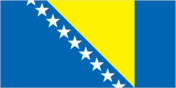
- a wide medium blue vertical band on the fly side with a yellow isosceles triangle abutting the band and the top of the flag; the remainder of the flag is medium blue with seven full five-pointed white stars and two half stars top and bottom along the hypotenuse of the triangle; the triangle approximates the shape of the country and its three points stand for the constituent peoples - Bosniaks, Croats, and Serbs; the stars represent Europe and are meant to be continuous (thus the half stars at top and bottom); the colors (white, blue, and yellow) are often associated with neutrality and peace, and traditionally are linked with Bosnia one of several flags where a prominent component of the design reflects the shape of the country; other such flags are those of Brazil, Eritrea, and Vanuatu
- note
- one of several flags where a prominent component of the design reflects the shape of the country; other such flags are those of Brazil, Eritrea, and Vanuatu
Government type
parliamentary republic
Independence
1 March 1992 (from Yugoslavia); note - referendum for independence completed on 1 March 1992; independence declared on 3 March 1992
International law organization participation
has not submitted an ICJ jurisdiction declaration; accepts ICCt jurisdiction
International organization participation
BIS, CD, CE, CEI, EAPC, EBRD, FAO, G-77, IAEA, IBRD, ICAO, ICC (NGOs), ICCt, ICRM, IDA, IFAD, IFC, IFRCS, ILO, IMF, IMO, IMSO, Interpol, IOC, IOM, IPU, ISO, ITSO, ITU, ITUC (NGOs), MIGA, MINUSMA, MONUSCO, NAM (observer), OAS (observer), OIC (observer), OIF (observer), OPCW, OSCE, PFP, SELEC, UN, UNCTAD, UNESCO, UNIDO, UNWTO, UPU, WCO, WHO, WIPO, WMO, WTO (observer)
Judicial branch
- BiH Constitutional Court (consists of 9 members); Court of BiH (consists of 44 national judges and 7 international judges organized into 3 divisions - Administrative, Appellate, and Criminal, which includes a War Crimes Chamber) BiH Constitutional Court judges - 4 selected by the Bosniak/Croat Federation's House of Representatives, 2 selected by the Republika Srpska's National Assembly, and 3 non-Bosnian judges selected by the president of the European Court of Human Rights; Court of BiH president and national judges appointed by the High Judicial and Prosecutorial Council; Court of BiH president appointed for renewable 6-year term; other national judges appointed to serve until age 70; international judges recommended by the president of the Court of BiH and appointed by the High Representative for Bosnia and Herzegovina; international judges appointed to serve until age 70 the Federation has 10 cantonal courts plus a number of municipal courts; the Republika Srpska has a supreme court, 5 district courts, and a number of municipal courts
- highest court(s)
- BiH Constitutional Court (consists of 9 members); Court of BiH (consists of 44 national judges and 7 international judges organized into 3 divisions - Administrative, Appellate, and Criminal, which includes a War Crimes Chamber)
- judge selection and term of office
- BiH Constitutional Court judges - 4 selected by the Bosniak/Croat Federation's House of Representatives, 2 selected by the Republika Srpska's National Assembly, and 3 non-Bosnian judges selected by the president of the European Court of Human Rights; Court of BiH president and national judges appointed by the High Judicial and Prosecutorial Council; Court of BiH president appointed for renewable 6-year term; other national judges appointed to serve until age 70; international judges recommended by the president of the Court of BiH and appointed by the High Representative for Bosnia and Herzegovina; international judges appointed to serve until age 70
- subordinate courts
- the Federation has 10 cantonal courts plus a number of municipal courts; the Republika Srpska has a supreme court, 5 district courts, and a number of municipal courts
Legal system
civil law system; Constitutional Court review of legislative acts
Legislative branch
- bicameral Parliamentary Assembly or Skupstina consists of the House of Peoples or Dom Naroda (15 seats - 5 Bosniak, 5 Croat, 5 Serb; members designated by the Federation of Bosnia and Herzegovina's House of Peoples and the Republika Srpska's National Assembly to serve 4-year terms) and the state-level House of Representatives or Predstavnicki Dom (42 seats to include 28 seats allocated to the Federation of Bosnia and Herzegovina and 14 to the Republika Srpska; members directly elected by proportional representation vote to serve 4-year terms); note - the Federation of Bosnia and Herzegovina has a bicameral legislature that consists of the House of Peoples (58 seats - 17 Bosniak, 17 Croat, 17 Serb, 7 other) and the House of Representatives (98 seats; members directly elected by proportional representation vote to serve 4-year terms); Republika Srpska's unicameral legislature is the National Assembly (83 directly elected delegates serve 4-year terms) House of Peoples - last constituted in 11 February 2015 (next likely to be constituted in 2019); state-level House of Representatives - election last held on 12 October 2014 (next to be held in October 2018) House of Peoples - percent of vote by party/coalition - NA; seats by party/coalition - NA; state-level House of Representatives - percent of vote by party/coalition - Federation votes: SDA 27.9%, DF 15.3%, SBB BiH 14.4%, Croat People's Assembly coalition or HNS (HDZ BiH-HSS-NHI-HKDU-HSP BiH-HSP HB) 12.2%, SDP 9.5%, HDZ-1990 4.1%, BPS-Sefer Halilovic 3.7%, A-SDA 2.3%, other 10.6%; Republika Srpska votes: SNSD 38.5%, SDS 32.6%, PDP-NDP 7.8%, DNS 5.7%, SDA 4.9%, other 10.5%; seats by party/coalition - SDA 10, SNSD 6, SDS 5, DF 5, SBB BiH 4, Croat People's Assembly coalition or HNS (HDZ BiH-HSS-NHI-HKDU-HSP BiH-HSP HB) 4, SDP 3, PDP-NDP 1, HDZ-1990 1, BPS-Sefer Halilovic 1, DNS 1, A-SDA 1
- description
- bicameral Parliamentary Assembly or Skupstina consists of the House of Peoples or Dom Naroda (15 seats - 5 Bosniak, 5 Croat, 5 Serb; members designated by the Federation of Bosnia and Herzegovina's House of Peoples and the Republika Srpska's National Assembly to serve 4-year terms) and the state-level House of Representatives or Predstavnicki Dom (42 seats to include 28 seats allocated to the Federation of Bosnia and Herzegovina and 14 to the Republika Srpska; members directly elected by proportional representation vote to serve 4-year terms); note - the Federation of Bosnia and Herzegovina has a bicameral legislature that consists of the House of Peoples (58 seats - 17 Bosniak, 17 Croat, 17 Serb, 7 other) and the House of Representatives (98 seats; members directly elected by proportional representation vote to serve 4-year terms); Republika Srpska's unicameral legislature is the National Assembly (83 directly elected delegates serve 4-year terms)
- election results
- House of Peoples - percent of vote by party/coalition - NA; seats by party/coalition - NA; state-level House of Representatives - percent of vote by party/coalition - Federation votes: SDA 27.9%, DF 15.3%, SBB BiH 14.4%, Croat People's Assembly coalition or HNS (HDZ BiH-HSS-NHI-HKDU-HSP BiH-HSP HB) 12.2%, SDP 9.5%, HDZ-1990 4.1%, BPS-Sefer Halilovic 3.7%, A-SDA 2.3%, other 10.6%; Republika Srpska votes: SNSD 38.5%, SDS 32.6%, PDP-NDP 7.8%, DNS 5.7%, SDA 4.9%, other 10.5%; seats by party/coalition - SDA 10, SNSD 6, SDS 5, DF 5, SBB BiH 4, Croat People's Assembly coalition or HNS (HDZ BiH-HSS-NHI-HKDU-HSP BiH-HSP HB) 4, SDP 3, PDP-NDP 1, HDZ-1990 1, BPS-Sefer Halilovic 1, DNS 1, A-SDA 1
- elections
- House of Peoples - last constituted in 11 February 2015 (next likely to be constituted in 2019); state-level House of Representatives - election last held on 12 October 2014 (next to be held in October 2018)
National anthem
- "Drzavna himna Bosne i Hercegovine" (The National Anthem of Bosnia and Herzegovina) none officially; Dusan SESTIC and Benjamin ISOVIC/Dusan SESTIC music adopted 1999; lyrics accepted 2009 but not yet approved
- lyrics/music
- none officially; Dusan SESTIC and Benjamin ISOVIC/Dusan SESTIC
- name
- "Drzavna himna Bosne i Hercegovine" (The National Anthem of Bosnia and Herzegovina)
- note
- music adopted 1999; lyrics accepted 2009 but not yet approved
National holiday
- National Day (Statehood Day), 25 November (1943); Independence Day, 1 March (1992); note - observed only in the Federation of Bosnia and Herzegovina Dayton Agreement Day, 21 November (2007); note - observed only in the Republika Srpska there is no national-level holiday
- note
- there is no national-level holiday
National symbol(s)
- golden lily; national colors: blue, yellow, white
- golden lily; national colors
- blue, yellow, white
Political parties and leaders
Alliance for a Better Future of BiH or SBB BiH [Fahrudin RADONCIC] Alliance of Independent Social Democrats or SNSD [Milorad DODIK] Alternative Party for Democratic Activity or A-SDA [Nermin OGRESEVIC] Bosnian-Herzegovinian Patriotic Party-Sefer Halilovic or BPS-Sefer Halilovic [Sefer HALILOVIC] Croat Peasants' Party or HSS [Mario KARAMATIC] Croatian Christian Democratic Union of Bosnia and Herzegovina or HKDU [Ivan MUSA] Croatian Democratic Union of Bosnia and Herzegovina or HDZ-BiH [Dragan COVIC] Croatian Democratic Union 1990 or HDZ-1990 [acting president Ilija CVITANOVIC] Croatian Party of Rights or HSP BiH [Stanko PRIMORAC] Croatian Party of Rights of Herceg-Bosne or HSP HB [Vesna PINJUH] Croatian People's Party-Liberal Democrats or HNS [Ivan VRDOLJAK] Democratic Front of DF [Zeljko KOMSIC] Democratic Peoples' Alliance or DNS [Marko PAVIC] Party for Democratic Action or SDA [Bakir IZETBEGOVIC] Party of Democratic Progress or PDP [Branislav BORENOVIC] People's Democratic Movement or NDP [Dragan CAVIC] Serb Democratic Party or SDS [Mladen BOSIC] Social Democratic Party or SDP [Nermin NIKSIC]
Political pressure groups and leaders
- war veterans; displaced persons associations; family associations of missing persons; private media
- other
- war veterans; displaced persons associations; family associations of missing persons; private media
Suffrage
18 years of age, 16 if employed; universal
Economy
Agriculture - products
wheat, corn, fruits, vegetables; livestock
Budget
- $7.606 billion $7.933 billion (2015 est.)
- expenditures
- $7.933 billion (2015 est.)
- revenues
- $7.606 billion
Budget surplus (+) or deficit (-)
-2.1% of GDP (2015 est.)
Commercial bank prime lending rate
5.79% (31 December 2015 est.) 6.64% (31 December 2014 est.)
Current account balance
-$1.078 billion (2015 est.) -$1.45 billion (2014 est.)
Debt - external
$9.597 billion (31 December 2015 est.) $10.59 billion (31 December 2014 est.)
Distribution of family income - Gini index
36.2 (2007)
Economy - overview
- Bosnia has a transitional economy with limited market reforms. The economy relies heavily on the export of metals, energy, textiles, and furniture as well as on remittances and foreign aid. A highly decentralized government hampers economic policy coordination and reform, while excessive bureaucracy and a segmented market discourage foreign investment. Foreign banks, primarily from Austria and Italy, now control most of the banking sector. The konvertibilna marka (convertible mark or BAM) - the national currency introduced in 1998 - is pegged to the euro, and confidence in the currency and the banking sector has remained stable. Interethnic warfare in Bosnia and Herzegovina caused production to plummet by 80% from 1992 to 1995 and unemployment to soar, but the economy made progress until 2008, when the global economic crisis caused a downturn. Bosnia and Herzegovina became a full member of the Central European Free Trade Agreement in September 2007. Bosnia's private sector is growing slowly, but foreign investment has dropped sharply since 2007. Government spending - including transfer payments - remains high, at roughly 40% of GDP, because of redundant government offices at the national, sub-national, and municipal level. High unemployment remains the most serious macroeconomic problem. Successful implementation of a value-added tax in 2006 provided a steady source of revenue for the government and helped rein in gray-market activity. National-level statistics have also improved over time but a large share of economic activity remains unofficial and unrecorded. Bosnia and Herzegovina's top economic priorities are: acceleration of integration into the EU; strengthening the fiscal system; public administration reform; World Trade Organization membership; and securing economic growth by fostering a dynamic, competitive private sector.
- Bosnia and Herzegovina's top economic priorities are
- acceleration of integration into the EU; strengthening the fiscal system; public administration reform; World Trade Organization membership; and securing economic growth by fostering a dynamic, competitive private sector.
Exchange rates
konvertibilna markas (BAM) per US dollar - 1.7626 (2015 est.) 1.4742 (2014 est.) 1.4718 (2013 est.) 1.52 (2012 est.) 1.407 (2011 est.)
Exports
$3.95 billion (2015 est.) $4.489 billion (2014 est.)
Exports - commodities
metals, clothing, wood products
Exports - partners
Slovenia 16.5%, Italy 15.9%, Germany 12.1%, Croatia 11.5%, Austria 11.1%, Turkey 5.2% (2015)
Fiscal year
calendar year
GDP - composition, by end use
- 80.9% 21.5% 18.6% 1.3% 32.8% -55.1% (2014 est.)
- exports of goods and services
- 32.8%
- government consumption
- 21.5%
- household consumption
- 80.9%
- imports of goods and services
- -55.1% (2014 est.)
- investment in fixed capital
- 18.6%
- investment in inventories
- 1.3%
GDP - composition, by sector of origin
- 7.9% 26.5% 65.6% (2015 est.)
- agriculture
- 7.9%
- industry
- 26.5%
- services
- 65.6% (2015 est.)
GDP - per capita (PPP)
- $10,500 (2015 est.) $10,200 (2014 est.) $10,100 (2013 est.) data are in 2015 US dollars
- note
- data are in 2015 US dollars
GDP - real growth rate
2.8% (2015 est.) 1.1% (2014 est.) 2.4% (2013 est.)
GDP (official exchange rate)
$15.79 billion (2015 est.)
GDP (purchasing power parity)
- $40.53 billion (2015 est.) $39.43 billion (2014 est.) $39.01 billion (2013 est.) data are in 2015 US dollars
- note
- data are in 2015 US dollars
Gross national saving
10.4% of GDP (2015 est.) 10.8% of GDP (2014 est.) 11.9% of GDP (2013 est.)
Household income or consumption by percentage share
- 2.7% 27.3% (2007)
- highest 10%
- 27.3% (2007)
- lowest 10%
- 2.7%
Imports
$8.173 billion (2015 est.) $9.982 billion (2014 est.)
Imports - commodities
machinery and equipment, chemicals, fuels, foodstuffs
Imports - partners
Croatia 19.3%, Germany 13.9%, Slovenia 13.8%, Italy 10.9%, Austria 5.7%, Hungary 5.2%, Turkey 4.5% (2015)
Industrial production growth rate
3.2% (2015 est.)
Industries
steel, coal, iron ore, lead, zinc, manganese, bauxite, aluminum, motor vehicle assembly, textiles, tobacco products, wooden furniture, ammunition, domestic appliances, oil refining
Inflation rate (consumer prices)
-1% (2015 est.) -0.9% (2014 est.)
Labor force
1.47 million (2015 est.)
Labor force - by occupation
- 19% 30% 51% (2013)
- agriculture
- 19%
- industry
- 30%
- services
- 51% (2013)
Market value of publicly traded shares
$NA
Population below poverty line
17.2% (2011 est.)
Public debt
- 46.1% of GDP (2015 est.) 44.8% of GDP (2014 est.) data cover general government debt and include debt instruments issued (or owned) by government entities other than the treasury; the data include treasury debt held by foreign entities; the data include debt issued by subnational entities, as well as intra-governmental debt; intra-governmental debt consists of treasury borrowings from surpluses in the social funds, such as for retirement, medical care, and unemployment; debt instruments for the social funds are not sold at public auctions
- note
- data cover general government debt and include debt instruments issued (or owned) by government entities other than the treasury; the data include treasury debt held by foreign entities; the data include debt issued by subnational entities, as well as intra-governmental debt; intra-governmental debt consists of treasury borrowings from surpluses in the social funds, such as for retirement, medical care, and unemployment; debt instruments for the social funds are not sold at public auctions
Reserves of foreign exchange and gold
$4.791 billion (31 December 2015 est.) $4.858 billion (31 December 2014 est.)
Stock of broad money
$9.223 billion (31 December 2015 est.) $10.72 billion (31 December 2014 est.)
Stock of direct foreign investment - abroad
$0 (2014)
Stock of direct foreign investment - at home
$7.92 billion (2014 est.) $7.721 billion (2013 est.)
Stock of domestic credit
$9.389 billion (31 December 2015 est.) $10.23 billion (31 December 2014 est.)
Stock of narrow money
$4.554 billion (31 December 2015 est.) $4.538 billion (31 December 2014 est.)
Taxes and other revenues
48.2% of GDP (2015 est.)
Unemployment rate
- 43.2% (2015 est.) 43.9% (2014 est.) official rate; actual rate is lower as many technically unemployed persons work in the gray economy
- note
- official rate; actual rate is lower as many technically unemployed persons work in the gray economy
Energy
Carbon dioxide emissions from consumption of energy
17 million Mt (2013 est.)
Crude oil - exports
0 bbl/day (2013 est.)
Crude oil - imports
20,690 bbl/day (2013 est.)
Crude oil - production
0 bbl/day (2015 est.)
Crude oil - proved reserves
0 bbl (1 January 2016 es)
Electricity - consumption
11 billion kWh (2014 est.)
Electricity - exports
6 billion kWh (2014 est.)
Electricity - from fossil fuels
54.8% of total installed capacity (2013 est.)
Electricity - from hydroelectric plants
43.6% of total installed capacity (2013 est.)
Electricity - from nuclear fuels
0% of total installed capacity (2013 est.)
Electricity - from other renewable sources
1.5% of total installed capacity (2013 est.)
Electricity - imports
3.2 billion kWh (2014 est.)
Electricity - installed generating capacity
4.3 million kW (2014 est.)
Electricity - production
15 billion kWh (2014 est.)
Electricity access
- 100% (2016)
- electrification - total population
- 100% (2016)
Natural gas - consumption
169 million cu m (2014 est.)
Natural gas - exports
0 cu m (2014 est.)
Natural gas - imports
169 million cu m (2014 est.)
Natural gas - production
0 cu m (2014 est.)
Natural gas - proved reserves
0 cu m (1 January 2014 es)
Refined petroleum products - consumption
30,000 bbl/day (2014 est.)
Refined petroleum products - exports
5,342 bbl/day (2013 est.)
Refined petroleum products - imports
15,230 bbl/day (2013 est.)
Refined petroleum products - production
20,280 bbl/day (2013 est.)
Communications
Broadcast media
- 3 public TV broadcasters: Radio and TV of Bosnia and Herzegovina, Federation TV (operating 2 networks), and Republika Srpska Radio-TV; a local commercial network of 5 TV stations; 3 private, near-national TV stations and dozens of small independent TV broadcasting stations; 3 large public radio broadcasters and many private radio stations (2010)
- 3 public TV broadcasters
- Radio and TV of Bosnia and Herzegovina, Federation TV (operating 2 networks), and Republika Srpska Radio-TV; a local commercial network of 5 TV stations; 3 private, near-national TV stations and dozens of small independent TV broadcasting stations; 3 large public radio broadcasters and many private radio stations (2010)
Internet country code
.ba
Internet users
- 2.516 million 65.1% (July 2015 est.)
- percent of population
- 65.1% (July 2015 est.)
- total
- 2.516 million
Telephone system
- post-war reconstruction of the telecommunications network, aided by an internationally sponsored program, resulted in sharp increases in fixed-line telephone availability fixed-line teledensity roughly 20 per 100 persons; mobile-cellular subscribership has been increasing rapidly and stands at roughly 90 telephones per 100 persons country code - 387; no satellite earth stations (2015)
- domestic
- fixed-line teledensity roughly 20 per 100 persons; mobile-cellular subscribership has been increasing rapidly and stands at roughly 90 telephones per 100 persons
- general assessment
- post-war reconstruction of the telecommunications network, aided by an internationally sponsored program, resulted in sharp increases in fixed-line telephone availability
- international
- country code - 387; no satellite earth stations (2015)
Telephones - fixed lines
- 771,684 20 (July 2015 est.)
- subscriptions per 100 inhabitants
- 20 (July 2015 est.)
- total subscriptions
- 771,684
Telephones - mobile cellular
- 3.444 million 89 (July 2015 est.)
- subscriptions per 100 inhabitants
- 89 (July 2015 est.)
- total
- 3.444 million
Transportation
Airports
24 (2013)
Airports - with paved runways
- 2 (2013)
- 1,524 to 2,437 m
- 1
- 2,438 to 3,047 m
- 4
- total
- 7
- under 914 m
- 2 (2013)
Airports - with unpaved runways
- 11 (2013)
- 1,524 to 2,437 m
- 1
- 914 to 1,523 m
- 5
- total
- 17
- under 914 m
- 11 (2013)
Civil aircraft registration country code prefix
T9 (2016)
Heliports
6 (2013)
National air transport system
- 7,070 87 mt-km (2015)
- annual freight traffic on registered air carriers
- 87 mt-km (2015)
- annual passenger traffic on registered air carriers
- 7,070
- inventory of registered aircraft operated by air carriers
- 1
- number of registered air carriers
- 1
Pipelines
gas 147 km; oil 9 km (2013)
Ports and terminals
- Bosanska Gradiska, Bosanski Brod, Bosanski Samac, Brcko, Orasje (Sava River)
- river port(s)
- Bosanska Gradiska, Bosanski Brod, Bosanski Samac, Brcko, Orasje (Sava River)
Railways
- 965 km 965 km 1.435-m gauge (565 km electrified) (2014)
- standard gauge
- 965 km 1.435-m gauge (565 km electrified) (2014)
- total
- 965 km
Roadways
- 22,926 km 19,426 km (4,652 km of interurban roads) 3,500 km (2010)
- paved
- 19,426 km (4,652 km of interurban roads)
- total
- 22,926 km
- unpaved
- 3,500 km (2010)
Waterways
(Sava River on northern border; open to shipping but use limited) (2011)
Military and Security
Military branches
- Armed Forces of Bosnia and Herzegovina (Oruzanih Snaga Bosne i Hercegovine, OSBiH): Army of Bosnia and Herzegovina, Air Force and Air Defense (Brigada Zracnih Snaga i Protuzracne Odbrane, br ZSiPZO), Tactical Support Brigade (Brigada Takticke Podrske, br TP) (2015)
- Armed Forces of Bosnia and Herzegovina (Oruzanih Snaga Bosne i Hercegovine, OSBiH)
- Army of Bosnia and Herzegovina, Air Force and Air Defense (Brigada Zracnih Snaga i Protuzracne Odbrane, br ZSiPZO), Tactical Support Brigade (Brigada Takticke Podrske, br TP) (2015)
Military expenditures
0.98% of GDP (2014) 1.04% of GDP (2013) 1.35% of GDP (2012) 1.15% of GDP (2011) 1.35% of GDP (2010)
Military service age and obligation
18 years of age for voluntary military service; mandatory retirement at age 35 or after 15 years of service for E-1 through E-4, mandatory retirement at age 50 and 30 years of service for E-5 through E-9, mandatory retirement at age 55 and 30 years of service for all officers (2014)
Transnational Issues
Disputes - international
Serbia delimited about half of the boundary with Bosnia and Herzegovina, but sections along the Drina River remain in dispute
Illicit drugs
increasingly a transit point for heroin being trafficked to Western Europe; minor transit point for marijuana; remains highly vulnerable to money-laundering activity given a primarily cash-based and unregulated economy, weak law enforcement, and instances of corruption
Refugees and internally displaced persons
- 6,679 (Croatia) (2015) 98,324 (Bosnian Croats, Serbs, and Bosniaks displaced by inter-ethnic violence, human rights violations, and armed conflict during the 1992-1995 war) (2015) 58 (2015)
- IDPs
- 98,324 (Bosnian Croats, Serbs, and Bosniaks displaced by inter-ethnic violence, human rights violations, and armed conflict during the 1992-1995 war) (2015)
- refugees (country of origin)
- 6,679 (Croatia) (2015)
- stateless persons
- 58 (2015)