2017 Edition
CIA World Factbook 2017 Archive (HTML)
Introduction
Background
Once the center of power for the large Austro-Hungarian Empire, Austria was reduced to a small republic after its defeat in World War I. Following annexation by Nazi Germany in 1938 and subsequent occupation by the victorious Allies in 1945, Austria's status remained unclear for a decade. A State Treaty signed in 1955 ended the occupation, recognized Austria's independence, and forbade unification with Germany. A constitutional law that same year declared the country's "perpetual neutrality" as a condition for Soviet military withdrawal. The Soviet Union's collapse in 1991 and Austria's entry into the EU in 1995 have altered the meaning of this neutrality. A prosperous, democratic country, Austria entered the EU Economic and Monetary Union in 1999.
Geography
Area
- 83,871 sq km 82,445 sq km 1,426 sq km
- land
- 82,445 sq km
- total
- 83,871 sq km
- water
- 1,426 sq km
Area - comparative
about the size of South Carolina; slightly more than two-thirds the size of Pennsylvania
Climate
temperate; continental, cloudy; cold winters with frequent rain and some snow in lowlands and snow in mountains; moderate summers with occasional showers
Coastline
0 km (landlocked)
Elevation
- 910 m lowest point: Neusiedler See 115 m highest point: Grossglockner 3,798 m
- elevation extremes
- lowest point: Neusiedler See 115 m
- highest point
- Grossglockner 3,798 m
- mean elevation
- 910 m
Environment - current issues
some forest degradation caused by air and soil pollution; soil pollution results from the use of agricultural chemicals; air pollution results from emissions by coal- and oil-fired power stations and industrial plants and from trucks transiting Austria between northern and southern Europe
Environment - international agreements
- Air Pollution, Air Pollution-Nitrogen Oxides, Air Pollution-Persistent Organic Pollutants, Air Pollution-Sulfur 85, Air Pollution-Sulphur 94, Air Pollution-Volatile Organic Compounds, Antarctic Treaty, Biodiversity, Climate Change, Climate Change-Kyoto Protocol, Desertification, Endangered Species, Environmental Modification, Hazardous Wastes, Law of the Sea, Ozone Layer Protection, Ship Pollution, Tropical Timber 83, Tropical Timber 94, Wetlands, Whaling none of the selected agreements
- party to
- Air Pollution, Air Pollution-Nitrogen Oxides, Air Pollution-Persistent Organic Pollutants, Air Pollution-Sulfur 85, Air Pollution-Sulphur 94, Air Pollution-Volatile Organic Compounds, Antarctic Treaty, Biodiversity, Climate Change, Climate Change-Kyoto Protocol, Desertification, Endangered Species, Environmental Modification, Hazardous Wastes, Law of the Sea, Ozone Layer Protection, Ship Pollution, Tropical Timber 83, Tropical Timber 94, Wetlands, Whaling
- signed, but not ratified
- none of the selected agreements
Geographic coordinates
47 20 N, 13 20 E
Geography - note
landlocked; strategic location at the crossroads of central Europe with many easily traversable Alpine passes and valleys; major river is the Danube; population is concentrated on eastern lowlands because of steep slopes, poor soils, and low temperatures elsewhere
Irrigated land
1,170 sq km (2012)
Land boundaries
- 2,524 km Czech Republic 402 km, Germany 801 km, Hungary 321 km, Italy 404 km, Liechtenstein 34 km, Slovakia 105 km, Slovenia 299 km, Switzerland 158 km
- border countries (8)
- Czech Republic 402 km, Germany 801 km, Hungary 321 km, Italy 404 km, Liechtenstein 34 km, Slovakia 105 km, Slovenia 299 km, Switzerland 158 km
- total
- 2,524 km
Land use
- 38.4% arable land 16.5%; permanent crops 0.8%; permanent pasture 21.1% 47.2% 14.4% (2011 est.)
- agricultural land
- 38.4%
- forest
- 47.2%
- other
- 14.4% (2011 est.)
Location
Central Europe, north of Italy and Slovenia
Map references
Europe
Maritime claims
none (landlocked)
Natural hazards
landslides; avalanches; earthquakes
Natural resources
oil, coal, lignite, timber, iron ore, copper, zinc, antimony, magnesite, tungsten, graphite, salt, hydropower
Population - distribution
the northern and eastern portions of the country are more densely populated; nearly two-thirds of the populace lives in urban areas
Terrain
mostly mountains (Alps) in the west and south; mostly flat or gently sloping along the eastern and northern margins
People and Society
Age structure
- 14.01% (male 628,205/female 598,519) 11.07% (male 494,016/female 475,500) 42.42% (male 1,856,532/female 1,856,937) 13.23% (male 574,570/female 584,022) 19.26% (male 731,126/female 954,986) (2017 est.)
- 0-14 years
- 14.01% (male 628,205/female 598,519)
- 15-24 years
- 11.07% (male 494,016/female 475,500)
- 25-54 years
- 42.42% (male 1,856,532/female 1,856,937)
- 55-64 years
- 13.23% (male 574,570/female 584,022)
- 65 years and over
- 19.26% (male 731,126/female 954,986) (2017 est.)
Birth rate
9.5 births/1,000 population (2017 est.)
Contraceptive prevalence rate
- 65.7% percent of women aged 18-49 (2012/13)
- note
- percent of women aged 18-49 (2012/13)
Death rate
9.6 deaths/1,000 population (2017 est.)
Dependency ratios
- 49.2 21.1 28.1 3.6 (2015 est.)
- elderly dependency ratio
- 28.1
- potential support ratio
- 3.6 (2015 est.)
- total dependency ratio
- 49.2
- youth dependency ratio
- 21.1
Drinking water source
- urban: 100% of population rural: 100% of population total: 100% of population urban: 0% of population rural: 0% of population total: 0% of population (2015 est.)
- rural
- 0% of population
- total
- 0% of population (2015 est.)
- urban
- 0% of population
Education expenditures
5.6% of GDP (2013)
Ethnic groups
Austrians 91.1%, former Yugoslavs 4% (includes Croatians, Slovenes, Serbs, and Bosniaks), Turks 1.6%, Germans 0.9%, other or unspecified 2.4% (2001 census)
Health expenditures
11.2% of GDP (2014)
HIV/AIDS - adult prevalence rate
NA
HIV/AIDS - deaths
NA
HIV/AIDS - people living with HIV/AIDS
NA
Hospital bed density
7.6 beds/1,000 population (2011)
Infant mortality rate
- 3.4 deaths/1,000 live births 3.8 deaths/1,000 live births 3 deaths/1,000 live births (2017 est.)
- female
- 3 deaths/1,000 live births (2017 est.)
- male
- 3.8 deaths/1,000 live births
- total
- 3.4 deaths/1,000 live births
Languages
German (official nationwide) 88.6%, Turkish 2.3%, Serbian 2.2%, Croatian (official in Burgenland) 1.6%, other (includes Slovene, official in South Carinthia, and Hungarian, official in Burgenland) 5.3% (2001 est.)
Life expectancy at birth
- 81.6 years 78.9 years 84.4 years (2017 est.)
- female
- 84.4 years (2017 est.)
- male
- 78.9 years
- total population
- 81.6 years
Major urban areas - population
VIENNA (capital) 1.753 million (2015)
Maternal mortality ratio
4 deaths/100,000 live births (2015 est.)
Median age
- 44 years 42.8 years 45.1 years (2017 est.)
- female
- 45.1 years (2017 est.)
- male
- 42.8 years
- total
- 44 years
Mother's mean age at first birth
29 years (2014 est.)
Nationality
- Austrian(s) Austrian
- adjective
- Austrian
- noun
- Austrian(s)
Net migration rate
4.8 migrant(s)/1,000 population (2017 est.)
Obesity - adult prevalence rate
20.1% (2016)
Physicians density
5.15 physicians/1,000 population (2015)
Population
8,754,413 (July 2017 est.)
Population distribution
the northern and eastern portions of the country are more densely populated; nearly two-thirds of the populace lives in urban areas
Population growth rate
0.47% (2017 est.)
Religions
Catholic 73.8% (includes Roman Catholic 73.6%, other Catholic 0.2%), Protestant 4.9%, Muslim 4.2%, Orthodox 2.2%, other 0.8% (includes other Christian), none 12%, unspecified 2% (2001 est.)
Sanitation facility access
- urban: 100% of population rural: 100% of population total: 100% of population urban: 0% of population rural: 0% of population total: 0% of population (2015 est.)
- rural
- 0% of population
- total
- 0% of population (2015 est.)
- urban
- 0% of population
School life expectancy (primary to tertiary education)
- 16 years 16 years 16 years (2015)
- female
- 16 years (2015)
- male
- 16 years
- total
- 16 years
Sex ratio
- 1.05 male(s)/female 1.05 male(s)/female 1.04 male(s)/female 1 male(s)/female 0.98 male(s)/female 0.76 male(s)/female 0.96 male(s)/female (2016 est.)
- 0-14 years
- 1.05 male(s)/female
- 15-24 years
- 1.04 male(s)/female
- 25-54 years
- 1 male(s)/female
- 55-64 years
- 0.98 male(s)/female
- 65 years and over
- 0.76 male(s)/female
- at birth
- 1.05 male(s)/female
- total population
- 0.96 male(s)/female (2016 est.)
Total fertility rate
1.47 children born/woman (2017 est.)
Unemployment, youth ages 15-24
- 10.6% 11.1% 10% (2015 est.)
- female
- 10% (2015 est.)
- male
- 11.1%
- total
- 10.6%
Urbanization
- 66.1% of total population (2017) 0.51% annual rate of change (2015-20 est.)
- rate of urbanization
- 0.51% annual rate of change (2015-20 est.)
- urban population
- 66.1% of total population (2017)
Government
Administrative divisions
9 states (Bundeslaender, singular - Bundesland); Burgenland, Kaernten (Carinthia), Niederoesterreich (Lower Austria), Oberoesterreich (Upper Austria), Salzburg, Steiermark (Styria), Tirol (Tyrol), Vorarlberg, Wien (Vienna)
Capital
- Vienna 48 12 N, 16 22 E UTC+1 (6 hours ahead of Washington, DC, during Standard Time) +1hr, begins last Sunday in March; ends last Sunday in October
- daylight saving time
- +1hr, begins last Sunday in March; ends last Sunday in October
- geographic coordinates
- 48 12 N, 16 22 E
- name
- Vienna
- time difference
- UTC+1 (6 hours ahead of Washington, DC, during Standard Time)
Citizenship
- no at least one parent must be a citizen of Austria no 10 years
- citizenship by birth
- no
- citizenship by descent only
- at least one parent must be a citizen of Austria
- dual citizenship recognized
- no
- residency requirement for naturalization
- 10 years
Constitution
- several previous; latest adopted 1 October 1920, revised 1929, replaced May 1934 (authoritarian corporate state), replaced by German Weimar constitution in 1938 following German annexation, reinstated 1 May 1945 proposed through laws designated “constitutional laws” or through the constitutional process if the amendment is part of another law; approval required by at least a two-thirds majority vote by the National Assembly if one-half of the members are present; a referendum is required only if requested by one-third of the National Council or Federal Council membership; passage by referendum requires absolute majority vote; amended many times, last in 2014 (2016)
- amendments
- proposed through laws designated “constitutional laws” or through the constitutional process if the amendment is part of another law; approval required by at least a two-thirds majority vote by the National Assembly if one-half of the members are present; a referendum is required only if requested by one-third of the National Council or Federal Council membership; passage by referendum requires absolute majority vote; amended many times, last in 2014 (2016)
- history
- several previous; latest adopted 1 October 1920, revised 1929, replaced May 1934 (authoritarian corporate state), replaced by German Weimar constitution in 1938 following German annexation, reinstated 1 May 1945
Country name
- Republic of Austria Austria Republik Oesterreich Oesterreich the name Oesterreich means "eastern realm" or "eastern march" and dates to the 10th century; the designation refers to the fact that Austria was the easternmost extension of Bavaria, and, in fact, of all the Germans; the word Austria is a Latinization of the German name
- conventional long form
- Republic of Austria
- conventional short form
- Austria
- etymology
- the name Oesterreich means "eastern realm" or "eastern march" and dates to the 10th century; the designation refers to the fact that Austria was the easternmost extension of Bavaria, and, in fact, of all the Germans; the word Austria is a Latinization of the German name
- local long form
- Republik Oesterreich
- local short form
- Oesterreich
Diplomatic representation from the US
- Ambassador (vacant); Charge d'Affaires Eugene YOUNG (since 20 January 2017) Boltzmanngasse 16, A-1090, Vienna use embassy street address [43] (1) 31339-0 [43] (1) 3100682
- chief of mission
- Ambassador (vacant); Charge d'Affaires Eugene YOUNG (since 20 January 2017)
- embassy
- Boltzmanngasse 16, A-1090, Vienna
- FAX
- [43] (1) 3100682
- mailing address
- use embassy street address
- telephone
- [43] (1) 31339-0
Diplomatic representation in the US
- Ambassador Wolfgang WALDNER (since 28 January 2016) 3524 International Court NW, Washington, DC 20008-3035 [1] (202) 895-6700 [1] (202) 895-6750 Los Angeles, New York Chicago
- chancery
- 3524 International Court NW, Washington, DC 20008-3035
- chief of mission
- Ambassador Wolfgang WALDNER (since 28 January 2016)
- consulate(s)
- Chicago
- consulate(s) general
- Los Angeles, New York
- FAX
- [1] (202) 895-6750
- telephone
- [1] (202) 895-6700
Executive branch
- Alexander VAN DER BELLEN (since 26 January 2017) Chancellor Sebastian KURZ (since 18 December 2017); Vice Chancellor Heinz-Christian STRACHE (since 18 December 2017) Council of Ministers chosen by the president on the advice of the chancellor president directly elected by absolute majority popular vote in 2 rounds if needed for a 6-year term (eligible for a second term); elections last held on 24 April 2016 (first round), 22 May 2016 (second round, which was annulled), and 4 December 2016 (second round re-vote); next election to be held in April 2022; chancellor appointed by the president but determined by the majority coalition parties in the Federal Assembly; vice chancellor appointed by the president on the advice of the chancellor Alexander VAN DER BELLEN elected in second round; percent of vote in first round - Norbet HOFER (FPOe) 35.1%, Alexander VAN DER BELLEN (independent, allied with the Greens) 21.3%, Irmgard GRISS (independent) 18.9%, Rudolf HUNDSTORFER (SPOe) 11.3%, Andreas KHOL (OeVP) 11.1%, Richard LUGNER (independent) 2.3%; percent of vote in second round - Alexander VAN DER BELLEN 53.8%, Norbet HOFER 46.2%
- cabinet
- Council of Ministers chosen by the president on the advice of the chancellor
- chief of state
- Alexander VAN DER BELLEN (since 26 January 2017)
- election results
- Alexander VAN DER BELLEN elected in second round; percent of vote in first round - Norbet HOFER (FPOe) 35.1%, Alexander VAN DER BELLEN (independent, allied with the Greens) 21.3%, Irmgard GRISS (independent) 18.9%, Rudolf HUNDSTORFER (SPOe) 11.3%, Andreas KHOL (OeVP) 11.1%, Richard LUGNER (independent) 2.3%; percent of vote in second round - Alexander VAN DER BELLEN 53.8%, Norbet HOFER 46.2%
- elections/appointments
- president directly elected by absolute majority popular vote in 2 rounds if needed for a 6-year term (eligible for a second term); elections last held on 24 April 2016 (first round), 22 May 2016 (second round, which was annulled), and 4 December 2016 (second round re-vote); next election to be held in April 2022; chancellor appointed by the president but determined by the majority coalition parties in the Federal Assembly; vice chancellor appointed by the president on the advice of the chancellor
- head of government
- Chancellor Sebastian KURZ (since 18 December 2017); Vice Chancellor Heinz-Christian STRACHE (since 18 December 2017)
Flag description
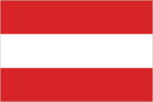
three equal horizontal bands of red (top), white, and red; the flag design is certainly one of the oldest - if not the oldest - national banners in the world; according to tradition, in 1191, following a fierce battle in the Third Crusade, Duke Leopold V of Austria's white tunic became completely blood-spattered; upon removal of his wide belt or sash, a white band was revealed; the red-white-red color combination was subsequently adopted as his banner
Government type
federal parliamentary republic
Independence
- 12 November 1918 (republic proclaimed); notable earlier dates: 976 (Margravate of Austria established); 17 September 1156 (Duchy of Austria founded); 11 August 1804 (Austrian Empire proclaimed)
- 12 November 1918 (republic proclaimed); notable earlier dates
- 976 (Margravate of Austria established); 17 September 1156 (Duchy of Austria founded); 11 August 1804 (Austrian Empire proclaimed)
International law organization participation
accepts compulsory ICJ jurisdiction; accepts ICCt jurisdiction
International organization participation
ADB (nonregional member), AfDB (nonregional member), Australia Group, BIS, BSEC (observer), CD, CE, CEI, CERN, EAPC, EBRD, ECB, EIB, EMU, ESA, EU, FAO, FATF, G-9, IADB, IAEA, IBRD, ICAO, ICC (national committees), ICCt, ICRM, IDA, IEA, IFAD, IFC, IFRCS, IGAD (partners), ILO, IMF, IMO, Interpol, IOC, IOM, IPU, ISO, ITSO, ITU, ITUC (NGOs), MIGA, MINURSO, NEA, NSG, OAS (observer), OECD, OIF (observer), OPCW, OSCE, Paris Club, PCA, PFP, Schengen Convention, SELEC (observer), UN, UNCTAD, UNESCO, UNFICYP, UNHCR, UNIDO, UNIFIL, UNTSO, UNWTO, UPU, WCO, WFTU (NGOs), WHO, WIPO, WMO, WTO, ZC
Judicial branch
- Supreme Court of Justice or Oberster Gerichtshof (consists of 85 judges organized into 17 senates or panels of 5 judges each); Constitutional Court or Verfassungsgerichtshof (consists of 20 judges including 6 substitutes; Administrative Court or Verwaltungsgerichtshof - 2 judges plus other members depending on the importance of the case) Supreme Court judges nominated by executive branch departments and appointed by the president; judges serve for life; Constitutional Court judges nominated by several executive branch departments and approved by the president; judges serve for life; Administrative Court judges recommended by executive branch departments and appointed by the president; terms of judges and members determined by the president Courts of Appeal (4); Regional Courts (20); district courts (120); county courts
- highest court(s)
- Supreme Court of Justice or Oberster Gerichtshof (consists of 85 judges organized into 17 senates or panels of 5 judges each); Constitutional Court or Verfassungsgerichtshof (consists of 20 judges including 6 substitutes; Administrative Court or Verwaltungsgerichtshof - 2 judges plus other members depending on the importance of the case)
- judge selection and term of office
- Supreme Court judges nominated by executive branch departments and appointed by the president; judges serve for life; Constitutional Court judges nominated by several executive branch departments and approved by the president; judges serve for life; Administrative Court judges recommended by executive branch departments and appointed by the president; terms of judges and members determined by the president
- subordinate courts
- Courts of Appeal (4); Regional Courts (20); district courts (120); county courts
Legal system
civil law system; judicial review of legislative acts by the Constitutional Court
Legislative branch
- bicameral Federal Assembly or Bundesversammlung consists of the Federal Council or Bundesrat (62 seats; members appointed by state parliaments with each state receiving 3 to 12 seats in proportion to its population; members serve 5- or 6-year terms) and the National Council or Nationalrat (183 seats; members directly elected in single-seat constituencies by proportional representation vote; members serve 5-year terms) National Council - last held on 15 October 2017 (next to be held in 2022); note - an early election was called after the coalition government collapsed National Council - percent of vote by party - OeVP 31.5%, SPOe 26.9%, FPOe 26%, NEOS 5.3%, PILZ 4.4%, other 5.9%; seats by party - OeVP 62, SPOe 62, FPOe 51, NEOS 10, PILZ 8
- description
- bicameral Federal Assembly or Bundesversammlung consists of the Federal Council or Bundesrat (62 seats; members appointed by state parliaments with each state receiving 3 to 12 seats in proportion to its population; members serve 5- or 6-year terms) and the National Council or Nationalrat (183 seats; members directly elected in single-seat constituencies by proportional representation vote; members serve 5-year terms)
- election results
- National Council - percent of vote by party - OeVP 31.5%, SPOe 26.9%, FPOe 26%, NEOS 5.3%, PILZ 4.4%, other 5.9%; seats by party - OeVP 62, SPOe 62, FPOe 51, NEOS 10, PILZ 8
- elections
- National Council - last held on 15 October 2017 (next to be held in 2022); note - an early election was called after the coalition government collapsed
National anthem
- "Bundeshymne" (Federal Hymn) Paula von PRERADOVIC/Wolfgang Amadeus MOZART or Johann HOLZER (disputed) adopted 1947; the anthem is also known as "Land der Berge, Land am Strome" (Land of the Mountains, Land by the River); Austria adopted a new national anthem after World War II to replace the former imperial anthem composed by Franz Josef HAYDN, which had been appropriated by Germany in 1922 and was thereafter associated with the Nazi regime; a gendered version of the lyrics was adopted by the Austrian Federal Assembly in fall 2011 and became effective 1 January 2012
- lyrics/music
- Paula von PRERADOVIC/Wolfgang Amadeus MOZART or Johann HOLZER (disputed)
- name
- "Bundeshymne" (Federal Hymn)
- note
- adopted 1947; the anthem is also known as "Land der Berge, Land am Strome" (Land of the Mountains, Land by the River); Austria adopted a new national anthem after World War II to replace the former imperial anthem composed by Franz Josef HAYDN, which had been appropriated by Germany in 1922 and was thereafter associated with the Nazi regime; a gendered version of the lyrics was adopted by the Austrian Federal Assembly in fall 2011 and became effective 1 January 2012
National holiday
National Day (commemorates passage of the law on permanent neutrality), 26 October (1955)
National symbol(s)
- eagle, edelweiss, Alpine gentian; national colors: red, white
- eagle, edelweiss, Alpine gentian; national colors
- red, white
Political parties and leaders
Austrian People's Party or OeVP [Sebastian KURZ] Communist Party of Austria or KPOe [Mirko MESSNER] Freedom Party of Austria or FPOe [Heinz-Christian STRACHE] The Greens [Werner KOGLER] NEOS - The New Austria [Matthias STROLZ] Pilz List or PILZ [Peter KOLBA] Social Democratic Party of Austria or SPOe [Christian KERN]
Political pressure groups and leaders
- Austrian Trade Union Federation or OeGB (nominally independent but primarily Social Democratic) Federal Agriculture Chamber (OeVP-dominated) Federal Economic Chamber (OeVP-dominated) Labor Chamber or AK (Social Democratic-leaning think tank) OeVP-oriented Association of Austrian Industrialists or IV Roman Catholic Church, including its chief lay organization, Catholic Action 3 composite leagues of the Austrian People's Party or OeVP representing business, labor, farmers, and other nongovernment organizations in the areas of environment and human rights
- other
- 3 composite leagues of the Austrian People's Party or OeVP representing business, labor, farmers, and other nongovernment organizations in the areas of environment and human rights
Suffrage
16 years of age; universal
Economy
Agriculture - products
grains, potatoes, wine, fruit; dairy products, cattle, pigs, poultry; lumber and other forestry products
Budget
- $191.5 billion $197.5 billion (2016 est.)
- expenditures
- $197.5 billion (2016 est.)
- revenues
- $191.5 billion
Budget surplus (+) or deficit (-)
-1.6% of GDP (2016 est.)
Commercial bank prime lending rate
1.86% (31 December 2016 est.) 2% (31 December 2015 est.)
Current account balance
$6.642 billion (2016 est.) $7.244 billion (2015 est.)
Debt - external
$689.1 billion (31 March 2016 est.) $679.3 billion (31 March 2015 est.)
Distribution of family income - Gini index
29.2 (2013) 26.3 (2007)
Economy - overview
Austria, with its well-developed market economy, skilled labor force, and high standard of living, is closely tied to other EU economies, especially Germany's. Its economy features a large service sector, a relatively sound industrial sector, and a small, but highly developed agricultural sector. Economic growth has been relatively weak in recent years, approaching 0.9% in 2015, but rising to 1.4% in 2016. Austria's 5.8% unemployment rate, while low by European standards, is at its highest rate since the end of World War II, driven by an increased number of refugees and EU migrants entering the labor market. Without extensive vocational training programs and generous early retirement, the unemployment rate would be even higher. Although Austria's fiscal position compares favorably with other euro-zone countries, it faces several external risks, such as unexpectedly weak world economic growth threatening the export market, Austrian banks' continued exposure to Central and Eastern Europe, repercussions from the Hypo Alpe Adria bank collapse, political and economic uncertainties caused by the European sovereign debt crisis, the current refugee crisis, and continued unrest in Russia/Ukraine. The budget deficit stood at 1.4% of GDP in 2016 and public debt reached a post-war high of 86.2% of the GDP in 2015.
Exchange rates
euros (EUR) per US dollar - 0.9214 (2016 est.) 0.885 (2015 est.) 0.885 (2014 est.) 0.7634 (2013 est.) 0.7752 (2012 est.)
Exports
$142.8 billion (2016 est.) $142.1 billion (2015 est.)
Exports - commodities
machinery and equipment, motor vehicles and parts, paper and paperboard, metal goods, chemicals, iron and steel, textiles, foodstuffs
Exports - partners
Germany 29.9%, US 6.3%, Italy 6.2%, Switzerland 5.7%, Slovakia 4.4% (2016)
Fiscal year
calendar year
GDP - composition, by end use
- 52.6% 20.1% 23% 0.8% 52.1% -48.6% (2016 est.)
- exports of goods and services
- 52.1%
- government consumption
- 20.1%
- household consumption
- 52.6%
- imports of goods and services
- -48.6% (2016 est.)
- investment in fixed capital
- 23%
- investment in inventories
- 0.8%
GDP - composition, by sector of origin
- 1.3% 28.1% 70.6% (2016 est.)
- agriculture
- 1.3%
- industry
- 28.1%
- services
- 70.6% (2016 est.)
GDP - per capita (PPP)
- $47,700 (2016 est.) $47,600 (2015 est.) $47,600 (2014 est.) data are in 2016 dollars
- note
- data are in 2016 dollars
GDP - real growth rate
1.5% (2016 est.) 1% (2015 est.) 0.6% (2014 est.)
GDP (official exchange rate)
$386.6 billion (2016 est.)
GDP (purchasing power parity)
- $417.1 billion (2016 est.) $405.8 billion (2015 est.) $397.7 billion (2014 est.) data are in 2016 dollars
- note
- data are in 2016 dollars
Gross national saving
25.5% of GDP (2016 est.) 25.4% of GDP (2015 est.) 26% of GDP (2014 est.)
Household income or consumption by percentage share
- 2.8% 23.5% (2012 est.)
- highest 10%
- 23.5% (2012 est.)
- lowest 10%
- 2.8%
Imports
$143 billion (2016 est.) $140.4 billion (2015 est.)
Imports - commodities
machinery and equipment, motor vehicles, chemicals, metal goods, oil and oil products, natural gas; foodstuffs
Imports - partners
Germany 42.5%, Italy 6%, Switzerland 5.6%, Czech Republic 4.4%, Netherlands 4% (2016)
Industrial production growth rate
1.8% (2016 est.)
Industries
construction, machinery, vehicles and parts, food, metals, chemicals, lumber, paper and paperboard, communications equipment, tourism
Inflation rate (consumer prices)
1% (2016 est.) 0.8% (2015 est.)
Labor force
3.944 million (2016 est.)
Labor force - by occupation
- 0.7% 25.3% 74% (2015 est.)
- agriculture
- 0.7%
- industry
- 25.3%
- services
- 74% (2015 est.)
Market value of publicly traded shares
$96.08 billion (31 December 2015 est.) $96.79 billion (31 December 2014 est.) $117.7 billion (31 December 2013 est.)
Population below poverty line
4% (2014 est.)
Public debt
- 84.6% of GDP (2016 est.) 85.5% of GDP (2015 est.) this is general government gross debt, defined in the Maastricht Treaty as consolidated general government gross debt at nominal value, outstanding at the end of the year; it covers the following categories of government liabilities (as defined in ESA95): currency and deposits (AF.2), securities other than shares excluding financial derivatives (AF.3, excluding AF.34), and loans (AF.4); the general government sector comprises the sub-sectors of central government, state government, local government and social security funds; as a percentage of GDP, the GDP used as a denominator is the gross domestic product in current year prices
- note
- this is general government gross debt, defined in the Maastricht Treaty as consolidated general government gross debt at nominal value, outstanding at the end of the year; it covers the following categories of government liabilities (as defined in ESA95): currency and deposits (AF.2), securities other than shares excluding financial derivatives (AF.3, excluding AF.34), and loans (AF.4); the general government sector comprises the sub-sectors of central government, state government, local government and social security funds; as a percentage of GDP, the GDP used as a denominator is the gross domestic product in current year prices
Reserves of foreign exchange and gold
$23.36 billion (31 December 2016 est.) $22.24 billion (31 December 2015 est.)
Stock of broad money
$326.2 billion (31 December 2016 est.) $317.2 billion (31 December 2015 est.)
Stock of direct foreign investment - abroad
$300.5 billion (31 December 2016 est.) $349.7 billion (31 December 2015 est.)
Stock of direct foreign investment - at home
$242.8 billion (31 December 2016 est.) $300.8 billion (31 December 2015 est.)
Stock of domestic credit
$489.3 billion (31 December 2016 est.) $462.9 billion (31 December 2015 est.)
Stock of narrow money
- $214 billion (31 December 2016 est.) $193.9 billion (31 December 2015 est.) see entry for the European Union for money supply for the entire euro area; the European Central Bank (ECB) controls monetary policy for the 18 members of the Economic and Monetary Union (EMU); individual members of the EMU do not control the quantity of money circulating within their own borders
- note
- see entry for the European Union for money supply for the entire euro area; the European Central Bank (ECB) controls monetary policy for the 18 members of the Economic and Monetary Union (EMU); individual members of the EMU do not control the quantity of money circulating within their own borders
Taxes and other revenues
49.5% of GDP (2016 est.)
Unemployment rate
6% (2016 est.) 5.7% (2015 est.)
Energy
Carbon dioxide emissions from consumption of energy
78.9 million Mt (2015 est.)
Crude oil - exports
0 bbl/day (2016 est.)
Crude oil - imports
148,400 bbl/day (2016 est.)
Crude oil - production
15,160 bbl/day (2016 est.)
Crude oil - proved reserves
43 million bbl (1 January 2017 es)
Electricity - consumption
62.78 billion kWh (2015 est.)
Electricity - exports
19.19 billion kWh (2016 est.)
Electricity - from fossil fuels
22.2% of total installed capacity (2015 est.)
Electricity - from hydroelectric plants
33.2% of total installed capacity (2015 est.)
Electricity - from nuclear fuels
0% of total installed capacity (2015 est.)
Electricity - from other renewable sources
24.3% of total installed capacity (2015 est.)
Electricity - imports
26.34 billion kWh (2016 est.)
Electricity - installed generating capacity
24.44 million kW (2015 est.)
Electricity - production
56.05 billion kWh (2015 est.)
Electricity access
- 100% (2016)
- electrification - total population
- 100% (2016)
Natural gas - consumption
8.371 billion cu m (2015 est.)
Natural gas - exports
5.407 billion cu m (2015 est.)
Natural gas - imports
11.48 billion cu m (2015 est.)
Natural gas - production
1.263 billion cu m (2015 est.)
Natural gas - proved reserves
6.994 billion cu m (1 January 2017 es)
Refined petroleum products - consumption
267,500 bbl/day (2016 est.)
Refined petroleum products - exports
49,230 bbl/day (2016 est.)
Refined petroleum products - imports
132,100 bbl/day (2016 est.)
Refined petroleum products - production
188,000 bbl/day (2016 est.)
Communications
Broadcast media
worldwide cable and satellite TV are available; the public incumbent ORF competes with three other major, several regional domestic, and up to 400 international TV stations; TV coverage is in principle 100%, but only 90% use broadcast media; Internet streaming not only complements, but increasingly replaces regular TV stations (2016)
Internet country code
.at
Internet users
- 7,346,055 84.3% (July 2016 est.)
- percent of population
- 84.3% (July 2016 est.)
- total
- 7,346,055
Telephone system
- highly developed and efficient mobile-cellular subscribership is ubiquitous; cable networks are very extensive, the fiber-optic net is being developed; all telephone applications and Internet services are available; broadband is available in all large municipalities country code - 43; earth stations available in the Astra, Intelsat, Eutelsat satellite systems (2016)
- domestic
- mobile-cellular subscribership is ubiquitous; cable networks are very extensive, the fiber-optic net is being developed; all telephone applications and Internet services are available; broadband is available in all large municipalities
- general assessment
- highly developed and efficient
- international
- country code - 43; earth stations available in the Astra, Intelsat, Eutelsat satellite systems (2016)
Telephones - fixed lines
- 3,567,200 41 (July 2016 est.)
- subscriptions per 100 inhabitants
- 41 (July 2016 est.)
- total subscriptions
- 3,567,200
Telephones - mobile cellular
- 14.27 million 164 (July 2016 est.)
- subscriptions per 100 inhabitants
- 164 (July 2016 est.)
- total
- 14.27 million
Transportation
Airports
52 (2013)
Airports - with paved runways
- 13 (2017)
- 1,524 to 2,437 m
- 1
- 2,438 to 3,047 m
- 5
- 914 to 1,523 m
- 4
- over 3,047 m
- 1
- total
- 24
- under 914 m
- 13 (2017)
Airports - with unpaved runways
- 24 (2013)
- 1,524 to 2,437 m
- 1
- 914 to 1,523 m
- 3
- total
- 28
- under 914 m
- 24 (2013)
Civil aircraft registration country code prefix
OE (2016)
Heliports
1 (2013)
Merchant marine
- 1 (2017)
- by type
- 1 (2017)
- total
- 1
National air transport system
- 14,718,641 351.379 million mt-km (2015)
- annual freight traffic on registered air carriers
- 351.379 million mt-km (2015)
- annual passenger traffic on registered air carriers
- 14,718,641
- inventory of registered aircraft operated by air carriers
- 130
- number of registered air carriers
- 11
Pipelines
gas 1,888 km; oil 594 km; refined products 157 km (2017)
Ports and terminals
- Enns, Krems, Linz, Vienna (Danube)
- river port(s)
- Enns, Krems, Linz, Vienna (Danube)
Railways
- 5,800 km (2016) 5,267.7 km 1.435-m gauge (3,556.4 km electrified) (2014)
- standard gauge
- 5,267.7 km 1.435-m gauge (3,556.4 km electrified) (2014)
- total
- 5,800 km (2016)
Roadways
- 138,696 km 138,696 km (includes 2,208 km of expressways) (2016)
- paved
- 138,696 km (includes 2,208 km of expressways) (2016)
- total
- 138,696 km
Waterways
358 km (2011)
Military and Security
Military branches
Land Forces (KdoLdSK), Air Forces (KdoLuSK) (2014)
Military expenditures
0.68% of GDP (2016 est.) 0.67% of GDP (2015) 0.75% of GDP (2014) 0.75% of GDP (2013) 0.78% of GDP (2012)
Military service age and obligation
registration requirement at age 17, the legal minimum age for voluntary military service; 18 is the legal minimum age for compulsory military service (6 months), or optionally, alternative civil/community service (9 months); males 18 to 50 years old in the militia or inactive reserve are subject to compulsory service; in a January 2012 referendum, a majority of Austrians voted in favor of retaining the system of compulsory military service (with the option of alternative/non-military service) instead of switching to a professional army system (2015)
Transnational Issues
Disputes - international
none
Illicit drugs
transshipment point for Southwest Asian heroin and South American cocaine destined for Western Europe; increasing consumption of European-produced synthetic drugs
Refugees and internally displaced persons
- 30,958 (Syria); 20,220 (Afghanistan); 13,773 (Russia); 5,555 (Iraq) (2016) 937 (2016)
- refugees (country of origin)
- 30,958 (Syria); 20,220 (Afghanistan); 13,773 (Russia); 5,555 (Iraq) (2016)
- stateless persons
- 937 (2016)