2017 Edition
CIA World Factbook 2017 Archive (HTML)
Introduction
Background
Discovered and claimed for Spain in 1499, Aruba was acquired by the Dutch in 1636. The island's economy has been dominated by three main industries. A 19th century gold rush was followed by prosperity brought on by the opening in 1924 of an oil refinery. The last decades of the 20th century saw a boom in the tourism industry. Aruba seceded from the Netherlands Antilles in 1986 and became a separate, autonomous member of the Kingdom of the Netherlands. Movement toward full independence was halted at Aruba's request in 1990.
Geography
Area
- 180 sq km 180 sq km 0 sq km
- land
- 180 sq km
- total
- 180 sq km
- water
- 0 sq km
Area - comparative
slightly larger than Washington, DC
Climate
tropical marine; little seasonal temperature variation
Coastline
68.5 km
Elevation
- NA lowest point: Caribbean Sea 0 m highest point: Ceru Jamanota 188 m
- elevation extremes
- lowest point: Caribbean Sea 0 m
- highest point
- Ceru Jamanota 188 m
- mean elevation
- NA
Environment - current issues
difficulty in properly disposing of waste produced by large numbers of tourists
Geographic coordinates
12 30 N, 69 58 W
Geography - note
a flat, riverless island renowned for its white sand beaches; its tropical climate is moderated by constant trade winds from the Atlantic Ocean; the temperature is almost constant at about 27 degrees Celsius (81 degrees Fahrenheit)
Irrigated land
NA
Land boundaries
0 km
Land use
- 11.1% arable land 11.1%; permanent crops 0%; permanent pasture 0% 2.3% 86.6% (2011 est.)
- agricultural land
- 11.1%
- forest
- 2.3%
- other
- 86.6% (2011 est.)
Location
Caribbean, island in the Caribbean Sea, north of Venezuela
Map references
Central America and the Caribbean
Maritime claims
- 12 nm 200 nm
- exclusive economic zone
- 200 nm
- territorial sea
- 12 nm
Natural hazards
hurricanes; lies outside the Caribbean hurricane belt and is rarely threatened
Natural resources
NEGL; white sandy beaches foster tourism
Population - distribution
most residents live in or around Oranjestad and San Nicolaas; most settlements tend to be located on the less mountainous western side of the island
Terrain
flat with a few hills; scant vegetation
People and Society
Age structure
- 17.64% (male 10,189/female 10,115) 12.78% (male 7,405/female 7,307) 41.72% (male 23,117/female 24,906) 14.28% (male 7,664/female 8,773) 13.59% (male 6,132/female 9,512) (2017 est.)
- 0-14 years
- 17.64% (male 10,189/female 10,115)
- 15-24 years
- 12.78% (male 7,405/female 7,307)
- 25-54 years
- 41.72% (male 23,117/female 24,906)
- 55-64 years
- 14.28% (male 7,664/female 8,773)
- 65 years and over
- 13.59% (male 6,132/female 9,512) (2017 est.)
Birth rate
12.4 births/1,000 population (2017 est.)
Death rate
8.4 deaths/1,000 population (2017 est.)
Dependency ratios
- 44.6 17.5 5.7 (2015 est.)
- elderly dependency ratio
- 17.5
- potential support ratio
- 5.7 (2015 est.)
- total dependency ratio
- 44.6
- youth dependency ratio
- 27
Drinking water source
- urban: 98.1% of population rural: 98.1% of population total: 98.1% of population urban: 1.9% of population rural: 1.9% of population total: 1.9% of population (2015 est.)
- rural
- 1.9% of population
- total
- 1.9% of population (2015 est.)
- urban
- 1.9% of population
Education expenditures
6.1% of GDP (2014)
Ethnic groups
Dutch 82.1%, Colombian 6.6%, Venezuelan 2.2%, Dominican 2.2%, Haitian 1.2%, other 5.5%, unspecified 0.1% (2010 est.)
HIV/AIDS - adult prevalence rate
NA
HIV/AIDS - deaths
NA
HIV/AIDS - people living with HIV/AIDS
NA
Infant mortality rate
- 10.7 deaths/1,000 live births 14 deaths/1,000 live births 7.4 deaths/1,000 live births (2017 est.)
- female
- 7.4 deaths/1,000 live births (2017 est.)
- male
- 14 deaths/1,000 live births
- total
- 10.7 deaths/1,000 live births
Languages
Papiamento (official) (a creole language that is a mixture of Portuguese, Spanish, Dutch, English, and, to a lesser extent, French, as well as elements of African languages and the language of the Arawak) 69.4%, Spanish 13.7%, English (widely spoken) 7.1%, Dutch (official) 6.1%, Chinese 1.5%, other 1.7%, unspecified 0.4% (2010 est.)
Life expectancy at birth
- 76.9 years 73.9 years 80.1 years (2017 est.)
- female
- 80.1 years (2017 est.)
- male
- 73.9 years
- total population
- 76.9 years
Literacy
- age 15 and over can read and write 97.5% 97.5% 97.5% (2015 est.)
- definition
- age 15 and over can read and write
- female
- 97.5% (2015 est.)
- male
- 97.5%
- total population
- 97.5%
Major infectious diseases
- active local transmission of Zika virus by Aedes species mosquitoes has been identified in this country (as of August 2016); it poses an important risk (a large number of cases possible) among US citizens if bitten by an infective mosquito; other less common ways to get Zika are through sex, via blood transfusion, or during pregnancy, in which the pregnant woman passes Zika virus to her fetus (2016)
- note
- active local transmission of Zika virus by Aedes species mosquitoes has been identified in this country (as of August 2016); it poses an important risk (a large number of cases possible) among US citizens if bitten by an infective mosquito; other less common ways to get Zika are through sex, via blood transfusion, or during pregnancy, in which the pregnant woman passes Zika virus to her fetus (2016)
Major urban areas - population
ORANJESTAD (capital) 29,000 (2014)
Median age
- 39.3 years 37.5 years 41.1 years (2017 est.)
- female
- 41.1 years (2017 est.)
- male
- 37.5 years
- total
- 39.3 years
Nationality
- Aruban(s) Aruban; Dutch
- adjective
- Aruban; Dutch
- noun
- Aruban(s)
Net migration rate
8.7 migrant(s)/1,000 population (2017 est.)
Population
115,120 (July 2017 est.)
Population distribution
most residents live in or around Oranjestad and San Nicolaas; most settlments tend to be located on the less mountainous western side of the island
Population growth rate
1.27% (2017 est.)
Religions
Roman Catholic 75.3%, Protestant 4.9% (includes Methodist 0.9%, Adventist 0.9%, Anglican 0.4%, other Protestant 2.7%), Jehovah's Witness 1.7%, other 12%, none 5.5%, unspecified 0.5% (2010 est.)
Sanitation facility access
- urban: 97.7% of population rural: 97.7% of population total: 97.7% of population urban: 2.3% of population rural: 2.3% of population total: 2.3% of population (2015 est.)
- rural
- 2.3% of population
- total
- 2.3% of population (2015 est.)
- urban
- 2.3% of population
School life expectancy (primary to tertiary education)
- 14 years 13 years 14 years (2012)
- female
- 14 years (2012)
- male
- 13 years
- total
- 14 years
Sex ratio
- 1.02 male(s)/female 1.01 male(s)/female 1.01 male(s)/female 0.93 male(s)/female 0.87 male(s)/female 0.64 male(s)/female 0.9 male(s)/female (2016 est.)
- 0-14 years
- 1.01 male(s)/female
- 15-24 years
- 1.01 male(s)/female
- 25-54 years
- 0.93 male(s)/female
- 55-64 years
- 0.87 male(s)/female
- 65 years and over
- 0.64 male(s)/female
- at birth
- 1.02 male(s)/female
- total population
- 0.9 male(s)/female (2016 est.)
Total fertility rate
1.83 children born/woman (2017 est.)
Unemployment, youth ages 15-24
- 28.9% 29.9% 27.5% (2010 est.)
- female
- 27.5% (2010 est.)
- male
- 29.9%
- total
- 28.9%
Urbanization
- 41.1% of total population (2017) -0.1% annual rate of change (2015-20 est.)
- rate of urbanization
- -0.1% annual rate of change (2015-20 est.)
- urban population
- 41.1% of total population (2017)
Government
Administrative divisions
- none (part of the Kingdom of the Netherlands) Aruba is one of four constituent countries of the Kingdom of the Netherlands; the other three are the Netherlands, Curacao, and Sint Maarten
- note
- Aruba is one of four constituent countries of the Kingdom of the Netherlands; the other three are the Netherlands, Curacao, and Sint Maarten
Capital
- Oranjestad 12 31 N, 70 02 W UTC-4 (1 hour ahead of Washington, DC, during Standard Time)
- geographic coordinates
- 12 31 N, 70 02 W
- name
- Oranjestad
- time difference
- UTC-4 (1 hour ahead of Washington, DC, during Standard Time)
Citizenship
see the Netherlands
Constitution
previous 1947, 1955; latest drafted and approved August 1985, enacted 1 January 1986 (regulates governance of Aruba but is subordinate to the Charter for the Kingdom of the Netherlands); note - in October 2010, following dissolution of the Netherlands Antilles, Aruba became a constituent country within the Kingdom of the Netherlands (2016)
Country name
- none Aruba the origin of the island's name is unclear; according to tradition, the name comes from the Spanish phrase "oro huba" (there was gold), but in fact no gold was ever found on the island; another possibility is the native word "oruba," which means "well-situated"
- conventional long form
- none
- conventional short form
- Aruba
- etymology
- the origin of the island's name is unclear; according to tradition, the name comes from the Spanish phrase "oro huba" (there was gold), but in fact no gold was ever found on the island; another possibility is the native word "oruba," which means "well-situated"
Dependency status
constituent country of the Kingdom of the Netherlands; full autonomy in internal affairs obtained in 1986 upon separation from the Netherlands Antilles; Dutch Government responsible for defense and foreign affairs
Diplomatic representation from the US
the US does not have an embassy in Aruba; the Consul General to Curacao is accredited to Aruba
Diplomatic representation in the US
none (represented by the Kingdom of the Netherlands); note - there is a Minister Plenipotentiary for Aruba at the Embassy of the Kingdom of the Netherlands
Executive branch
- King WILLEM-ALEXANDER of the Netherlands (since 30 April 2013); represented by Governor General Alfonso BOEKHOUDT (since 1 January 2017) Prime Minister Michiel "Mike" Godfried EMAN (since 30 October 2009) Council of Ministers elected by the Legislature (Staten) the monarchy is hereditary; governor general appointed by the monarch for a 6-year term; prime minister and deputy prime minister indirectly elected by the Staten for 4-year term; election last held on 27 September 2013 (next to be held by September 2017) Michiel "Mike" Godfried EMAN (AVP) elected prime minister; percent of legislative vote - NA
- cabinet
- Council of Ministers elected by the Legislature (Staten)
- chief of state
- King WILLEM-ALEXANDER of the Netherlands (since 30 April 2013); represented by Governor General Alfonso BOEKHOUDT (since 1 January 2017)
- election results
- Michiel "Mike" Godfried EMAN (AVP) elected prime minister; percent of legislative vote - NA
- elections/appointments
- the monarchy is hereditary; governor general appointed by the monarch for a 6-year term; prime minister and deputy prime minister indirectly elected by the Staten for 4-year term; election last held on 27 September 2013 (next to be held by September 2017)
- head of government
- Prime Minister Michiel "Mike" Godfried EMAN (since 30 October 2009)
Flag description
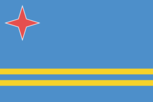
- blue, with two narrow, horizontal, yellow stripes across the lower portion and a red, four-pointed star outlined in white in the upper hoist-side corner; the star represents Aruba and its red soil and white beaches, its four points the four major languages (Papiamento, Dutch, Spanish, English) as well as the four points of a compass, to indicate that its inhabitants come from all over the world; the blue symbolizes Caribbean waters and skies; the stripes represent the island's two main "industries": the flow of tourists to the sun-drenched beaches and the flow of minerals from the earth
- blue, with two narrow, horizontal, yellow stripes across the lower portion and a red, four-pointed star outlined in white in the upper hoist-side corner; the star represents Aruba and its red soil and white beaches, its four points the four major language
- the flow of tourists to the sun-drenched beaches and the flow of minerals from the earth
Government type
parliamentary democracy (Legislature); part of the Kingdom of the Netherlands
Independence
none (part of the Kingdom of the Netherlands)
International organization participation
Caricom (observer), FATF, ILO, IMF, Interpol, IOC, ITUC (NGOs), UNESCO (associate), UNWTO (associate), UPU
Judicial branch
- Joint Court of Justice of Aruba, Curacao, Sint Maarten, and of Bonaire, Sint Eustatitus and Saba or "Joint Court of Justice" (sits as a 3-judge panel); final appeals heard by the Supreme Court, in The Hague, Netherlands Joint Court judges appointed by the monarch for life Courts in First Instance
- highest court(s)
- Joint Court of Justice of Aruba, Curacao, Sint Maarten, and of Bonaire, Sint Eustatitus and Saba or "Joint Court of Justice" (sits as a 3-judge panel); final appeals heard by the Supreme Court, in The Hague, Netherlands
- judge selection and term of office
- Joint Court judges appointed by the monarch for life
- subordinate courts
- Courts in First Instance
Legal system
civil law system based on the Dutch civil code
Legislative branch
- unicameral Legislature or Staten (21 seats; members directly elected in a single nationwide constituency by proportional representation vote; members serve 4-year terms) last held on 22 September 2017 (next to be held in September 2021) percent of vote by party AVP 39.8%, MEP 37.6%, POR 9.4%, RED 7.1%; seats by party - AVP 9, MEP 9, POR 2, RED 1
- description
- unicameral Legislature or Staten (21 seats; members directly elected in a single nationwide constituency by proportional representation vote; members serve 4-year terms)
- election results
- percent of vote by party AVP 39.8%, MEP 37.6%, POR 9.4%, RED 7.1%; seats by party - AVP 9, MEP 9, POR 2, RED 1
- elections
- last held on 22 September 2017 (next to be held in September 2021)
National anthem
- "Aruba Deshi Tera" (Aruba Precious Country) Juan Chabaya 'Padu' LAMPE/Rufo Inocencio WEVER local anthem adopted 1986; as part of the Kingdom of the Netherlands, "Het Wilhelmus" is official (see Netherlands)
- lyrics/music
- Juan Chabaya 'Padu' LAMPE/Rufo Inocencio WEVER
- name
- "Aruba Deshi Tera" (Aruba Precious Country)
- note
- local anthem adopted 1986; as part of the Kingdom of the Netherlands, "Het Wilhelmus" is official (see Netherlands)
National holiday
National Anthem and Flag Day, 18 March (1976)
National symbol(s)
- Hooiberg (Haystack) Hill; national colors: blue, yellow, red, white
- Hooiberg (Haystack) Hill; national colors
- blue, yellow, red, white
Political parties and leaders
Aruban People's Party or AVP [Michiel "Mike" EMAN] Democratic Electoral Network or RED [L.R. CROES] People's Electoral Movement Party or MEP [Evelyn WEVER-CROES] Pueblo Orguyoso y Respeta or POR [O.E. ODUBER];; Real Democracy or PDR [Andin BIKKER]
Political pressure groups and leaders
environmental groups
Suffrage
18 years of age; universal
Economy
Agriculture - products
aloes; livestock; fish
Budget
- $681.8 million $781.3 million (2016 est.)
- expenditures
- $781.3 million (2016 est.)
- revenues
- $681.8 million
Budget surplus (+) or deficit (-)
-4% of GDP (2016 est.)
Central bank discount rate
1% (31 December 2010) 3% (31 December 2009)
Commercial bank prime lending rate
7.83% (31 December 2016 est.) 8.25% (31 December 2015 est.)
Debt - external
$693.2 million (31 December 2014 est.) $666.4 million (31 December 2013 est.)
Economy - overview
Tourism, petroleum bunkering, hospitality, and financial and business services are the mainstays of the small open Aruban economy. Tourism accounts for a majority of economic activity; as of 2014, over 1.7 million tourists visited Aruba annually, with the large majority of those from the US. The rapid growth of the tourism sector has resulted in a substantial expansion of other activities. Construction continues to boom, especially in the hotel sector. Aruba is heavily dependent on imports and is making efforts to expand exports to improve its trade balance. Almost all consumer and capital goods are imported, with the US, the Netherlands, and Panama being the major suppliers. In 2016, Citgo Petroleum Corporation, an indirect wholly owned subsidiary of Petroleos de Venezuela SA, and the Government of Aruba signed an agreement to restart Valero Energy Corp.'s former 235,000-b/d refinery . Tourism and related industries have continued to grow, and the Aruban government is working to attract more diverse industries. Aruba's banking sector continues to be a strong sector; unemployment has significantly decreased.
Exchange rates
Aruban guilders/florins per US dollar - 1.79 (2016 est.) 1.79 (2015 est.) 1.79 (2014 est.) 1.79 (2013 est.) 1.79 (2012 est.)
Exports
$283.1 million (2016 est.) $334.1 million (2015 est.)
Exports - commodities
live animals and animal products, art and collectibles, machinery and electrical equipment, transport equipment
Exports - partners
Colombia 23.4%, US 19.8%, Netherlands 16.9%, Venezuela 13.9% (2016)
Fiscal year
calendar year
GDP - composition, by end use
- 60.3% 26.2% 22.3% 0% 70.2% -79% (2015 est.)
- exports of goods and services
- 70.2%
- government consumption
- 26.2%
- household consumption
- 60.3%
- imports of goods and services
- -79% (2015 est.)
- investment in fixed capital
- 22.3%
- investment in inventories
- 0%
GDP - composition, by sector of origin
- 0.4% 33.3% 66.3% (2002 est.)
- agriculture
- 0.4%
- industry
- 33.3%
- services
- 66.3% (2002 est.)
GDP - per capita (PPP)
$25,300 (2011 est.)
GDP - real growth rate
2.4% (2005 est.)
GDP (official exchange rate)
$2.516 billion (2009 est.)
GDP (purchasing power parity)
$2.516 billion (2009 est.) $2.258 billion (2005 est.) $2.205 billion (2004 est.)
Household income or consumption by percentage share
- NA% NA%
- highest 10%
- NA%
- lowest 10%
- NA%
Imports
$1.142 billion (2016 est.) $1.254 billion (2015 est.)
Imports - commodities
machinery and electrical equipment, refined oil for bunkering and reexport, chemicals; foodstuffs
Imports - partners
US 55.4%, Netherlands 12.6% (2016)
Industrial production growth rate
NA%
Industries
tourism, petroleum transshipment facilities, banking
Inflation rate (consumer prices)
-0.9% (2016 est.) 0.5% (2015 est.)
Labor force
- 51,610 of the 51,610 workers aged 15 and over in the labor force, 32,252 were born in Aruba and 19,353 came from abroad; foreign workers are 38% of the employed population (2007 est.)
- note
- of the 51,610 workers aged 15 and over in the labor force, 32,252 were born in Aruba and 19,353 came from abroad; foreign workers are 38% of the employed population (2007 est.)
Labor force - by occupation
- NA% NA% NA% most employment is in wholesale and retail trade, followed by hotels and restaurants
- agriculture
- NA%
- industry
- NA%
- note
- most employment is in wholesale and retail trade, followed by hotels and restaurants
- services
- NA%
Population below poverty line
NA%
Public debt
67% of GDP (2013) 55% of GDP (2012)
Stock of broad money
$2.328 billion (31 December 2016 est.) $2.126 billion (31 December 2015 est.)
Stock of domestic credit
$1.848 billion (31 December 2016 est.)
Stock of narrow money
$1.257 billion (31 December 2016 est.) $1.151 billion (31 December 2015 est.)
Taxes and other revenues
27.1% of GDP (2016 est.)
Unemployment rate
6.9% (2005 est.)
Energy
Carbon dioxide emissions from consumption of energy
900,000 Mt (2013 est.)
Crude oil - exports
0 bbl/day (2014 est.)
Crude oil - imports
0 bbl/day (2014 est.)
Crude oil - production
0 bbl/day (2016 est.)
Crude oil - proved reserves
0 bbl (1 January 2017 es)
Electricity - consumption
891.9 million kWh (2015 est.)
Electricity - exports
0 kWh (2016 est.)
Electricity - from fossil fuels
87.2% of total installed capacity (2015 est.)
Electricity - from hydroelectric plants
0% of total installed capacity (2015 est.)
Electricity - from nuclear fuels
0% of total installed capacity (2015 est.)
Electricity - from other renewable sources
12.8% of total installed capacity (2015 est.)
Electricity - imports
0 kWh (2016 est.)
Electricity - installed generating capacity
296,000 kW (2015 est.)
Electricity - production
959 million kWh (2015 est.)
Electricity access
- 11,364 91% 100% 80% (2012)
- electrification - rural areas
- 80% (2012)
- electrification - total population
- 91%
- electrification - urban areas
- 100%
- population without electricity
- 11,364
Natural gas - consumption
1 cu m (2013 est.)
Natural gas - exports
1 cu m (2013 est.)
Natural gas - imports
1 cu m (2013 est.)
Natural gas - production
1 cu m (2013 est.)
Natural gas - proved reserves
0 cu m (1 January 2014 es)
Refined petroleum products - consumption
7,500 bbl/day (2015 est.)
Refined petroleum products - exports
0 bbl/day (2014 est.)
Refined petroleum products - imports
7,661 bbl/day (2014 est.)
Refined petroleum products - production
0 bbl/day (2014 est.)
Communications
Broadcast media
2 commercial TV stations; cable TV subscription service provides access to foreign channels; about 19 commercial radio stations broadcast (2014)
Internet country code
.aw
Internet users
- 106,309 93.5% (July 2016 est.)
- percent of population
- 93.5% (July 2016 est.)
- total
- 106,309
Telephone system
- modern fully automatic telecommunications system increased competition through privatization has increased mobile-cellular teledensity to over 125 per 100 persons; three mobile-cellular service providers are now licensed country code - 297; landing site for the PAN-AM submarine telecommunications cable system that extends from the US Virgin Islands through Aruba to Venezuela, Colombia, Panama, and the west coast of South America; extensive interisland microwave radio relay links (2016)
- domestic
- increased competition through privatization has increased mobile-cellular teledensity to over 125 per 100 persons; three mobile-cellular service providers are now licensed
- general assessment
- modern fully automatic telecommunications system
- international
- country code - 297; landing site for the PAN-AM submarine telecommunications cable system that extends from the US Virgin Islands through Aruba to Venezuela, Colombia, Panama, and the west coast of South America; extensive interisland microwave radio relay links (2016)
Telephones - fixed lines
- 35,000 31 (July 2016 est.)
- subscriptions per 100 inhabitants
- 31 (July 2016 est.)
- total subscriptions
- 35,000
Telephones - mobile cellular
- 141,000 126 (July 2016 est.)
- subscriptions per 100 inhabitants
- 126 (July 2016 est.)
- total
- 141,000
Transportation
Airports
1 (2013)
Airports - with paved runways
- 1 (2017)
- 2,438 to 3,047 m
- 1 (2017)
- total
- 1
Civil aircraft registration country code prefix
P4 (2016)
National air transport system
- 2,120,578 0 mt-km (2015)
- annual freight traffic on registered air carriers
- 0 mt-km (2015)
- annual passenger traffic on registered air carriers
- 2,120,578
- inventory of registered aircraft operated by air carriers
- 19
- number of registered air carriers
- 3
Ports and terminals
- Barcadera, Oranjestad Sint Nicolaas Oranjestad
- cruise port(s)
- Oranjestad
- major seaport(s)
- Barcadera, Oranjestad
- oil terminal(s)
- Sint Nicolaas
Military and Security
Military - note
defense is the responsibility of the Netherlands; the Aruba security services focus on organized crime and terrorism
Military branches
no regular military forces (2011)
Transnational Issues
Disputes - international
none
Illicit drugs
transit point for US- and Europe-bound narcotics with some accompanying money-laundering activity; relatively high percentage of population consumes cocaine