2004 Edition
CIA World Factbook 2004 (Project Gutenberg)
Introduction
Background
Discovered and claimed for Spain in 1499, Aruba was acquired by the Dutch in 1636. The island's economy has been dominated by three main industries. A 19th century gold rush was followed by prosperity brought on by the opening in 1924 of an oil refinery. The last decades of the 20th century saw a boom in the tourism industry. Aruba seceded from the Netherlands Antilles in 1986 and became a separate, autonomous member of the Kingdom of the Netherlands. Movement toward full independence was halted at Aruba's request in 1990.
Geography
Area
- land
- 193 sq km
- total
- 193 sq km
- water
- 0 sq km
Area - comparative
slightly larger than Washington, DC
Climate
tropical marine; little seasonal temperature variation
Coastline
68.5 km
Elevation extremes
- highest point
- Mount Jamanota 188 m
- lowest point
- Caribbean Sea 0 m
Environment - current issues
NA
Geographic coordinates
12 30 N, 69 58 W
Geography - note
a flat, riverless island renowned for its white sand beaches; its tropical climate is moderated by constant trade winds from the Atlantic Ocean; the temperature is almost constant at about 27 degrees Celsius (81 degrees Fahrenheit)
Irrigated land
0.01 sq km (1998 est.)
Land boundaries
0 km
Land use
- arable land
- 10.53% (including aloe 0.01%)
- other
- 89.47% (2001)
- permanent crops
- 0%
Location
Caribbean, island in the Caribbean Sea, north of Venezuela
Map references
Central America and the Caribbean
Maritime claims
- territorial sea
- 12 nm
Natural hazards
lies outside the Caribbean hurricane belt
Natural resources
NEGL; white sandy beaches
Terrain
flat with a few hills; scant vegetation
People and Society
Age structure
0-14 years: 20.3% (male 7,429; female 7,051) 15-64 years: 68.2% (male 23,587; female 25,007) 65 years and over: 11.4% (male 3,347; female 4,797) (2004 est.)
Birth rate
11.53 births/1,000 population (2004 est.)
Death rate
6.47 deaths/1,000 population (2004 est.)
Ethnic groups
mixed white/Caribbean Amerindian 80%
HIV/AIDS - adult prevalence rate
NA
HIV/AIDS - deaths
NA
HIV/AIDS - people living with HIV/AIDS
NA
Infant mortality rate
- female
- 5.14 deaths/1,000 live births (2004 est.)
- male
- 6.85 deaths/1,000 live births
- total
- 6.02 deaths/1,000 live births
Languages
Dutch (official), Papiamento (a Spanish, Portuguese, Dutch, English dialect), English (widely spoken), Spanish
Life expectancy at birth
- female
- 82.49 years (2004 est.)
- male
- 75.64 years
- total population
- 78.98 years
Literacy
- definition:
- female
- NA
- male
- NA
- total population
- 97%
Median age
- female
- 39.1 years (2004 est.)
- male
- 35.7 years
- total
- 37.5 years
Nationality
- adjective
- Aruban; Dutch
- noun
- Aruban(s)
Net migration rate
0 migrant(s)/1,000 population (2004 est.)
Population
71,218 (July 2004 est.)
Population growth rate
0.51% (2004 est.)
Religions
Roman Catholic 82%, Protestant 8%, Hindu, Muslim, Confucian, Jewish
Sex ratio
- 15-64 years: 0.94 male(s)/female 65 years and over: 0.7 male(s)/female
- at birth
- 1.05 male(s)/female
- total population
- 0.93 male(s)/female (2004 est.)
- under 15 years
- 1.05 male(s)/female
Total fertility rate
1.79 children born/woman (2004 est.)
Government
Administrative divisions
none (part of the Kingdom of the Netherlands)
Capital
Oranjestad
Constitution
1 January 1986
Country name
- conventional long form
- none
- conventional short form
- Aruba
Dependency status
part of the Kingdom of the Netherlands; full autonomy in internal affairs obtained in 1986 upon separation from the Netherlands Antilles; Dutch Government responsible for defense and foreign affairs
Diplomatic representation from the US
the US does not have an embassy in Aruba; the Consul General to Netherlands Antilles, Robert E. SORENSON, is accredited to Aruba
Diplomatic representation in the US
none (represented by the Kingdom of the Netherlands)
Executive branch
- 1980), represented by Governor General Fredis REFUNJOL (since 11 May 2004)
- of legislative vote - NA
- a six-year term by the monarch; prime minister and deputy prime minister elected by the Staten for four-year terms; election last held 28 September 2001 (next to be held by December 2005)
- October 2001)
- cabinet
- Council of Ministers (elected by the Staten)
- chief of state
- Queen BEATRIX of the Netherlands (since 30 April
- election results
- Nelson O. ODUBER elected prime minister; percent
- elections
- the monarch is hereditary; governor general appointed for
- head of government
- Prime Minister Nelson O. ODUBER (since 30
Flag description
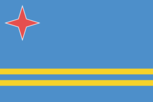
blue, with two narrow, horizontal, yellow stripes across the lower portion and a red, four-pointed star outlined in white in the upper hoist-side corner
Government type
parliamentary democracy
Independence
none (part of the Kingdom of the Netherlands)
International organization participation
ILO, IMF, Interpol, IOC, UNESCO (associate), UPU, WCL, WToO (associate)
Judicial branch
Joint High Court of Justice (judges are appointed by the monarch)
Legal system
based on Dutch civil law system, with some English common law influence
Legislative branch
- unicameral Legislature or Staten (21 seats; members elected by direct, popular vote to serve four-year terms)
- PPA 9.6%, OLA 5.7%, Aliansa 3.5%, other 2.1%; seats by party - MEP 12, AVP 6, PPA 2, OLA 1
- election results
- percent of vote by party - MEP 52.4%, AVP 26.7%,
- elections
- last held 28 September 2001 (next to be held by NA 2005)
National holiday
Flag Day, 18 March
Political parties and leaders
Aruba Solidarity Movement or MAS [leader NA]; Aruban Democratic Alliance or Aliansa [leader NA]; Aruban Democratic Party or PDA [Leo BERLINSKI]; Aruban Liberal Party or OLA [Glenbert CROES]; Aruban Patriotic Party or PPA [Benny NISBET]; Aruban People's Party or AVP [Jan (Henny) H. EMAN]; Concentration for the Liberation of Aruba or CLA [leader NA]; People's Electoral Movement Party or MEP [Nelson O. ODUBER]; For a Restructured Aruba Now or PARA [Urbana LOPEZ]; National Democratic Action or ADN [Pedro Charro KELLY]
Political pressure groups and leaders
NA
Suffrage
18 years of age; universal
Economy
Agriculture - products
aloes; livestock; fish
Budget
- (2000)
- expenditures
- $147 million, including capital expenditures of NA
- revenues
- $135.8 million
Currency
Aruban guilder/florin (AWG)
Currency code
AWG
Debt - external
$285 million (1996)
Economic aid - recipient
$26 million (1995); note - the Netherlands provided a $127 million aid package to Aruba and Suriname in 1996
Economy - overview
Tourism is the mainstay of the small, open Aruban economy, with offshore banking and oil refining and storage also important. The rapid growth of the tourism sector over the last decade has resulted in a substantial expansion of other activities. Construction has boomed, with hotel capacity five times the 1985 level. In addition, the reopening of the country's oil refinery in 1993, a major source of employment and foreign exchange earnings, has further spurred growth. Aruba's small labor force and low unemployment rate have led to a large number of unfilled job vacancies, despite sharp rises in wage rates in recent years. Tourist arrivals have declined in the aftermath of the 11 September 2001 terrorist attacks on the US. The government now must deal with a budget deficit and a negative trade balance.
Electricity - consumption
494.7 million kWh (2001)
Electricity - exports
0 kWh (2001)
Electricity - imports
0 kWh (2001)
Electricity - production
531.9 million kWh (2001)
Exchange rates
Aruban guilders/florins per US dollar - 1.79 (2003), 1.79 (2002), 1.79 (2001), 1.79 (2000), 1.79 (1999)
Exports
$128 million f.o.b. (including oil reexports) (2002 est.)
Exports - commodities
live animals and animal products, art and collectibles, machinery and electrical equipment, transport equipment
Exports - partners
Netherlands 33.7%, Colombia 12%, Netherlands Antilles 12%, Panama 12%, Venezuela 10.8%, US 9.6% (2003)
Fiscal year
calendar year
GDP
purchasing power parity - $1.94 billion (2002 est.)
GDP - composition by sector
- agriculture
- NA
- industry
- NA
- services
- NA
GDP - per capita
purchasing power parity - $28,000 (2002 est.)
GDP - real growth rate
-1.5% (2002 est.)
Household income or consumption by percentage share
- highest 10%
- NA
- lowest 10%
- NA
Imports
$841 million f.o.b. (2002 est.)
Imports - commodities
machinery and electrical equipment, crude oil for refining and reexport, chemicals; foodstuffs
Imports - partners
US 55.3%, Netherlands 13%, Netherlands Antilles 3.1% (2003)
Industrial production growth rate
NA (2002 est.)
Industries
tourism, transshipment facilities, oil refining
Inflation rate (consumer prices)
3.2% (2002 est.)
Labor force
41,500 (1997 est.)
Labor force - by occupation
most employment is in wholesale and retail trade and repair, followed by hotels and restaurants; oil refining
Oil - consumption
6,500 bbl/day (2001 est.)
Oil - exports
NA (2001)
Oil - imports
NA (2001)
Oil - production
0 bbl/day (2001 est.)
Population below poverty line
NA
Unemployment rate
0.6% (2003 est.)
Communications
Internet country code
.aw
Internet hosts
923 (2001)
Internet Service Providers (ISPs)
NA
Internet users
24,000 (2002)
Radio broadcast stations
AM 4, FM 6, shortwave 0 (1998)
Radios
50,000 (1997)
Telephone system
- (Netherlands Antilles); extensive interisland microwave radio relay links
- domestic
- more than adequate
- general assessment
- NA
- international
- country code - 297; 1 submarine cable to Sint Maarten
Telephones - main lines in use
37,100 (2002)
Telephones - mobile cellular
53,000 (2001)
Television broadcast stations
1 (1997)
Televisions
20,000 (1997)
Transportation
Airports
1 (2003 est.)
Airports - with paved runways
- 2,438 to 3,047 m: 1 (2004 est.)
- total
- 1
Highways
- tracts of the interior (1995)
- note
- most coastal roads are paved, while unpaved roads serve large
- paved
- 513 km
- total
- 800 km
- unpaved
- 287 km
Merchant marine
- by type
- cargo 1, petroleum tanker 2
- foreign-owned
- Germany 1, Russia 1
- registered in other countries
- 1 (2003 est.)
- total
- 3 ships (1,000 GRT or over) 5,772 GRT/7,068 DWT
Ports and harbors
Barcadera, Oranjestad, Sint Nicolaas
Military and Security
Military - note
defense is the responsibility of the Kingdom of the Netherlands
Military branches
no regular indigenous military forces; Royal Dutch Navy and Marines, Coast Guard
Transnational Issues
Disputes - international
none
Illicit drugs
transit point for US- and Europe-bound narcotics with some accompanying money-laundering activity This page was last updated on 10 February, 2005 @Ashmore and Cartier Islands