Introduction
<p>Voyagers from Samoa first settled on Niue around A.D. 900, and a second main group of settlers came from Tonga around 1500. With only one reliable source of fresh water, conflict was high on the island. Samoan and Tongan customs heavily influenced Niuean culture, including the formation of an island-wide elected kingship system in the early 1700s. In 1774, British explorer James COOK landed on the island and named it Savage Island because of the Niueans' hostility. Missionaries arrived in 1830 but were also largely unsuccessful at staying on the island until 1846, when a Niuean trained as a Samoan missionary returned to the island and provided a space from which the missionaries could work. In addition to converting the population, the missionaries worked to stop the violent conflicts and helped establish the first parliament in 1849.</p> <p>Great Britain established a protectorate over Niue in 1900. The following year, Niue was annexed to New Zealand and included as part of the Cook Islands. Niue’s remoteness and cultural and linguistic differences with the Cook Islands led New Zealand to separate Niue into its own administration in 1904. The island became internally self-governing in 1974; it is an independent member of international organizations but is in free association with New Zealand, which is responsible for defense and foreign affairs. In September 2023, the US recognized Niue as a sovereign and independent state.</p>
Geography
- Land
- 260 sq km
- Total
- 260 sq km
- Water
- 0 sq km
1.5 times the size of Washington, D.C.
tropical; modified by southeast trade winds
64 km
- Highest point
- unnamed elevation 1.4 km east of Hikutavake 80 m
- Lowest point
- Pacific Ocean 0 m
19 02 S, 169 52 W
one of world's largest coral islands; the only major break in the surrounding coral reef occurs in the central western part of the coast
0 sq km (2022)
- Total
- 0 km
- Agricultural land
- 18.5% (2023 est.)
- Agricultural land: arable land
- arable land: 3.8% (2023 est.)
- Agricultural land: permanent crops
- permanent crops: 10.8% (2023 est.)
- Agricultural land: permanent pasture
- permanent pasture: 3.8% (2023 est.)
- Forest
- 72.6% (2023 est.)
- Other
- 9% (2023 est.)
Oceania, island in the South Pacific Ocean, east of Tonga
Oceania
- Exclusive economic zone
- 200 nm
- Territorial sea
- 12 nm
tropical cyclones
arable land, fish
population distributed around the peripheral coastal areas of the island
steep limestone cliffs along coast, central plateau
People and Society
- Beer
- 4.28 liters of pure alcohol (2019 est.)
- Other alcohols
- 0 liters of pure alcohol (2019 est.)
- Spirits
- 2.33 liters of pure alcohol (2019 est.)
- Total
- 8.5 liters of pure alcohol (2019 est.)
- Wine
- 1.89 liters of pure alcohol (2019 est.)
- Elderly dependency ratio
- 26.4 (2024)
- Potential support ratio
- 3.8 (2024)
- Total dependency ratio
- 64.6 (2024)
- Youth dependency ratio
- 38.2 (2024)
- Improved: total
- total: 97% of population (2022 est.)
- Unimproved: total
- total: 3% of population (2022 est.)
5.6% national budget (2025 est.)
- Niuean 65.4%, part-Niuean 14%, non-Niuean 20.6% (2017 est.)
- note
- <strong>note:</strong> data represent the resident population
- Health expenditure (as % of GDP)
- 7.8% of GDP (2020)
- Health expenditure (as % of national budget)
- 6.9% of national budget (2022 est.)
Niuean 46% (official, a Polynesian language closely related to Tongan and Samoan), Niuean and English 32%, English (official) 11%, Niuean and others 5%, other 6% (2011 est.)
- Female
- 75.7 years (2016 est.)
- Male
- 71.8 years (2016)
- Female
- 100% (2022 est.)
- Male
- 100% (2022 est.)
- Total population
- 99.5% (2022 est.)
1,000 ALOFI (capital) (2018)
- Adjective
- Niuean
- Noun
- Niuean(s)
50% (2016)
- Female
- 938 (2024 est.)
- Male
- 877 (2024 est.)
- Total
- 1,815 (2024 est.)
-0.03% (2021 est.)
Ekalesia Niue 61.7%, Latter Day Saints 8.7%, Roman Catholic 8.4%, other 8.2%, not stated 5.1%, none 3.7%, Jehovah's Witnesses 2.7%, Seventh Day Adventist 1.4% (2017 est.)
- Improved: total
- total: 97.4% of population (2022 est.)
- Unimproved: total
- total: 2.6% of population (2022 est.)
- Rate of urbanization
- 1.43% annual rate of change (2020-25 est.)
- Urban population
- 48.2% of total population (2023)
Government
no first-order administrative divisions as defined by the US government, but 14 villages are considered second-order
- Etymology
- a traditional name for an area of the island; became the name for the newly declared capital in the 20th century
- Geographic coordinates
- 19 01 S, 169 55 W
- Name
- Alofi
- Time difference
- UTC-11 (6 hours behind Washington, DC, during Standard Time)
- Amendment process
- proposed by the Assembly; passage requires at least two-thirds majority vote of the Assembly membership in each of three readings and approval by at least two-thirds majority votes in a referendum; passage of amendments to a number of sections, including Niue’s self-governing status, British nationality and New Zealand citizenship, external affairs and defense, economic and administrative assistance by New Zealand, and amendment procedures, requires at least two-thirds majority vote by the Assembly and at least two thirds of votes in a referendum
- History
- several previous (New Zealand colonial statutes); latest 19 October 1974 (Niue Constitution Act 1974)
- Conventional long form
- none
- Conventional short form
- Niue
- Etymology
- the origin of the name is obscure; in Niuean, the word translates as "behold the coconut;" the former name, Savage Island, was the result of an acrimonious meeting in 1774 between English explorer Captain James COOK and local people
- Former
- Savage Island
- Note
- <strong>note:</strong> pronunciation falls between nyu-way and new-way, but not like new-wee
self-governing in free association with New Zealand since 1974; Niue is fully responsible for internal affairs; under the Niue Constitution Act of 1974, New Zealand provides necessary economic and administrative assistance to Niue, as well as assistance with foreign affairs, defense, and security if requested
- Embassy
- none (self-governing territory in free association with New Zealand)
- Note
- <strong>note:</strong> on 25 September 2023, the US officially established diplomatic relations with Niue
none (self-governing territory in free association with New Zealand)
- Cabinet
- Cabinet chosen by the prime minister
- Chief of state
- King CHARLES III (since 8 September 2022); represented by Governor-General of New Zealand Cindy KIRO (since 21 October 2021); the UK and New Zealand are represented by New Zealand High Commissioner Mark GIBBS (since 5 March 2024)
- Election results
- Dalton TAGELAGI reelected prime minister; Legislative Assembly vote - Dalton TAGELAGI (independent) 16, O'Love JACOBSEN (independent) 4
- Election/appointment process
- the monarchy is hereditary; prime minister indirectly elected by the Legislative Assembly for a 3-year term
- Expected date of next election
- 2026
- Head of government
- Prime Minister Dalton TAGELAGI; also referred to as premier (since 10 June 2020)
- Most recent election date
- 8 May 2023
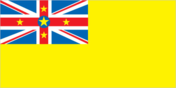
<strong>description:</strong> yellow with the UK flag in the upper-left quadrant; the UK flag has five yellow five-pointed stars, with a large star on a blue disk in the center and smaller stars on each arm of the red cross <br><br><strong>meaning:</strong> the large star represents Niue, and the smaller stars symbolize links with New Zealand; yellow stands for sunshine, as well as the warmth and friendship between Niue and New Zealand
parliamentary democracy
19 October 1974 (Niue became a self-governing state in free association with New Zealand)
ACP, AOSIS, FAO, IFAD, OPCW, PIF, Sparteca, SPC, UNESCO, UPU, WHO, WIPO, WMO
- Highest court(s)
- Court of Appeal (consists of the chief justice and up to 3 judges)
- Judge selection and term of office
- Niue chief justice appointed by the governor general on the advice of the Cabinet and tendered by the premier; other judges appointed by the governor general on the advice of the Cabinet and tendered by the chief justice and the minister of justice; judges serve until age 68
- Note
- <strong>note:</strong> the Judicial Committee of the Privy Council (in London) is the final appeal court beyond the Niue Court of Appeal
- Subordinate courts
- High Court
English common law
- Electoral system
- plurality/majority
- Expected date of next election
- April 2026
- Legislative structure
- unicameral
- Legislature name
- Niue Assembly (Fono Ekepule)
- Most recent election date
- 29 April 2023
- Number of seats
- 20
- Parties elected and seats per party
- independents (20)
- Percentage of women in chamber
- 15%
- Scope of elections
- full renewal
- Term in office
- 3 years
yellow
Waitangi Day (Treaty of Waitangi established British sovereignty over New Zealand), 6 February (1840)
yellow five-pointed star
none
18 years of age; universal
Economy
- coconuts, taro, fruits, sweet potatoes, tropical fruits, yams, vegetables, lemons/limes, bananas, pork (2023)
- note
- <b>note:</b> top ten agricultural products based on tonnage
upper-middle-income self-governing New Zealand territorial economy; environmentally fragile; massive emigration; post-pandemic tourism rebound; postage stamps, small-scale agricultural processing, and subsistence farming; most recent Asian Development Bank member
- Currency
- New Zealand dollars (NZD) per US dollar -
- Exchange rates 2020
- 1.542 (2020 est.)
- Exchange rates 2021
- 1.414 (2021 est.)
- Exchange rates 2022
- 1.577 (2022 est.)
- Exchange rates 2023
- 1.628 (2023 est.)
- Exchange rates 2024
- 1.652 (2024 est.)
- abrasive powder, coin (2023)
- note
- <strong>note:</strong> top export commodities based on value in dollars over $500,000
- USA 54%, Germany 8%, Canada 5%, UK 5%, Guatemala 4% (2023)
- note
- <b>note:</b> top five export partners based on percentage share of exports
- refined petroleum, plastic products, machine parts, construction vehicles, cars (2023)
- note
- <b>note:</b> top five import commodities based on value in dollars
- NZ 87%, Fiji 6%, UAE 2%, Slovakia 1%, Australia 1% (2023)
- note
- <b>note:</b> top five import partners based on percentage share of imports
handicrafts, food processing
- Real GDP (purchasing power parity) 2019
- $20.9 million (2019 est.)
- Real GDP (purchasing power parity) 2020
- $19.9 million (2020 est.)
- Real GDP (purchasing power parity) 2021
- $18.7 million (2021 est.)
- Note
- <strong>note:</strong> data are in 2009 dollars
- Real GDP per capita 2019
- $12,400 (2019 est.)
- Real GDP per capita 2020
- $11,800 (2020 est.)
- Real GDP per capita 2021
- $11,100 (2021 est.)
Energy
- Consumption
- 3 million kWh (2023 est.)
- Installed generating capacity
- 3,000 kW (2023 est.)
- Transmission/distribution losses
- 400,000 kWh (2023 est.)
- Fossil fuels
- 100% of total installed capacity (2023 est.)
- Refined petroleum consumption
- 61 bbl/day (2023 est.)
Communications
1 state-owned TV station, with many of the programs supplied by Television New Zealand; 1 state-owned radio station broadcasting in AM and FM (2019)
.nu
- Percent of population
- 80% (2024 est.)
- Subscriptions per 100 inhabitants
- 52 (2021 est.)
- Total subscriptions
- 1,000 (2021 est.)
Transportation
1 (2025)
- By type
- bulk carrier 5, container ship 2, general cargo 29, oil tanker 4, other 30
- Total
- 70 (2023)
- Key ports
- Alofi
- Large
- 0
- Medium
- 0
- Ports with oil terminals
- 0
- Small
- 0
- Total ports
- 1 (2024)
- Very small
- 1
Military and Security
under the Niue Constitution Act of 1974, New Zealand provides assistance with foreign affairs, defense, and security if requested by the Niue government
no regular indigenous military forces; Niue Police Department
Environment
- From petroleum and other liquids
- 9,000 metric tonnes of CO2 (2023 est.)
- Total emissions
- 9,000 metric tonnes of CO2 (2023 est.)
increasing attention to conservationist practices to counter loss of soil fertility from traditional slash-and-burn agriculture
- Party to
- Biodiversity, Climate Change, Climate Change-Kyoto Protocol, Climate Change-Paris Agreement, Comprehensive Nuclear Test Ban, Desertification, Law of the Sea, Ozone Layer Protection, Ship Pollution
- Signed, but not ratified
- none of the selected agreements
6.7 micrograms per cubic meter (2019 est.)