Introduction
<p>During the late 18th and early 19th centuries, the principality of Gorkha united many of the other principalities and states of the sub-Himalayan region into a Nepali Kingdom. Nepal retained its independence after the Anglo-Nepalese War of 1814-16, and the subsequent peace treaty laid the foundations for two centuries of amicable relations between Britain and Nepal. In 1951, the Nepali monarch ended the century-old system of hereditary rule and instituted a cabinet system that brought political parties into the government. That arrangement lasted until 1960, when political parties were again banned, but it was reinstated in 1990 with the establishment of a multiparty democracy within the framework of a constitutional monarchy.</p> <p>A Maoist-led insurgency broke out in 1996. During the ensuing 10-year civil war between Maoist and government forces, the monarchy dissolved the cabinet and parliament. In 2001, Crown Prince DIPENDRA first massacred the royal family and then shot himself. His uncle GYANENDRA became king, and the monarchy reassumed absolute power the next year. A peace accord in 2006 led to the promulgation of an interim constitution in 2007. After a nationwide Constituent Assembly (CA) election in 2008, the newly formed CA declared Nepal a federal democratic republic, abolished the monarchy, and elected the country's first president. <br><br>When the CA failed to draft a Supreme Court-mandated constitution, then-Prime Minister Baburam BHATTARAI dissolved the CA. An interim government held elections in 2013, in which the Nepali Congress (NC) won the largest share of seats. In 2014, NC formed a coalition government with the second-place Communist Party of Nepal-Unified Marxist-Leninist (UML). Nepal's new constitution came into effect in 2015, at which point the CA became the Parliament and Khagda Prasad Sharma OLI the first post-constitution prime minister (2015-16). He resigned ahead of a no-confidence motion, and Parliament elected Communist Party of Nepal-Maoist (CPN-M) leader Pushpa Kamal DAHAL as prime minister. <br><br>The parties headed by OLI and DAHAL ran in coalition and swept the parliamentary elections in 2017, and OLI was sworn in as prime minister in 2018. OLI's efforts to dissolve parliament and hold elections were declared unconstitutional in 2021, and the opposition-supported NC leader Sher Bahadur DEUBA was named prime minister. The NC won a majority of seats in the parliamentary elections in 2022, but DAHAL then broke with the ruling coalition and partnered with OLI and the CPN-UML to become prime minister. DAHAL's first cabinet lasted about two months, until OLI withdrew his support over disagreements about ministerial assignments. In early 2023, DAHAL survived a vote of confidence and formed a coalition with the NC to remain prime minister.</p>
Geography
- Land
- 143,351 sq km
- Total
- 147,181 sq km
- Water
- 3,830 sq km
slightly larger than New York State
varies from cool summers and severe winters in north to subtropical summers and mild winters in south
0 km (landlocked)
Asia
- Highest point
- Mount Everest (highest peak in Asia and highest point on earth above sea level) 8,849 m
- Lowest point
- Kanchan Kalan 70 m
- Mean elevation
- 2,565 m
28 00 N, 84 00 E
landlocked; strategic location between China and India; contains eight of world's 10 highest peaks, including Mount Everest and Kanchenjunga -- the world's tallest and third-tallest mountains -- on the borders with China and India, respectively
12,090 sq km (2022)
- Border countries
- China 1,389 km; India 1,770 km
- number of neighbors
- 2
- Total
- 3,159 km
- Agricultural land
- 26.1% (2023 est.)
- Agricultural land: arable land
- arable land: 12.6% (2023 est.)
- Agricultural land: permanent crops
- permanent crops: 1% (2023 est.)
- Agricultural land: permanent pasture
- permanent pasture: 12.5% (2023 est.)
- arable land
- 12.58%
- Forest
- 43.5% (2023 est.)
- Other
- 27.7% (2023 est.)
- permanent crops
- 1.01%
Yes
Southern Asia, between China and India
Indus-Ganges-Brahmaputra Basin
- Indian Ocean drainage
- Brahmaputra (651,335 sq km), Ganges (1,016,124 sq km), Indus (1,081,718 sq km)
- Google Maps
- https://goo.gl/maps/UMj2zpbQp7B5c3yT7
- OpenStreetMap
- https://www.openstreetmap.org/relation/184633
Asia
none (landlocked)
severe thunderstorms; flooding; landslides; drought and famine depending on the timing, intensity, and duration of the summer monsoons
quartz, water, timber, hydropower, scenic beauty, small deposits of lignite, copper, cobalt, iron ore
most of the population is divided nearly equally between a concentration in the southern-most plains of the Tarai region and the central hilly region; overall density is low
Southern Asia
Tarai or flat river plain of the Ganges in south; central hill region with rugged Himalayas in north
- UTC+05:45
- number of time zones
- 1
People and Society
- 0-14 years
- 25.8% (male 4,125,244/female 3,909,135)
- 15-64 years
- 67.8% (male 10,153,682/female 10,957,011)
- 65 years and over
- 6.4% (2024 est.) (male 961,717/female 1,015,598)
- Beer
- 0.22 liters of pure alcohol (2019 est.)
- Other alcohols
- 0 liters of pure alcohol (2019 est.)
- Spirits
- 0.13 liters of pure alcohol (2019 est.)
- Total
- 0.36 liters of pure alcohol (2019 est.)
- Wine
- 0 liters of pure alcohol (2019 est.)
16.66 births/1,000 population (2025 est.)
- Men married by age 18
- 7% (2022)
- Women married by age 15
- 5.8% (2022)
- Women married by age 18
- 34.9% (2022)
24.8%
18.3% (2022 est.)
75.1% (2022 est.)
- 5.62 deaths/1,000 population (2025 est.)
- adult female
- 139 per 1,000
- adult male
- 181 per 1,000
- Elderly dependency ratio
- 9.6 (2025 est.)
- Potential support ratio
- 10.4 (2025 est.)
- Total dependency ratio
- 46.8 (2025 est.)
- Youth dependency ratio
- 37.2 (2025 est.)
- improved total
- 16.49%
- Improved: rural
- rural: 91.6% of population (2022 est.)
- Improved: total
- total: 91.2% of population (2022 est.)
- Improved: urban
- urban: 90% of population (2022 est.)
- Unimproved: rural
- rural: 8.4% of population (2022 est.)
- Unimproved: total
- total: 8.8% of population (2022 est.)
- Unimproved: urban
- urban: 10% of population (2022 est.)
- Education expenditure (% GDP)
- 3.7% of GDP (2024 est.)
- Education expenditure (% national budget)
- 10.8% national budget (2025 est.)
4 % of GDP
- Chhettri 16.5%, Brahman-Hill 11.3%, Magar 6.9%, Tharu 6.2%, Tamang 5.6%, Bishwokarma 5%, Musalman 4.9%, Newar 4.6%, Yadav 4.2%, Rai 2.2%, Pariyar 1.9%, Gurung 1.9%, Thakuri 1.7%, Mijar 1.6%, Teli 1.5%, Yakthung/Limbu 1.4%, Chamar/Harijan/Ram 1.4%, Koiri/Kushwaha 1.2%, other 20% (2021 est.)
- note
- <strong>note:</strong> 141 caste/ethnic groups were reported in the 2021 national census
0.88 (2025 est.)
- 6 % of GDP
- Health expenditure (as % of GDP)
- 5.4% of GDP (2021)
- Health expenditure (as % of national budget)
- 8% of national budget (2022 est.)
0.1%
0.4 beds/1,000 population (2021 est.)
- Female
- 22.7 deaths/1,000 live births
- Male
- 25.2 deaths/1,000 live births
- neonatal
- 17 deaths/1,000 live births
- Total
- 23.4 deaths/1,000 live births (2025 est.)
- Languages
- Nepali (official) 44.9%, Maithali 11.1%, Bhojpuri 6.2%, Tharu 5.9%, Tamang 4.9%, Bajjika 3.9%, Avadhi 3%, Nepalbhasha (Newari) 3%, Magar Dhut 2.8%, Doteli 1.7%, Urdu 1.4%, Yakthung/Limbu 1.2%, Gurung 1.1%, other 8.9% (2021 est.)
- Major-language sample(s)
- <br>विश्व तथ्य पुस्तक,आधारभूत जानकारीको लागि अपरिहार्य स्रोत (Nepali)<br><br>The World Factbook, the indispensable source for basic information.
- Note
- <strong>note:</strong> 123 languages reported as mother tongue in 2021 national census; many in government and business also speak English
- number of languages
- 1
- Female
- 73.7 years
- Male
- 72.2 years
- Total population
- 73 years (2024 est.)
- Female
- 59.4% (2019 est.)
- Male
- 79.8% (2019 est.)
- Total population
- 68.7% (2019 est.)
1.571 million KATHMANDU (capital) (2023)
142 deaths/100,000 live births (2023 est.)
- Female
- 28.6 years
- Male
- 26.5 years
- Total
- 28.1 years (2025 est.)
- 20.4 years (2016 est.)
- note
- <strong>note:</strong> data represents median age at first birth among women 25-49
- Adjective
- Nepali
- Noun
- Nepali (singular and plural)
-4.46 migrant(s)/1,000 population (2025 est.)
4.1% (2016)
1.01 physicians/1,000 population (2023)
- Female
- 15,981,696
- Male
- 15,352,706
- Total
- 31,334,402 (2025 est.)
0.66% (2025 est.)
Hindu 81.2%, Buddhist 8.2%, Muslim 5.1%, Kirat 3.2%, Christian 1.8%; less than 1%: Prakriti, Bon, Jains, Sikh (2021 est.)
- improved total
- 53.41%
- Improved: rural
- rural: 89.2% of population (2022 est.)
- Improved: total
- total: 90.7% of population (2022 est.)
- Improved: urban
- urban: 96.1% of population (2022 est.)
- Unimproved: rural
- rural: 10.8% of population (2022 est.)
- Unimproved: total
- total: 9.3% of population (2022 est.)
- Unimproved: urban
- urban: 3.9% of population (2022 est.)
- Female
- 14 years (2023 est.)
- Male
- 14 years (2023 est.)
- Total
- 14 years (2023 est.)
- 0-14 years
- 1.06 male(s)/female
- 15-64 years
- 0.93 male(s)/female
- 65 years and over
- 0.95 male(s)/female
- At birth
- 1.06 male(s)/female
- Total population
- 0.96 male(s)/female (2024 est.)
- Female
- 7.6% (2025 est.)
- Male
- 40.3% (2025 est.)
- Total
- 22.9% (2025 est.)
1.82 children born/woman (2025 est.)
- Rate of urbanization
- 3.09% annual rate of change (2020-25 est.)
- Urban population
- 21.9% of total population (2023)
- measles
- 97%
Government
7 provinces (<em>pradesh</em>, singular - <em>pradesh</em>); Bagmati, Gandaki, Karnali, Koshi, Lumbini, Madhesh, Sudurpashchim
- Etymology
- the name comes from the Nepalese words <em>kath </em>(wooden) and <em>mandu </em>(temple), referring to the local temples that are often still built from wood
- Geographic coordinates
- 27 43 N, 85 19 E
- Name
- Kathmandu
- Time difference
- UTC+5.75 (10.75 hours ahead of Washington, DC, during Standard Time)
- Citizenship by birth
- yes
- Citizenship by descent only
- yes
- Dual citizenship recognized
- no
- Residency requirement for naturalization
- 15 years
- svg
- https://mainfacts.com/media/images/coats_of_arms/np.svg
- Amendment process
- proposed as a bill by either house of the Federal Parliament; bills affecting a state border or powers delegated to a state must be submitted to the affected state assembly; passage of such bills requires a majority vote of that state assembly membership; bills not requiring state assembly consent require at least two-thirds majority vote by the membership of both houses of the Federal Parliament; parts of the constitution on the sovereignty, territorial integrity, independence, and sovereignty vested in the people cannot be amended
- History
- several previous; latest approved by the Second Constituent Assembly 16 September 2015, signed by the president and effective 20 September 2015
- alternative spellings
- NP, Federal Democratic Republic of Nepal, Loktāntrik Ganatantra Nepāl
- Conventional long form
- none
- Conventional short form
- Nepal
- Etymology
- the name probably comes from the Sanskrit term <em>nepala</em>, from the words for "fly down" and "house," which would refer to the villages at the base of the mountains
- FIFA code
- NEP
- Local long form
- none
- local long form (nep)
- नेपाल संघीय लोकतान्त्रिक गणतन्त्र
- Local short form
- Nepal
- Chief of mission
- Ambassador Dean R. THOMPSON (since October 2022)
- Email address and website
- <br>usembktm@state.gov<br><br>https://np.usembassy.gov/
- Embassy
- Maharajgunj, Kathmandu
- FAX
- [977] (1) 400-7272
- Mailing address
- 6190 Kathmandu Place, Washington DC 20521-6190
- Telephone
- [977] (1) 423-4000
- Chancery
- 2730 34th Place NW, Washington, DC 20007
- Chief of mission
- Ambassador (vacant); Chargé d'Affaires Sharad Raj ARAN (since November 2025)
- Consulate(s) general
- New York
- Email address and website
- <br>info@nepalembassyusa.org<br><br>https://us.nepalembassy.gov.np/
- FAX
- [1] (202) 667-5534
- Telephone
- [1] (202) 667-4550
- Cabinet
- Council of Ministers appointed by the prime minister; cabinet positions shared among Nepali Congress, Communist Party of Nepal-Maoist Centre, and various coalition partners
- Chief of state
- President Ram Chandra POUDEL (since 13 March 2023)
- Election results
- <em><br>2023:</em> Ram Chandra POUDEL elected president; electoral college vote - Ram Chandra POUDEL (NC) 33,802, Subash Chandra NEMBANG (CPN-UML) 15,518
- Election/appointment process
- president indirectly elected by an electoral college of the Federal Parliament and the state assemblies for a 5-year term (eligible for a second term)
- Expected date of next election
- 5 March 2026
- Head of government
- Prime Minister Sushila KARKI (since 12 September 2025)
- Most recent election date
- 9 March 2023
- Note
- <strong>note:</strong> KARKI was sworn in as interim prime minister on 12 September 2025 after Khadga Prasad Sharma OLI resigned on 9 September following violent protests; KARKI will serve until elections are held in March 2026
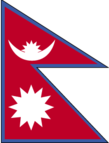
- <strong>description:</strong> crimson red with a blue border, in the shape of two overlapping right triangles; the smaller upper triangle has a stylized white moon, and the larger lower triangle has a 12-pointed white sun<br><br><strong>meaning:</strong> red stands for the rhododendron (the national flower) and victory and bravery, and the blue border for peace and harmony; the two triangles are a combination of two pennants that originally symbolized the Himalaya Mountains, but today they refer to Hinduism and Buddhism, the country's two main religions; the moon stands for the serenity of the people, as well as Himalayan shade and cool weather, and the sun for the heat and higher temperatures in the rest of the country
- note
- <strong>note:</strong> Nepal is the only country with a flag that is not rectangular or square
The flag of Nepal is the world's only non-quadrilateral flag of a sovereign country. It takes the shape of two adjoining right-angled triangles and has a crimson red field with deep blue edges. Within the smaller upper triangle is an emblem of the upper half of a white sun resting on an upward facing white crescent. The lower triangle bears a white sun with twelve rays.
- svg
- https://flagcdn.com/np.svg
federal parliamentary republic
1768 (unified by Prithvi Narayan SHAH)
has not submitted an ICJ jurisdiction declaration; non-party state to the ICCt
ADB, BIMSTEC, CD, CP, FAO, G-77, IAEA, IBRD, ICAO, ICC (NGOs), ICRM, IDA, IFAD, IFC, IFRCS, ILO, IMF, IMO, Interpol, IOC, IOM, IPU, ISO, ITSO, ITU, ITUC (NGOs), MIGA, MINURSO, MINUSTAH, MONUSCO, NAM, OPCW, SAARC, SACEP, UN, UNAMID, UNCTAD, UNDOF, UNESCO, UNIDO, UNIFIL, UNISFA, UNMIL, UNMISS, UNOCI, UNSOM, UNTSO, UNWTO, UPU, WCO, WFTU (NGOs), WHO, WIPO, WMO, WTO
- Highest court(s)
- Supreme Court (consists of the chief justice and up to 20 judges)
- Judge selection and term of office
- Supreme Court chief justice appointed by the president on the recommendation of the Constitutional Council, a 5-member, high-level advisory body headed by the prime minister; other judges appointed by the president on the recommendation of the Judicial Council, a 5-member advisory body headed by the chief justice; the chief justice serves a 6-year term; judges serve until age 65
- Subordinate courts
- High Court; district courts
English common law and Hindu legal concepts
- Legislative structure
- bicameral
- Legislature name
- Federal Parliament (Sanghiya Sansad)
- Note
- <strong>note: </strong>violent student-led protests in early September 2025 led to the resignation of the Prime Minister; the President dissolved Parliament on 12 September 2015 following the swearing in of an interim prime minister and set elections for 5 March 2026; the major political parties have demanded reinstatement of the Parliament
- Chamber name
- House of Representatives (Pratinidhi Sabha)
- Electoral system
- mixed system
- Expected date of next election
- 5 March 2026
- Most recent election date
- 11/20/2022
- Note
- <strong>note:</strong> Parliament was dissolved by the President on 12 September following violent protests, the resignation of the Prime Minister, and the appointment of an interim prime minister with new elections set for March 2026
- Number of seats
- 275 (all directly elected)
- Parties elected and seats per party
- Nepali Congress (NC) (89); Communist Party of Nepal (Unified Marxist-Leninist, UML) (78); Communist Party of Nepal-Maoist Centre (CPN-MC) (32); Rastriya Swatantra Party (20); Rastriya Prajatantra Party Nepal (RPP) (14); People's Socialist Party, Nepal (12); Communist Party of Nepal (Unified Socialist) (10); Janamat Party (6); Democratic Socialist Party, Nepal (4); People's Freedom Party (3); Nepal Workers Peasants Party (1); Rastriya Janamorcha (1); Independents (5)
- Percentage of women in chamber
- 0%
- Scope of elections
- full renewal
- Term in office
- 5 years
- Chamber name
- National Assembly (Rastriya Sabha)
- Expected date of next election
- January 2026
- Most recent election date
- 1/25/2024
- Number of seats
- 59 (56 indirectly elected; 3 appointed)
- Percentage of women in chamber
- 37.3%
- Scope of elections
- partial renewal
- Term in office
- 6 years
red
- Selected World Heritage Site locales
- Kathmandu Valley (c); Sagarmatha National Park (n); Chitwan National Park (n); Lumbini, Buddha Birthplace (c)
- Total World Heritage Sites
- 4 (2 cultural, 2 natural)
- Constitution Day, 20 September (2015)
- note
- <strong>note:</strong> replaces the previous Republic Day on 28 May as the official national day in Nepal; the Gregorian date fluctuates based on Nepal’s Hindu calendar
rhododendron blossom
Communist Party of Nepal (Maoist Centre) or CPN-MC<br>Communist Party of Nepal (Unified Marxist-Leninist) or CPN-UML<br>Communist Party of Nepal (Unified Socialist) or CPN-US<br>Janamat Party<br>Janata Samajbaadi Party or JSP<br>Loktantrik Samajwadi Party or LSP<br>Naya Shakti Party, Nepal<br>Nepali Congress or NC<br>Nepal Mazdoor Kisan Party (Nepal Workers' and Peasants' Party) or NWPP<br>Rastriya Janamorcha (National People's Front)<br>Rastriya Prajatantra Party (National Democratic Party) or RPP<br>Rastriya Swatantra Party or RSP
Sunday
18 years of age; universal
Yes
Economy
- rice, vegetables, potatoes, sugarcane, maize, wheat, bison milk, milk, mangoes/guavas, bananas (2023)
- note
- <b>note:</b> top ten agricultural products based on tonnage
- Expenditures
- $9.1 billion (2021 est.)
- Note
- <b>note:</b> central government revenues (excluding grants) and expenditures converted to US dollars at average official exchange rate for year indicated
- Revenues
- $7.625 billion (2021 est.)
- code
- NPR
- name
- Nepalese rupee (NPR) [₨]
- $1.68 billion
- Current account balance 2022
- -$3.088 billion (2022 est.)
- Current account balance 2023
- $146.66 million (2023 est.)
- Current account balance 2024
- $1.954 billion (2024 est.)
- Note
- <b>note:</b> balance of payments - net trade and primary/secondary income in current dollars
- $10.15 billion
- Debt - external 2023
- $5.719 billion (2023 est.)
- Note
- <b>note:</b> present value of external debt in current US dollars
low-income South Asian economy; post-conflict fiscal federalism increasing stability; COVID-19 hurt trade and tourism; widening current account deficits; environmentally fragile economy from earthquakes; growing Chinese relations and investments
- Currency
- Nepalese rupees (NPR) per US dollar -
- Exchange rates 2020
- 118.345 (2020 est.)
- Exchange rates 2021
- 118.134 (2021 est.)
- Exchange rates 2022
- 125.199 (2022 est.)
- Exchange rates 2023
- 132.115 (2023 est.)
- Exchange rates 2024
- 133.727 (2024 est.)
- $3.27 billion
- Exports 2022
- $2.106 billion (2022 est.)
- Exports 2023
- $2.258 billion (2023 est.)
- Exports 2024
- $3.744 billion (2024 est.)
- Note
- <b>note:</b> balance of payments - exports of goods and services in current dollars
- knotted carpets, garments, flat-rolled iron, synthetic fibers, palm oil (2023)
- note
- <b>note:</b> top five export commodities based on value in dollars
- India 67%, USA 12%, Germany 3%, China 2%, UK 2% (2023)
- note
- <b>note:</b> top five export partners based on percentage share of exports
- net inflows
- $56.9 million
- Exports of goods and services
- 7.6% (2024 est.)
- Government consumption
- 7.4% (2024 est.)
- Household consumption
- 86.3% (2024 est.)
- Imports of goods and services
- -32.9% (2024 est.)
- Investment in fixed capital
- 24.3% (2024 est.)
- Investment in inventories
- 6.1% (2024 est.)
- Note
- <b>note:</b> figures may not total 100% due to rounding or gaps in data collection
- Agriculture
- 21.9% (2024 est.)
- Industry
- 11.4% (2024 est.)
- Note
- <b>note:</b> figures may not total 100% due to non-allocated consumption not captured in sector-reported data
- Services
- 55.2% (2024 est.)
- $42.914 billion (2024 est.)
- note
- <b>note:</b> data in current dollars at official exchange rate
$1,447
- 32.8 (2010)
- Gini Index coefficient - distribution of family income 2022
- 30 (2022 est.)
- Note
- <strong>note:</strong> index (0-100) of income distribution; higher values represent greater inequality
$43.62 billion
$1,470
30 % of GDP
- Highest 10%
- 24.2% (2022 est.)
- Lowest 10%
- 3.7% (2022 est.)
- Note
- <strong>note:</strong> % share of income accruing to lowest and highest 10% of population
- $14.12 billion
- Imports 2022
- $15.227 billion (2022 est.)
- Imports 2023
- $13.877 billion (2023 est.)
- Imports 2024
- $17.777 billion (2024 est.)
- Note
- <b>note:</b> balance of payments - imports of goods and services in current dollars
- refined petroleum, natural gas, garments, iron reductions, broadcasting equipment (2023)
- note
- <b>note:</b> top five import commodities based on value in dollars
- India 71%, China 17%, UAE 3%, Singapore 2%, Germany 1% (2023)
- note
- <b>note:</b> top five import partners based on percentage share of imports
- 0.1% (2024 est.)
- note
- <b>note:</b> annual % change in industrial value added based on constant local currency
tourism, carpets, textiles, small rice, jute, sugar, oilseed mills, cigarettes, cement and brick production
- 4.69%
- Inflation rate (consumer prices) 2021
- 4.1% (2021 est.)
- Inflation rate (consumer prices) 2022
- 7.7% (2022 est.)
- Inflation rate (consumer prices) 2023
- 7.1% (2023 est.)
- Note
- <b>note:</b> annual % change based on consumer prices
- 8.435 million (2024 est.)
- note
- <b>note:</b> number of people ages 15 or older who are employed or seeking work
- total
- 8.36 million persons
- agriculture
- 22.91%
- industry
- 31.28%
- services
- 45.81%
- 20.3% (2022 est.)
- note
- <strong>note:</strong> % of population with income below national poverty line
- 40 % of GDP
- Note
- <b>note:</b> central government debt as a % of GDP
- Public debt 2021
- 39.9% of GDP (2021 est.)
- $170.1 billion
- Note
- <b>note:</b> data in 2021 dollars
- Real GDP (purchasing power parity) 2022
- $141.546 billion (2022 est.)
- Real GDP (purchasing power parity) 2023
- $144.352 billion (2023 est.)
- Real GDP (purchasing power parity) 2024
- $149.643 billion (2024 est.)
- 3.67%
- Note
- <b>note:</b> annual GDP % growth based on constant local currency
- Real GDP growth rate 2022
- 5.6% (2022 est.)
- Real GDP growth rate 2023
- 2% (2023 est.)
- Real GDP growth rate 2024
- 3.7% (2024 est.)
- $5,737
- Note
- <b>note:</b> data in 2021 dollars
- Real GDP per capita 2022
- $4,800 (2022 est.)
- Real GDP per capita 2023
- $4,900 (2023 est.)
- Real GDP per capita 2024
- $5,000 (2024 est.)
- $11.25 billion
- Note
- <b>note:</b> personal transfers and compensation between resident and non-resident individuals/households/entities
- Remittances 2022
- 22% of GDP (2022 est.)
- Remittances 2023
- 25.3% of GDP (2023 est.)
- Remittances 2024
- 33.1% of GDP (2024 est.)
- $12.46 billion
- Note
- <b>note:</b> holdings of gold (year-end prices)/foreign exchange/special drawing rights in current dollars
- Reserves of foreign exchange and gold 2021
- $9.639 billion (2021 est.)
- Reserves of foreign exchange and gold 2022
- $9.319 billion (2022 est.)
- Reserves of foreign exchange and gold 2023
- $12.456 billion (2023 est.)
17 % of GDP
14 % of GDP
- 17.5% (of GDP) (2021 est.)
- note
- <b>note:</b> central government tax revenue as a % of GDP
- 10.47%
- Note
- <b>note:</b> % of labor force seeking employment
- Unemployment rate 2022
- 10.9% (2022 est.)
- Unemployment rate 2023
- 10.7% (2023 est.)
- Unemployment rate 2024
- 10.8% (2024 est.)
- Female
- 23.6% (2024 est.)
- Male
- 19.3% (2024 est.)
- Note
- <b>note:</b> % of labor force ages 15-24 seeking employment
- Total
- 20.8% (2024 est.)
Energy
- Consumption
- 1.091 million metric tons (2023 est.)
- Exports
- 100 metric tons (2023 est.)
- Imports
- 1.076 million metric tons (2023 est.)
- Production
- 9,000 metric tons (2023 est.)
- Proven reserves
- 8 million metric tons (2023 est.)
- Consumption
- 9.806 billion kWh (2023 est.)
- consumption per capita
- 321 kWh
- Exports
- 1.1 billion kWh (2023 est.)
- Imports
- 1.846 billion kWh (2023 est.)
- Installed generating capacity
- 2.853 million kW (2023 est.)
- Transmission/distribution losses
- 1.638 billion kWh (2023 est.)
- Electrification - rural areas
- 93.7%
- Electrification - total population
- 91.3% (2022 est.)
- Electrification - urban areas
- 97.7%
- fossil fuels
- 0%
- hydroelectric
- 99.03%
- Hydroelectricity
- 99% of total installed capacity (2023 est.)
- nuclear
- 0%
- renewable
- 83.83%
- Solar
- 1% of total installed capacity (2023 est.)
- Wind
- 0.1% of total installed capacity (2023 est.)
- 520 kg of oil equivalent
- Total energy consumption per capita 2023
- 6.604 million Btu/person (2023 est.)
- Refined petroleum consumption
- 71,000 bbl/day (2023 est.)
73.7%
Communications
- per 100 inhabitants
- 5 per 100
- Subscriptions per 100 inhabitants
- 5 (2022 est.)
- Total
- 1.44 million (2022 est.)
state operates 3 TV stations, as well as national and regional radio stations; 117 television channels are licensed, 71 of which are cable TV, 3 are distributed through Direct-To-Home (DTH) system, and 4 are digital terrestrial; 736 FM radio stations are licensed, and at least 314 of those are community stations (2019)
.np
- Percent of population
- 56% (2023 est.)
#####
+977
- Subscriptions per 100 inhabitants
- 2 (2022 est.)
- Total subscriptions
- 726,000 (2021 est.)
- subscriptions per 100
- 133 per 100
- Subscriptions per 100 inhabitants
- 100 (2024 est.)
- Total subscriptions
- 29.6 million (2024 est.)
Transportation
- passengers carried
- 4.29 million passengers
- registered carrier departures
- 67,501 departures
51 (2025)
9N
Left
14 (2025)
- Narrow gauge
- 59 km (2018) 0.762-m gauge
- Total
- 59 km (2018)
NEP
Military and Security
- armored vehicles
- tanks
the Nepali Army is responsible for territorial defense, fulfilling Nepal's commitments to UN peacekeeping, and some domestic duties such as disaster relief/humanitarian assistance, social services, and nature conservation efforts; during the 10-year civil war that ended in 2006, it conducted counterinsurgency operations against Maoist guerrillas; the Army has a long history of supporting UN missions, having sent its first UN observers to Lebanon in 1958 and its first troop contingent to Egypt in 1974; as of 2025, 150,000 Nepali military personnel have deployed on over 40 UN missions; Nepal's key security partners are China, India, and the US<br><br>the British began to recruit Nepalese citizens (Gurkhas) into the East India Company Army during the Anglo-Nepalese War (1814-1816); the Gurkhas subsequently were brought into the British Indian Army and by 1914, there were 10 Gurkha regiments, collectively known as the Gurkha Brigade; following the partition of India in 1947, an agreement between Nepal, India, and Great Britain allowed for the transfer of the 10 regiments from the British Indian Army to the separate British and Indian armies; four regiments were transferred to the British Army, where they have since served continuously as the Brigade of Gurkhas; six Gurkha (aka Gorkha in India) regiments went to the new Indian Army; a seventh regiment was later added; Gurkhas are also recruited into the Singaporean Police and a special guard in the Sultanate of Brunei known as the Gurkha Reserve Unit (2025)
- Nepalese Armed Forces (Ministry of Defense): Nepali Army (includes Air Wing)<br><br>Ministry of Home Affairs: Nepal Police, Nepal Armed Police Force (APF) (2025)
- active duty personnel
- 112,000
- note
- <strong>note: </strong>the Nepal Police are responsible for enforcing law and order across the country; the Armed Police Force is responsible for combating terrorism, providing security during riots and public disturbances, assisting in natural disasters, and protecting vital infrastructure, public officials, and the borders; it also conducts counterinsurgency and counterterrorism operations and would assist the Army in the event of an external invasion
- percent of total labor force
- 1.40 %
approximately 95,000 active Armed Forces (2025)
1240 Central African Republic (MINUSCA); 1,150 Democratic Republic of the Congo (MONUSCO); 440 Golan Heights (UNDOF); 875 Lebanon (UNIFIL); 225 Liberia (UNSMIL); 100 South Sudan/Sudan (UNISFA); 1,750 (plus about 200 police) South Sudan (UNMISS) (2025)
the Army's inventory includes a mix of mostly older equipment largely of British, Chinese, Indian, Russian, and South African origin; in recent years, Nepal has received limited amounts of newer hardware from several countries, including China, Indonesia, Italy, and Russia (2025)
- 1 % of GDP
- current USD
- $426,517,834
- Military Expenditures 2020
- 1.3% of GDP (2020 est.)
- Military Expenditures 2021
- 1.3% of GDP (2021 est.)
- Military Expenditures 2022
- 1.1% of GDP (2022 est.)
- Military Expenditures 2023
- 1% of GDP (2023 est.)
- Military Expenditures 2024
- 1% of GDP (2024 est.)
- percent of central government expenditure
- 4.11 %
- percent of GDP
- 0.98 % of GDP
18 years of age for voluntary military service for men and women; upper age limit varies; no conscription (2025)
- PowerIndex score
- 2.8037
Transnational Issues
- IDPs
- 18,671 (2024 est.)
- Refugees
- 19,874 (2024 est.)
- Stateless persons
- 467 (2024 est.)
- Tier rating
- Tier 2 Watch List — the government did not demonstrate overall increasing efforts to eliminate trafficking compared with the previous reporting period, therefore Nepal remained on Tier 2 Watch List for the second consecutive year; for more details, go to: https://www.state.gov/reports/2025-trafficking-in-persons-report/nepal/
Terrorism
- Indian Mujahedeen
- note
- <strong>note:</strong> details about the history, aims, leadership, organization, areas of operation, tactics, targets, weapons, size, and sources of support of the group(s) appear(s) in the Terrorism reference guide
Environment
- From coal and metallurgical coke
- 2.025 million metric tonnes of CO2 (2023 est.)
- From petroleum and other liquids
- 9.332 million metric tonnes of CO2 (2023 est.)
- Total emissions
- 11.357 million metric tonnes of CO2 (2023 est.)
deforestation (overuse of wood for fuel and lack of alternatives); forest degradation; soil erosion; contaminated water from human and animal wastes, agricultural runoff, and industrial effluents; unmanaged solid waste; wildlife conservation; air pollution from vehicular emissions
- Party to
- Biodiversity, Climate Change, Climate Change-Kyoto Protocol, Climate Change-Paris Agreement, Desertification, Endangered Species, Hazardous Wastes, Law of the Sea, Nuclear Test Ban, Ozone Layer Protection, Wetlands
- Signed, but not ratified
- Comprehensive Nuclear Test Ban, Marine Life Conservation
36.9 micrograms per cubic meter (2019 est.)
24 % of total land area
-15 % of total
210.2 billion cubic meters (2022 est.)
- 5 % of internal resources
- Agricultural
- 9.32 billion cubic meters (2022 est.)
- Industrial
- 29.5 million cubic meters (2022 est.)
- Municipal
- 147.6 million cubic meters (2022 est.)
- Municipal solid waste generated annually
- 1.769 million tons (2024 est.)
- Percent of municipal solid waste recycled
- 4.6% (2022 est.)