Introduction
French Polynesia consists of five archipelagos -- the Austral Islands, the Gambier Islands, the Marquesas Islands, the Society Islands, and the Tuamotu Archipelago. The Marquesas were first settled around 200 B.C. and the Society Islands around A.D. 300. Raiatea in the Society Islands became a center for religion and culture. Exploration of the other islands emanated from Raiatea, and by 1000, there were small permanent settlements in all the island groups. Ferdinand MAGELLAN was the first European to see the islands of French Polynesia in 1520. In 1767, British explorer Samuel WALLIS was the first European to visit Tahiti, followed by French navigator Louis Antoine de BOUGAINVILLE in 1768 and British explorer James COOK in 1769. King POMARE I united Tahiti and surrounding islands into the Kingdom of Tahiti in 1788. Protestant missionaries arrived in 1797, and POMARE I’s successor converted in the 1810s, along with most Tahitians. In the 1830s, Queen POMARE IV refused to allow French Catholic missionaries to operate, leading France to declare a protectorate over Tahiti and fight the French-Tahitian War of the 1840s in an attempt to annex the islands. <br><br>In 1880, King POMARE V ceded Tahiti and its possessions to France, changing its status into a colony. France then claimed the Gambier Islands and Tuamotu Archipelago and by 1901 had incorporated all five island groups into its establishments in Oceania. A Tahitian nationalist movement formed in 1940, leading France to grant French citizenship to the islanders in 1946 and change it to an overseas territory. In 1957, the islands’ name was changed to French Polynesia, and the following year, 64% of voters chose to stay part of France when they approved a new constitution. Uninhabited Mururoa Atoll was established as a French nuclear test site in 1962, and tests were conducted between 1966 and 1992 (underground beginning in 1975). France also conducted tests at Fangataufa Atoll, including its last nuclear test in 1996.<br><br>France granted French Polynesia partial internal autonomy in 1977 and expanded autonomy in 1984. French Polynesia was converted into an overseas collectivity in 2003 and renamed an overseas territory in 2004. Pro-independence politicians won a surprise majority in local elections that same year, but in subsequent elections, they have been relegated to a vocal minority. In 2013, French Polynesia was relisted on the UN List of Non-Self-Governing Territories.
Geography
- Land
- 3,827 sq km
- Total
- 4,167 sq km (118 islands and atolls; 67 are inhabited)
- Water
- 340 sq km
slightly less than one-third the size of Connecticut
tropical, but moderate
2,525 km
Oceania
- Highest point
- Mont Orohena 2,241 m
- Lowest point
- Pacific Ocean 0 m
15 00 S, 140 00 W
includes five archipelagoes: four volcanic (Iles Gambier, Iles Marquises, Iles Tubuai, Society Islands) and one coral (Archipel des Tuamotu); the Tuamotu Archipelago forms the largest group of atolls in the world -- 78 in total, 48 inhabited; Makatea in the Tuamotu Archipelago is one of the three great phosphate rock islands in the Pacific Ocean -- the others are Banaba (Ocean Island) in Kiribati and Nauru
10 sq km (2012)
- Total
- 0 km
- Agricultural land
- 8.7% (2023 est.)
- Agricultural land: arable land
- arable land: 0.7% (2023 est.)
- Agricultural land: permanent crops
- permanent crops: 7.5% (2023 est.)
- Agricultural land: permanent pasture
- permanent pasture: 0.5% (2023 est.)
- arable land
- 0.72%
- Forest
- 43.1% (2023 est.)
- Other
- 48.3% (2023 est.)
- permanent crops
- 7.49%
No
Oceania, five archipelagoes (Archipel des Tuamotu, Iles Gambier, Iles Marquises, Iles Tubuai, Society Islands) in the South Pacific Ocean about halfway between South America and Australia
- Google Maps
- https://goo.gl/maps/xgg6BQTRyeQg4e1m6
- OpenStreetMap
- https://www.openstreetmap.org/relation/3412620
Oceania
- Exclusive economic zone
- 200 nm
- Territorial sea
- 12 nm
occasional cyclonic storms in January
timber, fish, cobalt, hydropower
the majority of the population lives in the Society Islands, one of five archipelagos that includes the most populous island, Tahiti, with approximately 70% of the nation's population
Polynesia
mixture of rugged high islands and low islands with reefs
- UTC-10:00, UTC-09:30, UTC-09:00
- number of time zones
- 3
People and Society
- 0-14 years
- 20.3% (male 31,659/female 30,006)
- 15-64 years
- 68.7% (male 107,162/female 101,228)
- 65 years and over
- 11% (2024 est.) (male 16,317/female 17,168)
12.7 births/1,000 population (2025 est.)
66.8% (2017 est.)
- 5.84 deaths/1,000 population (2025 est.)
- adult female
- 26 per 1,000
- adult male
- 44 per 1,000
- Elderly dependency ratio
- 16.8 (2025 est.)
- Potential support ratio
- 6 (2025 est.)
- Total dependency ratio
- 46 (2025 est.)
- Youth dependency ratio
- 29.3 (2025 est.)
- improved total
- 90.45%
- Improved: total
- total: 100% of population (2022 est.)
- Unimproved: total
- total: 0% of population (2022 est.)
Polynesian 78%, Chinese 12%, local French 6%, metropolitan French 4%
0.87 (2025 est.)
- Female
- 3.4 deaths/1,000 live births
- Male
- 5.2 deaths/1,000 live births
- Total
- 4.2 deaths/1,000 live births (2025 est.)
- Languages
- French (official) 73.5%, Tahitian 20.1%, Marquesan 2.6%, Austral languages 1.2%, Paumotu 1%, other 1.6% (2017 est.)
- Major-language sample(s)
- <br>The World Factbook, une source indispensable d'informations de base. (French)<br><br>The World Factbook, the indispensable source for basic information.
- number of languages
- 1
- Female
- 81.3 years
- Male
- 76.6 years
- Total population
- 78.9 years (2024 est.)
136,000 PAPEETE (capital) (2018)
- Female
- 35.6 years
- Male
- 35 years
- Total
- 35.8 years (2025 est.)
24 births/1,000 women 15-19
- Adjective
- French Polynesian
- Noun
- French Polynesian(s)
-0.56 migrant(s)/1,000 population (2025 est.)
73.57%
0.02 physicians/1,000 population (2023)
- Female
- 149,423
- Male
- 156,084
- Total
- 305,507 (2025 est.)
0.63% (2025 est.)
Protestant 54%, Roman Catholic 30%, other 10%, no religion 6%
- Improved: total
- total: 97% of population (2022 est.)
- Unimproved: total
- total: 3% of population (2022 est.)
- 0-14 years
- 1.06 male(s)/female
- 15-64 years
- 1.06 male(s)/female
- 65 years and over
- 0.95 male(s)/female
- At birth
- 1.05 male(s)/female
- Total population
- 1.05 male(s)/female (2024 est.)
1.78 children born/woman (2025 est.)
- Rate of urbanization
- 0.65% annual rate of change (2020-25 est.)
- Urban population
- 62.3% of total population (2023)
Government
- 5 administrative subdivisions (<em>subdivisions administratives</em>, singular - <em>subdivision administrative</em>): Iles Australes (Austral Islands), Iles du Vent (Windward Islands), Iles Marquises (Marquesas Islands), Iles Sous-le-Vent (Leeward Islands), Iles Tuamotu-Gambier
- note
- <strong>note:</strong> the Leeward Islands and the Windward Islands together make up the Society Islands (Iles de la Société)
- Etymology
- the name derives from the Tahitian words <em>pape </em>(water) and <em>ete </em>(basket), referring to a place where people came to get water
- Geographic coordinates
- 17 32 S, 149 34 W
- Name
- Papeete (located on Tahiti)
- Time difference
- UTC-10 (5 hours behind Washington, DC, during Standard Time)
see France
- svg
- https://mainfacts.com/media/images/coats_of_arms/pf.svg
- Amendment process
- French constitution amendment procedures apply
- History
- 4 October 1958 (French Constitution)
- alternative spellings
- PF, Polynésie française, French Polynesia, Pōrīnetia Farāni
- Conventional long form
- Overseas Lands of French Polynesia
- Conventional short form
- French Polynesia
- Etymology
- the term "Polynesia" is an 18th-century construct composed of two Greek words, <em>poly </em>(many) and <em>nesoi </em>(islands), and refers to the more than 1,000 islands scattered over the central and southern Pacific Ocean
- Former
- Establishments in Oceania, French Establishments in Oceania
- Local long form
- Pays d'outre-mer de la Polynésie française
- local long form (fra)
- Polynésie française
- Local short form
- Polynésie Française
- overseas country of France
- note
- <strong>note:</strong> overseas territory of France from 1946-2003; overseas collectivity of France since 2003, but it is often referred to as an overseas country due to its degree of autonomy
- Embassy
- none (overseas lands of France)
none (overseas lands of France)
- Cabinet
- Council of Ministers approved by the Assembly from a list of its members submitted by the president
- Chief of state
- President Emmanuel MACRON (since 14 May 2017), represented by High Commissioner of the Republic Alexander ROCHATTE (since 1 September 2025)
- Election/appointment process
- French president directly elected by absolute-majority popular vote in 2 rounds, if needed, for a 5-year term (eligible for a second term); high commissioner appointed by the French president on the advice of the French Ministry of Interior; French Polynesia president indirectly elected by Assembly of French Polynesia for a 5-year term (no term limits)
- Head of government
- President of French Polynesia Moetai BROTHERSON (since 12 May 2023)
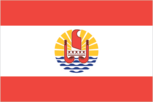
- <strong>description:</strong> two horizontal red bands flank a wide white band in a 1:2:1 ratio; centered on the white band is a disk with a blue-and-white wave pattern depicting the sea on the lower half and a gold-and-white ray pattern depicting the sun on the upper half; a stylized red Polynesian canoe on the disk has a crew of five, represented by five stars <br><br><strong>meaning: </strong>the stars symbolize the five island groups; red and white are traditional Polynesian colors
- note
- <strong>note 1:</strong> similar to the red-white-red flag of Tahiti, the largest and most populous of the French Polynesian islands, but the Tahitian flag has no emblem on the white band<br><br><strong>note 2:</strong> the flag of France is used for official occasions
The flag of French Polynesia has two red horizontal bands flanking a wide white band in a 1:2:1 ratio. Centered on the white band is a disk with a blue-and-white wave pattern depicting the sea on the lower half and a gold-and-white ray pattern depicting the sun on the upper half. A canoe on the disk has a crew of five.
- svg
- https://flagcdn.com/pf.svg
French Polynesia has acquired autonomy from France in all areas except those relating to police, monetary policy, tertiary education, immigration, and defense and foreign affairs; the duties of its president are similar to those of the French prime minister
parliamentary democracy (Assembly of French Polynesia); an overseas collectivity of France
none (overseas land of France)
ITUC (NGOs), PIF, SPC, UPU, WMO
- Highest court(s)
- Court of Appeal or Cour d'Appel (composition NA)
- Judge selection and term of office
- judges assigned from France for 3 years
- Note
- <strong>note: </strong>appeals beyond the French Polynesia Court of Appeal are heard by the Court of Cassation (in Paris)
- Subordinate courts
- Court of the First Instance or Tribunal de Première Instance; Court of Administrative Law or Tribunal Administratif
the laws of France apply
- Electoral system
- proportional representation
- Expected date of next election
- 2028
- Legislative structure
- unicameral
- Legislature name
- Assembly of French Polynesia (Assemblée de la Polynésie française)
- Most recent election date
- 4/30/2023
- Note
- <strong>note 1:</strong> elections held in two rounds; in the second round, 38 members are directly elected in multi-seat constituencies by a closed-list proportional representation vote; the party receiving the most votes gets an additional 19 seats<br><br><strong>note 2:</strong> French Polynesia indirectly elects 2 senators to the French Senate for 6-year terms with one-half the membership renewed every 3 years and directly elects 3 deputies to the French National Assembly for 5-year terms
- Number of seats
- 57 (directly elected)
- Parties elected and seats per party
- People's Servant People (38); List of the People (15); I Love Polynesia (3); Rally of the Mahoi People (1)
- Percentage of women in chamber
- 49.1%
- Scope of elections
- full renewal
- Term in office
- 5 years
red, white
- Selected World Heritage Site locales
- Taputapuātea (c); Te Henua Enata – The Marquesas Islands (m)
- Total World Heritage Sites
- 2 (1 cultural, 1 mixed); note - excerpted from the France entry
- Fête de la Fédération, 14 July (1790)
- note
- <strong>note 1:</strong> the local holiday is Internal Autonomy Day, 29 June (1880)<br><br><strong>note 2:</strong> often incorrectly referred to as Bastille Day, France's national celebration commemorates the storming of the Bastille prison on 14 July 1789 and the establishment of a constitutional monarchy; other names for the holiday are <em>la Fête nationale</em> (National Holiday) and <em>le Quatorze Juillet</em> (14th of July)
outrigger canoe, Tahitian gardenia flower (<em>Gardenia taitensis</em>)
I Love Polynesia (A here la Porinetia) <br>List of the People (Tapura Huiraatira) <br>People's Servant Party (Tavini Huiraatira) <br>Rally of the Maohi People (Amuitahiraʻa o te Nunaʻa Maohi) (formerly known as Popular Rally (Tahoeraa Huiraatira))
Monday
18 years of age; universal
No
Economy
- coconuts, fruits, cassava, sugarcane, pineapples, eggs, tropical fruits, watermelons, tomatoes, pork (2023)
- note
- <b>note:</b> top ten agricultural products based on tonnage
- code
- XPF
- name
- CFP franc (XPF) [₣]
- Current account balance 2014
- $264.32 million (2014 est.)
- Current account balance 2015
- $291.182 million (2015 est.)
- Current account balance 2016
- $411.963 million (2016 est.)
- Note
- <b>note:</b> balance of payments - net trade and primary/secondary income in current dollars
small, territorial-island tourism-based economy; large French financing; lower EU import duties; Pacific Islands Forum member; fairly resilient from COVID-19; oil-dependent infrastructure
- Currency
- Comptoirs Francais du Pacifique francs (XPF) per US dollar -
- Exchange rates 2020
- 104.711 (2020 est.)
- Exchange rates 2021
- 100.88 (2021 est.)
- Exchange rates 2022
- 113.474 (2022 est.)
- Exchange rates 2023
- 110.347 (2023 est.)
- Exchange rates 2024
- 110.306 (2024 est.)
- $1.16 billion
- Exports 2019
- $184 million (2019 est.)
- Exports 2020
- $94.4 million (2020 est.)
- Exports 2021
- $162 million (2021 est.)
- Note
- <b>note:</b> balance of payments - exports of goods and services in current dollars
- pearls, fish, aircraft parts, gas turbines, vanilla (2023)
- note
- <b>note:</b> top five export commodities based on value in dollars
- Japan 44%, USA 15%, France 12%, Netherlands 9%, China 5% (2023)
- note
- <b>note:</b> top five export partners based on percentage share of exports
- net inflows
- $-13,866,940
- Exports of goods and services
- 23.1% (2023 est.)
- Government consumption
- 30.5% (2023 est.)
- Household consumption
- 70.4% (2023 est.)
- Imports of goods and services
- -45.6% (2023 est.)
- Investment in fixed capital
- 21.7% (2023 est.)
- Investment in inventories
- 0% (2023 est.)
- Note
- <strong>note:</strong> figures may not total 100% due to rounding or gaps in data collection
- Agriculture
- 2.2% (2020 est.)
- Industry
- 10.6% (2020 est.)
- Note
- <b>note:</b> figures may not total 100% due to non-allocated consumption not captured in sector-reported data
- Services
- 75.9% (2020 est.)
- $6.563 billion (2024 est.)
- note
- <b>note:</b> data in current dollars at official exchange rate
$22,440
$6.96 billion
$23,930
22 % of GDP
- $2.92 billion
- Imports 2019
- $2.24 billion (2019 est.)
- Imports 2020
- $1.75 billion (2020 est.)
- Imports 2021
- $1.66 billion (2021 est.)
- Note
- <b>note:</b> balance of payments - imports of goods and services in current dollars
- cars, packaged medicine, refined petroleum, poultry, broadcasting equipment (2023)
- note
- <b>note:</b> top five import commodities based on value in dollars
- France 26%, China 11%, USA 10%, NZ 7%, Malaysia 4% (2023)
- note
- <b>note:</b> top five import partners based on percentage share of imports
tourism, pearls, agricultural processing, handicrafts, phosphates
- Inflation rate (consumer prices) 2020
- -0.1% (2020 est.)
- Inflation rate (consumer prices) 2021
- 0.5% (2021 est.)
- Inflation rate (consumer prices) 2022
- 6.4% (2022 est.)
- Note
- <strong>note:</strong> annual % change based on consumer prices
- 119,100 (2024 est.)
- note
- <b>note:</b> number of people ages 15 or older who are employed or seeking work
- total
- 120,628 persons
- agriculture
- 1.92%
- industry
- 14.33%
- services
- 83.75%
- Note
- <strong>note:</strong> data in 2015 dollars
- Real GDP (purchasing power parity) 2022
- $5.892 billion (2022 est.)
- Real GDP (purchasing power parity) 2023
- $5.935 billion (2023 est.)
- Real GDP (purchasing power parity) 2024
- $6.007 billion (2024 est.)
- 1.13%
- Note
- <b>note:</b> annual GDP % growth based on constant local currency
- Real GDP growth rate 2021
- 2.1% (2021 est.)
- Real GDP growth rate 2022
- 4.5% (2022 est.)
- Real GDP growth rate 2023
- 3% (2023 est.)
- Note
- <strong>note:</strong> data in 2015 dollars
- Real GDP per capita 2022
- $20,700 (2022 est.)
- Real GDP per capita 2023
- $22,800 (2023 est.)
- Real GDP per capita 2024
- $23,300 (2024 est.)
- $581.56 million
- Note
- <b>note:</b> personal transfers and compensation between resident and non-resident individuals/households/entities
- Remittances 2021
- 9.5% of GDP (2021 est.)
- Remittances 2022
- 10% of GDP (2022 est.)
- Remittances 2023
- 9.1% of GDP (2023 est.)
- 11.66%
- Note
- <b>note:</b> % of labor force seeking employment
- Unemployment rate 2022
- 11.9% (2022 est.)
- Unemployment rate 2023
- 11.8% (2023 est.)
- Unemployment rate 2024
- 11.8% (2024 est.)
- Female
- 41.5% (2024 est.)
- Male
- 33.5% (2024 est.)
- Note
- <b>note:</b> % of labor force ages 15-24 seeking employment
- Total
- 36.9% (2024 est.)
Energy
- Imports
- 1 metric tons (2023 est.)
- Consumption
- 669.5 million kWh (2023 est.)
- Installed generating capacity
- 345,000 kW (2023 est.)
- Transmission/distribution losses
- 42.663 million kWh (2023 est.)
- Electrification - total population
- 100% (2022 est.)
- Fossil fuels
- 66% of total installed capacity (2023 est.)
- hydroelectric
- 23.11%
- Hydroelectricity
- 27% of total installed capacity (2023 est.)
- nuclear
- 0%
- renewable
- 23.73%
- Solar
- 7% of total installed capacity (2023 est.)
- Refined petroleum consumption
- 7,000 bbl/day (2023 est.)
7%
Communications
- per 100 inhabitants
- 36 per 100
- Subscriptions per 100 inhabitants
- 28 (2022 est.)
- Total
- 78,000 (2022 est.)
French public overseas broadcaster Réseau Outre-Mer provides 2 TV channels and 1 radio station; 1 government-owned TV station; a small number of privately owned radio stations (2019)
.pf
- Percent of population
- 73% (2017 est.)
#####
+689
- Subscriptions per 100 inhabitants
- 24 (2023 est.)
- Total subscriptions
- 66,000 (2023 est.)
- subscriptions per 100
- 119 per 100
- Subscriptions per 100 inhabitants
- 119 (2023 est.)
- Total subscriptions
- 334,000 (2023 est.)
Transportation
54 (2025)
F-OH
Right
- By type
- general cargo 14
- Total
- 24 (2023)
- Key ports
- Atuona, Baie Taiohae, Papeete, Port Rikitea, Uturoa, Vaitape
- Large
- 0
- Medium
- 0
- Ports with oil terminals
- 1
- Small
- 1
- Total ports
- 6 (2024)
- Very small
- 5
F
Military and Security
defense is the responsibility of France, and it maintains a military garrison in French Polynesia (Forces Armées en Polynésie Française, FAPF)
no regular military forces
Environment
- From petroleum and other liquids
- 1.01 million metric tonnes of CO2 (2023 est.)
- Total emissions
- 1.01 million metric tonnes of CO2 (2023 est.)
sea-level rise; cyclones, storms, and tsunamis producing floods, landslides, erosion, and reef damage; droughts; fresh water scarcity
0 % of total land area
1 % of total
- Municipal solid waste generated annually
- 147,000 tons (2024 est.)