Introduction
Eritrea won independence from Italian colonial control in 1941, but the UN only established it as an autonomous region within the Ethiopian federation in 1952, after a decade of British administrative control. Ethiopia's full annexation of Eritrea as a province 10 years later sparked a violent 30-year conflict for independence that ended in 1991 with Eritrean fighters defeating government forces. Eritreans overwhelmingly approved independence in a 1993 referendum. ISAIAS Afwerki has been Eritrea's only president since independence; his rule, particularly since 2001, has been characterized by highly autocratic and repressive actions. His government has created a highly militarized society by instituting an unpopular program of mandatory conscription into national service -- divided between military and civilian service -- of indefinite length. <br><br>A two-and-a-half-year border war with Ethiopia that erupted in 1998 ended under UN auspices in 2000. Ethiopia rejected a subsequent 2007 Eritrea-Ethiopia Boundary Commission (EEBC) demarcation. More than a decade of a tense “no peace, no war” stalemate ended in 2018 when the newly elected Ethiopian prime minister accepted the EEBC’s 2007 ruling, and the two countries signed declarations of peace and friendship. Eritrean leaders then engaged in intensive diplomacy around the Horn of Africa, bolstering regional peace, security, and cooperation, as well as brokering rapprochements between governments and opposition groups. In 2018, the UN Security Council lifted an arms embargo that had been imposed on Eritrea since 2009, after the UN Somalia-Eritrea Monitoring Group reported they had not found evidence of Eritrean support in recent years for al-Shabaab. The country’s rapprochement with Ethiopia led to a resumption of economic ties, but the level of air transport, trade, and tourism have remained roughly the same since late 2020. <br><br>The Eritrean economy remains agriculture-dependent, and the country is still one of Africa’s poorest nations. Eritrea faced new international condemnation and US sanctions in mid-2021 for its participation in the war in Ethiopia’s Tigray Regional State, where Eritrean forces were found to have committed war crimes and crimes against humanity. As most Eritrean troops were departing northern Ethiopia in January 2023, ISAIAS began a series of diplomatic engagements aimed at bolstering Eritrea’s foreign partnerships and regional influence. Despite the country's improved relations with its neighbors, ISAIAS has not let up on repression, and conscription and militarization continue.
Geography
- Land
- 101,000 sq km
- Total
- 117,600 sq km
- Water
- 16,600 sq km
slightly smaller than Pennsylvania
hot, dry desert strip along Red Sea coast; cooler and wetter in the central highlands (up to 61 cm of rainfall annually, heaviest June to September); semiarid in western hills and lowlands
2,234 km (mainland on Red Sea 1,151 km; islands in Red Sea 1,083 km)
Africa
- Highest point
- Soira 3,018 m
- Lowest point
- near Kulul within the Danakil Depression -75 m
- Mean elevation
- 853 m
15 00 N, 39 00 E
strategic geopolitical position along world's busiest shipping lanes
210 sq km (2012)
- Border countries
- Djibouti 125 km; Ethiopia 1,033 km; Sudan 682 km
- number of neighbors
- 3
- Total
- 1,840 km
- Agricultural land
- 62.7% (2023 est.)
- Agricultural land: arable land
- arable land: 5.7% (2023 est.)
- Agricultural land: permanent crops
- permanent crops: 0% (2023 est.)
- Agricultural land: permanent pasture
- permanent pasture: 56.9% (2023 est.)
- arable land
- 5.69%
- Forest
- 12% (2023 est.)
- Other
- 25.3% (2023 est.)
- permanent crops
- 0.02%
No
Eastern Africa, bordering the Red Sea, between Djibouti and Sudan
- Google Maps
- https://goo.gl/maps/HRyqUpnPwwG6jY5j6
- OpenStreetMap
- https://www.openstreetmap.org/relation/296961
Africa
- Territorial sea
- 12 nm
frequent droughts, rare earthquakes and volcanoes; locust swarms <br><br><strong>volcanism:</strong> Dubbi (1,625 m), which last erupted in 1861, was the country's only historically active volcano until Nabro (2,218 m) came to life in 2011
gold, potash, zinc, copper, salt, possibly oil and natural gas, fish
density is highest in the center of the country, in and around the cities of Asmara (capital) and Keren; smaller settlements exist in the north and south, as shown in this population distribution map
Eastern Africa
dominated by extension of Ethiopian north-south trending highlands, descending on the east to a coastal desert plain, on the northwest to hilly terrain and on the southwest to flat-to-rolling plains
- UTC+03:00
- number of time zones
- 1
People and Society
- 0-14 years
- 35.7% (male 1,138,382/female 1,123,925)
- 15-64 years
- 60.3% (male 1,882,547/female 1,944,266)
- 65 years and over
- 4% (2024 est.) (male 101,504/female 153,332)
- Beer
- 0.42 liters of pure alcohol (2019 est.)
- Other alcohols
- 0.51 liters of pure alcohol (2019 est.)
- Spirits
- 0 liters of pure alcohol (2019 est.)
- Total
- 0.93 liters of pure alcohol (2019 est.)
- Wine
- 0 liters of pure alcohol (2019 est.)
25.92 births/1,000 population (2025 est.)
- 6.43 deaths/1,000 population (2025 est.)
- adult female
- 159 per 1,000
- adult male
- 217 per 1,000
- Elderly dependency ratio
- 6.6 (2025 est.)
- Potential support ratio
- 15.1 (2025 est.)
- Total dependency ratio
- 64.2 (2025 est.)
- Youth dependency ratio
- 57.6 (2025 est.)
- Tigrinya 50%, Tigre 30%, Saho 4%, Afar 4%, Kunama 4%, Bilen 3%, Hedareb/Beja 2%, Nara 2%, Rashaida 1% (2021 est.)
- note
- <strong>note:</strong> data represent Eritrea's nine recognized ethnic groups
1.65 (2025 est.)
- 4 % of GDP
- Health expenditure (as % of GDP)
- 4.2% of GDP (2021)
- Health expenditure (as % of national budget)
- 2.4% of national budget (2022 est.)
0.18%
1 beds/1,000 population (2020 est.)
- Female
- 32.8 deaths/1,000 live births
- Male
- 46.6 deaths/1,000 live births
- neonatal
- 16 deaths/1,000 live births
- Total
- 39 deaths/1,000 live births (2025 est.)
- Tigrinya (official), Arabic (official), English (official), Tigre, Kunama, Afar, other Cushitic languages
- languages
- Arabic, English, Tigrinya
- number of languages
- 3
- Female
- 70.2 years
- Male
- 64.9 years
- Total population
- 67.5 years (2024 est.)
1.073 million ASMARA (capital) (2023)
291 deaths/100,000 live births (2023 est.)
- Female
- 21.8 years
- Male
- 20.8 years
- Total
- 21.7 years (2025 est.)
- 21.3 years (2010 est.)
- note
- <strong>note:</strong> data represents median age at first birth among women 25-29
- Adjective
- Eritrean
- Noun
- Eritrean(s)
-7.95 migrant(s)/1,000 population (2025 est.)
5% (2016)
0.09 physicians/1,000 population (2022)
- Female
- 3,258,154
- Male
- 3,158,281
- Total
- 6,416,435 (2025 est.)
1.16% (2025 est.)
Eritrean Orthodox, Roman Catholic, Evangelical Lutheran, Sunni Muslim
- Female
- 7 years (2015 est.)
- Male
- 9 years (2015 est.)
- Total
- 8 years (2015 est.)
- 0-14 years
- 1.01 male(s)/female
- 15-64 years
- 0.97 male(s)/female
- 65 years and over
- 0.66 male(s)/female
- At birth
- 1.03 male(s)/female
- Total population
- 0.97 male(s)/female (2024 est.)
- Female
- 0.2% (2020 est.)
- Male
- 14.7% (2020 est.)
- Total
- 7.5% (2020 est.)
3.35 children born/woman (2025 est.)
- Rate of urbanization
- 3.67% annual rate of change (2020-25 est.)
- Urban population
- 43.3% of total population (2023)
- measles
- 93%
Government
6 regions (<em>zobatat</em>, singular - <em>zoba</em>); 'Anseba, Debub (South), Debubawi K'eyyih Bahri (Southern Red Sea), Gash-Barka, Ma'ikel (Central), Semienawi K'eyyih Bahri (Northern Red Sea)
- Etymology
- the name's origin is unclear; according to Tigrinya oral tradition, the name is part of a phrase meaning "the women made them unite," referring to a group of women who made four clans unite to defeat a common enemy; <em>asmara </em>also means "flowery wood" in the Tigrinya language
- Geographic coordinates
- 15 20 N, 38 56 E
- Name
- Asmara
- Time difference
- UTC+3 (8 hours ahead of Washington, DC, during Standard Time)
- Citizenship by birth
- no
- Citizenship by descent only
- at least one parent must be a citizen of Eritrea
- Dual citizenship recognized
- no
- Residency requirement for naturalization
- 20 years
- svg
- https://mainfacts.com/media/images/coats_of_arms/er.svg
- Amendment process
- proposed by the president of Eritrea or by assent of at least one half of the National Assembly membership; passage requires at least an initial three-quarters majority vote by the Assembly and, after one year, final passage by at least four-fifths majority vote by the Assembly
- History
- ratified by the Constituent Assembly 23 May 1997 (never implemented)
- alternative spellings
- ER, State of Eritrea, ሃገረ ኤርትራ, Dawlat Iritriyá, ʾErtrā, Iritriyā
- Conventional long form
- State of Eritrea
- Conventional short form
- Eritrea
- Etymology
- the country name derives from the ancient Greek name <em>Erythra Thalassa</em>, meaning "Red Sea," the body of water that borders the country
- FIFA code
- ERI
- Former
- Eritrea Autonomous Region in Ethiopia
- Local long form
- Hagere Ertra
- local long form (ara)
- دولة إرتريا
- Local short form
- Ertra
- Chief of mission
- Ambassador (vacant); Chargé d'Affaires Christine E. MEYER (since July 2025)
- Email address and website
- <br>consularasmara@state.gov<br><br>https://er.usembassy.gov/
- Embassy
- 179 Alaa Street, Asmara
- FAX
- [291] (1) 12-75-84
- Mailing address
- 7170 Asmara Place, Washington DC 20521-7170
- Telephone
- [291] (1) 12-00-04
- Chancery
- 1708 New Hampshire Avenue NW, Washington, DC 20009
- Chief of mission
- Ambassador (vacant); Chargé d'Affaires Berhane Gebrehiwet SOLOMON (since 15 March 2011)
- Email address and website
- <br>embassyeritrea@embassyeritrea.org<br><br>https://us.embassyeritrea.org/
- FAX
- [1] (202) 319-1304
- Telephone
- [1] (202) 319-1991
- Cabinet
- State Council appointed by the president
- Chief of state
- President ISAIAS Afwerki (since 24 May 1993)
- Election results
- <em><br>1993:</em> ISAIAS Afwerki elected president by the transitional National Assembly; percent of National Assembly vote - ISAIAS Afwerki (PFDJ) 95%, other 5%
- Election/appointment process
- president indirectly elected by the National Assembly for a 5-year term (eligible for a second term), according to the constitution
- Expected date of next election
- postponed indefinitely
- Head of government
- President ISAIAS Afwerki (since 8 June 1993)
- Most recent election date
- 24 May 1993, following independence from Ethiopia
- Note
- <strong>note 1: </strong>Eritrea’s authoritarian regime is controlled entirely by the president, who heads the sole political party, which has ruled the country since 1991; national elections have not taken place since 1991 and the constitution has not been implemented.<strong><br><br>note 2:</strong> the president is both chief of state and head of government and is head of the State Council and National Assembly
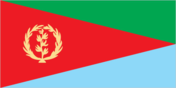
- <strong>description:</strong> a red isosceles triangle (based on the left side) divides the flag into two right triangles; the upper triangle is green, the lower is blue; a gold wreath around a gold olive branch is on the left side of the red triangle<br><br><strong>meaning:</strong> green stands for the country's agriculture economy, red for the blood shed in the fight for freedom, and blue for the sea's bounty; the shape of the red triangle mimics the country's shape
- note
- <strong>note:</strong> one of four national flags that reflect the country's shape in the flag design; the others are Bosnia and Herzegovina, Brazil, and Vanuatu
The flag of Eritrea comprises three triangles — a large red isosceles triangle with its base spanning the hoist end and its apex at the midpoint on the fly end, and a green and blue right-angled triangle above and beneath the red triangle. On the hoist side of the red triangle is a golden vertical olive branch encircled by a golden olive wreath.
- svg
- https://flagcdn.com/er.svg
authoritarian
24 May 1993 (from Ethiopia)
has not submitted an ICJ jurisdiction declaration; non-party state to the ICCt
ACP, AfDB, AU, COMESA, FAO, G-77, IAEA, IBRD, ICAO, ICC (NGOs), IDA, IFAD, IFC, IFRCS (observer), IGAD, ILO, IMF, IMO, Interpol, IOC, ISO (correspondent), ITU, ITUC (NGOs), LAS (observer), MIGA, NAM, OPCW, PCA, UN, UNCTAD, UNESCO, UNHRC, UNIDO, UNWTO, UPU, WCO, WFTU (NGOs), WHO, WIPO, WMO
- Highest court(s)
- High Court (consists of 20 judges and organized into civil, commercial, criminal, labor, administrative, and customary sections)
- Judge selection and term of office
- High Court judges appointed by the president
- Subordinate courts
- regional/zonal courts; community courts; special courts; sharia courts (for issues dealing with Muslim marriage, inheritance, and family); military courts
mixed system of civil, customary, and Islamic religious law
- Legislative structure
- unicameral
- Legislature name
- National Assembly (Hagerawi Baito)
- Most recent election date
- 2/1/1994
- Note
- <strong>note:</strong> in 1997, after the new constitution was adopted, the government formed a Transitional National Assembly to serve as the country's legislative body until countrywide elections to form a National Assembly could be held; the constitution stipulates that once past the transition stage, all National Assembly members will be elected by secret ballot of all eligible voters; National Assembly elections scheduled for December 2001 were postponed indefinitely due to the war with Ethiopia; as of 2025, no sitting legislative body exists
- Number of seats
- 150 (all indirectly elected)
- Scope of elections
- full renewal
- Term in office
- 4 years
Eritrea adopted its coat of arms on May 24, 1993, when it won independence from Ethiopia; the camel was used to transport supplies and goods during the war, and it became a symbol of the country’s success; the olive wreath represents peace, reconciliation, and harmony; under the camel is name of the country in its three official languages: Tigrinya, English, and Arabic
green, red, blue
- Selected World Heritage Site locales
- Asmara: A Modernist African City
- Total World Heritage Sites
- 1 (cultural)
Independence Day, 24 May (1991)
camel
People's Front for Democracy and Justice or PFDJ (the only party recognized by the government)
Monday
18 years of age; universal
Yes
Economy
- sorghum, milk, barley, vegetables, root vegetables, cereals, pulses, wheat, beef, maize (2023)
- note
- <b>note:</b> top ten agricultural products based on tonnage
- Expenditures
- $549 million (2018 est.)
- Revenues
- $633 million (2018 est.)
- code
- ERN
- name
- Eritrean nakfa (ERN) [Nfk]
- $693.28 million
- Debt - external 2023
- $461.376 million (2023 est.)
- Note
- <b>note:</b> present value of external debt in current US dollars
largely agrarian economy with a significant mining sector; substantial fiscal surplus due to tight controls; high and vulnerable debts; increased Ethiopian trade and shared port usage decreasing prices; financial and economic data integrity challenges
- Currency
- nakfa (ERN) per US dollar -
- Exchange rates 2020
- 15.075 (2020 est.)
- Exchange rates 2021
- 15.075 (2021 est.)
- Exchange rates 2022
- 15.075 (2022 est.)
- Exchange rates 2023
- 15.075 (2023 est.)
- Exchange rates 2024
- 15.075 (2024 est.)
- Exports 2011
- $374.898 million (2011 est.)
- Exports 2016
- $485.4 million (2016 est.)
- Exports 2017
- $624.3 million (2017 est.)
- copper ore, zinc ore, gold, garments, liquor (2023)
- note
- <b>note:</b> top five export commodities based on value in dollars
- China 67%, UAE 26%, Philippines 5%, Italy 1%, Croatia 1% (2023)
- note
- <b>note:</b> top five export partners based on percentage share of exports
- net inflows
- $-27,949,590
- $2.535 billion (2024 est.)
- note
- <strong>note:</strong> data in current dollars at official exchange rate
- Imports 2009
- $435.275 million (2009 est.)
- Imports 2010
- $494.229 million (2010 est.)
- trucks, sorghum, construction vehicles, wheat flours, other foods (2023)
- note
- <b>note:</b> top five import commodities based on value in dollars
- China 32%, UAE 27%, Turkey 9%, USA 7%, Italy 5% (2023)
- note
- <b>note:</b> top five import partners based on percentage share of imports
food processing, beverages, clothing and textiles, light manufacturing, salt, cement
- Inflation rate (consumer prices) 2020
- 5.6% (2020 est.)
- Inflation rate (consumer prices) 2021
- 6.6% (2021 est.)
- Inflation rate (consumer prices) 2022
- 7.4% (2022 est.)
- Note
- <strong>note:</strong> annual % change based on consumer prices
- 1.71 million (2024 est.)
- note
- <b>note:</b> number of people ages 15 or older who are employed or seeking work
- total
- 1.76 million persons
- agriculture
- 55.48%
- industry
- 12.74%
- services
- 31.78%
- Public debt 2016
- 132.8% of GDP (2016 est.)
- Note
- <strong>note:</strong> data in 2015 dollars
- Real GDP (purchasing power parity) 2022
- $2.398 billion (2022 est.)
- Real GDP (purchasing power parity) 2023
- $2.465 billion (2023 est.)
- Real GDP (purchasing power parity) 2024
- $2.534 billion (2024 est.)
- Real GDP growth rate 2015
- 2.6% (2015 est.)
- Real GDP growth rate 2016
- 1.9% (2016 est.)
- Real GDP growth rate 2017
- 5% (2017 est.)
- Note
- <strong>note:</strong> data in 2015 dollars
- Real GDP per capita 2022
- $700 (2022 est.)
- Real GDP per capita 2023
- $700 (2023 est.)
- Real GDP per capita 2024
- $700 (2024 est.)
- Note
- <b>note:</b> holdings of gold (year-end prices)/foreign exchange/special drawing rights in current dollars
- Reserves of foreign exchange and gold 2017
- $143.412 million (2017 est.)
- Reserves of foreign exchange and gold 2018
- $163.034 million (2018 est.)
- Reserves of foreign exchange and gold 2019
- $191.694 million (2019 est.)
- 5.98%
- Note
- <b>note:</b> % of labor force seeking employment
- Unemployment rate 2022
- 5.7% (2022 est.)
- Unemployment rate 2023
- 5.6% (2023 est.)
- Unemployment rate 2024
- 5.6% (2024 est.)
- Female
- 10.5% (2024 est.)
- Male
- 8.5% (2024 est.)
- Note
- <b>note:</b> % of labor force ages 15-24 seeking employment
- Total
- 9.4% (2024 est.)
Energy
- Consumption
- 388.987 million kWh (2023 est.)
- consumption per capita
- 102 kWh
- Installed generating capacity
- 243,000 kW (2023 est.)
- Transmission/distribution losses
- 51.528 million kWh (2023 est.)
- Electrification - rural areas
- 36%
- Electrification - total population
- 55.4% (2022 est.)
- Electrification - urban areas
- 75.5%
- Fossil fuels
- 89.1% of total installed capacity (2023 est.)
- hydroelectric
- 0%
- nuclear
- 0%
- renewable
- 5.79%
- Solar
- 10.7% of total installed capacity (2023 est.)
- Wind
- 0.2% of total installed capacity (2023 est.)
- 290 kg of oil equivalent
- Total energy consumption per capita 2023
- 2.977 million Btu/person (2023 est.)
- Refined petroleum consumption
- 5,000 bbl/day (2023 est.)
80.7%
Communications
- per 100 inhabitants
- 0 per 100
- Subscriptions per 100 inhabitants
- (2022 est.) less than 1
- Total
- 6,000 (2022 est.)
government controls broadcast media, with private ownership prohibited; 1 state-owned TV station; 2 state-owned radio networks; purchases of satellite dishes and subscriptions to international broadcast media are permitted (2023)
.er
- Percent of population
- 20% (2023 est.)
+291
- Subscriptions per 100 inhabitants
- 2 (2022 est.)
- Total subscriptions
- 68,200 (2022 est.)
- subscriptions per 100
- 59 per 100
- Subscriptions per 100 inhabitants
- 59 (2022 est.)
- Total subscriptions
- 2.02 million (2022 est.)
Transportation
11 (2025)
E3
Right
- By type
- general cargo 4, oil tanker 1, other 4
- Total
- 9 (2023)
- Key ports
- Assab, Mitsiwa Harbor
- Large
- 0
- Medium
- 0
- Ports with oil terminals
- 2
- Small
- 2
- Total ports
- 2 (2024)
- Very small
- 0
- Narrow gauge
- 306 km (2018) 0.950-m gauge
- Total
- 306 km (2018)
ER
Military and Security
- armored vehicles
- tanks
the military’s primary responsibilities are external defense, border security, and providing the regime a vehicle for national cohesion; the conscript-based Army is the dominant service<br><br>since the country's independence in 1991, the Eritrean military has participated in numerous conflicts, including the Hanish Island Crisis with Yemen (1995), the First Congo War (1996-1997), the Second Sudanese Civil War (1996-1998), the Eritrea-Ethiopia War (1998-2000), the Djiboutian-Eritrean border conflict (2008), and the Tigray conflict in Ethiopia (2020-2022); during the Tigray conflict, the Eritrean Defense Forces were accused of human rights abuses; in recent years, it has provided training support to the military of Somalia (2025)
- Eritrean Defense Forces (EDF): Eritrean Ground Forces, Eritrean Navy, Eritrean Air Force; People's Militia (aka People's Army or Hizbawi Serawit) (2024)
- active duty personnel
- 202,000
- note
- <strong>note: </strong>police are responsible for maintaining internal security, but the government sometimes uses the armed forces, reserves, demobilized soldiers, or civilian militia to meet domestic as well as external security requirements; the armed forces have authority to arrest and detain civilians
- percent of total labor force
- 13.29 %
available information varies widely; estimated 150,000-200,000 active Defense Forces (2025)
the EDF's inventory is comprised primarily of Soviet-era weapons and equipment (2025)
- Military Expenditures 2015
- 10.6% of GDP (2015 est.)
- Military Expenditures 2016
- 10.4% of GDP (2016 est.)
- Military Expenditures 2017
- 10.3% of GDP (2017 est.)
- Military Expenditures 2018
- 10.2% of GDP (2018 est.)
- Military Expenditures 2019
- 10% of GDP (2019 est.)
Eritrea mandates military service for all citizens age 18-40; 18-month conscript service obligation, which reportedly includes 4-6 months of military training and 12 months of military or other national service (military service is most common); in practice, military and national service is often extended indefinitely; citizens up to the age of 59 eligible for recall during mobilization (2025)
- PowerIndex score
- 2.6841
Transnational Issues
- Refugees
- 119 (2024 est.)
- Tier rating
- Tier 3 — Eritrea does not fully meet the minimum standards for the elimination of trafficking and is not making significant efforts to do so, therefore Eritrea remained on Tier 3; for more details, go to: https://www.state.gov/reports/2025-trafficking-in-persons-report/eritrea/
Environment
- From petroleum and other liquids
- 733,000 metric tonnes of CO2 (2023 est.)
- Total emissions
- 733,000 metric tonnes of CO2 (2023 est.)
deforestation; desertification; soil erosion; overgrazing
- Party to
- Biodiversity, Climate Change, Climate Change-Kyoto Protocol, Comprehensive Nuclear Test Ban, Desertification, Endangered Species, Hazardous Wastes, Ozone Layer Protection, Whaling
- Signed, but not ratified
- Climate Change-Paris Agreement
- Agriculture
- 117.4 kt (2019-2021 est.)
- Energy
- 15.7 kt (2022-2024 est.)
- Other
- 2.8 kt (2019-2021 est.)
- Waste
- 20.5 kt (2019-2021 est.)
22.7 micrograms per cubic meter (2019 est.)
0 % of total land area
6 % of total
7.315 billion cubic meters (2022 est.)
- 21 % of internal resources
- Agricultural
- 550 million cubic meters (2022 est.)
- Industrial
- 1 million cubic meters (2022 est.)
- Municipal
- 31 million cubic meters (2022 est.)
- Municipal solid waste generated annually
- 727,000 tons (2024 est.)
- Percent of municipal solid waste recycled
- 6.8% (2022 est.)