Introduction
Upon independence in 1960, the former French region of Middle Congo became the Republic of the Congo. From 1968 to 1992, the country was named the People’s Republic of the Congo. A quarter-century of experimentation with Marxism was abandoned in 1990, and a democratically elected government took office in 1992, at which time the country reverted to "the Republic of the Congo" name. A two-year civil war that ended in 1999 restored to power former President Denis SASSOU-Nguesso, who had ruled from 1979 to 1992. A new constitution adopted three years later provided for a multi-party system and a seven-year presidential term, and the next elections retained SASSOU-Nguesso. After a year of renewed fighting, SASSOU-Nguesso and southern-based rebel groups agreed to a final peace accord in 2003. SASSOU-Nguesso was reelected in 2009 and, after passing a constitutional referendum allowing him to run for additional terms, was reelected again in 2016 and 2021. The Republic of the Congo is one of Africa's largest petroleum producers.
Geography
- Land
- 341,500 sq km
- Total
- 342,000 sq km
- Water
- 500 sq km
slightly smaller than Montana; about twice the size of Florida
tropical; rainy season (March to June); dry season (June to October); persistent high temperatures and humidity; particularly enervating climate astride the Equator
169 km
Africa
- Highest point
- Mont Nabeba 1,020 m
- Lowest point
- Atlantic Ocean 0 m
- Mean elevation
- 430 m
1 00 S, 15 00 E
about 70% of the population lives in Brazzaville, Pointe-Noire, or along the railroad between them
20 sq km (2012)
- Border countries
- Angola 231 km; Cameroon 494 km; Central African Republic 487 km; Democratic Republic of the Congo 1,775 km; Gabon 2,567 km
- number of neighbors
- 5
- Total
- 5,554 km
- Agricultural land
- 31.2% (2023 est.)
- Agricultural land: arable land
- arable land: 1.6% (2023 est.)
- Agricultural land: permanent crops
- permanent crops: 0.3% (2023 est.)
- Agricultural land: permanent pasture
- permanent pasture: 29.3% (2023 est.)
- arable land
- 1.61%
- Forest
- 63.9% (2023 est.)
- Other
- 4.9% (2023 est.)
- permanent crops
- 0.3%
No
Central Africa, bordering the South Atlantic Ocean, between Angola and Gabon
Congo Basin
Oubangui (Ubangi) (shared with Central African Republic [s] and Democratic Republic of Congo [m]) - 2,270 km<br><br><strong>note:</strong> [s] after country name indicates river source; [m] after country name indicates river mouth
- Atlantic Ocean drainage
- Congo (3,730,881 sq km)
- Google Maps
- https://goo.gl/maps/Phf5dDDKdfCtuBTb6
- OpenStreetMap
- https://www.openstreetmap.org/relation/192794
Africa
- Contiguous zone
- 24 nm
- Exclusive economic zone
- 200 nm
- Territorial sea
- 12 nm
seasonal flooding
petroleum, timber, potash, lead, zinc, uranium, copper, phosphates, gold, magnesium, natural gas, hydropower
the population is primarily located in the south, in and around the capital of Brazzaville, as shown in this population distribution map
Middle Africa
coastal plain, southern basin, central plateau, northern basin
- UTC+01:00
- number of time zones
- 1
People and Society
- 0-14 years
- 37.8% (male 1,162,298/female 1,143,668)
- 15-64 years
- 57.8% (male 1,770,337/female 1,756,925)
- 65 years and over
- 4.3% (2024 est.) (male 113,338/female 151,099)
- Beer
- 5.11 liters of pure alcohol (2019 est.)
- Other alcohols
- 0.01 liters of pure alcohol (2019 est.)
- Spirits
- 0.52 liters of pure alcohol (2019 est.)
- Total
- 5.74 liters of pure alcohol (2019 est.)
- Wine
- 0.1 liters of pure alcohol (2019 est.)
28.34 births/1,000 population (2025 est.)
- Men married by age 18
- 5.6% (2018 est.)
- Women married by age 15
- 6.9% (2015)
- Women married by age 18
- 27.3% (2015)
51.8% (2023 est.)
- 4.64 deaths/1,000 population (2025 est.)
- adult female
- 216 per 1,000
- adult male
- 273 per 1,000
- Elderly dependency ratio
- 7.5 (2024 est.)
- Potential support ratio
- 13.3 (2024 est.)
- Total dependency ratio
- 72.9 (2024 est.)
- Youth dependency ratio
- 65.4 (2024 est.)
- improved total
- 45.87%
- Education expenditure (% GDP)
- 3.3% of GDP (2023 est.)
- Education expenditure (% national budget)
- 14.7% national budget (2023 est.)
3 % of GDP
Kongo (Bakongo) 40.5%, Teke 16.9%, Mbochi 13.1%, foreigner 8.2%, Sangha 5.6%, Mbere/Mbeti/Kele 4.4%, Punu 4.3%, Pygmy 1.6%, Oubanguiens 1.6%, Duma 1.5%, Makaa 1.3%, other and unspecified 1% (2014-15 est.)
1.83 (2025 est.)
- 3 % of GDP
- Health expenditure (as % of GDP)
- 3.9% of GDP (2021)
- Health expenditure (as % of national budget)
- 3.5% of national budget (2022 est.)
2.7%
- Female
- 27.7 deaths/1,000 live births
- Male
- 33.5 deaths/1,000 live births
- neonatal
- 18 deaths/1,000 live births
- Total
- 29.9 deaths/1,000 live births (2025 est.)
- Languages
- French (official), French Lingala and Monokutuba (trade languages), many local languages and dialects (of which Kikongo is the most widespread)
- Major-language sample(s)
- <br>Buku oyo ya bosembo ya Mokili Mobimba Ezali na Makanisi ya Liboso Mpenza. (Lingala)<br><br>The World Factbook, the indispensable source for basic information.
- number of languages
- 3
- Female
- 74.3 years
- Male
- 71.5 years
- Total population
- 72.9 years (2024 est.)
2.638 million BRAZZAVILLE (capital), 1.336 million Pointe-Noire (2023)
241 deaths/100,000 live births (2023 est.)
- Female
- 20.9 years
- Male
- 20.5 years
- Total
- 20.9 years (2025 est.)
- 19.6 years (2011/12 est.)
- note
- <strong>note:</strong> data represents median age at first birth among women 20-49
- Adjective
- Congolese or Congo
- Noun
- Congolese (singular and plural)
-0.08 migrant(s)/1,000 population (2025 est.)
9.6% (2016)
0.17 physicians/1,000 population (2022)
- Female
- 3,051,692
- Male
- 3,045,973
- Total
- 6,097,665 (2024 est.)
2.36% (2025 est.)
Roman Catholic 33.1%, Awakening Churches/Christian Revival 22.3%, Protestant 19.9%, Salutiste 2.2%, Muslim 1.6%, Kimbanguist 1.5%, other 8.1%, none 11.3% (2007 est.)
- 0-14 years
- 1.02 male(s)/female
- 15-64 years
- 1.01 male(s)/female
- 65 years and over
- 0.75 male(s)/female
- At birth
- 1.03 male(s)/female
- Total population
- 1 male(s)/female (2024 est.)
- Female
- 1.7% (2025 est.)
- Male
- 30% (2025 est.)
- Total
- 15.8% (2025 est.)
3.72 children born/woman (2025 est.)
- Rate of urbanization
- 3.19% annual rate of change (2020-25 est.)
- Urban population
- 69.2% of total population (2023)
- measles
- 72%
Government
15 departments; Bouenza, Brazzaville, Congo-Oubangui, Cuvette, Cuvette-Ouest, Djoue-Lefini, Kouilou, Lekoumou, Likouala, Niari, Nkeni-Alima, Plateaux, Pointe-Noire, Pool, Sangha
- Etymology
- named after the Italian-born French explorer and humanitarian, Pierre Savorgnan de BRAZZA (1852-1905), who founded the town in 1883
- Geographic coordinates
- 4 15 S, 15 17 E
- Name
- Brazzaville
- Time difference
- UTC+1 (6 hours ahead of Washington, DC, during Standard Time)
- Citizenship by birth
- no
- Citizenship by descent only
- at least one parent must be a citizen of the Republic of the Congo
- Dual citizenship recognized
- no
- Residency requirement for naturalization
- 10 years
- svg
- https://mainfacts.com/media/images/coats_of_arms/cd.svg
- Amendment process
- proposed by the president of the republic or by Parliament; passage of presidential proposals requires Supreme Court review followed by approval in a referendum; such proposals may also be submitted directly to Parliament, in which case passage requires at least three-quarters majority vote of both houses in joint session; proposals by Parliament require three-fourths majority vote of both houses in joint session; constitutional articles including those affecting the country’s territory, republican form of government, and secularity of the state are not amendable
- History
- several previous; latest approved by referendum 25 October 2015
- alternative spellings
- CG, Congo, Congo-Brazzaville
- Conventional long form
- Republic of the Congo
- Conventional short form
- Congo (Brazzaville)
- Etymology
- named for the Congo River, which makes up much of the country's eastern border; the river name derives from Kongo, a Bantu kingdom in the area
- FIFA code
- CGO
- Former
- French Congo, Middle Congo, People's Republic of the Congo, Congo/Brazzaville
- Local long form
- République du Congo
- local long form (fra)
- République du Congo
- Local short form
- Congo
- Chief of mission
- Ambassador (vacant); Chargé d’Affaires Amanda S. JACOBSEN (since 18 July 2025)
- Email address and website
- <br>BrazzavilleACS@state.gov<br><br>https://cg.usembassy.gov/
- Embassy
- 70-83 Section D, Boulevard Denis Sassou N'Guesso, Brazzaville
- Mailing address
- 2090 Brazzaville Place, Washington DC 20521-2090
- Telephone
- [242] 06 612-2000, [242] 05 387-9700
- Chancery
- 1720 16th Street NW, Washington, DC 20009
- Chief of mission
- Ambassador (vacant); Chargé d'Affaires Firmine BOUITY (since 6 September 2025)
- Email address and website
- <br>info@ambacongo-us.org<br><br>http://www.ambacongo-us.org/en-us/home.aspx
- FAX
- [1] (202) 726-1860
- Telephone
- [1] (202) 726-5500
- Cabinet
- Council of Ministers appointed by the president
- Chief of state
- President Denis SASSOU-Nguesso (since 1997)
- Election results
- <br><em>2021: </em>Denis SASSOU-Nguesso reelected president in the first round; percent of vote - Denis SASSOU-Nguesso (PCT) 88.4%, Guy Price Parfait KOLELAS (MCDDI) 8.0%, other 3.6% <br><br><em>2016: </em>Denis SASSOU-Nguesso reelected president in the first round; percent of vote - Denis SASSOU-Nguesso (PCT) 60.4%, Guy Price Parfait KOLELAS (MCDDI) 15.1%, Jean-Marie MOKOKO (independent) 13.9%, Pascal Tsaty MABIALA (UPADS) 4.4%, other 6.2%
- Election/appointment process
- president directly elected by absolute majority popular vote in 2 rounds, if needed, for a 5-year term (eligible for 2 additional terms)
- Expected date of next election
- 21 March 2026
- Head of government
- Prime Minister Anatole Collinet MAKOSSO (since 12 May 2021)
- Most recent election date
- 21 March 2021
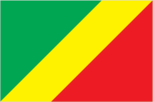
- <strong>description:</strong> divided diagonally from the lower-left side by a wide yellow band; the upper triangle (left side) is green, and the lower triangle is red<br><br><strong>meaning:</strong> green stands for agriculture and forests, and yellow for the people's friendship and nobility; the meaning of the red color is not noted but has been associated with the struggle for independence
- note
- <strong>history:</strong> uses the colors of the Pan-African movement
The flag of the Republic of the Congo features a yellow diagonal band that extends from the lower hoist-side corner to the upper fly-side corner of the field. Above and beneath this band are a green and red triangle respectively.
- svg
- https://flagcdn.com/cg.svg
presidential republic
15 August 1960 (from France)
has not submitted an ICJ jurisdiction declaration; accepts ICCt jurisdiction
ACP, AfDB, AU, BDEAC, CEMAC, EITI (compliant country), FAO, FZ, G-77, IAEA, IBRD, ICAO, ICCt, ICRM, IDA, IFAD, IFC, IFRCS, ILO, IMF, IMO, Interpol, IOC, IOM, IPU, ISO (correspondent), ITSO, ITU, ITUC (NGOs), LCBC (observer), MIGA, NAM, OIF, OPCW, UN, UNCTAD, UNESCO, UNHCR, UNIDO, UNWTO, UPU, WCO, WFTU (NGOs), WHO, WIPO, WMO, WTO
- Highest court(s)
- Supreme Court or Cour Supreme (consists of NA judges); Constitutional Court (consists of 9 members)
- Judge selection and term of office
- Supreme Court judges elected by Parliament and serve until age 65; Constitutional Court members appointed by the president of the republic - 3 directly by the president and 6 nominated by Parliament; members appointed for renewable 9-year terms with one third of the membership renewed every 3 years
- Note
- <strong>note:</strong> a High Court of Justice, outside the judicial authority, tries cases involving treason by the President of the Republic
- Subordinate courts
- Court of Audit and Budgetary Discipline; courts of appeal; regional and district courts; employment tribunals; juvenile courts
mixed system of French civil law and customary law
- Legislative structure
- bicameral
- Legislature name
- Parliament (Parlement)
- Chamber name
- National Assembly (Assemblée nationale)
- Electoral system
- plurality/majority
- Expected date of next election
- July 2026
- Most recent election date
- 8/20/2023
- Number of seats
- 151 (all directly elected)
- Parties elected and seats per party
- Congolese Workers Party (PCT) (112); Other (39)
- Percentage of women in chamber
- 14.6%
- Scope of elections
- full renewal
- Term in office
- 5 years
- Chamber name
- Senate (Sénat)
- Expected date of next election
- August 2029
- Most recent election date
- 7/10/2022 to 7/31/2022
- Number of seats
- 72 (all indirectly elected)
- Percentage of women in chamber
- 31.9%
- Scope of elections
- full renewal
- Term in office
- 6 years
green, yellow, red
- Selected World Heritage Site locales
- Sangha Trinational Forest; Forest Massif of Odzala-Kokoua
- Total World Heritage Sites
- 2 (natural)
Independence Day, 15 August (1960)
lion, elephant
Alliance of the Presidential Majority or AMP<br>Action Movement for Renewal or MAR <br>Citizen's Rally or RC <br>Congolese Labour Party or PCT <br>Congolese Movement for Democracy and Integral Development or MCDDI <br>Congo on the Move or LCEM <br>Movement for Unity, Solidarity, and Work or MUST <br>Pan-African Union for Social Development or UPADS <br>Club 2002-Party for the Unity and the Republic or Club 2002 <br>Patriotic Union for Democracy and Progress or UPDP <br>Perspectives and Realities Club or CPR <br>Rally for Democracy and Social Progress or RDPS <br>Republican and Liberal Party or PRL <br>Union of Democratic Forces or UDF <br>Union for Democracy and Republic or UDR<br>Union of Humanist Democrats or UDH-YUKI <br>Union for the Republic or UR
Monday
18 years of age; universal
Yes
Economy
- cassava, sugarcane, oil palm fruit, bananas, plantains, root vegetables, game meat, vegetables, mangoes/guavas, fruits (2023)
- note
- <b>note:</b> top ten agricultural products based on tonnage
- Expenditures
- $3.231 billion (2020 est.)
- Note
- <b>note:</b> central government revenues (excluding grants) and expenditures converted to US dollars at average official exchange rate for year indicated
- Revenues
- $2.393 billion (2020 est.)
- code
- XAF
- name
- Central African CFA franc (XAF) [Fr]
- $1.72 billion
- Current account balance 2019
- $1.632 billion (2019 est.)
- Current account balance 2020
- $1.441 billion (2020 est.)
- Current account balance 2021
- $1.716 billion (2021 est.)
- Note
- <b>note:</b> balance of payments - net trade and primary/secondary income in current dollars
- $6.73 billion
- Debt - external 2023
- $6.36 billion (2023 est.)
- Note
- <b>note:</b> present value of external debt in current US dollars
primarily an oil- and natural resources-based economy; recovery from mid-2010s oil devaluation has been slow and curtailed by COVID-19; extreme poverty increasing, particularly in southern rural regions; attempting to implement recommended CEMAC reforms; increasing likelihood of debt default
- Currency
- Cooperation Financiere en Afrique Centrale francs (XAF) per US dollar -
- Exchange rates 2020
- 575.586 (2020 est.)
- Exchange rates 2021
- 554.531 (2021 est.)
- Exchange rates 2022
- 623.76 (2022 est.)
- Exchange rates 2023
- 606.57 (2023 est.)
- Exchange rates 2024
- 606.345 (2024 est.)
- $8.3 billion
- Exports 2019
- $7.855 billion (2019 est.)
- Exports 2020
- $4.67 billion (2020 est.)
- Exports 2021
- $7.752 billion (2021 est.)
- Note
- <b>note:</b> balance of payments - exports of goods and services in current dollars
- crude petroleum, refined copper, gold, wood, refined petroleum (2023)
- note
- <b>note:</b> top five export commodities based on value in dollars
- China 46%, UAE 23%, India 6%, Saudi Arabia 5%, Portugal 3% (2023)
- note
- <b>note:</b> top five export partners based on percentage share of exports
- net inflows
- $603.62 million
- Exports of goods and services
- 52.8% (2024 est.)
- Government consumption
- 13.4% (2024 est.)
- Household consumption
- 47.4% (2024 est.)
- Imports of goods and services
- -40.4% (2024 est.)
- Investment in fixed capital
- 26.5% (2024 est.)
- Investment in inventories
- 0.3% (2024 est.)
- Note
- <b>note:</b> figures may not total 100% due to rounding or gaps in data collection
- Agriculture
- 9.4% (2024 est.)
- Industry
- 40.1% (2024 est.)
- Note
- <b>note:</b> figures may not total 100% due to non-allocated consumption not captured in sector-reported data
- Services
- 45% (2024 est.)
- $15.72 billion (2024 est.)
- note
- <b>note:</b> data in current dollars at official exchange rate
$2,482
48.9 (2011)
$14.18 billion
$2,280
27 % of GDP
- $6.35 billion
- Imports 2019
- $4.945 billion (2019 est.)
- Imports 2020
- $3.279 billion (2020 est.)
- Imports 2021
- $4.487 billion (2021 est.)
- Note
- <b>note:</b> balance of payments - imports of goods and services in current dollars
- ships, poultry, garments, iron pipes, refined petroleum (2023)
- note
- <b>note:</b> top five import commodities based on value in dollars
- China 24%, Angola 20%, Gabon 9%, France 6%, UAE 5% (2023)
- note
- <b>note:</b> top five import partners based on percentage share of imports
- 0.3% (2024 est.)
- note
- <b>note:</b> annual % change in industrial value added based on constant local currency
petroleum extraction, cement, lumber, brewing, sugar, palm oil, soap, flour, cigarettes
- 3.09%
- Inflation rate (consumer prices) 2022
- 3% (2022 est.)
- Inflation rate (consumer prices) 2023
- 4.3% (2023 est.)
- Inflation rate (consumer prices) 2024
- 3.1% (2024 est.)
- Note
- <b>note:</b> annual % change based on consumer prices
- 2.563 million (2024 est.)
- note
- <b>note:</b> number of people ages 15 or older who are employed or seeking work
- total
- 2.64 million persons
- agriculture
- 36.35%
- industry
- 19.48%
- services
- 44.17%
- Public debt 2016
- 128.7% of GDP (2016 est.)
- $44.5 billion
- Note
- <b>note:</b> data in 2021 dollars
- Real GDP (purchasing power parity) 2022
- $37.448 billion (2022 est.)
- Real GDP (purchasing power parity) 2023
- $38.163 billion (2023 est.)
- Real GDP (purchasing power parity) 2024
- $39.147 billion (2024 est.)
- 2.58%
- Note
- <b>note:</b> annual GDP % growth based on constant local currency
- Real GDP growth rate 2022
- 1.5% (2022 est.)
- Real GDP growth rate 2023
- 1.9% (2023 est.)
- Real GDP growth rate 2024
- 2.6% (2024 est.)
- $7,026
- Note
- <b>note:</b> data in 2021 dollars
- Real GDP per capita 2022
- $6,200 (2022 est.)
- Real GDP per capita 2023
- $6,200 (2023 est.)
- Real GDP per capita 2024
- $6,200 (2024 est.)
- $44 million
- Note
- <b>note:</b> personal transfers and compensation between resident and non-resident individuals/households/entities
- Remittances 2021
- 0.3% of GDP (2021 est.)
- Remittances 2022
- 0.3% of GDP (2022 est.)
- Remittances 2023
- 0.3% of GDP (2023 est.)
- $715.39 million
- Note
- <b>note:</b> holdings of gold (year-end prices)/foreign exchange/special drawing rights in current dollars
- Reserves of foreign exchange and gold 2021
- $828.56 million (2021 est.)
- Reserves of foreign exchange and gold 2022
- $835.649 million (2022 est.)
- Reserves of foreign exchange and gold 2023
- $715.391 million (2023 est.)
20 % of GDP
7 % of GDP
- 6.5% (of GDP) (2021 est.)
- note
- <b>note:</b> central government tax revenue as a % of GDP
- 19.88%
- Note
- <b>note:</b> % of labor force seeking employment
- Unemployment rate 2022
- 20.2% (2022 est.)
- Unemployment rate 2023
- 19.9% (2023 est.)
- Unemployment rate 2024
- 19.7% (2024 est.)
- Female
- 39% (2024 est.)
- Male
- 41% (2024 est.)
- Note
- <b>note:</b> % of labor force ages 15-24 seeking employment
- Total
- 40% (2024 est.)
Energy
- Imports
- 65 metric tons (2023 est.)
- Consumption
- 2.832 billion kWh (2023 est.)
- consumption per capita
- 459 kWh
- Exports
- 31 million kWh (2023 est.)
- Imports
- 30.588 million kWh (2023 est.)
- Installed generating capacity
- 842,000 kW (2023 est.)
- Transmission/distribution losses
- 2.335 billion kWh (2023 est.)
- Electrification - rural areas
- 12.4%
- Electrification - total population
- 50.6% (2022 est.)
- Electrification - urban areas
- 67.5%
- Biomass and waste
- 0.2% of total installed capacity (2023 est.)
- Fossil fuels
- 79.4% of total installed capacity (2023 est.)
- hydroelectric
- 22.32%
- Hydroelectricity
- 20.2% of total installed capacity (2023 est.)
- nuclear
- 0%
- renewable
- 26.27%
- Solar
- 0.2% of total installed capacity (2023 est.)
- 628 kg of oil equivalent
- Total energy consumption per capita 2023
- 7.351 million Btu/person (2023 est.)
- Consumption
- 425 million cubic meters (2023 est.)
- Production
- 425 million cubic meters (2023 est.)
- Proven reserves
- 283.99 billion cubic meters (2021 est.)
- Crude oil estimated reserves
- 2.882 billion barrels (2021 est.)
- Refined petroleum consumption
- 13,000 bbl/day (2023 est.)
- Total petroleum production
- 267,000 bbl/day (2023 est.)
71.4%
Communications
- per 100 inhabitants
- 1 per 100
- Subscriptions per 100 inhabitants
- 1 (2023 est.)
- Total
- 78,000 (2023 est.)
1 state-owned TV and 3 state-owned radio stations; several privately owned TV and radio stations; satellite TV service is available; rebroadcasts of several international broadcasters are available
.cg
- Percent of population
- 38% (2023 est.)
+242
- Subscriptions per 100 inhabitants
- (2022 est.) less than 1
- Total subscriptions
- 17,000 (2020 est.)
- subscriptions per 100
- 95 per 100
- Subscriptions per 100 inhabitants
- 96 (2024 est.)
- Total subscriptions
- 5,875,800 (2023 est.)
Transportation
- passengers carried
- 147,084 passengers
- registered carrier departures
- 1,545 departures
56 (2025)
TN
Right
- By type
- oil tanker 1, other 10
- Total
- 11 (2023)
- Key ports
- Djeno Terminal, Dussafu Terminal, N'kossa Terminal, Pointe Noire, Yombo Terminal
- Large
- 0
- Medium
- 0
- Ports with oil terminals
- 4
- Small
- 1
- Total ports
- 5 (2024)
- Very small
- 4
- Narrow gauge
- 510 km (2014) 1.067-m gauge
- Total
- 510 km (2014)
RCB
Military and Security
the FAC's primary focuses are internal and maritime security; since its creation in 1961, the FAC has had a turbulent history; it has been sidelined by some national leaders in favor of personal militias, endured an internal rebellion (1996), and clashed with various rebel groups and political or ethnic militias (1993-1996, 2002-2005, 2017); during the 1997-1999 civil war, the military generally split along ethnic lines, with most northern officers supporting eventual winner SASSOU-Nguesso, and most southerners backing the rebels; others joined ethnic-based factions loyal to regional warlords; forces backing SASSOU-Nguesso were supported by Angolan troops and received some French assistance; the FAC also has undergone at least three reorganizations that included the incorporation of former rebel combatants and various ethnic and political militias; in recent years, France has provided some advice and training, and a military cooperation agreement was signed with Russia in 2019 (2025)
- Congolese Armed Forces (Forces Armees Congolaises, FAC): Army, Navy, Congolese Air Force, National Gendarmerie<br><br>Ministry of Interior: National Police (2025)
- active duty personnel
- 12,000
- note
- <strong>note:</strong> the National Gendarmerie (GN) is a paramilitary force with domestic law enforcement and security responsibilities; it is under the Ministry of Defense, but also reports to the Ministry of Interior; the GN nominally includes the Republican Guard (GR), which is responsible for presidential security and has a separate command structure
- percent of total labor force
- 0.55 %
approximately 12-14,000 active FAC, including Gendarmerie (2025)
has about 175 mostly police personnel deployed to the Central African Republic (MINUSCA) (2025)
the FAC has a mixed inventory of Chinese, French, Italian, Russian/Soviet, and South African armaments (2025)
- 1 % of GDP
- current USD
- $182,044,403
- Military Expenditures 2020
- 2.8% of GDP (2020 est.)
- Military Expenditures 2021
- 2.4% of GDP (2021 est.)
- Military Expenditures 2022
- 1.8% of GDP (2022 est.)
- Military Expenditures 2023
- 2% of GDP (2023 est.)
- Military Expenditures 2024
- 1.2% of GDP (2024 est.)
- percent of central government expenditure
- 5.39 %
- percent of GDP
- 1.19 % of GDP
18-25 years of age for voluntary military service for men and women (2025)
Transnational Issues
- Refugees
- 69,766 (2024 est.)
- Tier rating
- Tier 2 Watch List — the Republic of the Congo does not fully meet the minimum standards for the elimination of trafficking, but the government has devoted sufficient resources to a written plan that, if implemented, would constitute significant efforts to meet the minimum standards; therefore, the Republic of the Congo was granted a waiver per the Trafficking Victims Protection Act from an otherwise required downgrade to Tier 3 and remained on Tier 2 Watch List for the third consecutive year; for more details, go to: https://www.state.gov/reports/2025-trafficking-in-persons-report/republic-of-the-congo/
Environment
- From consumed natural gas
- 834,000 metric tonnes of CO2 (2023 est.)
- From petroleum and other liquids
- 1.826 million metric tonnes of CO2 (2023 est.)
- Total emissions
- 2.66 million metric tonnes of CO2 (2023 est.)
air pollution from vehicle emissions; water pollution from raw sewage; tap water not potable; deforestation; wildlife protection
- Party to
- Biodiversity, Climate Change, Climate Change-Kyoto Protocol, Climate Change-Paris Agreement, Desertification, Endangered Species, Hazardous Wastes, Law of the Sea, Marine Dumping-London Protocol, Ozone Layer Protection, Ship Pollution, Tropical Timber 2006, Wetlands
- Signed, but not ratified
- none of the selected agreements
- Agriculture
- 19.7 kt (2019-2021 est.)
- Energy
- 308.8 kt (2022-2024 est.)
- Other
- 11.4 kt (2019-2021 est.)
- Waste
- 25.3 kt (2019-2021 est.)
36.5 micrograms per cubic meter (2019 est.)
33 % of total land area
2 % of total
832 billion cubic meters (2022 est.)
- 0 % of internal resources
- Agricultural
- 4 million cubic meters (2022 est.)
- Industrial
- 24 million cubic meters (2022 est.)
- Municipal
- 63.7 million cubic meters (2022 est.)
- Municipal solid waste generated annually
- 451,200 tons (2024 est.)
- Percent of municipal solid waste recycled
- 17.2% (2022 est.)