Introduction
Bolivia, named after independence fighter Simón BOLÍVAR, broke away from Spanish rule in 1825. Much of its subsequent history has consisted of a series of coups and countercoups, with the last coup occurring in 1980. Democratic civilian rule was established in 1982, but leaders have faced problems of deep-seated poverty, social unrest, and illegal drug production. <br><br>In 2005, Bolivians elected Movement Toward Socialism leader Evo MORALES as president -- by the widest margin of any leader since 1982 -- after he ran on a promise to change the country's traditional political class and empower the poor and indigenous majority. In 2009 and 2014, MORALES easily won reelection, and his party maintained control of the legislative branch. In 2016, MORALES narrowly lost a referendum to approve a constitutional amendment that would have allowed him to compete in the 2019 presidential election. A subsequent Supreme Court ruling stating that term limits violate human rights provided the justification for MORALES to run despite the referendum, but rising violence, pressure from the military, and widespread allegations of electoral fraud ultimately forced him to flee the country. An interim government, led by President Jeanine AÑEZ Chávez, held new elections in 2020, and Luis Alberto ARCE Catacora was elected president.
Geography
- Land
- 1,083,301 sq km
- Total
- 1,098,581 sq km
- Water
- 15,280 sq km
slightly less than three times the size of Montana
varies with altitude; humid and tropical to cold and semiarid
0 km (landlocked)
South America
- Highest point
- Nevado Sajama 6,542 m
- Lowest point
- Rio Paraguay 90 m
- Mean elevation
- 1,192 m
17 00 S, 65 00 W
landlocked; shares control of Lago Titicaca, world's highest navigable lake (elevation 3,805 m), with Peru
2,972 sq km (2017)
- Border countries
- Argentina 942 km; Brazil 3,403 km; Chile 942 km; Paraguay 753 km; Peru 1,212 km
- number of neighbors
- 5
- Total
- 7,252 km
- Agricultural land
- 35.8% (2023 est.)
- Agricultural land: arable land
- arable land: 5.1% (2023 est.)
- Agricultural land: permanent crops
- permanent crops: 0.2% (2023 est.)
- Agricultural land: permanent pasture
- permanent pasture: 30.5% (2023 est.)
- arable land
- 5.13%
- Forest
- 50.6% (2023 est.)
- Other
- 13.5% (2023 est.)
- permanent crops
- 0.23%
Yes
Central South America, southwest of Brazil
Amazon Basin
- Fresh water lake(s)
- Lago Titicaca (shared with Peru) - 8,030 sq km
- Salt water lake(s)
- Lago Poopo - 1,340 sq km
- Atlantic Ocean drainage
- Amazon (6,145,186 sq km), Paraná (2,582,704 sq km)
- Google Maps
- https://goo.gl/maps/9DfnyfbxNM2g5U9b9
- OpenStreetMap
- https://www.openstreetmap.org/relation/252645
South America
none (landlocked)
flooding in the northeast (March to April) <br><br><strong>volcanism:</strong> volcanic activity in Andes Mountains on the border with Chile; historically active volcanoes in this region are Irruputuncu (5,163 m), which last erupted in 1995, and the Olca-Paruma volcanic complex (5,762 m to 5,167 m)
lithium, tin, natural gas, petroleum, zinc, tungsten, antimony, silver, iron, lead, gold, timber, hydropower
a high-altitude plain in the west between two cordillera of the Andes, known as the Altiplano, is the focal area for most of the population; a dense settlement pattern is also found in and around the city of Santa Cruz, located on the eastern side of the Andes
South America
rugged Andes Mountains with a highland plateau (Altiplano), hills, lowland plains of the Amazon Basin
- UTC-04:00
- number of time zones
- 1
People and Society
- 0-14 years
- 28.5% (male 1,792,803/female 1,718,081)
- 15-64 years
- 64.5% (male 4,002,587/female 3,937,953)
- 65 years and over
- 7% (2024 est.) (male 397,384/female 463,166)
- Beer
- 2.22 liters of pure alcohol (2019 est.)
- Other alcohols
- 0.08 liters of pure alcohol (2019 est.)
- Spirits
- 0.54 liters of pure alcohol (2019 est.)
- Total
- 2.98 liters of pure alcohol (2019 est.)
- Wine
- 0.14 liters of pure alcohol (2019 est.)
17.02 births/1,000 population (2025 est.)
- Men married by age 18
- 5.2% (2016)
- Women married by age 15
- 3.4% (2016)
- Women married by age 18
- 19.7% (2016)
3.4% (2016 est.)
50.2% (2022 est.)
- 5.99 deaths/1,000 population (2025 est.)
- adult female
- 148 per 1,000
- adult male
- 229 per 1,000
- Elderly dependency ratio
- 11 (2025 est.)
- Potential support ratio
- 9.1 (2025 est.)
- Total dependency ratio
- 54 (2025 est.)
- Youth dependency ratio
- 42.9 (2025 est.)
- Improved: rural
- rural: 81% of population (2022 est.)
- Improved: total
- total: 94.1% of population (2022 est.)
- Improved: urban
- urban: 99.5% of population (2022 est.)
- Unimproved: rural
- rural: 19% of population (2022 est.)
- Unimproved: total
- total: 5.9% of population (2022 est.)
- Unimproved: urban
- urban: 0.5% of population (2022 est.)
- Education expenditure (% GDP)
- 8.3% of GDP (2023 est.)
- Education expenditure (% national budget)
- 10.8% national budget (2024 est.)
8 % of GDP
- Mestizo (mixed White and Indigenous ancestry) 68%, Indigenous 20%, White 5%, Cholo/Chola 2%, African descent 1%, other 1%, unspecified 3%; 44% other Indigenous group, predominantly Quechua or Aymara (2009 est.)
- note
- <strong>note:</strong> results among surveys vary based on the wording of the ethnicity question and the available response choices; the 2001 national census did not provide "Mestizo" as a response choice, resulting in a much higher proportion of respondents identifying themselves as belonging to one of the available indigenous ethnicity choices; the use of "Mestizo" and "Cholo" varies among response choices in surveys, with surveys using the terms interchangeably, providing one or the other as a response choice, or providing the two as separate response choices
1.04 (2025 est.)
- 7 % of GDP
- Health expenditure (as % of GDP)
- 8.2% of GDP (2021)
- Health expenditure (as % of national budget)
- 16.4% of national budget (2022 est.)
0.27%
1.4 beds/1,000 population (2021 est.)
- Female
- 20 deaths/1,000 live births
- Male
- 24.5 deaths/1,000 live births
- neonatal
- 12 deaths/1,000 live births
- Total
- 22.1 deaths/1,000 live births (2025 est.)
- Languages
- Spanish (official) 68.1%, Quechua (official) 17.2%, Aymara (official) 10.5%, Guarani (official) 0.6%, other 1.5%, unspecified 2.1%; note - Spanish and all Indigenous languages are official (2012 est.)
- Major-language sample(s)
- <br>La Libreta Informativa del Mundo, la fuente indispensable de información básica. (Spanish)<br><br>The World Factbook, the indispensable source for basic information.
- number of languages
- 4
- Female
- 74 years
- Male
- 71 years
- Total population
- 72.5 years (2024 est.)
- Female
- 93.5% (2023 est.)
- Male
- 97.8% (2023 est.)
- Total population
- 95.6% (2023 est.)
1.936 million LA PAZ (capital), 1.820 million Santa Cruz, 1.400 million Cochabamba (2022); 278,000 Sucre (constitutional capital) (2018)
146 deaths/100,000 live births (2023 est.)
- Female
- 27 years
- Male
- 26.2 years
- Total
- 27 years (2025 est.)
- 21.1 years (2008 est.)
- note
- <strong>note:</strong> data represents median age at first birth among women 25-49
- Adjective
- Bolivian
- Noun
- Bolivian(s)
-0.95 migrant(s)/1,000 population (2025 est.)
20.2% (2016)
1.28 physicians/1,000 population (2021)
- Female
- 6,178,189
- Male
- 6,257,914
- Total
- 12,436,103 (2025 est.)
1.01% (2025 est.)
Roman Catholic 65%, Protestant 19.6% (Evangelical (non-specific) 11.9%, Evangelical Baptist 2.1%, Evangelical Pentecostal 1.8%, Evangelical Methodist 0.7%, Adventist 2.8%, Protestant (non-specific) 0.3%), Believer (not belonging to the church) 0.9%, other 4.8%, atheist 1.7%, agnostic 0.6%, none 6.1%, unspecified 1.3% (2023 est.)
- Improved: rural
- rural: 51.4% of population (2022 est.)
- Improved: total
- total: 85.8% of population (2022 est.)
- Improved: urban
- urban: 100% of population (2022 est.)
- Unimproved: rural
- rural: 48.6% of population (2022 est.)
- Unimproved: total
- total: 14.2% of population (2022 est.)
- Unimproved: urban
- urban: 0% of population (2022 est.)
- 0-14 years
- 1.04 male(s)/female
- 15-64 years
- 1.02 male(s)/female
- 65 years and over
- 0.86 male(s)/female
- At birth
- 1.05 male(s)/female
- Total population
- 1.01 male(s)/female (2024 est.)
- Female
- 3.2% (2025 est.)
- Male
- 18.9% (2025 est.)
- Total
- 11% (2025 est.)
2.13 children born/woman (2025 est.)
- Rate of urbanization
- 1.87% annual rate of change (2020-25 est.)
- Urban population
- 71.2% of total population (2023)
- measles
- 67%
Government
9 departments (<em>departamentos</em>, singular - <em>departamento</em>); Beni, Chuquisaca, Cochabamba, La Paz, Oruro, Pando, Potosi, Santa Cruz, Tarija
- Etymology
- La Paz is a shortening of the original name of the city, Pueblo Nuevo de Nuestra Señora de La Paz (New Town of Our Lady of Peace); Sucre is named after Antonio José de SUCRE (1795-1830), the second president of Bolivia
- Geographic coordinates
- 16 30 S, 68 09 W
- Name
- La Paz (administrative capital); Sucre (constitutional [legislative and judicial] capital)
- Note
- <strong>note:</strong> at approximately 3,630 m above sea level, La Paz's elevation makes it the highest capital city in the world
- Time difference
- UTC-4 (1 hour ahead of Washington, DC, during Standard Time)
- Citizenship by birth
- yes
- Citizenship by descent only
- yes
- Dual citizenship recognized
- yes
- Residency requirement for naturalization
- 3 years
- svg
- https://mainfacts.com/media/images/coats_of_arms/bo.svg
- Amendment process
- proposed through public petition by at least 20% of voters or by the Plurinational Legislative Assembly; passage requires approval by at least two-thirds majority vote of the total membership of the Assembly and approval in a referendum
- History
- many previous; latest drafted 6 August 2006 to 9 December 2008, approved by referendum 25 January 2009, effective 7 February 2009
- alternative spellings
- BO, Buliwya, Wuliwya, Bolivia, Plurinational State of, Plurinational State of Bolivia, Estado Plurinacional de Bolivia, Buliwya Mamallaqta, Wuliwya Suyu, Tetã Volívia
- Conventional long form
- Plurinational State of Bolivia
- Conventional short form
- Bolivia
- Etymology
- the country is named in honor of Simón BOLÍVAR, a 19th-century leader in the South American wars for independence
- FIFA code
- BOL
- Former
- Upper Peru
- Local long form
- Estado Plurinacional de Bolivia
- local long form (aym)
- Wuliwya Suyu
- local long form (fra)
- Collectivité de Saint-Barthélemy
- Local short form
- Bolivia
- Chief of mission
- Ambassador (vacant); Chargé d'Affaires Debra HEVIA (since September 2023)
- Email address and website
- <br>ConsularLaPazACS@state.gov<br><br>https://bo.usembassy.gov/
- Embassy
- Avenida Arce 2780, Casilla 425, La Paz
- FAX
- [591] (2) 216-8111
- Mailing address
- 3220 La Paz Place, Washington DC 20512-3220
- Note
- <strong>note:</strong> in September 2008, the Bolivian Government expelled the US Ambassador to Bolivia, Philip GOLDBERG, and both countries have yet to reinstate their ambassadors
- Telephone
- [591] (2) 216-8000
- Chancery
- 3014 Massachusetts Ave., NW, Washington, DC 20008
- Chief of mission
- Ambassador (vacant); Chargé d'Affaires Henry BALDELOMAR CHÁVEZ (since 11 October 2023)
- Consulate(s) general
- Houston, Los Angeles, Miami, New York
- Email address and website
- <br>embolivia.wdc@gmail.com<br><br>https://www.boliviawdc.org/en-us/
- FAX
- [1] (202) 328-3712
- Telephone
- [1] (202) 483-4410
- Cabinet
- Cabinet appointed by the president
- Chief of state
- President Rodrigo PAZ Pereira (since 8 November 2025)
- Election results
- <br><em>2025:</em> Rodrigo PAZ Pereira elected president in second round; percent vote in first round - Rodrigo PAZ Pereira (PDC) 32.1%, Jorge<strong> </strong>Fernando QUIROGA<strong> </strong>Ramírez (LIBRE) 26.7%, Samuel DORIA MEDINA Auza (UN) 19.7%, Andrónico RODRÌGUEZ Ledezma<strong> </strong>(AP) 8.5%, Manfred REYES Villa (APB Súmate) 6.8%, Eduardo DEL CASTILLO (MAS) 3.2%, other 3%; percent of vote in second round - Rodrigo PAZ Pereira 55%, Jorge<strong> </strong>Fernando QUIROGA<strong> </strong>Ramírez 45%<em><br><br>2020:</em> Luis Alberto ARCE Catacora elected president; percent of vote - Luis Alberto ARCE Catacora (MAS) 55.1%; Carlos Diego MESA Gisbert (CC) 28.8%; Luis Fernando CAMACHO Vaca (Creemos) 14%; other 2.1%<br><br><em>2019:</em> Juan Evo MORALES Ayma reelected president; percent of vote - Juan Evo MORALES Ayma (MAS) 61%; Samuel DORIA MEDINA Arana (UN) 24.5%; Jorge QUIROGA Ramirez (POC) 9.1%; other 5.4%
- Election/appointment process
- president and vice president directly elected on the same ballot one of 3 ways: candidate wins at least 50% of the vote, or at least 40% of the vote and 10% more than the next highest candidate; otherwise, a second round is held and the winner determined by simple majority vote; president and vice president are elected by majority vote to serve a 5-year term; no term limits
- Expected date of next election
- 2030
- Head of government
- President Rodrigo PAZ Pereira (since 8 November 2025)
- Most recent election date
- 17 August 2025
- Note
- <strong>note:</strong> the president is both chief of state and head of government
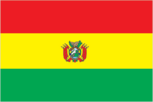
- <strong>description:</strong> three equal horizontal bands of red (top), yellow, and green, with the coat of arms centered on the yellow band<br><br><strong>meaning:</strong> red stands for bravery and the blood of national heroes, yellow for the nation's mineral resources, and green for the land's fertility<br><br><strong>history: </strong>in 2009, a presidential decree made it mandatory for a <em>wiphala -</em>- a square, multi-colored flag representing the country's ethnic groups -- to be used alongside the national flag
- note
- <strong>note:</strong> similar to the flag of Ghana, which has a large, five-pointed black star centered in the yellow band
The flag of Bolivia is composed of three equal horizontal bands of red, yellow and green, with the national coat of arms centered in the yellow band.
- svg
- https://flagcdn.com/bo.svg
presidential republic
6 August 1825 (from Spain)
has not submitted an ICJ jurisdiction declaration; accepts ICCt jurisdiction
CAN, CD, CELAC, FAO, G-77, IADB, IAEA, IBRD, ICAO, ICC (national committees), ICCt, ICRM, IDA, IFAD, IFC, IFRCS, ILO, IMF, IMO, Interpol, IOC, IOM, IPU, ISO (correspondent), ITSO, ITU, LAES, LAIA, Mercosur (associate), MIGA, MINUSTAH, MONUSCO, NAM, OAS, OPANAL, OPCW, PCA, UN, UN Security Council (temporary), UNAMID, UNASUR, UNCTAD, UNESCO, UNIDO, Union Latina, UNISFA, UNMIL, UNMISS, UNOCI, UNOOSA, UNWTO, UPU, WCO, WFTU (NGOs), WHO, WIPO, WMO, WTO
- Highest court(s)
- Supreme Court or Tribunal Supremo de Justicia (consists of 12 judges<em> </em>organized into civil, penal, social, and administrative chambers); Plurinational Constitutional Tribunal (consists of 7 primary and 7 alternate magistrates); Plurinational Electoral Organ (consists of 7 members and 6 alternates); National Agro-Environment Court (consists of 5 primary and 5 alternate judges; Council of the Judiciary (consists of 3 primary and 3 alternate judges)
- Judge selection and term of office
- Supreme Court, Plurinational Constitutional Tribunal, National Agro-Environmental Court, and Council of the Judiciary candidates pre-selected by the Plurinational Legislative Assembly and elected by direct popular vote; judges elected for 6-year terms; Plurinational Electoral Organ judges appointed - 6 by the Legislative Assembly and 1 by the president of the republic; members serve single 6-year terms
- Subordinate courts
- National Electoral Court; District Courts (in each of the 9 administrative departments); agro-environmental lower courts
civil law system with influences from Roman, Spanish, canon (religious), French, and ethnic groups' pre-colonial law
- Legislative structure
- bicameral
- Legislature name
- Plurinational Legislative Assembly (Asamblea Legislativa Plurinacional)
- Chamber name
- Chamber of Deputies (Cámara de Diputados)
- Electoral system
- mixed system
- Expected date of next election
- August 2030
- Most recent election date
- 8/17/2025
- Number of seats
- 130 (all directly elected)
- Parties elected and seats per party
- Christian Democratic Party (PDC) (49); LIBRE (39); Unity (26); Popular Alliance (8); Other (8)
- Percentage of women in chamber
- 50.8%
- Scope of elections
- full renewal
- Term in office
- 5 years
- Chamber name
- Chamber of Senators (Cámara de Senadores)
- Electoral system
- proportional representation
- Expected date of next election
- August 2030
- Most recent election date
- 8/17/2025
- Number of seats
- 36 (all directly elected)
- Parties elected and seats per party
- Christian Democratic Party (PDC) (16); LIBRE (12); Unity (7); Other (1)
- Percentage of women in chamber
- 58.3%
- Scope of elections
- full renewal
- Term in office
- 5 years
red, yellow, green
- Selected World Heritage Site locales
- City of Potosi (c); El Fuerte de Samaipata (c); Historic Sucre (c); Jesuit Missions of Chiquitos (c); Noel Kempff Mercado National Park (n); Tiahuanacu (c); Qhapaq Ñan/Andean Road System (c)
- Total World Heritage Sites
- 7 (6 cultural, 1 natural)
Independence Day, 6 August (1825)
llama, Andean condor; two national flowers, the cantuta and the patuju
- Autonomy for Bolivia – Súmate or APB Súmate<br>Christian Democratic Party or PDC<br>Community Citizen Alliance or ACC<br>Freedom and Democracy or LIBRE<br>Front for Victory or FPV<br>Movement Toward Socialism or MAS<br>National Unity or UN<br>Popular Alliance or AP<br>Revolutionary Left Front or FRI<br>Revolutionary Nationalist Movement or MNR<br>Social Democrat Movement or MDS<br>Third System Movement or MTS<br>We Believe or Creemos
- note
- <strong>note:</strong> We Believe or Creemos [Luis Fernando CAMACHO Vaca] is a coalition comprised of several opposition parties that participated in the 2020 election, which includes the Christian Democratic Party (PDC) and Solidarity Civic Unity (UCS)
Monday
18 years of age; universal and compulsory
Yes
Economy
- sugarcane, soybeans, maize, potatoes, sorghum, rice, milk, chicken, plantains, beef (2023)
- note
- <b>note:</b> top ten agricultural products based on tonnage
- On alcohol and tobacco
- 2.2% of household expenditures (2023 est.)
- On food
- 29.3% of household expenditures (2023 est.)
- Expenditures
- $14.75 billion (2019 est.)
- Revenues
- $11.796 billion (2019 est.)
- code
- BOB
- name
- Bolivian boliviano (BOB) [Bs.]
- $-1,407,061,487
- Current account balance 2021
- $1.581 billion (2021 est.)
- Current account balance 2022
- $939.084 million (2022 est.)
- Current account balance 2023
- -$1.15 billion (2023 est.)
- Note
- <b>note:</b> balance of payments - net trade and primary/secondary income in current dollars
- $15.72 billion
- Debt - external 2023
- $11.174 billion (2023 est.)
- Note
- <b>note:</b> present value of external debt in current US dollars
resource-rich economy benefits during commodity booms; has bestowed juridical rights to Mother Earth, impacting extraction industries; increasing Chinese lithium mining trade relations; hard hit by COVID-19; increased fiscal spending amid poverty increases; rampant banking and finance corruption
- Currency
- bolivianos (BOB) per US dollar -
- Exchange rates 2020
- 6.91 (2020 est.)
- Exchange rates 2021
- 6.91 (2021 est.)
- Exchange rates 2022
- 6.91 (2022 est.)
- Exchange rates 2023
- 6.91 (2023 est.)
- Exchange rates 2024
- 6.91 (2024 est.)
- $11.76 billion
- Exports 2021
- $11.594 billion (2021 est.)
- Exports 2022
- $14.465 billion (2022 est.)
- Exports 2023
- $11.905 billion (2023 est.)
- Note
- <b>note:</b> balance of payments - exports of goods and services in current dollars
- gold, natural gas, precious metal ore, zinc ore, soybean meal (2023)
- note
- <b>note:</b> top five export commodities based on value in dollars
- Brazil 15%, India 13%, China 11%, Argentina 11%, UAE 8% (2023)
- note
- <b>note:</b> top five export partners based on percentage share of exports
- net inflows
- $387.03 million
- Exports of goods and services
- 25.5% (2023 est.)
- Government consumption
- 19.3% (2023 est.)
- Household consumption
- 68.5% (2023 est.)
- Imports of goods and services
- -30.9% (2023 est.)
- Investment in fixed capital
- 17.5% (2023 est.)
- Investment in inventories
- 0.1% (2023 est.)
- Note
- <b>note:</b> figures may not total 100% due to rounding or gaps in data collection
- Agriculture
- 13.5% (2023 est.)
- Industry
- 24.2% (2023 est.)
- Note
- <b>note:</b> figures may not total 100% due to non-allocated consumption not captured in sector-reported data
- Services
- 51.1% (2023 est.)
- $49.668 billion (2024 est.)
- note
- <b>note:</b> data in current dollars at official exchange rate
$4,421
- 41.6 (2019)
- Gini Index coefficient - distribution of family income 2023
- 42.1 (2023 est.)
- Note
- <b>note:</b> index (0-100) of income distribution; higher values represent greater inequality
$53.77 billion
$4,160
18 % of GDP
- Highest 10%
- 31.3% (2023 est.)
- Lowest 10%
- 1.8% (2023 est.)
- Note
- <b>note:</b> % share of income accruing to lowest and highest 10% of population
- $14.02 billion
- Imports 2021
- $10.187 billion (2021 est.)
- Imports 2022
- $13.462 billion (2022 est.)
- Imports 2023
- $12.988 billion (2023 est.)
- Note
- <b>note:</b> balance of payments - imports of goods and services in current dollars
- refined petroleum, cars, pesticides, trucks, plastics (2023)
- note
- <b>note:</b> top five import commodities based on value in dollars
- China 22%, Brazil 18%, Chile 13%, USA 7%, Peru 5% (2023)
- note
- <b>note:</b> top five import partners based on percentage share of imports
- 1.1% (2023 est.)
- note
- <b>note:</b> annual % change in industrial value added based on constant local currency
mining, smelting, electricity, petroleum, food and beverages, handicrafts, clothing, jewelry
- 5.1%
- Inflation rate (consumer prices) 2022
- 1.7% (2022 est.)
- Inflation rate (consumer prices) 2023
- 2.6% (2023 est.)
- Inflation rate (consumer prices) 2024
- 5.1% (2024 est.)
- Note
- <b>note:</b> annual % change based on consumer prices
- 6.859 million (2024 est.)
- note
- <b>note:</b> number of people ages 15 or older who are employed or seeking work
- total
- 6.98 million persons
- agriculture
- 24.71%
- industry
- 19.79%
- services
- 55.49%
- 37.7% (2022 est.)
- note
- <b>note:</b> % of population with income below national poverty line
- Note
- <strong>note:</strong> data cover general government debt and includes debt instruments issued by government entities other than the treasury; the data include treasury debt held by foreign entities; the data include debt issued by subnational entities
- Public debt 2017
- 49% of GDP (2017 est.)
- $159.85 billion
- Note
- <b>note:</b> data in 2021 dollars
- Real GDP (purchasing power parity) 2022
- $116.927 billion (2022 est.)
- Real GDP (purchasing power parity) 2023
- $120.531 billion (2023 est.)
- Real GDP (purchasing power parity) 2024
- $122.2 billion (2024 est.)
- -1.12%
- Note
- <b>note:</b> annual GDP % growth based on constant local currency
- Real GDP growth rate 2022
- 3.6% (2022 est.)
- Real GDP growth rate 2023
- 3.1% (2023 est.)
- Real GDP growth rate 2024
- 1.4% (2024 est.)
- $12,878
- Note
- <b>note:</b> data in 2021 dollars
- Real GDP per capita 2022
- $9,700 (2022 est.)
- Real GDP per capita 2023
- $9,800 (2023 est.)
- Real GDP per capita 2024
- $9,800 (2024 est.)
- $1.28 billion
- Note
- <b>note:</b> personal transfers and compensation between resident and non-resident individuals/households/entities
- Remittances 2021
- 3.5% of GDP (2021 est.)
- Remittances 2022
- 3.3% of GDP (2022 est.)
- Remittances 2023
- 3.2% of GDP (2023 est.)
- $1.98 billion
- Note
- <b>note:</b> holdings of gold (year-end prices)/foreign exchange/special drawing rights in current dollars
- Reserves of foreign exchange and gold 2022
- $3.752 billion (2022 est.)
- Reserves of foreign exchange and gold 2023
- $1.8 billion (2023 est.)
- Reserves of foreign exchange and gold 2024
- $1.977 billion (2024 est.)
- 2.97%
- Note
- <b>note:</b> % of labor force seeking employment
- Unemployment rate 2022
- 3.6% (2022 est.)
- Unemployment rate 2023
- 3.1% (2023 est.)
- Unemployment rate 2024
- 3.1% (2024 est.)
- Female
- 5.8% (2024 est.)
- Male
- 4.8% (2024 est.)
- Note
- <b>note:</b> % of labor force ages 15-24 seeking employment
- Total
- 5.2% (2024 est.)
Energy
- Consumption
- 9,000 metric tons (2023 est.)
- Imports
- 7,000 metric tons (2023 est.)
- Proven reserves
- 1 million metric tons (2023 est.)
- Consumption
- 10.863 billion kWh (2023 est.)
- consumption per capita
- 859 kWh
- Installed generating capacity
- 4.375 million kW (2023 est.)
- Transmission/distribution losses
- 1.079 billion kWh (2023 est.)
- Electrification - rural areas
- 95.6%
- Electrification - total population
- 99.9% (2022 est.)
- Electrification - urban areas
- 100%
- Biomass and waste
- 3.5% of total installed capacity (2023 est.)
- Fossil fuels
- 65% of total installed capacity (2023 est.)
- hydroelectric
- 24.99%
- Hydroelectricity
- 24.9% of total installed capacity (2023 est.)
- nuclear
- 0%
- renewable
- 38.26%
- Solar
- 2.9% of total installed capacity (2023 est.)
- Wind
- 3.7% of total installed capacity (2023 est.)
- 798 kg of oil equivalent
- Total energy consumption per capita 2023
- 29.34 million Btu/person (2023 est.)
- Consumption
- 4.025 billion cubic meters (2023 est.)
- Exports
- 7.816 billion cubic meters (2023 est.)
- Production
- 12.302 billion cubic meters (2023 est.)
- Proven reserves
- 302.99 billion cubic meters (2021 est.)
- Crude oil estimated reserves
- 240.9 million barrels (2021 est.)
- Refined petroleum consumption
- 100,000 bbl/day (2023 est.)
- Total petroleum production
- 58,000 bbl/day (2023 est.)
12.8%
Communications
- per 100 inhabitants
- 11 per 100
- Subscriptions per 100 inhabitants
- 11 (2022 est.)
- Total
- 1.33 million (2022 est.)
large number of radio and TV stations broadcasting with private media outlets dominating; state-owned and private radio and TV stations generally operating freely, although both pro-government and anti-government groups have attacked media outlets in response to their reporting (2019)
.bo
- Percent of population
- 70% (2023 est.)
### ###
+591
- Subscriptions per 100 inhabitants
- 3 (2024 est.)
- Total subscriptions
- 369,000 (2024 est.)
- subscriptions per 100
- 102 per 100
- Subscriptions per 100 inhabitants
- 98 (2024 est.)
- Total subscriptions
- 12.2 million (2024 est.)
Transportation
- passengers carried
- 5.6 million passengers
- registered carrier departures
- 50,459 departures
201 (2025)
CP
Right
3 (2025)
- By type
- general cargo 30, oil tanker 2, other 18
- Total
- 50 (2023)
- Narrow gauge
- 3,960 km (2014) 1.000-m gauge
- Total
- 3,960 km (2019)
BOL
Military and Security
- armored vehicles
- tanks
the Bolivian Armed Forces (FAB) are responsible for territorial defense but also have some internal security duties, particularly counternarcotics and border security; the FAB shares responsibility for border enforcement with the National Police (PNB), and it may be called out to assist the PNB with maintaining public order in critical situations<br><br>land-locked Bolivia has a naval force for patrolling some 5,000 miles of navigable rivers to combat narcotics trafficking and smuggling, provide disaster relief, and deliver supplies to remote rural areas, as well as for maintaining a presence on Lake Titicaca; the Navy also exists in part to cultivate a maritime tradition and as a reminder of Bolivia’s defeat at the hands of Chile in the War of the Pacific (1879-1883), and its desire to regain access to the Pacific Ocean; every year on 23 March, the Navy participates in parades and government ceremonies commemorating the Día Del Mar (Day of the Sea) holiday that remembers the loss (2025)
- Bolivian Armed Forces (Fuerzas Armadas de Bolivia or FAB): Bolivian Army (Ejercito de Boliviano), Bolivian Navy (Armada Boliviana), Bolivian Air Force (Fuerza Aerea Boliviana)<br><br>Ministry of Government: National Police (Policía Nacional de Bolivia, PNB) (2025)
- active duty personnel
- 71,000
- note
- <strong>note:</strong> the PNB is part of the reserves for the Armed Forces; the police and military share responsibility for border enforcement
- percent of total labor force
- 1.21 %
approximately 30-35,000 active-duty Armed Forces (2025)
the military is equipped with a mix of mostly older Brazilian, Chinese, European, and US armaments (2025)
- 1 % of GDP
- current USD
- $655,130,126
- Military Expenditures 2020
- 1.4% of GDP (2020 est.)
- Military Expenditures 2021
- 1.4% of GDP (2021 est.)
- Military Expenditures 2022
- 1.3% of GDP (2022 est.)
- Military Expenditures 2023
- 1.2% of GDP (2023 est.)
- Military Expenditures 2024
- 1.2% of GDP (2024 est.)
- percent of central government expenditure
- 3.67 %
- percent of GDP
- 1.37 % of GDP
- voluntary service for men and women 18-22 years of age; selective 12-month compulsory service for men, 18-22 (24 months of search and rescue service can be substituted for military service) (2025)
- note
- <strong>note:</strong> as of 2024, women comprised about 11% of the Bolivian military's personnel
- PowerIndex score
- 1.8301
Transnational Issues
- USG identification
- <br>major illicit drug-producing and/or drug-transit country<br><br>major precursor-chemical producer (2025)
- IDPs
- 12,070 (2024 est.)
- Refugees
- 1,163 (2024 est.)
- Tier rating
- Tier 2 Watch List — Bolivia did not demonstrate overall increasing efforts to eliminate trafficking compared with the previous reporting period and was downgraded to Tier 2 Watch List; for more details, go to: https://www.state.gov/reports/2025-trafficking-in-persons-report/bolivia/
Space
2013 - first communications satellite (Túpac Katari, TKSAT-1) built and launched by China<br><br>2016 - began independently operating the TKSAT-1 satellite<br><br>2021 - signed protocols for establishment of the Latin American and Caribbean Space Agency
Bolivian Space Agency (la Agencia Boliviana Espacial, ABE; established 2010 as a national public company under Ministry of Public Works, Services and Housing) (2025)
has a small space program focused on acquiring and operating satellites; operates a telecommunications satellite and ground stations; has cooperated with China and India and member states of the Latin American and Caribbean Space Agency (2025)
Terrorism
- Tren de Aragua (TdA)
- note
- <strong>note:</strong> details about the history, aims, leadership, organization, areas of operation, tactics, targets, weapons, size, and sources of support of the group(s) appear(s) in the Terrorism reference guide
Environment
- From coal and metallurgical coke
- 24,000 metric tonnes of CO2 (2023 est.)
- From consumed natural gas
- 7.881 million metric tonnes of CO2 (2023 est.)
- From petroleum and other liquids
- 13.647 million metric tonnes of CO2 (2023 est.)
- Total emissions
- 21.552 million metric tonnes of CO2 (2023 est.)
deforestation from agricultural clearing and international demand for timber; soil erosion from overgrazing and poor cultivation methods (including slash-and-burn agriculture); desertification; loss of biodiversity; industrial pollution of water supplies used for drinking and irrigation
- Party to
- Biodiversity, Climate Change, Climate Change-Kyoto Protocol, Climate Change-Paris Agreement, Comprehensive Nuclear Test Ban, Desertification, Endangered Species, Hazardous Wastes, Law of the Sea, Marine Dumping-London Convention, Nuclear Test Ban, Ozone Layer Protection, Ship Pollution, Wetlands,
- Signed, but not ratified
- Environmental Modification, Marine Life Conservation
- Agriculture
- 673.4 kt (2019-2021 est.)
- Energy
- 122.8 kt (2022-2024 est.)
- Other
- 150.3 kt (2019-2021 est.)
- Waste
- 73.1 kt (2019-2021 est.)
24.6 micrograms per cubic meter (2019 est.)
31 % of total land area
9 % of total
574 billion cubic meters (2022 est.)
- 0 % of internal resources
- Agricultural
- 1.92 billion cubic meters (2022 est.)
- Industrial
- 32 million cubic meters (2022 est.)
- Municipal
- 252.91 million cubic meters (2022 est.)
- Municipal solid waste generated annually
- 2.219 million tons (2024 est.)
- Percent of municipal solid waste recycled
- 34.4% (2022 est.)