Introduction
<p>Aboriginal Australians arrived on the continent at least 60,000 years ago and developed complex hunter-gatherer societies and oral histories. Dutch navigators led by Abel TASMAN were the first Europeans to land in Australia in 1606, and they mapped the western and northern coasts. They named the continent New Holland but made no attempts to permanently settle it. In 1770, Englishman James COOK sailed to the east coast of Australia, named it New South Wales, and claimed it for Great Britain. In 1788 and 1825 respectively, Great Britain established New South Wales and then Tasmania as penal colonies. Great Britain and Ireland sent more than 150,000 convicts to Australia before ending the practice in 1868. As Europeans began settling areas away from the coasts, they came into more direct contact with Aboriginal Australians. Europeans also cleared land for agriculture, impacting Aboriginal Australians’ ways of life. These issues, along with disease and a policy in the 1900s that forcefully removed Aboriginal children from their parents, reduced the Aboriginal Australian population from more than 700,000 pre-European contact to a low of 74,000 in 1933.<br><br>Four additional colonies were established in Australia in the mid-1800s: Western Australia (1829), South Australia (1836), Victoria (1851), and Queensland (1859). Gold rushes beginning in the 1850s brought thousands of new immigrants to New South Wales and Victoria, helping to reorient Australia away from its penal colony roots. In the second half of the 1800s, the colonies were all gradually granted self-government, and in 1901, they federated and became the Commonwealth of Australia. Australia contributed more than 400,000 troops to Allied efforts during World War I, and Australian troops played a large role in the defeat of Japanese troops in the Pacific in World War II. Australia severed most constitutional links with the UK in 1942 but remained part of the British Commonwealth. Australia’s post-war economy boomed and by the 1970s, racial policies that prevented most non-Whites from immigrating to Australia were removed, greatly increasing Asian immigration to the country. In recent decades, Australia has become an internationally competitive, advanced market economy due in large part to economic reforms adopted in the 1980s and its proximity to East and Southeast Asia. </p> <p>In the early 2000s, Australian politics became unstable with frequent attempts to oust party leaders, including five changes of prime minister between 2010 and 2018. As a result, both major parties instituted rules to make it harder to remove a party leader.</p>
Geography
- Land
- 7,682,300 sq km
- Note
- <strong>note:</strong> includes Lord Howe Island and Macquarie Island
- Total
- 7,741,220 sq km
- Water
- 58,920 sq km
slightly smaller than the 48 contiguous US states
generally arid to semiarid; temperate in south and east; tropical in north
25,760 km
Oceania
- Highest point
- Mount Kosciuszko 2,228 m
- Lowest point
- Lake Eyre -15 m
- Mean elevation
- 330 m
27 00 S, 133 00 E
<strong>note 1:</strong> world's smallest continent but sixth-largest country; the largest country in Oceania, the largest country entirely in the Southern Hemisphere, and the largest country without land borders<br><br><strong>note 2:</strong> the Great Dividing Range that runs along eastern Australia is that continent’s longest mountain range and the third-longest land-based range in the world; the term "Great Dividing Range" refers to the fact that the mountains form a watershed crest from which all of the rivers of eastern Australia flow – east, west, north, and south<br><br><strong>note 3:</strong> Australia is the only continent without glaciers; it is the driest inhabited continent on earth; Perth on the west coast is home to the invigorating sea breeze known as the "Fremantle Doctor," one of the most consistent winds in the world; Australia hosts 10% of the world's biodiversity, and a great number of its flora and fauna exist nowhere else in the world
19,450 sq km (2022)
- Total
- 0 km
- Agricultural land
- 47.2% (2023 est.)
- Agricultural land: arable land
- arable land: 4% (2023 est.)
- Agricultural land: permanent crops
- permanent crops: 0.1% (2023 est.)
- Agricultural land: permanent pasture
- permanent pasture: 43.1% (2023 est.)
- arable land
- 4.03%
- Forest
- 17.3% (2023 est.)
- Other
- 35.4% (2023 est.)
- permanent crops
- 0.05%
No
Oceania, continent between the Indian Ocean and the South Pacific Ocean
Great Artesian Basin, Canning Basin
- Fresh water lake(s)
- Lake Alexandrina - 570 sq km
- Salt water lake(s)
- Lake Eyre - 9,690 sq km; Lake Torrens (ephemeral) - 5,780 sq km; Lake Gairdner - 4,470 sq km; Lake Mackay (ephemeral) - 3,494 sq km; Lake Frome - 2,410 sq km; Lake Amadeus (ephemeral) - 1,032 sq km
River Murray - 2,508 km; Darling River - 1,545 km; Murrumbidgee River - 1,485 km; Lachlan River - 1,339 km; Cooper Creek - 1,113 km; Flinders River - 1,004 km
- Indian Ocean drainage
- <em>(Great Australian Bight)</em> Murray-Darling (1,050,116 sq km)
- Internal (endorheic basin) drainage
- Lake Eyre (1,212,198 sq km)
- Google Maps
- https://goo.gl/maps/DcjaDa7UbhnZTndH6
- OpenStreetMap
- https://www.openstreetmap.org/relation/80500
Oceania
- Contiguous zone
- 24 nm
- Continental shelf
- 200 nm or to the edge of the continental margin
- Exclusive economic zone
- 200 nm
- Territorial sea
- 12 nm
cyclones along the coast; severe droughts; forest fires <br><br><strong>volcanism:</strong> volcanic activity on Heard and McDonald Islands
- alumina, coal, iron ore, copper, lithium, tin, gold, silver, uranium, nickel, tungsten, rare earth elements, mineral sands, lead, zinc, diamonds, opals, natural gas, petroleum
- note
- <strong>note 1:</strong> Australia is the world's largest net exporter of coal accounting for 26.5% of global coal exports in 2021; coal is the country’s most abundant energy resource, and coal ranks as the second-largest export commodity from Australia in terms of revenue; in 2020, Australia held the third-largest recoverable coal reserves in the world behind the United States and Russia<br><br><strong>note 2:</strong> Australia is by far the world's largest supplier of opals<br><br><strong>note 3:</strong> Australia holds the largest uranium reserves in the world and was the second-largest global uranium producer behind Kazakhstan in 2020<br><br><strong>note 4: </strong>Australia was the largest exporter of LNG in the world in 2020
population is primarily located on the periphery, with the highest concentration of people residing in the east and southeast; a secondary population center is located in and around Perth in the west; of the states and territories, New South Wales has, by far, the largest population; the interior, or "outback," has a very sparse population
Australia and New Zealand
mostly low plateau with deserts; fertile plain in southeast
- UTC+05:00, UTC+06:30, UTC+07:00, UTC+08:00, UTC+09:30, UTC+10:00, UTC+10:30, UTC+11:30
- number of time zones
- 8
People and Society
- 0-14 years
- 18.3% (male 2,526,772/female 2,369,425)
- 15-64 years
- 64.7% (male 8,688,023/female 8,640,671)
- 65 years and over
- 17% (2024 est.) (male 2,090,315/female 2,453,392)
- Beer
- 3.71 liters of pure alcohol (2019 est.)
- Other alcohols
- 0.81 liters of pure alcohol (2019 est.)
- Spirits
- 1.32 liters of pure alcohol (2019 est.)
- Total
- 9.51 liters of pure alcohol (2019 est.)
- Wine
- 3.67 liters of pure alcohol (2019 est.)
10.75 births/1,000 population (2025 est.)
54% (2021 est.)
- 6.81 deaths/1,000 population (2025 est.)
- adult female
- 42 per 1,000
- adult male
- 73 per 1,000
- Elderly dependency ratio
- 26.5 (2025 est.)
- Potential support ratio
- 3.8 (2025 est.)
- Total dependency ratio
- 53.3 (2025 est.)
- Youth dependency ratio
- 26.7 (2025 est.)
- Improved: rural
- rural: 100% of population (2022 est.)
- Improved: total
- total: 100% of population (2022 est.)
- Improved: urban
- urban: 100% of population (2022 est.)
- Unimproved: rural
- rural: 0% of population (2022 est.)
- Unimproved: total
- total: 0% of population (2022 est.)
- Unimproved: urban
- urban: 0% of population (2022 est.)
- Education expenditure (% GDP)
- 5.1% of GDP (2022 est.)
- Education expenditure (% national budget)
- 12.7% national budget (2022 est.)
5 % of GDP
- English 33%, Australian 29.9%, Irish 9.5%, Scottish 8.6%, Chinese 5.5%, Italian 4.4%, German 4%, Indian 3.1%, Australian Aboriginal 2.9%, Greek 1.7%, unspecified 4.7% (2021 est.)
- note
- <strong>note:</strong> data represent self-identified ancestry, with the option of reporting two ancestries
0.73 (2025 est.)
- 10 % of GDP
- Health expenditure (as % of GDP)
- 10.5% of GDP (2021)
- Health expenditure (as % of national budget)
- 20.2% of national budget (2022 est.)
0.1%
3.8 beds/1,000 population (2016 est.)
- Female
- 2.7 deaths/1,000 live births
- Male
- 3.2 deaths/1,000 live births
- neonatal
- 2 deaths/1,000 live births
- Total
- 3 deaths/1,000 live births (2025 est.)
- English 72%, Mandarin 2.7%, Arabic 1.4%, Vietnamese 1.3%, Cantonese 1.2%, other 15.7%, unspecified 5.7% (2021 est.)
- languages
- English
- note
- <strong>note:</strong> data represent language spoken at home
- number of languages
- 1
- Female
- 85.7 years
- Male
- 81.3 years
- Total population
- 83.5 years (2024 est.)
5.235 million Melbourne, 5.121 million Sydney, 2.505 million Brisbane, 2.118 million Perth, 1.367 million Adelaide, 472,000 CANBERRA (capital) (2023)
2 deaths/100,000 live births (2023 est.)
- Female
- 39.2 years
- Male
- 36.9 years
- Total
- 38.5 years (2025 est.)
28.7 years (2019 est.)
- Adjective
- Australian
- Noun
- Australian(s)
11.98 migrant(s)/1,000 population (2025 est.)
29% (2016)
4.09 physicians/1,000 population (2022)
- Female
- 13,804,986
- Male
- 13,685,935
- Total
- 27,490,921 (2025 est.)
1.59% (2025 est.)
Roman Catholic 20%, Protestant 18.1% (Anglican 9.8%, Uniting Church 2.6%, Presbyterian and Reformed 1.6%, Baptist 1.4%, Pentecostal 1%, other Protestant 1.7%), other Christian 3.5%, Muslim 3.2%, Hindu 2.7%, Buddhist 2.4%, Orthodox 2.3% (Eastern Orthodox 2.1%, Oriental Orthodox 0.2%), other 2.1%, none 38.4%, unspecified 7.3% (2021 est.)
- improved total
- 95.77%
- Improved: total
- total: 100% of population (2022 est.)
- Unimproved: total
- total: 0% of population (2022 est.)
- Female
- 21 years (2023 est.)
- Male
- 20 years (2023 est.)
- Total
- 21 years (2023 est.)
- 0-14 years
- 1.07 male(s)/female
- 15-64 years
- 1.01 male(s)/female
- 65 years and over
- 0.85 male(s)/female
- At birth
- 1.06 male(s)/female
- Total population
- 0.99 male(s)/female (2024 est.)
- Female
- 9.2% (2025 est.)
- Male
- 13.6% (2025 est.)
- Total
- 11.4% (2025 est.)
1.5 children born/woman (2025 est.)
- Note
- <strong>note:</strong> data include Christmas Island, Cocos Islands, and Norfolk Island
- Rate of urbanization
- 1.27% annual rate of change (2020-25 est.)
- Urban population
- 86.6% of total population (2023)
- measles
- 91%
Government
6 states and 2 territories*; Australian Capital Territory*, New South Wales, Northern Territory*, Queensland, South Australia, Tasmania, Victoria, Western Australia
- Daylight saving time
- +1hr, begins first Sunday in October; ends first Sunday in April
- Etymology
- the name may derive from the Aboriginal word <em>nganbirra</em>, meaning "meeting place"
- Geographic coordinates
- 35 16 S, 149 08 E
- Name
- Canberra
- Time difference
- UTC+11 (16 hours ahead of Washington, DC, during Standard Time)
- Time zone note
- Australia has six time zones, including Lord Howe Island (UTC+11)
- Citizenship by birth
- no
- Citizenship by descent only
- at least one parent must be a citizen or permanent resident of Australia
- Dual citizenship recognized
- yes
- Residency requirement for naturalization
- 4 years
- svg
- https://mainfacts.com/media/images/coats_of_arms/au.svg
- Amendment process
- proposed by Parliament; passage requires approval of a referendum bill by absolute majority vote in both houses of Parliament, approval in a referendum by a majority of voters in at least four states and in the territories, and Royal Assent; proposals that would reduce a state’s representation in either house or change a state’s boundaries require that state’s approval prior to Royal Assent
- History
- approved in a series of referenda from 1898 through 1900 and became law 9 July 1900, effective 1 January 1901
- alternative spellings
- AU
- Conventional long form
- Commonwealth of Australia
- Conventional short form
- Australia
- Etymology
- the name Australia derives from the Latin <em>australis </em>meaning "southern;" the Australian landmass was long referred to as "Terra Australis," or the Southern Land
- FIFA code
- AUS
- local long form (eng)
- Commonwealth of Australia
Ashmore and Cartier Islands, Christmas Island, Cocos (Keeling) Islands, Coral Sea Islands, Heard Island and McDonald Islands, Jervis Bay, Norfolk Island (7)
- Chief of mission
- Ambassador (vacant); Chargé d'Affaires Erika OLSON (since January 2025)
- Consulate(s) general
- Melbourne, Perth, Sydney
- Email address and website
- <br>AskEmbassyCanberra@state.gov<br><br>https://au.usembassy.gov/
- Embassy
- Moonah Place, Yarralumla, Australian Capital Territory 2600
- FAX
- [61] (02) 9373-9184
- Mailing address
- 7800 Canberra Place, Washington DC 20512-7800
- Telephone
- [61] (02) 6214-5600
- Chancery
- 1601 Massachusetts Avenue NW, Washington, DC 20036
- Chief of mission
- Ambassador Kevin Michael RUDD (since 19 April 2023)
- Consulate(s) general
- Chicago, Honolulu, Houston, Los Angeles, New York, San Francisco
- Email address and website
- <br>info.us@dfat.gov.au<br><br>https://usa.embassy.gov.au/
- FAX
- [1] (202) 797-3168
- Telephone
- [1] (202) 797-3000
- Cabinet
- Cabinet nominated by the prime minister from among members of Parliament and sworn in by the governor general
- Chief of state
- King CHARLES III (since 8 September 2022); represented by Governor General Samantha (Sam) MOSTYN (since 1 July 2024)
- Election/appointment process
- the monarchy is hereditary; governor general appointed by the monarch on the recommendation of the prime minister; following legislative elections, the leader of the majority party or majority coalition is sworn in as prime minister by the governor general
- Head of government
- Prime Minister Anthony ALBANESE (since 23 May 2022)
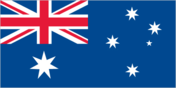
<strong>description:</strong> blue, with the UK flag in the upper-left quadrant and a large seven-pointed star in the lower-left quadrant; on the right half is a representation of the Southern Cross constellation in white, with one small five-pointed star and four larger seven-pointed stars<br><br><strong>meaning:</strong> the largest star is known as the Commonwealth or Federation Star and represents the federation of the Australian colonies in 1901; the star has one point for each of the six original states, plus one representing all of Australia's internal and external territories
The flag of Australia has a dark blue field. It features the flag of the United Kingdom — the Union Jack — in the canton, beneath which is a large white seven-pointed star. A representation of the Southern Cross constellation, made up of one small five-pointed and four larger seven-pointed white stars, is situated on the fly side of the field.
- svg
- https://flagcdn.com/au.svg
federal parliamentary democracy under a constitutional monarchy; a Commonwealth realm
1 January 1901 (from the federation of UK colonies)
accepts compulsory ICJ jurisdiction with reservations; accepts ICCt jurisdiction
ADB, ANZUS, APEC, ARF, ASEAN (dialogue partner), Australia Group, BIS, C, CD, CP, EAS, EBRD, EITI (implementing country), FAO, FATF, G-20, IAEA, IBRD, ICAO, ICC (national committees), ICCt, ICRM, IDA, IEA, IFC, IFRCS, IHO, ILO, IMF, IMO, IMSO, Interpol, IOC, IOM, IPU, ISO, ITSO, ITU, ITUC (NGOs), MIGA, NEA, NSG, OECD, OPCW, OSCE (partner), Pacific Alliance (observer), Paris Club, PCA, PIF, SAARC (observer), Quad, SICA (observer), Sparteca, SPC, UN, UNCTAD, UNESCO, UNHCR, UNMISS, UNMIT, UNOOSA, UNRWA, UNTSO, UNWTO, UPU, Wassenaar Arrangement, WCO, WFTU (NGOs), WHO, WIPO, WMO, WTO, ZC
- Highest court(s)
- High Court of Australia (consists of 7 justices, including the chief justice); each of the 6 states, 2 territories, and Norfolk Island has a Supreme Court; the High Court is the final appellate court
- Judge selection and term of office
- justices appointed by the governor-general in council for life with mandatory retirement at age 70
- Subordinate courts
- subordinate courts: <em>at the federal level:</em> Federal Court; Federal Circuit and Family Court of Australia; <em>at the state and territory level:</em> Local Court - New South Wales; Magistrates' Courts – Victoria, Queensland, South Australia, Western Australia, Tasmania, Northern Territory, Australian Capital Territory; District Courts – New South Wales, Queensland, South Australia, Western Australia; County Court – Victoria; Family Court – Western Australia; Court of Petty Sessions – Norfolk Island
common law system based on the English model
- Legislative structure
- bicameral
- Legislature name
- Parliament
- Chamber name
- House of Representatives
- Electoral system
- plurality/majority
- Expected date of next election
- May 2028
- Most recent election date
- 5/3/2025
- Number of seats
- 150 (all directly elected)
- Parties elected and seats per party
- Australian Labor Party (ALP) (94); Liberal National coalition (43); Independents (10); Other (3)
- Percentage of women in chamber
- 46%
- Scope of elections
- full renewal
- Term in office
- 3 years
- Chamber name
- Senate
- Electoral system
- proportional representation
- Expected date of next election
- May 2028
- Most recent election date
- 5/3/2025
- Number of seats
- 76 (all directly elected)
- Parties elected and seats per party
- Australian Labor Party (ALP) (16); Liberal (6); The Greens (6); Liberal/Nationals (4); Pauline Hanson's One Nation (3); Liberal National Party of Queensland (2); Other (3)
- Percentage of women in chamber
- 56.6%
- Scope of elections
- partial renewal
- Term in office
- 6 years
King George V of the United Kingdom granted the current Commonwealth Coat of Arms to Australia on 19 September 1912; the center of the shield has the symbols of Australia’s six states; the kangaroo and the emu symbolize a nation moving forward, since neither animal can move backward easily; the gold Commonwealth star sits above the shield, with six points representing the Australian states and the seventh representing the territories; the gold and blue in the wreath under the star are the livery, or identifying, colors for the coat of arms; Australia’s floral emblem, the golden wattle, frames the shield
green, gold
- Note
- <strong>note:</strong> includes one site on Heard Island and McDonald Islands
- Selected World Heritage Site locales
- Great Barrier Reef (n); Greater Blue Mountains Area (n); Fraser Island (n); Gondwana Rainforests (n); Lord Howe Island Group (n); Royal Exhibition Building and Carlton Gardens (c); Shark Bay (n); Sydney Opera House (c); Uluṟu-Kata Tjuṯa National Park (m); Kakadu National Park (m); Murujuga Cultural Landscape (c)
- Total World Heritage Sites
- 21 (5 cultural, 12 natural, 4 mixed)
Australia Day (commemorates the arrival of the First Fleet of Australian settlers), 26 January (1788); ANZAC Day (commemorates the anniversary of the landing of troops of the Australian and New Zealand Army Corps during World War I at Gallipoli, Turkey), 25 April (1915)
Commonwealth Star (seven-pointed Star of Federation), golden wattle tree (<em>Acacia pycnantha</em>), kangaroo, emu
- Australian Greens Party or The Greens <br>Australian Labor Party or ALP <br>Australia's Voice<br>Centre Alliance (formerly known as the Nick Xenophon Team or NXT)<br>Jacqui Lambie Network or JLN <br>Katter's Australian Party (KAP)<br>Liberal Party of Australia <br>The Nationals <br>Pauline Hanson's One Nation or ONP <br>United Australia Party
- note
- <strong>note:</strong> the Labor Party is Australia’s oldest political party, established federally in 1901; the present Liberal Party was formed in 1944; the Country Party was formed in 1920, renamed the National Country Party in 1975, the National Party of Australia in 1982, and since 2003 has been known as the Nationals; since the general election of 1949, the Liberal Party and the Nationals (under various names) when forming government have done so as a coalition
Monday
18 years of age; universal and compulsory
Yes
Economy
- wheat, sugarcane, barley, rapeseed, milk, cotton, sorghum, beef, lentils, grapes (2023)
- note
- <b>note:</b> top ten agricultural products based on tonnage
- On alcohol and tobacco
- 3.6% of household expenditures (2023 est.)
- On food
- 9.9% of household expenditures (2023 est.)
- Expenditures
- $453.105 billion (2022 est.)
- Note
- <b>note:</b> central government revenues (excluding grants) and expenditures converted to US dollars at average official exchange rate for year indicated
- Revenues
- $431.27 billion (2022 est.)
- code
- AUD
- name
- Australian dollar (AUD) [$]
- $-34,755,874,895
- Current account balance 2022
- $5.707 billion (2022 est.)
- Current account balance 2023
- -$5.186 billion (2023 est.)
- Current account balance 2024
- -$34.402 billion (2024 est.)
- Note
- <b>note:</b> balance of payments - net trade and primary/secondary income in current dollars
<p>high-income and globally integrated economy; strong mining, manufacturing, and service sectors driving slow but steady growth; net exporter, driven by commodities to East Asian trade partners; weak productivity and aging population straining labor force participation</p>
- Currency
- Australian dollars (AUD) per US dollar -
- Exchange rates 2020
- 1.453 (2020 est.)
- Exchange rates 2021
- 1.331 (2021 est.)
- Exchange rates 2022
- 1.442 (2022 est.)
- Exchange rates 2023
- 1.505 (2023 est.)
- Exchange rates 2024
- 1.515 (2024 est.)
- $432.61 billion
- Exports 2022
- $465.99 billion (2022 est.)
- Exports 2023
- $448.507 billion (2023 est.)
- Exports 2024
- $425.16 billion (2024 est.)
- Note
- <b>note:</b> balance of payments - exports of goods and services in current dollars
- iron ore, coal, natural gas, gold, minerals (2023)
- note
- <b>note:</b> top five export commodities based on value in dollars
- China 37%, Japan 16%, S. Korea 6%, India 5%, Taiwan 5% (2023)
- note
- <b>note:</b> top five export partners based on percentage share of exports
- net inflows
- $53.39 billion
- Exports of goods and services
- 24.7% (2024 est.)
- Government consumption
- 22.2% (2024 est.)
- Household consumption
- 51.2% (2024 est.)
- Imports of goods and services
- -22.6% (2024 est.)
- Investment in fixed capital
- 24.3% (2024 est.)
- Investment in inventories
- 0.1% (2024 est.)
- Note
- <b>note:</b> figures may not total 100% due to rounding or gaps in data collection
- Agriculture
- 2.2% (2024 est.)
- Industry
- 26% (2024 est.)
- Note
- <b>note:</b> figures may not total 100% due to non-allocated consumption not captured in sector-reported data
- Services
- 65.5% (2024 est.)
- $1.752 trillion (2024 est.)
- note
- <b>note:</b> data in current dollars at official exchange rate
$64,604
- 34.4 (2014)
- Gini Index coefficient - distribution of family income 2018
- 34.3 (2018 est.)
- Note
- <b>note:</b> index (0-100) of income distribution; higher values represent greater inequality
$1.7 trillion
$62,680
24 % of GDP
- Highest 10%
- 26.2% (2018 est.)
- Lowest 10%
- 2.8% (2018 est.)
- Note
- <b>note:</b> % share of income accruing to lowest and highest 10% of population
- $395.75 billion
- Imports 2022
- $379.981 billion (2022 est.)
- Imports 2023
- $389.211 billion (2023 est.)
- Imports 2024
- $405.336 billion (2024 est.)
- Note
- <b>note:</b> balance of payments - imports of goods and services in current dollars
- refined petroleum, cars, trucks, broadcasting equipment, garments (2023)
- note
- <b>note:</b> top five import commodities based on value in dollars
- China 26%, USA 11%, S. Korea 6%, Japan 6%, Thailand 5% (2023)
- note
- <b>note:</b> top five import partners based on percentage share of imports
- 0.5% (2024 est.)
- note
- <b>note:</b> annual % change in industrial value added based on constant local currency
mining, industrial and transportation equipment, food processing, chemicals, steel
- 3.16%
- Inflation rate (consumer prices) 2022
- 6.6% (2022 est.)
- Inflation rate (consumer prices) 2023
- 5.6% (2023 est.)
- Inflation rate (consumer prices) 2024
- 3.2% (2024 est.)
- Note
- <b>note:</b> annual % change based on consumer prices
- 14.912 million (2024 est.)
- note
- <b>note:</b> number of people ages 15 or older who are employed or seeking work
- total
- 15.03 million persons
- agriculture
- 2.18%
- industry
- 19.29%
- services
- 78.53%
- 58 % of GDP
- Note
- <b>note:</b> central government debt as a % of GDP
- Public debt 2022
- 58% of GDP (2022 est.)
- $1.96 trillion
- Note
- <b>note:</b> data in 2021 dollars
- Real GDP (purchasing power parity) 2022
- $1.558 trillion (2022 est.)
- Real GDP (purchasing power parity) 2023
- $1.611 trillion (2023 est.)
- Real GDP (purchasing power parity) 2024
- $1.635 trillion (2024 est.)
- 1.37%
- Note
- <b>note:</b> annual GDP % growth based on constant local currency
- Real GDP growth rate 2022
- 4.2% (2022 est.)
- Real GDP growth rate 2023
- 3.4% (2023 est.)
- Real GDP growth rate 2024
- 1.4% (2024 est.)
- $72,111
- Note
- <b>note:</b> data in 2021 dollars
- Real GDP per capita 2022
- $59,900 (2022 est.)
- Real GDP per capita 2023
- $60,500 (2023 est.)
- Real GDP per capita 2024
- $60,100 (2024 est.)
- $1.77 billion
- Note
- <b>note:</b> personal transfers and compensation between resident and non-resident individuals/households/entities
- Remittances 2022
- 0.1% of GDP (2022 est.)
- Remittances 2023
- 0.1% of GDP (2023 est.)
- Remittances 2024
- 0.1% of GDP (2024 est.)
- $60.4 billion
- Note
- <b>note:</b> holdings of gold (year-end prices)/foreign exchange/special drawing rights in current dollars
- Reserves of foreign exchange and gold 2022
- $56.702 billion (2022 est.)
- Reserves of foreign exchange and gold 2023
- $61.703 billion (2023 est.)
- Reserves of foreign exchange and gold 2024
- $60.404 billion (2024 est.)
26 % of GDP
24 % of GDP
- 23.6% (of GDP) (2022 est.)
- note
- <b>note:</b> central government tax revenue as a % of GDP
- 4.09%
- Note
- <b>note:</b> % of labor force seeking employment
- Unemployment rate 2022
- 3.8% (2022 est.)
- Unemployment rate 2023
- 3.7% (2023 est.)
- Unemployment rate 2024
- 4.1% (2024 est.)
- Female
- 8.7% (2024 est.)
- Male
- 10.2% (2024 est.)
- Note
- <b>note:</b> % of labor force ages 15-24 seeking employment
- Total
- 9.5% (2024 est.)
Energy
- Consumption
- 95.667 million metric tons (2023 est.)
- Exports
- 348.32 million metric tons (2023 est.)
- Imports
- 630,000 metric tons (2023 est.)
- Production
- 445.077 million metric tons (2023 est.)
- Proven reserves
- 149.472 billion metric tons (2023 est.)
- Consumption
- 267.818 billion kWh (2023 est.)
- consumption per capita
- 9,820 kWh
- Installed generating capacity
- 108.193 million kW (2023 est.)
- Transmission/distribution losses
- 11.455 billion kWh (2023 est.)
- Electrification - total population
- 100% (2022 est.)
- Biomass and waste
- 1.1% of total installed capacity (2023 est.)
- Fossil fuels
- 64.9% of total installed capacity (2023 est.)
- hydroelectric
- 6.07%
- Hydroelectricity
- 5.4% of total installed capacity (2023 est.)
- nuclear
- 0%
- renewable
- 26.66%
- Solar
- 17.1% of total installed capacity (2023 est.)
- Wind
- 11.5% of total installed capacity (2023 est.)
- 4,928 kg of oil equivalent
- Total energy consumption per capita 2023
- 223.158 million Btu/person (2023 est.)
- Consumption
- 48.845 billion cubic meters (2023 est.)
- Exports
- 105.146 billion cubic meters (2023 est.)
- Imports
- 521.034 million cubic meters (2023 est.)
- Production
- 151.307 billion cubic meters (2023 est.)
- Proven reserves
- 3.228 trillion cubic meters (2021 est.)
- Crude oil estimated reserves
- 2.446 billion barrels (2021 est.)
- Refined petroleum consumption
- 1.151 million bbl/day (2024 est.)
- Total petroleum production
- 386,000 bbl/day (2023 est.)
12.3%
Communications
- per 100 inhabitants
- 37 per 100
- Subscriptions per 100 inhabitants
- 36 (2023 est.)
- Total
- 9.63 million (2023 est.)
tradition of public broadcasting, but privately owned TV and radio have the biggest audiences; ownership of print and broadcast media is concentrated; Australian Broadcasting Corporation (ABC) runs national and local public radio and TV; other main public broadcaster is the multilingual Special Broadcasting Service (SBS); national commercial TV is dominated by three big free-to-air networks; broadcasters must carry a minimum percentage of Australian-made programs; pay TV via cable, satellite, and IPTV has a strong foothold (2023)
.au
- Percent of population
- 97% (2023 est.)
####
+61
- Subscriptions per 100 inhabitants
- 22 (2024 est.)
- Total subscriptions
- 5.95 million (2024 est.)
- subscriptions per 100
- 113 per 100
- Subscriptions per 100 inhabitants
- 113 (2024 est.)
- Total subscriptions
- 30.1 million (2024 est.)
Transportation
- passengers carried
- 68.96 million passengers
- registered carrier departures
- 678,852 departures
2,257 (2025)
VH
Left
392 (2025)
- By type
- bulk carrier 2, general cargo 76, oil tanker 6, other 520
- Total
- 604 (2023)
- Key ports
- Brisbane, Dampier, Darwin, Fremantle, Geelong, Hobart, Melbourne, Newcastle, Port Adelaide, Port Dalrymple, Port Kembla, Port Lincoln, Sydney
- Large
- 5
- Medium
- 8
- Ports with oil terminals
- 38
- Small
- 24
- Total ports
- 66 (2024)
- Very small
- 29
- Broad gauge
- 2,685 km (2022) 1.600 mm
- Narrow gauge
- 11,914 km (2022) 1.067 mm
- Standard gauge
- 18,007 km (2022) 1.435 mm
- Total
- 32,606 km (2022) 3,448 km electrified
AUS
Military and Security
- armored vehicles
- tanks
the ADF's missions include protecting Australia’s borders and maritime interests, responding to domestic natural disasters, and deploying overseas for humanitarian, peacekeeping, and other security-related missions; in 2024, it established a cyber command; the ADF regularly participates in bi-lateral and multi-lateral exercises with foreign militaries <br><br>Australia has been part of the Australia, New Zealand, and US Security (ANZUS) Treaty since 1951; Australia is also a member of the Five Powers Defense Arrangements (FPDA), a series of mutual assistance agreements reached in 1971 embracing Australia, Malaysia, New Zealand, Singapore, and the UK<br><br>Australia has long-standing bi-lateral defense and security ties to the UK, including defense and security cooperation treaties in 2024 and 2013; the Australia-UK Ministerial Consultations (AUKMIN) is their premier bilateral forum on foreign policy, defense, and security issues <br><br>Australia also has a long-standing military relationship with the US; Australian and US forces first fought together in France in 1918 and have fought together in every major US conflict since; Australia and the US signed an agreement in 2014 that allowed for closer bi-lateral defense and security cooperation, including rotations of US military forces and equipment to Australia; Australian military forces train often with US forces; Australia has Major Non-NATO Ally (MNNA) status with the US, a designation under US law that provides foreign partners with certain benefits in the areas of defense trade and security cooperation <br><br>in 2021, Australia, the UK, and the US announced an enhanced trilateral security partnership called “AUKUS” which would build on existing bilateral ties, including deeper integration of defense and security-related science, technology, industrial bases, and supply chains, as well as deeper cooperation on a range of defense and security capabilities (2025)
- Australian Defense Force (ADF): Australian Army, Royal Australian Navy, Royal Australian Air Force (2025)
- active duty personnel
- 60,000
- note
- <strong>note: </strong>the Australian Federal Police (AFP) is an independent agency of the Attorney-General’s Department; the AFP, state, and territorial police forces are responsible for internal security; the Australian Border Force (ABF) is under the Department of Home Affairs
- percent of total labor force
- 0.44 %
approximately 60,000 active ADF personnel (2025)
<strong>note: </strong>the number of Australian military forces varies by mission; since the 1990s, Australia has deployed more than 30,000 personnel on nearly 100 UN peacekeeping and coalition military operations around the World
- the military's inventory includes a mix of domestically produced and imported Western weapons systems; in recent years, the US has been the largest supplier of arms; the Australian defense industry produces a variety of land and sea weapons platforms; the defense industry also participates in joint development and production ventures with other Western countries, including the US and Canada (2025)
- note
- <strong>note:</strong> in 2023, the Australian defense ministry announced a new strategic review that called for the acquisition of more long-range deterrence capabilities, including missiles, submarines, and cyber tools; in early 2024, Australia announced a 10-year plan to more than double the number of the Navy's major surface combatant ships
- 2 % of GDP
- current USD
- $33,819,572,368
- Military Expenditures 2020
- 2% of GDP (2020 est.)
- Military Expenditures 2021
- 2% of GDP (2021 est.)
- Military Expenditures 2022
- 2% of GDP (2022 est.)
- Military Expenditures 2023
- 2% of GDP (2023 est.)
- Military Expenditures 2024
- 2% of GDP (2024 est.)
- percent of central government expenditure
- 4.96 %
- percent of GDP
- 1.88 % of GDP
- 17 years of age (with parental consent; 18 years of age to deploy) for voluntary military service for men and women; no conscription (abolished 1972) (2025)
- note
- <strong>note 1: </strong>as of July 2024, New Zealanders who are permanent residents and have lived in Australia for at least 12 months could apply to join the ADF; from January 2025, eligible permanent residents from Canada, the UK, and the US were also to be allowed to apply<br><br><strong>note 2:</strong> women have served in all roles, including combat arms, since 2013; in 2024, they comprised slightly more than 20% of the military
- PowerIndex score
- 0.3208
Transnational Issues
- IDPs
- 185 (2024 est.)
- Refugees
- 120,789 (2024 est.)
- Stateless persons
- 6,922 (2024 est.)
Space
1960 - built first space-tracking station outside the US<br><br>1967 - first domestically built satellite (WRSEA) launched on a US rocket from Australian test range<br><br>1981 - commissioned first national satellite system<br><br>1996 - first Australian in space on US Space Shuttle<br><br>2021 - announced intent to provide a robotic lunar lander for US Artemis project<br><br>2022 - launched a US NASA rocket from a commercial launch site; joint Australia-US space surveillance telescope based in Western Australia became operational<br><br>2025 - first attempted launch of Australian-designed and -manufactured orbital launch vehicle failed to reach orbit
- Australian Space Agency (ASA; established 2018; headquarters opened in 2020) (2025)
- note
- <strong>note:</strong> Australia established a Defense Space Command in 2022
Whalers Way Orbital Launch Complex (commercial site, South Australia); Arnhem Space Center (commercial site, Northern Territory); Bown Orbital Spaceport (commercial site, North Queensland) (2025)
has a history of involvement in space-related activities, including astronomy, rockets, satellites, and space tracking; develops, builds, operates, and tracks satellites, including communications, remote sensing (RS), and navigational, often in partnership with other countries; develops other space technologies, including communications, RS capabilities, and telescopes; encouraging growth in domestic commercial space-industry sector, including satellite launch vehicles; cooperates with a variety of foreign space agencies and industries, including those of China, the ESA, individual ESA member states, India, Japan, New Zealand, South Korea, the UK, and the US; co-leads the Global Earth Observation System of Systems and hosts one of the telescopes for the international Square Kilometer Array radio telescope (2025)
Terrorism
- Islamic State of Iraq and ash-Sham (ISIS)
- note
- <strong>note:</strong> details about the history, aims, leadership, organization, areas of operation, tactics, targets, weapons, size, and sources of support of the group(s) appear(s) in the Terrorism reference guide
Environment
- From coal and metallurgical coke
- 146.81 million metric tonnes of CO2 (2023 est.)
- From consumed natural gas
- 93.497 million metric tonnes of CO2 (2023 est.)
- From petroleum and other liquids
- 154.346 million metric tonnes of CO2 (2023 est.)
- Total emissions
- 394.653 million metric tonnes of CO2 (2023 est.)
soil erosion from overgrazing, deforestation, industrial development, urbanization, and poor farming practices; limited natural freshwater resources; soil salinity from use of poor-quality water, drought, desertification; habitat loss from agricultural clearing; floral extinctions; Great Barrier Reef preservation; overfishing; pollution; invasive species
- Party to
- Antarctic-Environmental Protection, Antarctic-Marine Living Resources, Antarctic Seals, Antarctic Treaty, Biodiversity, Climate Change, Climate Change-Kyoto Protocol, Climate Change-Paris Agreement, Comprehensive Nuclear Test Ban, Desertification, Endangered Species, Environmental Modification, Hazardous Wastes, Law of the Sea, Marine Dumping-London Convention, Marine Dumping-London Protocol, Marine Life Conservation, Nuclear Test Ban, Ozone Layer Protection, Ship Pollution, Tropical Timber 2006, Wetlands, Whaling
- Signed, but not ratified
- none of the selected agreements
- Agriculture
- 2,382.2 kt (2019-2021 est.)
- Energy
- 2,146 kt (2022-2024 est.)
- Other
- 144.1 kt (2019-2021 est.)
- Waste
- 587.8 kt (2019-2021 est.)
9.1 micrograms per cubic meter (2019 est.)
34 % of total land area
21 % of total
492 billion cubic meters (2022 est.)
- 2 % of internal resources
- Agricultural
- 11.19 billion cubic meters (2022)
- Industrial
- 3.11 billion cubic meters (2022)
- Municipal
- 2.43 billion cubic meters (2022)
- Municipal solid waste generated annually
- 13.345 million tons (2024 est.)
- Percent of municipal solid waste recycled
- 52.9% (2022 est.)